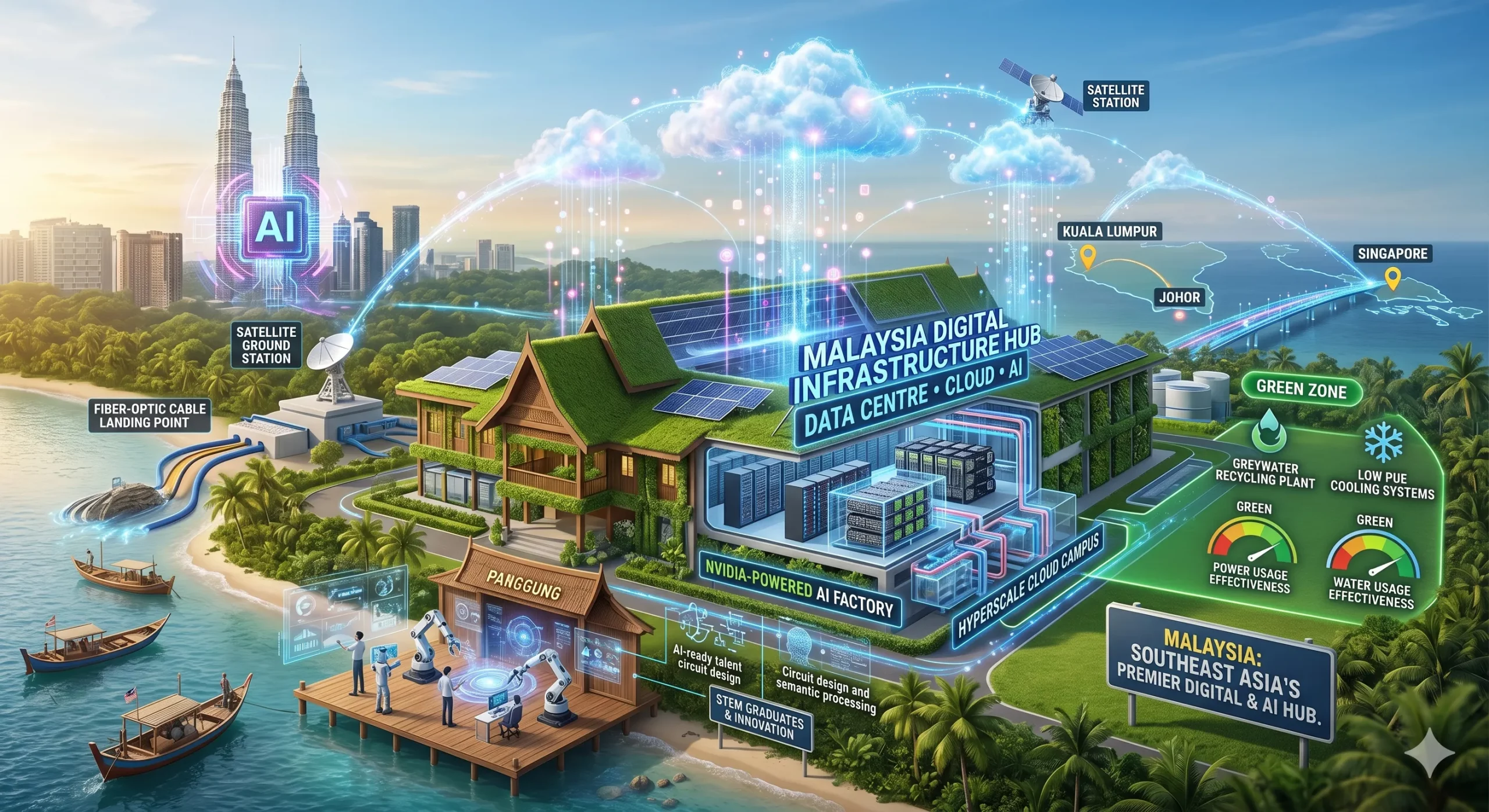
Malasia se está convirtiendo en uno de los mercados de crecimiento de centros de datos más importantes del Sudeste Asiático. La demanda de computación en la nube, inteligencia artificial, aplicaciones empresariales, pagos digitales, comercio electrónico, ciberseguridad y servicios regionales de baja latencia está impulsando a las empresas a construir más infraestructura cerca de los usuarios.
Tabla de contenido
Este crecimiento no se basa solo en expectativas exageradas. Malasia ha atraído inversiones a gran escala de empresas tecnológicas globales, proveedores cloud, operadores de infraestructura de inteligencia artificial y desarrolladores de centros de datos hyperscale. Según la actualización de MIDA sobre inversiones en centros de datos y computación en la nube, Malasia aprobó 144.400 millones de RM en inversiones en centros de datos y computación en la nube entre 2021 y mediados de 2025.
Para las empresas, Malasia ofrece varias ventajas: ubicación estratégica en el Sudeste Asiático, creciente demanda de cloud e inteligencia artificial, mejora de la conectividad, apoyo de políticas gubernamentales y fuerte interés de operadores en Johor, Kuala Lumpur, Cyberjaya y el Gran Kuala Lumpur. Al mismo tiempo, las empresas también deben planificar cuidadosamente el suministro eléctrico, las tarifas de electricidad, el agua, la refrigeración, la sostenibilidad, la conectividad y la planificación de recursos IP públicos.
Por eso Malasia no es solo una historia inmobiliaria. Se está convirtiendo en una historia de infraestructura cloud, inteligencia artificial y redes.
Por qué Malasia es importante en el mercado de centros de datos.
Malasia está ganando atención porque se encuentra en la intersección de tres grandes tendencias: el crecimiento de la economía digital del Sudeste Asiático, la creciente adopción del cloud y la rápida expansión de la infraestructura de inteligencia artificial.
Las empresas necesitan más capacidad informática para respaldar plataformas cloud, cargas de trabajo de inteligencia artificial, alojamiento de aplicaciones, datos de clientes, analítica, distribución de contenido, software empresarial y servicios digitales regionales. En lugar de atender a todos los usuarios desde un pequeño número de mercados maduros, muchos operadores buscan ahora hubs regionales adicionales que puedan ofrecer capacidad, conectividad y resiliencia operativa.
Malasia se beneficia de este cambio porque ofrece acceso a la demanda del Sudeste Asiático y, al mismo tiempo, cuenta con múltiples ubicaciones de desarrollo, como Johor, Kuala Lumpur, Cyberjaya y el Gran Kuala Lumpur. Para empresas de cloud, inteligencia artificial y alojamiento, esto convierte a Malasia en un mercado práctico para la expansión.
El auge de Malasia también encaja con la orientación digital más amplia del país. La iniciativa oficial MyDIGITAL describe el objetivo de Malasia de convertirse en una nación de altos ingresos impulsada por la tecnología y habilitada digitalmente, así como en un líder regional de la economía digital.
Impulso a la inversión en centros de datos en Malasia
Uno de los indicadores más claros del crecimiento del mercado de centros de datos en Malasia es el volumen de inversión. MIDA informó de que, entre 2021 y mediados de 2025, se aprobaron en Malasia inversiones por valor de 144.400 millones de RM en centros de datos y computación en la nube.
MIDA también destacó el crecimiento del mercado malasio de centros de datos durante el evento Data Centre Nexus 2025. Según el comunicado de MIDA sobre Data Centre Nexus 2025, el mercado de centros de datos de Malasia estaba valorado en 4.040 millones de dólares estadounidenses en 2024 y se prevé que alcance los 13.570 millones de dólares en 2030.
Este crecimiento es importante porque demuestra que Malasia no solo está atrayendo proyectos individuales. Está construyendo un ecosistema más amplio de centros de datos que involucra a operadores globales, proveedores cloud, proveedores locales, empresas energéticas, compañías de construcción, operadores de redes y usuarios de tecnología.
Para las empresas que planifican infraestructuras cloud o regionales, este impulso inversor puede generar más opciones para alojamiento, colocation, servicios de red, recuperación ante desastres, infraestructura de inteligencia artificial y plataformas digitales orientadas al cliente.
La demanda de la nube y la IA está impulsando el crecimiento de la infraestructura.
La computación en la nube y la inteligencia artificial son dos de los principales factores que impulsan el aumento de la demanda de centros de datos en Malasia. Los servicios en la nube requieren una infraestructura regional fiable para dar soporte a aplicaciones, almacenamiento, bases de datos, análisis de datos, ciberseguridad y plataformas empresariales. Las cargas de trabajo de IA exigen una infraestructura aún más avanzada, con alta capacidad de procesamiento, sistemas de refrigeración de última generación, un suministro eléctrico sólido y conectividad de red de baja latencia.
El Gobierno de Malasia también ha vinculado el desarrollo de la nube y la inteligencia artificial con la competitividad nacional. Reuters informó de que el país tiene previsto implantar una política nacional de computación en la nube y un marco regulador para la IA, centrados en la innovación de los servicios públicos, la competitividad económica, la seguridad de los datos y la inclusión digital. El mismo informe señala que Malasia aspira a convertirse en un centro regional para la inteligencia artificial generativa, donde la inversión tecnológica desempeñará un papel fundamental en la construcción de una infraestructura digital segura. Puede obtener más información en el informe de Reuters sobre los planes de la política nacional de nube y regulación de la IA en Malasia.
Esto es especialmente relevante para los centros de datos porque el crecimiento de la inteligencia artificial y la computación en la nube no se limita al software. También requiere infraestructura física: terrenos, suministro eléctrico, sistemas de refrigeración, conectividad por fibra óptica, recursos de direcciones IP públicas, enrutamiento, seguridad y soporte operativo.
Las empresas tecnológicas globales están invirtiendo en Malasia.
La posición de Malasia como centro regional de infraestructura de nube e IA está respaldada por varias inversiones tecnológicas de gran escala. Entre ellas se incluyen regiones de nube pública de hyperscalers globales, alianzas de infraestructura de IA y el desarrollo de campus hyperscale por parte de operadores especializados de centros de datos.AWS: región Asia-Pacífico (Malasia) y compromiso a largo plazo
Amazon Web Services lanzó la región AWS Asia-Pacífico (Malasia) en agosto de 2024, con planes de invertir aproximadamente 6.200 millones de dólares estadounidenses (29.200 millones de RM) en Malasia hasta 2038. Según el anuncio oficial de lanzamiento de AWS, la región está construida sobre tres Zonas de Disponibilidad con suministro eléctrico, refrigeración y seguridad física independientes, conectadas mediante redes redundantes de baja latencia. MIDA informó que se estima que la construcción y operación de la región añadirán alrededor de 12.100 millones de dólares estadounidenses (57.300 millones de RM) al PIB de Malasia y respaldarán más de 3.500 empleos equivalentes a tiempo completo cada año hasta 2038. Esto convierte a AWS en uno de los mayores compromisos individuales de infraestructura cloud en el mercado malasio.ByteDance: centro de IA y expansión de centros de datos en Johor
ByteDance, empresa matriz de TikTok, anunció planes para invertir alrededor de 10.000 millones de RM con el objetivo de convertir a Malasia en un centro regional de IA, con 1.500 millones de RM adicionales destinados a ampliar sus instalaciones actuales de centros de datos en Johor. Bernama informó que la empresa opera a través de ByteDance System Sdn Bhd en Sedenak Tech Park, en Kulai, Johor. ByteDance también es el inquilino principal de la instalación hyperscale MY06 de Bridge Data Centres en el mismo parque tecnológico, según el informe de DataCenterDynamics sobre la expansión. En enero de 2026, el New Straits Times informó que la inversión total de ByteDance en centros de datos en Malasia había crecido hasta superar los 29.500 millones de RM.Vantage Data Centers: campus hyperscale en Cyberjaya
Vantage Data Centers comprometió 3.000 millones de dólares estadounidenses adicionales (13.320 millones de RM) para construir un segundo campus hyperscale en Cyberjaya. Según el anuncio de Vantage sobre el campus, el campus KUL2 abarcará casi 35 acres distribuidos entre 10 instalaciones y ofrecerá hasta 256MW de capacidad de TI una vez completamente desarrollado, respaldado por una subestación N+1 de 500MVA de Tenaga Nasional Berhad. Desde entonces, Vantage ha iniciado las obras del campus KUL2 en virtud de un acuerdo con Cyberview, desarrollador del centro tecnológico de Cyberjaya. Junto con su campus KUL1 existente, la plataforma de Vantage en Malasia está diseñada para atender a hyperscalers, proveedores cloud y grandes empresas.DayOne: campus verdes y expansión de reservas de suelo en Johor y Selangor
DayOne, con sede en Singapur y escindida del operador chino GDS en 2025, ha posicionado a Malasia como su mayor mercado global. La empresa anunció que espera que su inversión acumulada en Malasia supere los 28.000 millones de RM (alrededor de 7.000 millones de dólares estadounidenses) a finales de 2026, según informó Malay Mail. Sus principales campus se encuentran en Nusajaya Tech Park y Kempas Tech Park, dentro de la Zona Económica Especial Johor-Singapur, y están financiados en parte mediante un paquete de financiación verde multidivisa de 15.000 millones de RM, compuesto por una facilidad islámica onshore de 7.500 millones de RM y un préstamo a plazo offshore de 1.700 millones de dólares estadounidenses. The Edge Malaysia informó que se trata de la mayor facilidad sindicada de financiación islámica verde del país. DayOne ha continuado ampliando su reserva de suelo en Malasia más allá de Johor. En junio de 2026, acordó adquirir 26,4 hectáreas en Tanjung Kupang, Johor, a Paragon Globe por 398,1 millones de RM. Posteriormente realizó una adquisición de 617,8 millones de RM (152,8 millones de dólares estadounidenses) de 78,8 acres en el distrito Southville City de Mah Sing Group, en Sepang, Selangor, dando al operador una presencia de desarrollo en el Gran Kuala Lumpur junto con sus operaciones en Johor. DataCenterDynamics informó que la cartera de DayOne comprende ahora más de 500MW de capacidad en servicio y en construcción, con otros 500MW reservados para futuros desarrollos en Hong Kong, Singapur, Malasia, Indonesia y Japón. Se prevé que ambas operaciones de suelo en Malasia se completen en la segunda mitad de 2027, sujetas a aprobaciones de planificación, uso del suelo y regulación.ST Telemedia Global Data Centres: campus de Iskandar Puteri
Respaldada por Temasek, ST Telemedia Global Data Centres está desarrollando un campus en Nusa Cemerlang Industrial Park, en Iskandar Puteri, aproximadamente a 15 kilómetros de Singapur. Según STT GDC, el campus abarca más de 22 acres y cuenta con un potencial de desarrollo de hasta 120MW de carga de TI, suministrada por diversas subestaciones cercanas. La primera instalación, STT Johor 1, fue diseñada con 16MW de capacidad de TI, y DataCenterDynamics informó que está previsto que esté plenamente operativa a finales de 2026. El emplazamiento está previsto para interconectarse con STT Singapore 5, el centro regional de interconexión de la empresa, lo que refuerza cómo la conectividad transfronteriza influye en la selección de ubicaciones en Johor.TM Nxera: empresa conjunta Malasia-Singapur para capacidad preparada para IA
TM Nxera es una empresa conjunta entre Telekom Malaysia y Nxera, la división regional de centros de datos de la unidad Digital InfraCo de Singtel. En enero de 2026, la empresa firmó un acuerdo plurianual de suministro eléctrico con Tenaga Nasional que garantiza 280MW de potencia para su campus en Iskandar Puteri, Johor. Según el anuncio de Telekom Malaysia, el campus Tier 3 habilitado para cloud está diseñado para escalar su capacidad de TI por encima de 200MW, utilizando refrigeración líquida para soportar cargas de trabajo de IA de alta densidad. TM confirmó en su anuncio de topping-out que la estructura del primer edificio se completó en abril de 2026, con la primera fase de operaciones comerciales prevista para 2026. El campus es una de las inversiones emblemáticas dentro de la Zona Económica Especial Johor-Singapur.Google: primer centro de datos de Malasia y región de Google Cloud
Google anunció una inversión de 2.000 millones de dólares estadounidenses en Malasia, que incluye su primer centro de datos de Google y una región de Google Cloud en el país. El anuncio oficial del centro de datos y la región cloud de Google en Malasia señaló que la inversión respaldaría la demanda de servicios cloud y los programas de alfabetización en IA. Google anunció posteriormente que la construcción había comenzado en Elmina Business Park, Selangor, y se estima que la inversión generará más de 3.200 millones de dólares estadounidenses de impacto económico y respaldará 26.500 empleos para 2030.
Microsoft: compromiso con infraestructura cloud y de IA
Microsoft anunció una inversión de 2.200 millones de dólares estadounidenses en Malasia destinada a infraestructura cloud y de IA, ciberseguridad, formación en habilidades de IA y apoyo a desarrolladores. En marzo de 2025, Reuters informó que Microsoft Malaysia planeaba lanzar su primera región cloud en Malasia, compuesta por tres centros de datos en el área del Gran Kuala Lumpur. Esto refuerza el papel de Malasia como ubicación para infraestructura cloud y de IA en el sudeste asiático. Consulte el informe de Reuters sobre la primera región cloud de Microsoft Malaysia.
Oracle: región de nube pública planificada
Oracle también anunció planes para invertir más de 6.500 millones de dólares estadounidenses con el fin de establecer su primera región de nube pública en Malasia. Reuters informó que la región cloud ayudaría a las organizaciones malasias a modernizar aplicaciones, migrar cargas de trabajo e innovar mediante datos, analítica e IA. Consulte el informe de Reuters sobre la inversión cloud de Oracle en Malasia.
Nvidia y YTL: infraestructura de IA en Johor
La infraestructura de IA también se está expandiendo mediante asociaciones. Reuters informó que Nvidia se asociaría con la empresa malasia YTL Power en un proyecto de infraestructura de IA valorado en 4.300 millones de dólares estadounidenses. El proyecto incluye infraestructura de computación cloud para IA y supercomputación, y está alojado en el parque de centros de datos de YTL en Kulai, Johor. Consulte el informe de Reuters sobre el proyecto de infraestructura de IA de Nvidia y YTL en Malasia.
AirTrunk: expansión hyperscale en Johor Bahru
El operador de centros de datos hyperscale AirTrunk anunció dos nuevos campus en Johor Bahru, JHB3 y JHB4. Según el anuncio de expansión de AirTrunk en Johor Bahru, los nuevos campus añadirán más de 280MW de carga de TI y elevarán su plataforma en Malasia a más de 700MW distribuidos entre cuatro campus.
Equinix: expansión en Kuala Lumpur para IA y computación de alto rendimiento
En 2026, Reuters informó que Equinix planeaba una nueva inversión de más de 190 millones de dólares estadounidenses para establecer un cuarto centro de datos en Kuala Lumpur. Se espera que la instalación soporte más de 2.200 racks y refrigeración líquida avanzada para cargas de trabajo de IA y computación de alto rendimiento. Consulte el informe de Reuters sobre la expansión del centro de datos de Equinix en Kuala Lumpur.
En conjunto, estas inversiones muestran que Malasia está siendo considerada no solo para el alojamiento tradicional, sino también para regiones de nube pública, infraestructura de IA, computación de alto rendimiento, servicios de nube soberana y capacidad hyperscale. También muestran un cambio en el tipo de operador que entra en el mercado: junto a los hyperscalers que construyen sus propias regiones, las plataformas especializadas de centros de datos están desarrollando grandes campus multi-tenant que los hyperscalers y proveedores de IA pueden alquilar. Ambos modelos requieren recursos IP públicos, enrutamiento BGP y planificación de interconexión antes de que cualquier carga de trabajo pueda ser accesible.
Principales ubicaciones de centros de datos en Malasia
El crecimiento de los centros de datos en Malasia no se concentra en una sola ciudad. Cada ubicación responde a diferentes necesidades de infraestructura.
Johor
Johor es uno de los principales destinos para la expansión de centros de datos en Malasia. Su proximidad a Singapur le otorga una importante ventaja regional. Singapur es un destacado centro digital y financiero, pero las limitaciones de terreno, energía y capacidad han llevado a algunos operadores a buscar ubicaciones cercanas. Johor puede respaldar el crecimiento regional manteniéndose al mismo tiempo cerca del ecosistema de Singapur.
Johor también está adquiriendo una creciente relevancia para la infraestructura de inteligencia artificial y los centros de datos hyperscale. Los campus de AirTrunk en Johor Bahru y el proyecto de Nvidia-YTL en Kulai demuestran cómo el estado se está consolidando como un importante destino para la infraestructura cloud y de IA.
Kuala Lumpur y el Gran Kuala Lumpur
Kuala Lumpur y el Gran Kuala Lumpur son zonas estratégicas por su proximidad a usuarios empresariales, instituciones financieras, sedes corporativas, proyectos vinculados al gobierno, clientes de servicios cloud y proveedores de servicios digitales. El centro de datos y la región cloud de Google en Elmina Business Park, Selangor, junto con la región cloud Malaysia West de Microsoft en el área del Gran Kuala Lumpur, refuerzan la posición de esta región como un importante núcleo de infraestructura cloud y empresarial.
Cyberjaya
Cyberjaya ha estado tradicionalmente vinculada a la economía digital y a la infraestructura tecnológica de Malasia. Sigue siendo un lugar relevante para el desarrollo de centros de datos gracias a su ecosistema consolidado, su proximidad a Kuala Lumpur y su papel dentro de la estrategia tecnológica nacional.
Para las empresas, la ubicación más adecuada dependerá de factores como los requisitos de latencia, la base de clientes, el acceso a proveedores cloud, la disponibilidad de operadores de red, la planificación energética, las necesidades de cumplimiento normativo y el calendario previsto de expansión.
Política gubernamental y dirección de la infraestructura digital
El crecimiento de los centros de datos en Malasia también está respaldado por la orientación de sus políticas nacionales. El Plan Maestro de la Economía Digital de Malasia (Malaysia Digital Economy Blueprint) incluye una iniciativa destinada a crear un entorno favorable para que las empresas locales de centros de datos se especialicen en servicios avanzados de computación en la nube y colaboren con proveedores tecnológicos internacionales.
El país también está desarrollando políticas relacionadas con la nube y la inteligencia artificial. Reuters informó de que Malasia tiene previsto establecer una política nacional de computación en la nube y crear una oficina nacional de IA para coordinar las iniciativas en este ámbito, incluyendo un plan de acción tecnológico de cinco años y un marco ético para la inteligencia artificial. Esta estrategia respalda la ambición del país de convertirse en un centro regional de infraestructura para la nube y la IA.
Malasia también ha introducido un marco más estructurado para la aprobación de centros de datos. Baker McKenzie informó de que el país presentó un nuevo Marco para Centros de Datos el 22 de julio de 2025, cuya entrada en vigor está prevista para octubre de 2025. La misma actualización señala que la MIDA actuará como organismo principal y punto de referencia para evaluar y aprobar las solicitudes de nuevos proyectos y ampliaciones de centros de datos. Más información en el resumen sobre el Marco para Centros de Datos de Malasia y su estrategia de sostenibilidad.
Esto es importante porque los centros de datos requieren mucho más que terrenos y edificios. Necesitan coordinación en materia de energía, agua, sostenibilidad, conectividad, proveedores locales, construcción y políticas digitales. Una de las señales más claras del crecimiento del sector de los centros de datos en Malasia es el volumen de inversión.
Conectividad y acceso regional
Data centres need strong connectivity. Without reliable network access, even high-quality facilities cannot serve users effectively.
Malaysia benefits from its regional position and improving digital infrastructure. The Malaysia Digital Economy Blueprint and MyDIGITAL direction emphasize cloud services, data centre capabilities, and digital infrastructure. MIDA has also highlighted the importance of building a resilient Malaysian data centre ecosystem through local supply chain development and digital investment coordination.
For businesses, connectivity planning should include:
- Carrier availability
- Internet transit options
- Peering and interconnection
- Latency to user markets
- Cross-border connectivity
- Cloud on-ramp availability
- Routing policy and BGP support
- Public IP resource planning
Connectivity is especially important for cloud platforms, SaaS companies, streaming services, gaming platforms, VPN providers, financial applications, and enterprise systems that depend on stable response times.
Ventajas de ampliar los centros de datos en Malasia
1. Mejor acceso a los usuarios del Sudeste Asiático
Malasia puede prestar servicio a usuarios de toda la región del Sudeste Asiático. Las empresas que se expanden en esta zona pueden utilizar Malasia para reducir la latencia, reforzar su presencia local y disminuir la dependencia de un único mercado de centros de datos.
2. Soporte para cargas de trabajo en la nube e inteligencia artificial
Las cargas de trabajo en la nube y de inteligencia artificial requieren una infraestructura escalable. El creciente ecosistema de centros de datos de Malasia ofrece a las empresas más opciones para capacidades de procesamiento, almacenamiento, redes y cargas de trabajo de alto rendimiento.
3. Mayor redundancia regional
Las empresas pueden incorporar Malasia como parte de una estrategia de infraestructura distribuida en varias ubicaciones. Esto favorece la recuperación ante desastres, la continuidad del negocio y la planificación de conmutación por error a nivel regional.
4. Creciente ecosistema de proveedores locales
Data Centre Nexus 2025 de MIDA destacó el desarrollo de la cadena de suministro local y la colaboración entre los operadores de centros de datos y los proveedores malasios. Esto puede contribuir a fortalecer el ecosistema de infraestructura en su conjunto.
5. Alineación con el crecimiento de la economía digital
Las ambiciones de Malasia en materia de economía digital, su estrategia para la computación en la nube, la creación de una oficina nacional de inteligencia artificial y las inversiones en infraestructura crean un entorno favorable para las empresas que desarrollan servicios digitales a largo plazo.
Desafíos: Energía, agua, sostenibilidad y regulación
Las oportunidades que ofrece Malasia para el desarrollo de centros de datos son considerables, pero las empresas no deben pasar por alto las limitaciones existentes. La expansión de un centro de datos requiere una inversión significativa tanto en capital como en recursos.
Disponibilidad de energía y coste de la electricidad
La disponibilidad de energía es uno de los factores más importantes en la planificación de un centro de datos. Reuters informó de que los operadores de centros de datos en Malasia estaban reevaluando sus costes tras un aumento de las tarifas eléctricas superior al previsto, con posibles incrementos del coste de la electricidad de entre el 10 % y el 14 % antes de aplicar recargos a los grandes consumidores. El informe también señalaba que, para una instalación de 100 MW, el coste adicional podría situarse entre 15 y 20 millones de dólares estadounidenses al año, sin incluir el recargo por combustible. Consulte el informe de Reuters sobre los centros de datos en Malasia y el aumento de los costes energéticos.
Demanda de agua y refrigeración
Las cargas de trabajo de inteligencia artificial y computación de alto rendimiento pueden incrementar significativamente las necesidades de refrigeración. Dependiendo del sistema de refrigeración utilizado, el consumo de agua puede convertirse en un factor clave. Antes de comprometerse con una capacidad a largo plazo, las empresas deben evaluar los métodos de refrigeración, la disponibilidad de agua, las exigencias medioambientales locales y el diseño de las instalaciones.
Normas de sostenibilidad
La sostenibilidad está adquiriendo una importancia cada vez mayor para los inversores en centros de datos, los clientes de servicios cloud y los organismos reguladores. La Green Building Index Data Centre Tool Version 2.0 se publicó en julio de 2025 y será aplicable a los proyectos de centros de datos registrados a partir del 1 de febrero de 2026. Esto demuestra que la eficiencia energética y los estándares de construcción sostenible están pasando a formar parte del desarrollo del sector de los centros de datos en Malasia.
Planificación regulatoria y de aprobaciones
Los grandes proyectos de centros de datos pueden requerir autorizaciones relacionadas con el uso del suelo, el suministro eléctrico, la construcción, el impacto ambiental, la seguridad, la inversión y la conexión a las infraestructuras. El Marco para Centros de Datos de Malasia puede contribuir a mejorar la coordinación, pero las empresas siguen necesitando planificar cuidadosamente los plazos de aprobación.
Complejidad de la conectividad y el enrutamiento
Los usuarios de centros de datos necesitan mucho más que espacio físico. También requieren conectividad estable, recursos de direcciones IP públicas, enrutamiento BGP, planificación de DNS, reglas de firewall, redundancia e ingeniería de tráfico. Estos aspectos de la red pueden influir directamente en la disponibilidad del servicio y en la experiencia del usuario.
Por qué la planificación de recursos de propiedad intelectual es importante para la expansión de los centros de datos en Malasia.
La expansión de un centro de datos no depende únicamente de edificios, racks, servidores y suministro eléctrico. La conectividad pública es esencial. Las empresas necesitan recursos de direcciones IP para que los usuarios, clientes, aplicaciones y sistemas de sus socios puedan acceder a sus servicios.
Las empresas que se expanden en Malasia pueden necesitar recursos de direcciones IP públicas para:
- Plataformas en la nube
- Servidores dedicados
- Servicios VPN
- Clientes de hosting
- Aplicaciones SaaS
- Infraestructura de correo electrónico
- Dispositivos de seguridad
- Puntos de acceso API
- Despliegue de servicios regionales
- Entornos de recuperación ante desastres
Los recursos de direcciones IP públicas garantizan la accesibilidad. Sin una planificación adecuada de las direcciones IP, las empresas pueden enfrentarse a problemas de enrutamiento, dificultades de acceso para los clientes, problemas de reputación del correo electrónico, una mayor complejidad en la configuración de los firewalls o retrasos en el lanzamiento de los servicios.
Esto es especialmente importante para proveedores de hosting, plataformas SaaS, operadores de VPN, empresas de ciberseguridad, proveedores de servicios en la nube y organizaciones que gestionan sistemas orientados al cliente.
Las empresas deberían evaluar desde el principio sus necesidades de recursos IP, incluyendo cuántos servicios públicos ofrecerán, si sus clientes necesitarán direcciones IP dedicadas, si serán necesarios anuncios BGP, si la reputación de las direcciones IP es un factor importante y si resulta más conveniente comprar direcciones IP o arrendarlas.
Nota práctica de i.Lease
As businesses expand data centre operations in Malaysia, IP resource planning becomes part of infrastructure strategy. A facility may have servers, racks, cooling, and power, but it still needs public connectivity, routing, and reliable address resources to support real services.
i.Lease supports Data Centre Operators and Infrastructure teams with long term IPv4 Leasing solutions for practical network growth.
Reflexiones finales
Malasia se está consolidando como un centro de datos de referencia porque la computación en la nube, la inteligencia artificial, las aplicaciones empresariales y la creciente demanda digital regional requieren cada vez más infraestructura. El impulso de la inversión, su ubicación estratégica, el apoyo de las políticas públicas y la expansión de grandes operadores han convertido a Malasia en uno de los mercados de centros de datos con mayor crecimiento del Sudeste Asiático.
Sin embargo, este crecimiento debe planificarse cuidadosamente. El coste de la energía, la disponibilidad eléctrica, la refrigeración, el agua, los estándares de sostenibilidad, la conectividad y la planificación de los recursos de direcciones IP son factores clave. Las empresas no deberían considerar la expansión de un centro de datos únicamente como una decisión inmobiliaria, sino como una estrategia integral de infraestructura.
En cualquier proyecto de expansión de un centro de datos, los recursos de direcciones IP deben planificarse junto con el suministro eléctrico, la refrigeración, los servidores y la conectividad de red. Las direcciones IP públicas permiten que las plataformas de hosting, las cargas de trabajo en la nube, las pasarelas VPN, las aplicaciones SaaS, los sistemas de correo electrónico y los servicios orientados al cliente permanezcan accesibles.
Lea también:
- ¿Qué es un centro de datos? Cómo respalda los sitios web, las aplicaciones y las redes empresariales
- IP pública vs. IP privada: lo que las empresas deben saber antes de ampliar su infraestructura
- Alquiler de direcciones IP: por qué las empresas alquilan IPv4 y qué deben comprobar primero
- Mercado de direcciones IP: cómo comprar, vender y alquilar direcciones IPv4 de forma segura
Frequent Asked Questions (FAQs)
Why is Malaysia becoming a Data Centre hub?
Malaysia is becoming a data centre hub because of regional digital demand, cloud growth, AI infrastructure needs, strategic location, government policy support, and major investments from technology and data centre companies.
Which locations are important for data centres in Malaysia?
Johor, Kuala Lumpur, Greater Kuala Lumpur, and Cyberjaya are important locations. Johor benefits from proximity to Singapore, while Kuala Lumpur and Greater Kuala Lumpur are close to enterprise demand and cloud infrastructure investment.
Why are cloud and AI increasing data centre demand?
Cloud and AI workloads require large computing capacity, storage, power, cooling, and network connectivity. As more companies adopt AI and cloud platforms, demand for data centre infrastructure increases.
What are the main challenges for data centres in Malaysia?
Key challenges include power availability, electricity cost, cooling, water use, sustainability requirements, connectivity, land, and regulatory approvals.
Why does IP planning matter for data centres?
IP planning matters because data centres need public connectivity for hosting, cloud services, VPNs, SaaS applications, email systems, APIs, security systems, and customer-facing platforms.
Can i.lease support data centre expansion?
Yes. i.lease supports businesses that need to Buy IP, Sell IP, or use IPv4 Leasing for data centre, hosting, cloud, VPN, SaaS, AI, and network expansion.