Arrendamiento de direcciones IP: Cómo arrendar direcciones IP
 Stephanie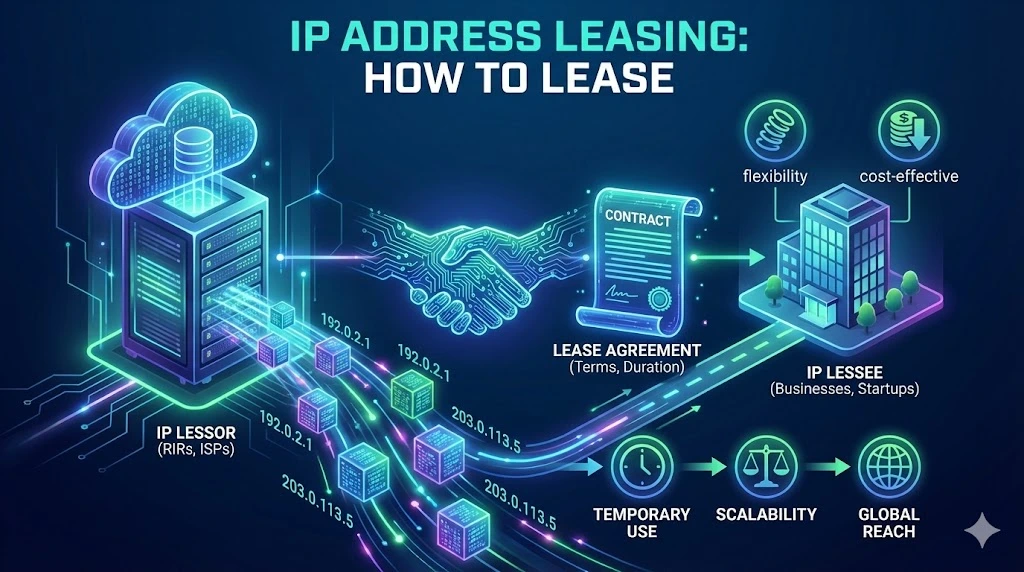
El mundo digital en el que nos movemos hoy depende en gran medida de las direcciones IP, identificadores únicos asignados a los dispositivos conectados a internet o a una red local. A medida que la demanda de direcciones IP sigue aumentando, empresas y particulares exploran diversas opciones para obtener los recursos necesarios. Un método cada vez más popular es el arrendamiento de direcciones IP. Este artículo profundiza en el concepto de arrendamiento de direcciones IP, sus beneficios y por qué se ha convertido en una solución viable para muchos.
Table of Contents
¿Qué es el arrendamiento de direcciones IP?
El arrendamiento de direcciones IP consiste en alquilar direcciones IP a un proveedor de servicios en lugar de comprarlas de forma permanente. Este modelo ofrece flexibilidad y escalabilidad, lo que lo convierte en una opción atractiva para las empresas con necesidades variables o temporales. El arrendamiento puede ser especialmente beneficioso para gestionar direcciones IPv4, cuya disponibilidad es cada vez más limitada debido al crecimiento exponencial de los dispositivos conectados a Internet.
Ventajas del arrendamiento de direcciones IP
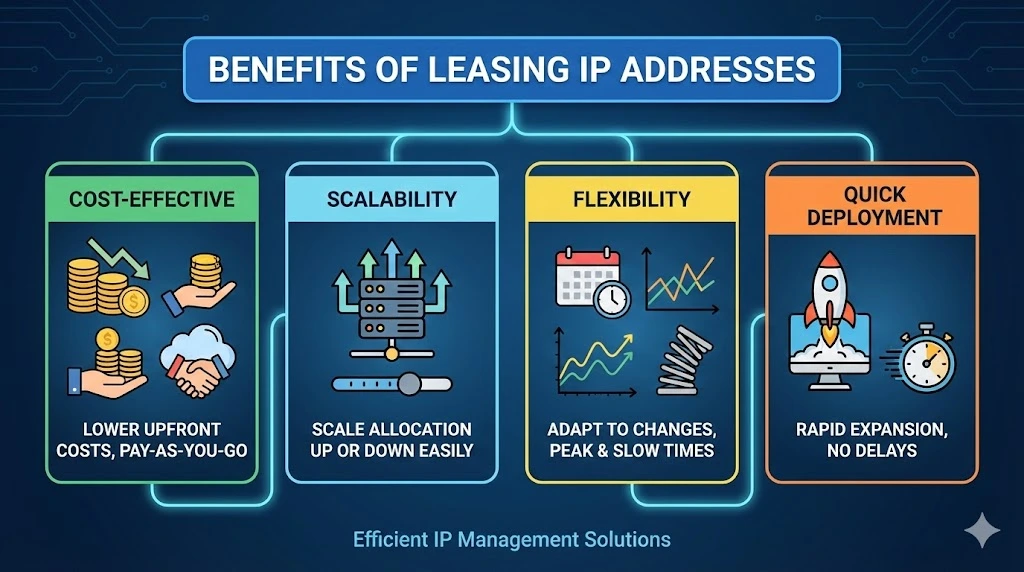
Rentable
Comprar direcciones IP puede representar una inversión considerable, especialmente para las pequeñas y medianas empresas. El arrendamiento ofrece una alternativa más asequible, ya que permite pagar únicamente por las direcciones que se necesitan, reduciendo los costes iniciales.
Escalabilidad
Las necesidades de direcciones IP de una empresa pueden variar con el tiempo. El arrendamiento permite aumentar o reducir la cantidad de direcciones según las necesidades actuales, sin asumir el compromiso a largo plazo que implica la propiedad.
Flexibilidad
El arrendamiento de direcciones IP ofrece la flexibilidad necesaria para adaptarse a los cambios del mercado y al crecimiento del negocio. Las empresas pueden alquilar direcciones adicionales durante los periodos de mayor demanda y reducir su uso en épocas de menor actividad.
Implementación rápida
El arrendamiento permite desplegar direcciones IP con rapidez, algo fundamental para las empresas que necesitan ampliar su infraestructura de red o lanzar nuevos servicios sin retrasos.
Proceso de arrendamiento de direcciones IP
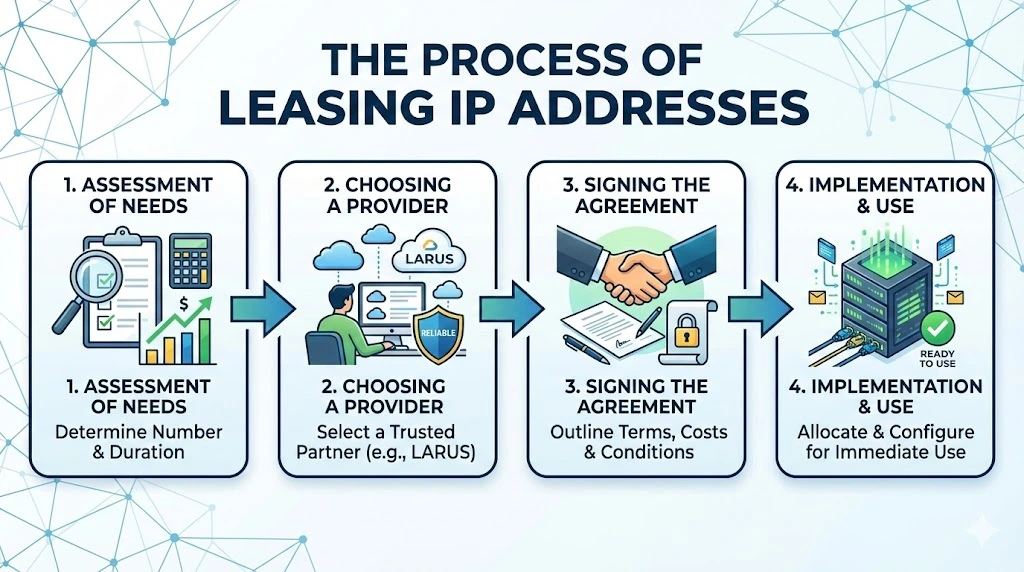
1. Evaluación de las necesidades
El primer paso para arrendar direcciones IP es evaluar las necesidades específicas de su empresa. Esto incluye determinar cuántas direcciones IP se necesitan y durante cuánto tiempo serán requeridas.
2. Elegir un proveedor
Seleccione un proveedor de confianza para el arrendamiento de direcciones IP. Empresas como LARUS están especializadas en el arrendamiento de direcciones IPv4 y ofrecen diferentes planes para adaptarse a diversas necesidades.
3. Firmar el contrato
Una vez elegido el proveedor, será necesario firmar un contrato de arrendamiento. Este documento establece las condiciones del acuerdo, incluyendo la duración, el coste y las condiciones para su renovación o finalización.
4. Implementación
Tras la firma del contrato, el proveedor asignará las direcciones IP arrendadas a su empresa. A continuación, estas direcciones podrán configurarse en su red para comenzar a utilizarlas de inmediato.
¿Por qué alquilar direcciones IP?
Escasez de direcciones
La escasez de direcciones IPv4 ha convertido el arrendamiento en una solución práctica. A medida que las direcciones IPv4 son cada vez más limitadas, el arrendamiento permite a las empresas obtener las direcciones que necesitan sin asumir el elevado coste de comprarlas.
Transición a IPv6
Aunque la adopción de IPv6 sigue creciendo, muchas empresas aún dependen de IPv4. El arrendamiento sirve como una solución de transición, permitiendo a las organizaciones mantener sus operaciones mientras integran IPv6 de forma gradual.
Cumplimiento normativo
Algunos sectores tienen requisitos específicos relacionados con la gestión de direcciones IP. Arrendar direcciones a un proveedor de confianza puede ayudar a garantizar el cumplimiento de estas normativas.
El arrendamiento de direcciones IP es una solución eficiente y flexible para las empresas que necesitan gestionar sus recursos de red de forma eficaz. Ofrece numerosas ventajas, como ahorro de costes, escalabilidad y una implementación rápida, lo que lo convierte en una opción muy atractiva en el entorno digital actual. A medida que la demanda de direcciones IP sigue aumentando, el arrendamiento representa una alternativa práctica a la compra, permitiendo a las empresas cubrir sus necesidades de conectividad sin realizar una gran inversión financiera.
Para obtener más información sobre el arrendamiento de direcciones IP y conocer las opciones disponibles, póngase en contacto con nosotros.
FAQs
¿Qué significa arrendar una dirección IP?
El arrendamiento de una dirección IP consiste en alquilar espacio de direcciones IPv4 por una tarifa mensual o anual, en lugar de comprarla de forma permanente. Las empresas utilizan direcciones IP arrendadas para alojamiento web, infraestructura en la nube, VPN, redes de proveedores de servicios de Internet (ISP), SaaS, correo electrónico, seguridad y otros servicios con acceso a Internet.
¿Por qué las empresas alquilan direcciones IPv4?
Las empresas alquilan direcciones IPv4 para reducir los costos iniciales, agilizar el despliegue, escalar la capacidad, garantizar la compatibilidad con IPv4 y evitar la compra directa de espacio de direcciones. El alquiler resulta útil cuando las empresas necesitan conectividad IPv4 pública sin una inversión de capital a largo plazo.
¿Con qué rapidez puedo utilizar las direcciones IP arrendadas?
A diferencia de la compra de direcciones IP, cuya transferencia puede tardar semanas, el arrendamiento es prácticamente instantáneo. Una vez firmado el acuerdo y emitida la Carta de Autorización (LOA), normalmente puede empezar a anunciar las direcciones IP en su red en un plazo de 24 a 48 horas.
¿Puedo usar direcciones IP alquiladas para marketing por correo electrónico (SMTP)?
Sí, pero la mayoría de los proveedores exigen que se indique este caso de uso por adelantado. Los arrendadores de confianza revisarán la reputación de la IP antes de arrendarla y esperan que usted mantenga una reputación intachable. Si utiliza las IP para enviar spam, el arrendador se reserva el derecho de rescindir el contrato de inmediato para proteger el valor del activo.
¿Es mejor alquilar o comprar direcciones IPv4?
El arrendamiento suele ser mejor en cuanto a flexibilidad, menor costo inicial y rápida implementación. La compra puede ser mejor para un control a largo plazo, pero requiere más capital, verificaciones de transferencia y capacidad de gestión de registros.
Artículos relacionados

¿Qué es una Carta de Autorización (LOA) en el arrendamiento de propiedad intelectual? LOA vs. ROA y qué verificar
Una Carta de Autorización (LOA) es un documento formal mediante el cual el titular registrado de un bloque de direcciones IP autoriza a otra parte a anunciar ese espacio de direcciones desde un Número de Sistema Autónomo especificado. Es el permiso escrito que conecta el derecho contractual de utilizar un espacio de direcciones con el acto técnico de enrutarlo y, sin él, los proveedores upstream generalmente se negarán aRead more Related Posts IP地址租赁中的授权书 (LOA) 是什么?LOA 与 ROA 的区别以及需要核实的内容 授权书(Letter of Authorization,LOA)是一份正式文件,由 IP 地址块的注册持有者授权另一方通过指定的自治系统编号(ASN)公告该地址空间。 它是一份书面授权,将使用地址空间的合同权利与实际进行路由公告的技术行为连接起来——如果没有 LOA,上游服务提供商通常会拒绝接受你的路由公告。 正是这种拒绝,使 LOA 在运营上具有决定性意义,而不仅仅是一项行政文件。Transit 服务提供商、数据中心和电信运营商都需要证明,公告某个前缀的一方确实获得了授权,因为接受未经授权的公告就意味着参与了一次路由劫持。Cloudflare 的 BYOIP 文档对此说明得非常明确:其 Transit 服务提供商要求在接受 Cloudflare 代表客户公告的路由之前提供 LOA,而且文件必须明确列出获得授权的前缀以及将用于公告这些前缀的 ASN。整个行业普遍都有类似要求。一家企业即使已经签署租赁协议、完成路由器配置,仍然可能因为 Qu’est-ce qu’une lettre d’autorisation (LOA) dans le cadre d’un bail de propriété intellectuelle ? LOA vs ROA et points à vérifier Une Lettre d’Autorisation (LOA) est un document officiel dans lequel le titulaire enregistré d’un bloc d’adresses IP autorise une autre What Is a Letter of Authorization (LOA) in IP Leasing? LOA vs ROA and What to Verify A Letter of Authorization (LOA) is a formal document in which the registered holder of an IP address block authorizes .related-post {} .related-post .post-list { text-align: left; } .related-post .post-list .item { margin: 5px; padding: 10px; } .related-post .headline { font-size: 18px !important; color: #999999 !important; } .related-post .post-list .item .post_thumb { max-height: 220px; margin: 10px 0px; padding: 0px; display: block; } .related-post .post-list .item .post_title { font-size: 16px; color: #3f3f3f; margin: 10px 0px; padding: 0px; display: block; text-decoration: none; } .related-post .post-list .item .post_excerpt { font-size: 13px; color: #3f3f3f; margin: 10px 0px; padding: 0px; display: block; text-decoration: none; } @media only screen and (min-width: 1024px) { .related-post .post-list .item { width: 30%; } } @media only screen and (min-width: 768px) and (max-width: 1023px) { .related-post .post-list .item { width: 90%; } } @media only screen and (min-width: 0px) and (max-width: 767px) { .related-post .post-list .item { width: 90%; } }
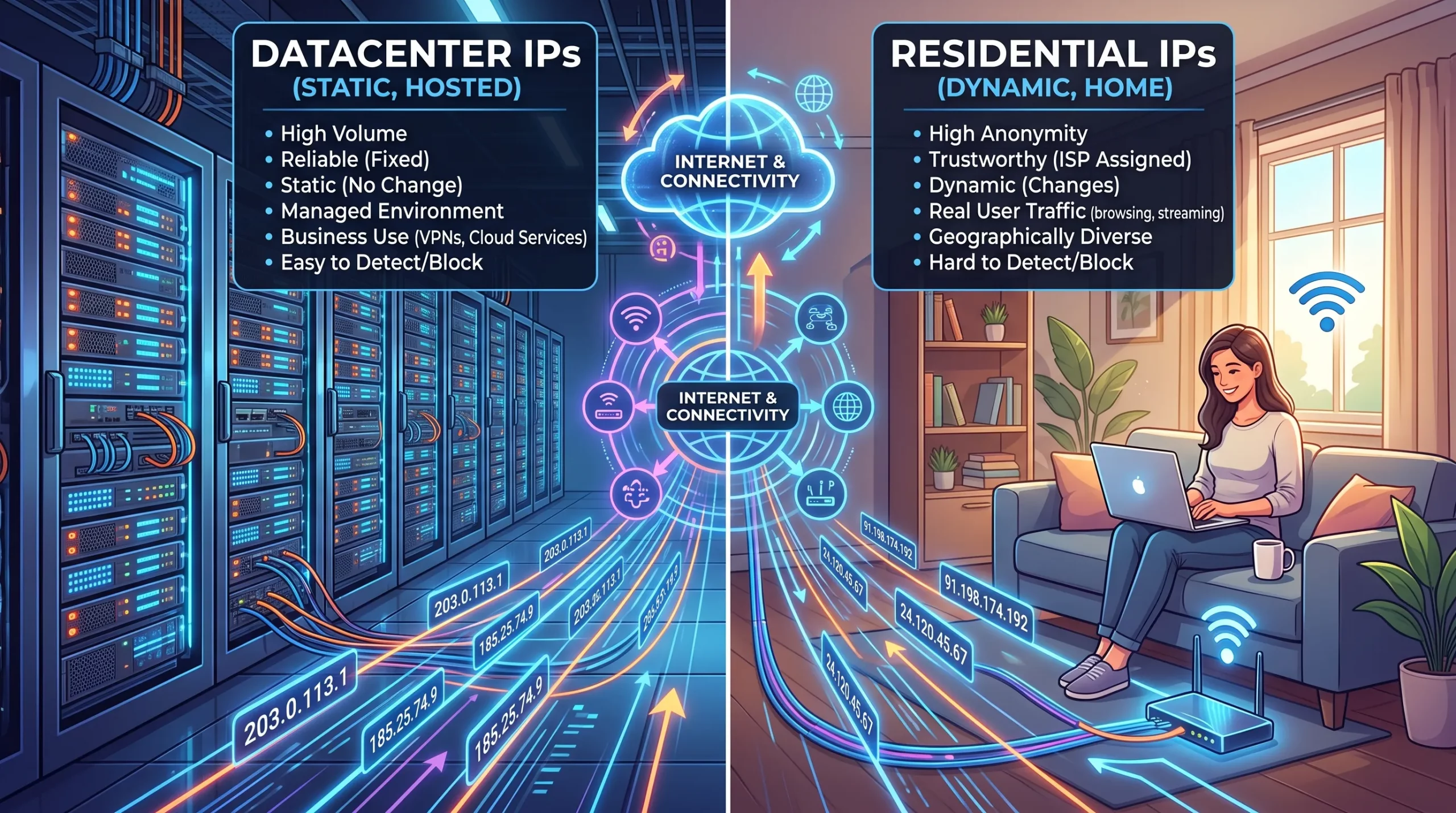
Direcciones IP de centros de datos frente a direcciones IP residenciales: ¿Cuál es la diferencia y por qué es importante?
Una dirección IP de centro de datos se origina en un centro de datos comercial, un proveedor cloud o una empresa de hosting, mientras que una dirección IP residencial es asignada por un proveedor de servicios de Internet a un usuario doméstico o empresarial. La diferencia está en el origen: una proviene de infraestructura diseñada para ejecutar servidores; la otra, de una conexión diseñada para dar servicio a unRead more Related Posts ¿Qué es una Carta de Autorización (LOA) en el arrendamiento de propiedad intelectual? LOA vs. ROA y qué verificar Una Carta de Autorización (LOA) es un documento formal mediante el cual el titular registrado de un bloque de direcciones 数据中心IP地址与住宅IP地址:区别是什么?为什么这很重要? 数据中心 IP 地址来源于商业数据中心、云服务提供商或托管公司,而住宅 IP 地址则由互联网服务提供商分配给家庭或企业用户。 两者的区别在于来源:一种来自为运行服务器而建设的基础设施,另一种来自为终端用户提供连接而建设的网络。正是这一根本区别,决定了互联网其他系统如何看待来自这两类地址的流量。 这个话题通常只会在代理和反检测的狭窄语境下被讨论,因此很容易形成片面的认知。实际上,数据中心 IP 与住宅 IP 的区别,对任何运营互联网基础设施的人都很重要,因为它会影响一个地址天然具有多少信任度、网站和安全系统如何响应它,以及这个地址适合什么用途。几乎所有合法的商业互联网基础设施——包括你使用的每个网站、API、邮件服务器和云服务——都运行在数据中心 IP 地址空间上,而这本来就是正确的使用方式。重点并不是哪一种更好、哪一种更差;而是它们服务于不同目的,也会受到不同方式的对待。了解自己正在使用或真正需要哪一种,可以避免许多本来可以避免的问题。 本文将解释这两种 IP 地址分别是什么、系统如何区分它们、为什么它们会受到不同对待,以及这种差异对于在公共 IPv4 地址空间上部署真实服务的企业意味着什么——包括它与地址信誉、地理定位以及不同使用场景究竟需要哪种地址空间之间的关系。 数据中心 IP Adresses IP de centres de données vs adresses IP résidentielles : quelle est la différence ? Pourquoi est-ce important ? Une adresse IP de centre de données provient d’un centre de données commercial, d’un fournisseur cloud ou d’une société d’hébergement, .related-post {} .related-post .post-list { text-align: left; } .related-post .post-list .item { margin: 5px; padding: 10px; } .related-post .headline { font-size: 18px !important; color: #999999 !important; } .related-post .post-list .item .post_thumb { max-height: 220px; margin: 10px 0px; padding: 0px; display: block; } .related-post .post-list .item .post_title { font-size: 16px; color: #3f3f3f; margin: 10px 0px; padding: 0px; display: block; text-decoration: none; } .related-post .post-list .item .post_excerpt { font-size: 13px; color: #3f3f3f; margin: 10px 0px; padding: 0px; display: block; text-decoration: none; } @media only screen and (min-width: 1024px) { .related-post .post-list .item { width: 30%; } } @media only screen and (min-width: 768px) and (max-width: 1023px) { .related-post .post-list .item { width: 90%; } } @media only screen and (min-width: 0px) and (max-width: 767px) { .related-post .post-list .item { width: 90%; } }
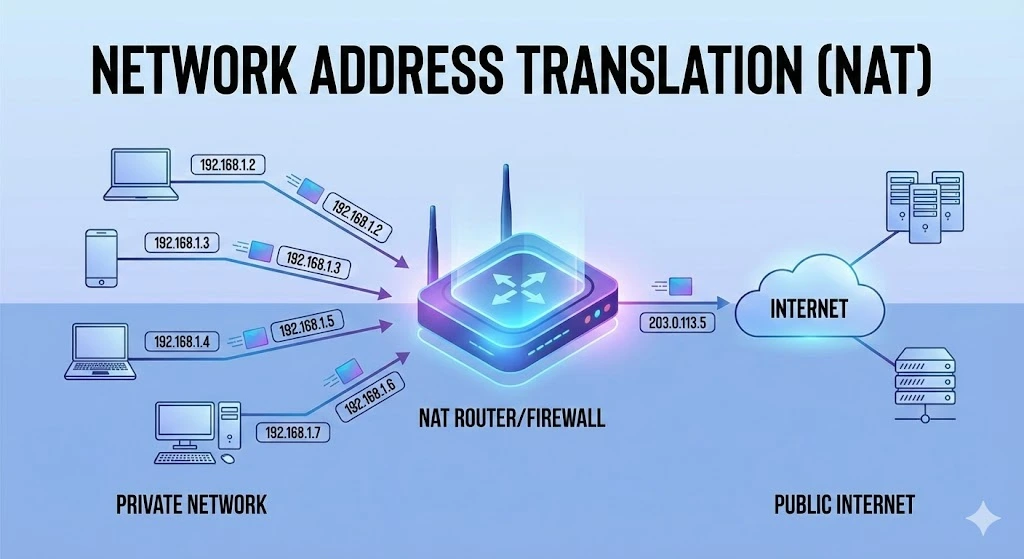
Comprensión de la traducción de direcciones de red (NAT)
En las redes informáticas, gestionar las direcciones IP de forma eficiente es fundamental para garantizar una comunicación fluida entre los dispositivos. Una de las tecnologías clave que ha surgido para afrontar este desafío es la Traducción de Direcciones de Red (NAT, por sus siglas en inglés). En este artículo explicamos qué es NAT, cómo funciona, sus distintos tipos, así como sus ventajas y limitaciones. ¿Qué es la traducción deRead more Related Posts ¿Qué es una Carta de Autorización (LOA) en el arrendamiento de propiedad intelectual? LOA vs. ROA y qué verificar Una Carta de Autorización (LOA) es un documento formal mediante el cual el titular registrado de un bloque de direcciones Direcciones IP de centros de datos frente a direcciones IP residenciales: ¿Cuál es la diferencia y por qué es importante? Una dirección IP de centro de datos se origina en un centro de datos comercial, un proveedor cloud o una Desbloqueando la privacidad digital con una red privada virtual (VPN) ¿Qué es una VPN? Una red privada virtual (VPN) es una tecnología que permite a los usuarios crear una conexión .related-post {} .related-post .post-list { text-align: left; } .related-post .post-list .item { margin: 5px; padding: 10px; } .related-post .headline { font-size: 18px !important; color: #999999 !important; } .related-post .post-list .item .post_thumb { max-height: 220px; margin: 10px 0px; padding: 0px; display: block; } .related-post .post-list .item .post_title { font-size: 16px; color: #3f3f3f; margin: 10px 0px; padding: 0px; display: block; text-decoration: none; } .related-post .post-list .item .post_excerpt { font-size: 13px; color: #3f3f3f; margin: 10px 0px; padding: 0px; display: block; text-decoration: none; } @media only screen and (min-width: 1024px) { .related-post .post-list .item { width: 30%; } } @media only screen and (min-width: 768px) and (max-width: 1023px) { .related-post .post-list .item { width: 90%; } } @media only screen and (min-width: 0px) and (max-width: 767px) { .related-post .post-list .item { width: 90%; } }
