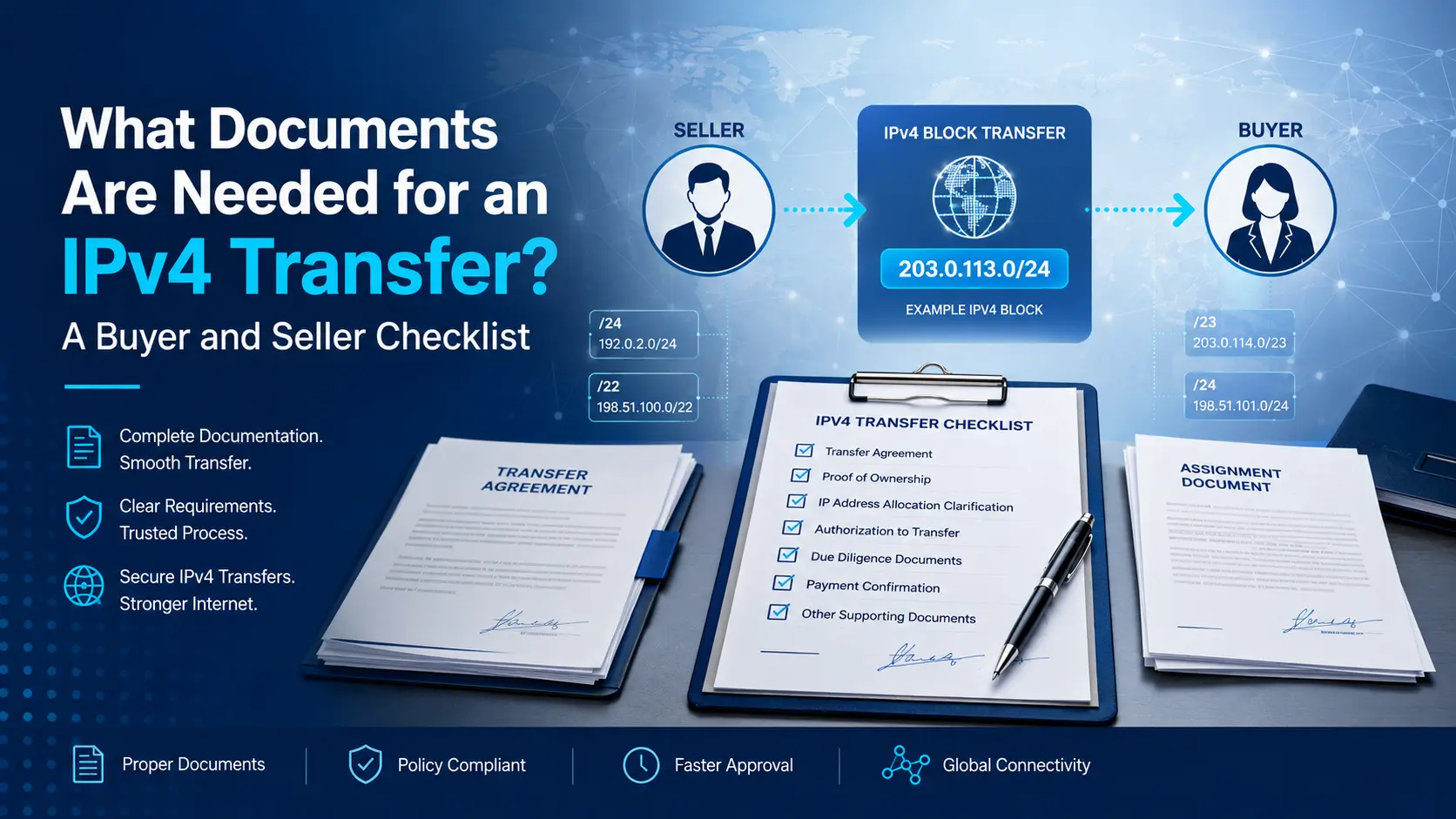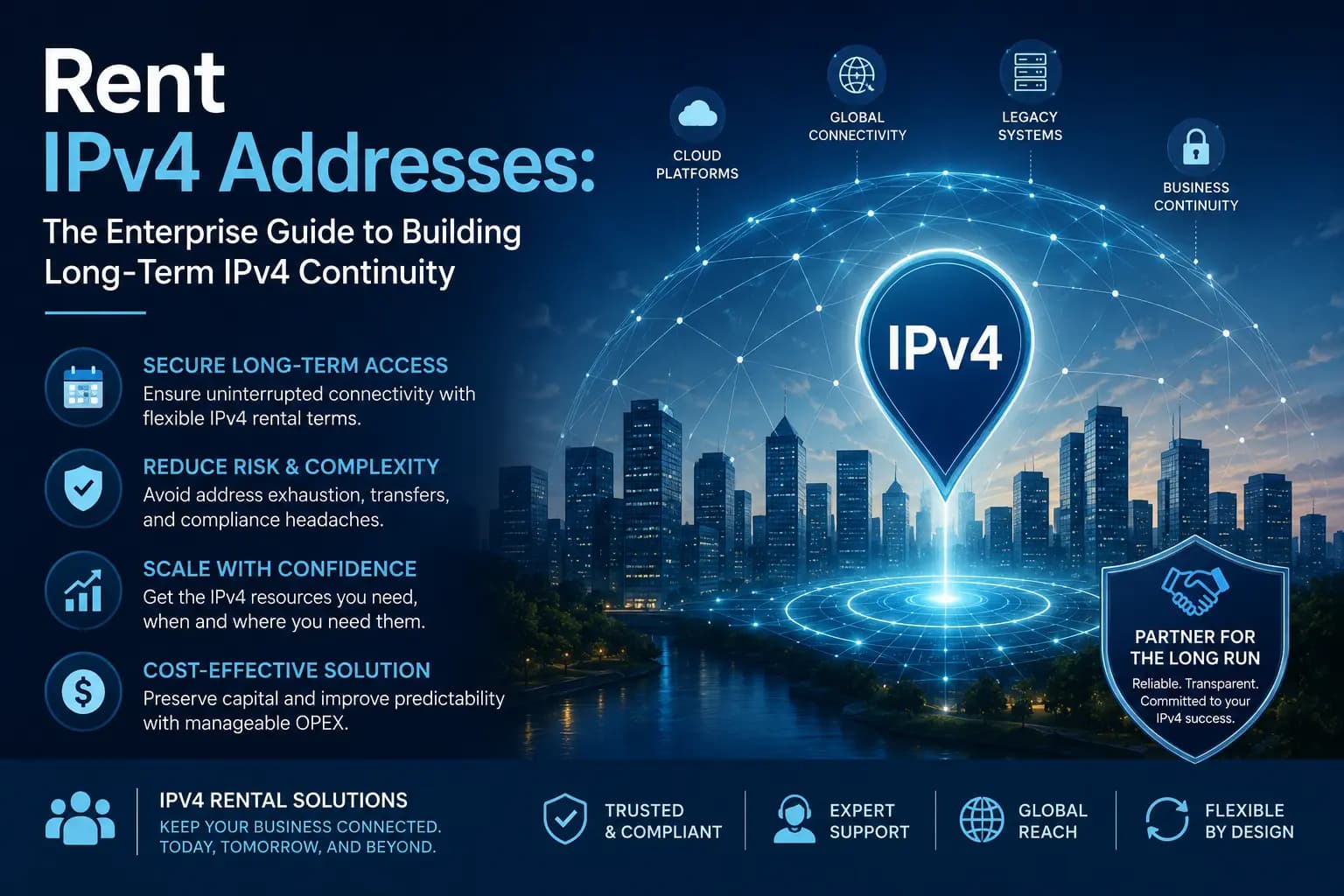
If you’re looking to rent IPv4 addresses, you’re not alone.
Table of Contents
Businesses worldwide continue to need IPv4 resources to support growth, expand infrastructure and meet customer demand.
However, the conversation around IPv4 is changing.
For years, businesses treated IPv4 as a procurement exercise.
The process was simple:
- Find available IPv4
- Acquire IPv4
- Deploy IPv4
Today, that mindset is becoming outdated.
IPv4 has evolved into critical infrastructure.
At i.LEASE, we believe businesses should think beyond transactions and start planning for continuity.
Because obtaining IPv4 is no longer the hardest challenge.
Maintaining reliable access to IPv4 over time is becoming increasingly important.
As Heng Lu has previously written, many questions in today’s IPv4 market are actually risk questions disguised as transaction questions.
The same principle applies when organizations rent IPv4.
The question is no longer:
Where can we rent IPv4 addresses?
The better question is:
How can we rent IPv4 addresses while building long-term resilience?
This guide explains how businesses can do exactly that.
What Does It Mean to Rent IPv4 Addresses?
Renting IPv4 addresses allows organizations to access IPv4 resources without purchasing them outright.
Instead of making large capital investments, businesses obtain access through flexible commercial arrangements.
Organizations commonly rent IPv4 for:
- Hosting infrastructure
- Cloud platforms
- Data centres
- Internet service providers
- SaaS platforms
- Enterprise applications
Renting provides flexibility while preserving capital.
For many organizations, renting is no longer a temporary solution.
It is becoming part of long-term infrastructure planning.
Why Businesses Rent IPv4 Instead of Buying
Organizations usually rent IPv4 for four reasons.
Lower Upfront Investment
Buying IPv4 can require substantial capital investment.
Renting allows businesses to allocate resources elsewhere.
Faster Deployment
Businesses often need additional IPv4 capacity immediately.
Renting accelerates growth.
Greater Flexibility
Requirements evolve over time.
Renting allows organizations to adapt.
Better Cash Flow Management
Many organizations prefer predictable operating expenses over large capital expenditures.
Why IPv4 Still Matters in an IPv6 World
Many people ask:
Isn’t IPv6 replacing IPv4?
Eventually, yes.
Immediately, no.
The internet will likely operate in a dual-stack environment for many years.
IPv4 remains important because:
- Legacy systems still depend on it
- Customers continue to require it
- Hosting providers continue supporting it
- Interoperability remains essential
Most organizations are not choosing IPv4 instead of IPv6.
They are operating both simultaneously.
This means IPv4 remains a strategic infrastructure resource.
Who Should Rent IPv4?
Renting IPv4 is particularly useful for organizations experiencing growth.
Hosting Providers
Expand customer capacity quickly.
Cloud Providers
Scale infrastructure efficiently.
Data Centres
Support customer demand.
Internet Service Providers
Manage subscriber growth.
Enterprises
Support digital transformation projects.
Organizations with changing requirements often benefit the most.
How to Rent IPv4 Addresses in 5 Steps
Step 1: Determine Your Requirements
Evaluate:
- Number of addresses required
- Geographic requirements
- Growth expectations
- Business objectives
Avoid reactive decisions.
Step 2: Define Your Timeline
Ask:
- Is this temporary?
- Is this long term?
- Is this permanent?
Time affects strategy.
Step 3: Evaluate Providers Carefully
Don’t focus solely on price.
Also evaluate:
- Stability
- Transparency
- Operational maturity
- Support quality
Step 4: Understand The Entire Lifecycle
Evaluate:
- Provisioning
- Scaling
- Renewals
- Exit planning
Infrastructure should always be viewed as a lifecycle.
Step 5: Build Continuity Into Your Strategy
This is where many organizations fail.
Obtaining IPv4 is easy.
Maintaining continuity is harder.
How Much Does It Cost to Rent IPv4 Addresses?
Pricing varies according to several factors.
Address Block Size
Larger requirements affect pricing.
Rental Duration
Longer agreements may affect costs.
Market Conditions
Supply and demand influence pricing.
Geographic Requirements
Regional availability may impact costs.
Avoid choosing providers based solely on price.
The cheapest solution is not always the lowest-risk solution.
Rent IPv4 vs Buy IPv4
| Category | Rent IPv4 | Buy IPv4 |
|---|---|---|
| Upfront investment | Lower | Higher |
| Flexibility | High | Lower |
| Capital efficiency | High | Lower |
| Ownership | No | Yes |
| Adaptability | High | Lower |
Many organizations use hybrid approaches.
The objective is resilience.
Not ideology.
Where Can Businesses Rent IPv4 Addresses?
Businesses typically access IPv4 through several models.
IPv4 Brokers
Transaction-focused intermediaries.
IPv4 Marketplaces
Platforms that connect participants.
IPv4 Leasing Platforms
Platforms focused on long-term access models.
At i.LEASE, we encourage businesses to evaluate more than price and availability.
They should also evaluate sustainability.
Because renting IPv4 is ultimately an infrastructure decision.
Not just a transaction.
What Is IPv4 Continuity Risk?
IPv4 continuity risk is the possibility that long-term access, operational flexibility or infrastructure stability becomes disrupted over time.
Many organizations assume:
If we obtained IPv4, the problem is solved.
Unfortunately, that assumption creates risk.
The challenge is rarely obtaining IPv4.
The challenge is sustaining access over years.
Not months.
The Four Types of IPv4 Continuity Risk
Registry Risk
As Heng Lu has argued, some broker questions are actually registry risk questions.
Organizations should understand the larger ecosystem surrounding IPv4.
Provider Dependency Risk
Every provider relationship introduces dependency.
Ask:
What happens if our infrastructure relies entirely on one source?
Operational Risk
Can your systems adapt as requirements evolve?
Flexibility matters.
Strategic Risk
Short-term thinking often creates long-term constraints.
Plan beyond today’s requirements.
10 Questions to Ask Before You Rent IPv4 Addresses
1. Why Are We Renting IPv4?
This may sound obvious, but it’s the question most organizations skip.
Many businesses only realize they need IPv4 when they are already under pressure. New customers are arriving, servers are reaching capacity, or expansion plans are underway.
But before renting IPv4, define the actual business objective.
Are you:
- Expanding hosting capacity?
- Launching new services?
- Entering a new region?
- Supporting customer growth?
- Bridging a temporary shortage?
The answer matters because different objectives require different strategies.
At i.LEASE, we believe IPv4 should not be treated as an emergency procurement exercise. It should be treated as infrastructure planning.
The clearer your objective, the easier it becomes to build a sustainable IPv4 strategy.
2. How Long Will We Need These Addresses?
Time fundamentally changes risk.
Many organizations solve a six-month problem with a five-year commitment, while others build long-term infrastructure on temporary assumptions.
Ask yourself:
- Is this a short-term project?
- Is this a growth phase?
- Is this permanent infrastructure?
Infrastructure tends to outlive initial assumptions.
Services grow. Customers expand. Systems become more dependent on the resources that support them.
The longer IPv4 becomes embedded in your operations, the more continuity matters.
Don’t only plan for today’s requirements.
Plan for the next three to five years.
3. Are We Solving Capacity Problems or Building Infrastructure?
These are not the same thing.
Capacity solves immediate shortages.
Infrastructure supports long-term growth.
Many organizations confuse the two.
Adding more IPv4 addresses may solve today’s bottleneck, but if those addresses become integrated into your production systems, you’ve made an infrastructure decision.
Infrastructure decisions require a different mindset.
Ask:
Will our business depend on these addresses next year?
If the answer is yes, stop thinking about transactions and start thinking about continuity.
4. Where Do These IPv4 Addresses Come From?
This is one of the most important questions nobody asks.
Most businesses only see a transaction.
However, IPv4 exists within a much larger ecosystem.
As Heng Lu has argued, some questions in the IPv4 market are actually risk questions disguised as transaction questions.
Instead of only asking:
Who is renting us IPv4?
Also ask:
What ecosystem sits behind these addresses?
Understanding source transparency, operational legitimacy and long-term sustainability helps businesses reduce uncertainty.
Infrastructure leaders should always know where critical resources originate.
Further reading: Heng Lu, When Registry Power Detaches From Liability, It Detaches From Reality
5. Are We Creating a Single Point of Failure?
Convenience often creates concentration risk.
It’s easy to depend entirely on a single provider because it simplifies operations.
But every dependency introduces risk.
Ask yourself:
- What percentage of our infrastructure depends on one source?
- Do we have contingency plans?
- Could we adapt if circumstances change?
No organization can eliminate dependency entirely.
The objective is to manage it intentionally.
Healthy infrastructure is resilient infrastructure.
6. Can This Support Future Growth?
The IPv4 strategy that works today may not work tomorrow.
Growth changes requirements.
Questions to consider include:
- Can we expand into other regions?
- Can we onboard more customers?
- Can we increase infrastructure capacity?
Businesses rarely remain static.
Your IPv4 strategy shouldn’t either.
Build flexibility into your infrastructure from the beginning.
Planning for growth is often cheaper than reacting to growth later.
7. What Happens If Requirements Change?
Requirements always change.
The real question is whether your infrastructure can adapt when they do.
Businesses should understand:
- Renewal processes
- Expansion options
- Migration strategies
- Exit planning
Many organizations only think about onboarding.
Very few think about offboarding.
Infrastructure planning should cover the entire lifecycle.
Not just initial deployment.
8. Are We Optimizing For Price Or Continuity?
This may be the biggest mistake organizations make.
Low prices are attractive.
But the cheapest option today isn’t always the lowest-cost decision tomorrow.
Businesses should balance:
- Cost
- Flexibility
- Stability
- Operational resilience
At i.LEASE, we believe continuity deserves a seat at the decision-making table.
Because price is temporary.
Continuity is strategic.
Businesses that optimize solely for cost often create larger problems later.
We’ve also seen how organizations can unlock long-term value by treating digital infrastructure as a strategic asset rather than a short-term expense. This case study explores how enterprises generate recurring income from IPv4 while strengthening business continuity and operational resilience.
Read this: Case study: How enterprises generate recurring income from IPv4
9. Who Owns IPv4 Continuity Internally?
This responsibility often falls between departments.
Is it:
- Network engineering?
- Infrastructure operations?
- Procurement?
- Leadership?
Increasingly, IPv4 affects all of them.
Someone should be responsible for long-term continuity planning.
Without ownership, continuity becomes accidental.
And accidental continuity is not a strategy.
Assigning accountability early creates stronger infrastructure later.
10. Are We Building Resilience Or Solving Today’s Problem?
This may be the most important question of all.
The old mindset says:
We need more IP addresses.
The new mindset says:
We need reliable access to IPv4 that can support our business over time.
There’s a subtle but important difference.
Obtaining IPv4 is relatively straightforward.
Maintaining continuity is much harder.
At i.LEASE, we believe organizations are entering a new era of IPv4 planning.
The conversation is no longer ownership versus renting.
The conversation is resilience.
Because ultimately, the biggest risk isn’t failing to obtain IPv4.
It’s assuming continuity happens automatically.
It doesn’t.
Continuity must be designed.
Most businesses don’t fail because they couldn’t obtain IPv4 addresses.
They run into problems because they underestimate what happens after obtaining them.
At i.LEASE, we believe the biggest IPv4 risks are often created unintentionally through small decisions that accumulate over time.
Here are five common mistakes organizations should avoid.
5 Mistakes That Create IPv4 Continuity Risk
Mistake 1: Choosing Providers Solely Based on Price
Price is important.
But price should never be the only evaluation criteria.
The cheapest option today can become the most expensive decision tomorrow if it introduces operational friction, unnecessary complexity or future limitations.
Instead of asking:
Who has the cheapest IPv4?
Ask:
Which option best supports our long-term infrastructure goals?
Businesses should evaluate:
- Stability
- Transparency
- Flexibility
- Continuity
Price is temporary.
Infrastructure decisions often last for years.
Mistake 2: Treating IPv4 as a One-Time Procurement Task
Many organizations think:
We got the addresses. Problem solved.
Unfortunately, that’s rarely true.
Infrastructure evolves continuously.
Customer demand changes.
Services expand.
Geographic requirements shift.
IPv4 should not be treated as a one-time procurement exercise.
It should be managed as an ongoing infrastructure responsibility.
The decision doesn’t end when IPv4 is deployed.
In many ways, that’s when the real work begins.
Mistake 3: Ignoring Future Growth
Businesses rarely remain static.
The IPv4 requirements you have today may look very different 24 months from now.
Before renting IPv4, ask:
- What happens if we double our customer base?
- What happens if we expand into new markets?
- What happens if demand grows faster than expected?
Organizations often spend significant effort solving today’s bottleneck while unintentionally creating tomorrow’s constraints.
Growth should be part of the initial conversation.
Not an afterthought.
Mistake 4: Creating Provider Dependency Without Realizing It
Convenience often creates concentration risk.
Over time, entire infrastructures can become dependent on a single source without anyone noticing.
This doesn’t mean dependency is inherently bad.
Every organization has dependencies.
The risk emerges when dependencies become invisible.
Ask yourself:
- What percentage of our infrastructure relies on one provider?
- Do we have contingency plans?
- Could we adapt if circumstances change?
Healthy infrastructure is resilient infrastructure.
Resilient infrastructure avoids unnecessary single points of failure.
Mistake 5: Ignoring IPv4 Continuity Planning
This is perhaps the biggest mistake of all.
Many organizations assume continuity happens automatically.
It doesn’t.
As Heng Lu has argued, many IPv4 decisions are actually risk decisions disguised as transaction decisions.
The same applies here.
Obtaining IPv4 is relatively easy.
Sustaining reliable access over time is much harder.
Businesses should think about:
- Long-term operational stability
- Future growth
- Provider relationships
- Infrastructure resilience
At i.LEASE, we believe organizations should move from procurement thinking to continuity thinking.
The question is no longer:
How do we get IPv4?
The better question is:
How do we maintain reliable access to IPv4 over time?
That’s the conversation infrastructure leaders should be having.
The Bigger Shift: From Procurement to Stewardship
The IPv4 market is evolving.
Organizations are moving away from purely transactional thinking.
They’re beginning to think about continuity, resilience and long-term sustainability.
The businesses that succeed over the next decade won’t necessarily own the most IPv4 addresses.
They will be the organizations that manage IPv4 continuity most effectively.
Because ultimately, the biggest IPv4 risk isn’t scarcity.
It’s assuming continuity will take care of itself.
It won’t.
Continuity must be intentionally designed.
Why Traditional IPv4 Procurement Is Changing
Historically, businesses viewed IPv4 as procurement.
That model is evolving.
Organizations increasingly need to think beyond obtaining IPv4.
They need to think about sustaining it.
This is why continuity is becoming more important than ownership.
The organizations that succeed over the next decade won’t necessarily own the most IPv4.
They will maintain continuity most effectively.
Why i.LEASE Thinks Differently
i.LEASE was created around a simple observation.
The industry is good at helping businesses obtain IPv4.
The industry is less mature at helping businesses maintain continuity.
This continuity-first philosophy is heavily influenced by Heng Lu’s writing around registry risk and LARUS ‘s operational approach to infrastructure planning.
The future of IPv4 is not ownership versus renting.
The future of IPv4 is sustainable access.
The question is no longer:
How do we get IPv4?
The better question is:
How do we sustain IPv4 over time?
Conclusion
The easiest part of IPv4 is obtaining it.
The harder part is sustaining it.
Organizations that understand this distinction will build stronger infrastructure over the next decade.
Because continuity doesn’t happen automatically.
Continuity must be designed.
Frequent Asked Questions
1. Is renting IPv4 legal?
Commercial IPv4 leasing and transfer arrangements are widely practiced globally, subject to applicable registry policies, contractual agreements and operational requirements.
2. Is renting IPv4 better than buying?
There is no universal answer. The right approach depends on your infrastructure strategy, capital allocation priorities, business growth plans and long-term operational requirements.
3. How long can organizations rent IPv4?
Rental periods vary based on commercial agreements, provider models and business needs. Organizations should evaluate whether the arrangement aligns with their long-term continuity requirements.
4.What is IPv4 continuity risk?
IPv4 continuity risk is the possibility that access to critical IP resources, operational stability or future scalability could be disrupted due to changes in policies, providers or infrastructure dependencies.
5.What is the biggest mistake organizations make?
Treating IPv4 as a one-time procurement exercise instead of an ongoing infrastructure responsibility.
The organizations that manage IPv4 most effectively treat it as a strategic asset that requires continuous planning, governance and risk management.