Why the Cheapest IPv4 Lease May Cost More in the Long Run
 Stephanie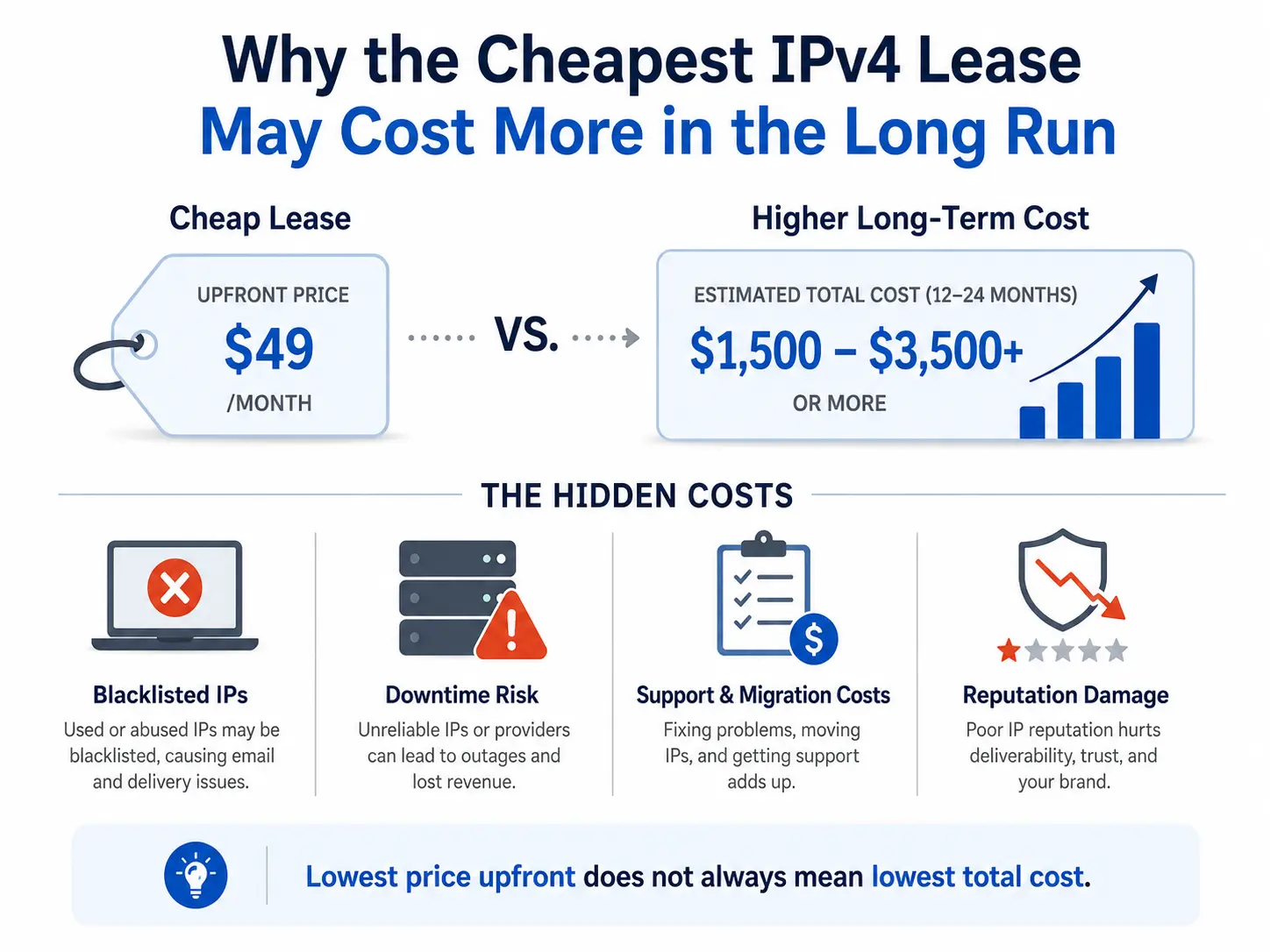
A low monthly price may look attractive during procurement, but the real cost of leased IPv4 addresses includes much more than the advertised rate. Poor IP reputation, incomplete routing authorisation, deployment delays, weak technical support, incorrect geolocation and uncertain renewal terms can quickly erase the initial saving.
Table of Contents
For testing or short-lived projects, a basic low-cost IPv4 lease may be sufficient. For production networks, however, businesses should evaluate the total cost of deployment and continuity, not just the monthly cost per IP address.
The right question is not:
How cheap is this IPv4 block?
It is:
How much will it cost to deploy, operate, maintain and eventually replace this IPv4 block?
Key Takeaways
- The monthly lease rate represents only part of the total IPv4 leasing cost.
- Poor IP reputation can affect email delivery, platform access and customer traffic.
- Missing LOAs, ROAs or routing records can delay deployment.
- Weak technical support increases incident-response and engineering costs.
- Incorrect IP geolocation can make a block unsuitable for regional services.
- Uncertain renewal terms can force an expensive renumbering project.
- The best-value IPv4 lease is the one that matches the workload’s operational and continuity requirements.
Why Businesses Look for Cheap IPv4 Leases
IPv4 addresses remain essential for hosting, cloud services, VPN infrastructure, telecom networks, SaaS platforms, email systems and other Internet-facing workloads.
At the same time, unrestricted supplies of new IPv4 addresses have largely disappeared. RIPE NCC, for example, reports that it exhausted its remaining IPv4 pool in November 2019. Networks in its service region generally cannot obtain large quantities of previously unused IPv4 space directly from the registry.
As a result, organisations increasingly obtain IPv4 capacity through transfers and leasing arrangements.
Businesses commonly compare IPv4 lease offers using:
- Monthly price per IP address
- Block size
- Lease duration
- Regional availability
- Setup time
Price is important, but two IPv4 blocks of the same size are not necessarily equal.
They may have very different:
- Reputation histories
- Registry records
- Routing configurations
- Origin-ASN restrictions
- Reverse DNS arrangements
- Geolocation records
- Renewal conditions
- Support structures
A lower price may simply mean that some of these operational responsibilities have been transferred to the customer.
What Is the Real Cost of an IPv4 Lease?
The total cost of an IPv4 lease can be understood as:
Total IPv4 leasing cost = lease payments + deployment costs + remediation costs + support costs + disruption risk + renewal or exit costs
The monthly invoice usually represents only the first component.
A low-cost IPv4 block can become expensive when engineers must spend additional time making it usable, resolving reputation problems or replacing it earlier than expected.
Businesses should therefore compare IPv4 lease offers using total cost of ownership, even though the addresses are being rented rather than purchased.
1. Poor IP Reputation Can Create Immediate Costs
Every IPv4 address has a history.
A previous user may have used an address range for legitimate services. Alternatively, the range may have been associated with:
- Spam
- Malware distribution
- Fraudulent accounts
- Credential attacks
- Aggressive scanning
- Abusive proxies
- Compromised servers
- Policy-violating automation
The new lessee is not automatically responsible for the previous user’s activity. However, it may inherit the operational consequences.
Spamhaus defines IP reputation as an assessment of an IP address’s trustworthiness based on information about the address or range. Its blocklists include IP addresses associated with activities such as spam, malicious content and hijacked address space.
Before leasing a block, buyers can use tools such as the Spamhaus IP and Domain Reputation Checker to determine whether addresses appear on relevant blocklists.
What can poor IP reputation affect?
A block with an unfavourable history may experience:
- Rejected or filtered email
- Reduced email deliverability
- Repeated CAPTCHA challenges
- Blocked website registrations
- Restricted access to APIs
- Traffic filtering
- Customer complaints
- Manual delisting requirements
- Delayed production launches
Some reputation issues can be corrected. The correction process, however, may require investigation, delisting requests, documentation and waiting for multiple systems to update.
If a company saves a small amount per month but loses several days of engineering time, the cheaper lease may already have become the more expensive option.
What to ask before leasing
Before signing an IPv4 lease, ask:
- When was the block last used?
- What reputation systems were checked?
- Was the entire prefix assessed?
- Are there active blocklist listings?
- Who handles existing reputation problems?
- Is replacement space available if remediation fails?
- Does the provider continue monitoring reputation after deployment?
A single clean result does not guarantee that every service will accept an address. Reputation is dynamic and different platforms use different data. Nevertheless, screening reduces the risk of discovering a serious issue after deployment.
The i.lease IPv4 marketplace focuses on connecting IPv4 sourcing with operational considerations such as reputation, routing support and deployment readiness.
2. The Cheapest Block May Not Be Ready to Route
Receiving an IPv4 prefix is not the same as receiving immediately deployable network capacity.
A production deployment may require:
- A Letter of Authorization, or LOA
- A valid Route Origin Authorization, or ROA
- Internet Routing Registry route objects
- Accurate origin-ASN information
- Upstream-provider approval
- Reverse DNS delegation
- Registry coordination
- Geolocation updates
If these requirements are incomplete or inconsistent, the customer may be unable to announce the prefix as planned.
Deployment delays create business costs
A delayed IPv4 deployment can postpone:
- Customer onboarding
- A hosting-cluster expansion
- A new regional service
- A cloud migration
- An ISP rollout
- VPN or security infrastructure
- Revenue-generating workloads
The business cost may include idle hardware, delayed contracts, missed launch dates and additional engineering work.
A cheaper block that takes two weeks to deploy may provide less value than a more expensive block that can be configured within the required launch window.
For organisations that need operational assistance, i.lease managed IPv4 leasing incorporates functions such as LOA generation, registry coordination, RPKI support, reverse DNS and reputation assessment into the leasing workflow.
3. Missing or Incorrect ROAs Can Affect Reachability
The Border Gateway Protocol does not independently prove that an Autonomous System is authorised to announce a particular IPv4 prefix.
Resource Public Key Infrastructure, or RPKI, provides cryptographically verifiable statements that connect Internet number resources with their legitimate holders. A Route Origin Authorization identifies which ASN is authorised to originate a prefix.
Operators can learn more from ARIN’s official guide to Route Origin Authorizations.
If an announcement conflicts with an existing ROA, the route may be classified as RPKI invalid.
Networks performing Route Origin Validation may reject or deprioritise that announcement. The result can be partial reachability: the service works for some users but fails for others.
Questions to ask about RPKI
Before selecting an IPv4 lease, confirm:
- Which ASN will be authorised to originate the prefix?
- Who controls the RPKI certificate?
- Who can create or change the ROA?
- What maximum prefix length will be authorised?
- How quickly can an incorrect ROA be corrected?
- Will the ROA remain active for the full lease term?
- What happens when the origin ASN changes?
A low monthly rate provides little value when part of the Internet cannot reliably reach the address block.
4. Provider Chains Can Increase Coordination Costs
Some IPv4 leases involve multiple parties:
- The registered resource holder
- An asset manager
- A broker or marketplace
- A reseller
- The final network operator
Multiple parties do not automatically make a lease unsafe. The risk appears when authority and responsibility are unclear.
For example, the customer may report an invalid ROA to its direct provider. That provider may need to contact a broker, which must then contact the party controlling the relevant RIR account.
Each additional handoff can introduce:
- Delayed responses
- Incomplete information
- Conflicting instructions
- Lost documentation
- Unclear accountability
- Slow emergency changes
A low-price lease may therefore carry a high coordination cost.
Identify the party that controls each function
Ask who can directly manage:
- The RIR account
- Registry records
- LOAs
- RPKI and ROAs
- IRR route objects
- Reverse DNS
- Abuse contacts
- Renewal approval
- Replacement space
i.lease describes its marketplace as an execution-focused model connecting IPv4 transactions with registry, authorisation and operational requirements over time.
This distinction matters because completing a commercial agreement does not automatically make the address block usable.
5. Outdated Registry Data Can Slow Verification
WHOIS and RDAP records help network operators identify the organisation responsible for an IP address range or Autonomous System Number.
APNIC describes its Whois Database as an official record containing information about organisations that hold IP addresses and AS Numbers in the Asia-Pacific region. Users can query it to determine who is responsible for a resource.
Buyers can review official information through services such as the APNIC Whois Database and the equivalent databases operated by other Regional Internet Registries.
Registry records may not prove every contractual right on their own, but inconsistencies can create additional due diligence.
Common problems include:
- An outdated organisation name
- A former employee listed as the contact
- An inactive abuse mailbox
- A provider that no longer manages the resource
- Registry information that conflicts with the LOA
- Missing downstream registration where applicable
Resolving these inconsistencies may require additional documents or direct confirmation from the resource holder.
The cheapest offer may therefore take longer to verify and onboard.
6. Reverse DNS May Carry Additional Costs
Reverse DNS maps an IP address to a hostname through a PTR record.
It may be important for:
- Mail servers
- Security investigations
- Network diagnostics
- Logging
- Hosting platforms
- Customer infrastructure
Not every IPv4 lease gives the customer direct reverse-DNS control.
In some arrangements, every PTR change must be submitted manually to the provider. Other providers delegate reverse-DNS management to the lessee.
Before signing, ask:
- Is reverse DNS included?
- Is it delegated to the customer?
- How quickly are PTR changes processed?
- Are bulk updates supported?
- Are additional fees charged?
- What happens during an urgent change?
A lower lease price may not represent a saving if routine reverse-DNS requests create repeated support charges or operational delays.
7. Incorrect Geolocation Can Make a Block Less Valuable
IP geolocation is not determined directly by BGP. Geolocation providers infer location using registry data, routing observations, operator submissions, geofeeds and other signals.
When an IPv4 block changes users or deployment regions, third-party databases may continue associating it with its previous location.
This can affect:
- Regional content delivery
- Fraud-detection systems
- Advertising
- Search results
- Customer localisation
- Licensing controls
- Regulatory workflows
- Access to location-sensitive services
The IETF’s RFC 8805 geofeed format allows network operators to publish mappings between IP prefixes and simplified geographic information. RFC 9632 subsequently standardised methods for locating and optionally authenticating geofeed data.
Publishing a geofeed can improve the information available to geolocation providers, but it does not guarantee that every database will update immediately.
Before leasing IPv4 addresses for a location-sensitive service, determine:
- How the block is currently geolocated
- Whether a geofeed is available
- Who can update the geofeed
- Whether registry remarks are accurate
- Who contacts geolocation providers
- Whether alternative space is available
A cheap block that appears to be in the wrong country may not be usable for the intended workload.
8. Weak Support Can Increase Incident Costs
IPv4 leasing is not only access to an address range. For production users, it also includes the ability to obtain help when the address range stops working as expected.
Possible incidents include:
- An incorrect ROA
- A route rejected by an upstream
- A blocklist listing
- A reverse-DNS failure
- An invalid LOA
- Incorrect geolocation
- An abuse complaint
- A registry-record issue
A basic provider may offer only best-effort email support. That may be acceptable for a test environment, but inadequate for customer-facing infrastructure.
Evaluate the support model
Ask:
- What support is included?
- Is there a defined response time?
- Is technical escalation available?
- Who handles urgent routing changes?
- Who handles abuse reports?
- Is reputation remediation included?
- Are emergency changes charged separately?
- Is support available outside normal office hours?
The value of support often becomes visible only after an incident. By that point, changing providers may be difficult.
9. Unclear Acceptable-Use Terms Can Create Contract Risk
An inexpensive IPv4 lease may come with restrictions that are not obvious in the initial quotation.
The written agreement should clearly define:
- Permitted uses
- Prohibited activities
- Abuse-management requirements
- Subleasing rights
- Geographic restrictions
- Routing conditions
- Suspension procedures
- Termination triggers
- Investigation obligations
- Notice periods
A use case informally accepted during a sales conversation should also be permitted in the contract.
Otherwise, a customer may build production infrastructure on a block that can later be suspended for a use-policy violation.
Before comparing prices, make sure every provider is quoting for the same permitted workload and service level.
10. Renewal Uncertainty Can Force Expensive Renumbering
A short-term IPv4 lease may be appropriate for temporary workloads. It is more problematic when the addresses become embedded in long-term systems.
Over time, an IPv4 range may appear in:
- Customer allowlists
- Firewall policies
- API configurations
- DNS records
- Mail-server settings
- VPN configurations
- Monitoring systems
- Security platforms
- Partner documentation
- Compliance records
Replacing those addresses can become a significant project.
Renumbering may require
- Finding replacement IPv4 capacity
- Running old and new prefixes in parallel
- Updating DNS and reverse DNS
- Changing firewall rules
- Updating customer allowlists
- Reconfiguring applications
- Rebuilding IP reputation
- Notifying customers and partners
- Testing routing and reachability
- Removing hard-coded addresses
The network change may be technically straightforward. Coordinating every external dependency is often harder.
Before accepting a low-cost offer, evaluate:
- Initial lease duration
- Renewal-notice requirements
- Renewal pricing
- Termination conditions
- Replacement guarantees
- Migration assistance
- Transition periods
- Responsibility if the resource becomes unavailable
The i.lease guide to short-term and long-term IPv4 leasing explains that short-term leasing provides flexibility, while longer arrangements can offer more stable access and pricing for persistent workloads.
For infrastructure that is difficult to renumber, renewal certainty may be worth more than a small monthly discount.
A Better Way to Compare IPv4 Lease Offers
Do not compare offers using price alone. Use a structured scorecard.
Evaluation area | Questions to ask |
Price | What is included in the monthly rate? |
Source | Who controls the resource and RIR account? |
Reputation | Was the entire block checked before delivery? |
Routing | Can the intended ASN originate the prefix? |
RPKI | Who creates and updates the ROA? |
Authorisation | How and when is the LOA issued? |
Registry data | Are WHOIS and RDAP records consistent? |
Reverse DNS | Is rDNS included or delegated? |
Geolocation | Is geofeed support available? |
Abuse handling | Who receives and resolves reports? |
Support | What response and escalation commitments apply? |
Renewal | How are renewal and pricing handled? |
Exit | Is there a migration or replacement process? |
Contract | Are all fees and use restrictions disclosed? |
A Simple Total-Cost Example
Consider two hypothetical offers for the same IPv4 block size.
Offer A: The lowest advertised price
- Lower monthly rate
- No documented reputation assessment
- LOA provided manually
- ROA changes depend on a third party
- Reverse DNS charged separately
- Best-effort support
- No renewal commitment
- Geolocation assistance excluded
Offer B: A moderately higher price
- Pre-deployment reputation checks
- Defined LOA workflow
- ROA and routing coordination
- Reverse-DNS support
- Clear escalation process
- Documented abuse handling
- Geolocation support
- Defined renewal terms
Offer A is cheaper while nothing goes wrong.
One delayed launch, serious reputation issue or forced migration could exceed the annual price difference between the two offers.
Offer B may therefore have the lower risk-adjusted total cost, even though the monthly invoice is higher.
When Is a Cheap IPv4 Lease Appropriate?
The lowest-cost option is not always the wrong option.
It may be reasonable when:
- The project is temporary
- The addresses are used for testing
- The workload is not reputation-sensitive
- The network can renumber easily
- Downtime has little commercial impact
- The customer can independently manage routing and registry coordination
- Renewal certainty is not important
A more fully managed lease may be preferable when:
- The addresses support customer-facing services
- Email deliverability matters
- The block will enter external allowlists
- Regional geolocation is important
- The deployment has a fixed deadline
- The company needs rapid technical support
- The infrastructure cannot easily be renumbered
The right choice depends on the cost of disruption, not only the cost of the addresses.
How i.lease Approaches IPv4 Leasing
i.lease is a global IPv4 marketplace supporting IPv4 buying, selling, leasing-in and leasing-out. The platform’s positioning emphasises that completing a transaction does not by itself guarantee ongoing usability; registry alignment, authorisation, reputation, routing and operational execution also matter.
For organisations that require more than basic address access, managed IPv4 leasing through i.lease includes operational components such as LOA generation, RPKI and ROA coordination, reverse DNS, reputation checks, geofeed support and abuse management.
Businesses beginning their evaluation can also review:
- How IP address marketplaces work
- How IPv4 leasing works, including costs and risks
- Short-term versus long-term IPv4 leasing
- Why control may matter more than price in future IPv4 markets
These resources help buyers evaluate IPv4 capacity as operational infrastructure rather than as a simple monthly commodity.
Conclusion
The cheapest IPv4 lease may cost more in the long run because the value of an IPv4 address depends on more than its availability.
The address space must also be:
- Suitable for the intended workload
- Properly authorised
- Routable from the required ASN
- Supported by correct RPKI records
- Usable from a reputation perspective
- Correctly registered
- Operationally manageable
- Renewable for the required period
- Supported when an incident occurs
For temporary or low-risk projects, an inexpensive unmanaged lease may be appropriate.
For production infrastructure, businesses should compare the lease price with the potential cost of delayed deployment, lost traffic, reputation remediation, weak support and forced renumbering.
The best IPv4 lease is not necessarily the cheapest one.
It is the lease that delivers the required address capacity with an acceptable level of operational risk, support and long-term continuity.
Explore i.lease IPv4 marketplace options or review managed IPv4 leasing for deployments requiring routing, reputation and lifecycle support.
Frequent Asked Questions
1. Why are some IPv4 leases cheaper than others?
IPv4 lease prices vary according to block size, lease duration, region, demand, address history, reputation, routing readiness, support and renewal conditions. A lower price may also mean that fewer operational services are included.
2. Is a cheap IPv4 lease always risky?
No. A low-cost lease may be suitable for temporary, non-critical or easily replaceable workloads. The risk depends on the block’s history, routing configuration, documentation, support and the cost of disruption to the customer.
3. What hidden fees should I check before leasing IPv4 addresses?
Check for setup fees, deposits, LOA charges, ROA or routing fees, reverse-DNS fees, abuse-management charges, geolocation support, reputation remediation, renewal increases, early termination and replacement-address costs.
4. How can I check an IPv4 block’s reputation?
Check the full prefix against recognised blocklists and reputation services, examine its prior routing and registration history, and test it against platforms important to the intended workload. Tools such as the Spamhaus Reputation Checker can be part of this process.
5. What is an LOA in IPv4 leasing?
A Letter of Authorization is a document allowing a network operator to perform a defined action involving an IPv4 prefix, commonly announcing it from a specified ASN. The receiving provider should confirm that the issuer has authority to grant that permission.
Artículos relacionados
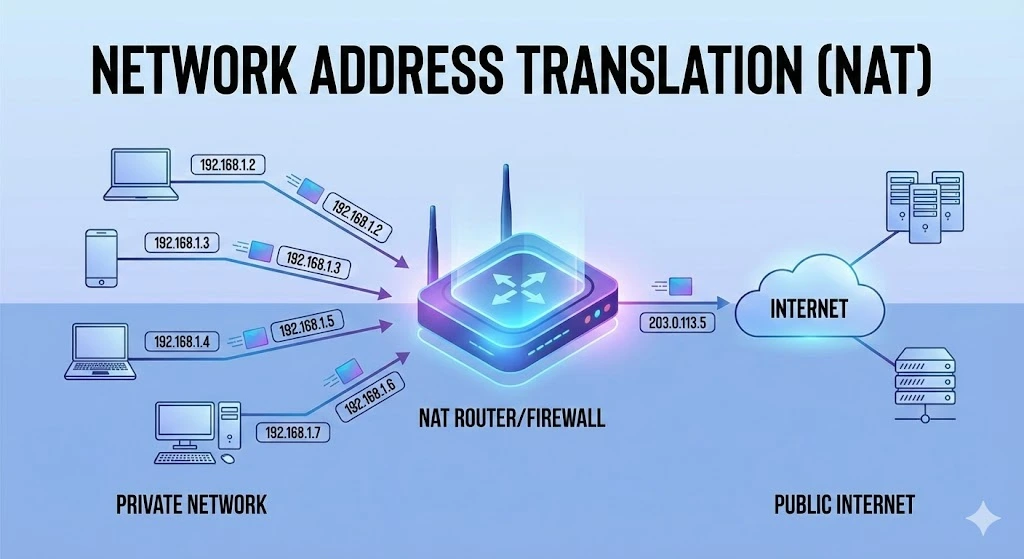
Comprensión de la traducción de direcciones de red (NAT)
En las redes informáticas, gestionar las direcciones IP de forma eficiente es fundamental para garantizar una comunicación fluida entre los dispositivos. Una de las tecnologías clave que ha surgido para afrontar este desafío es la Traducción de Direcciones de Red (NAT, por sus siglas en inglés). En este artículo explicamos qué es NAT, cómo funciona, sus distintos tipos, así como sus ventajas y limitaciones. ¿Qué es la traducción deRead more Related Posts Desbloqueando la privacidad digital con una red privada virtual (VPN) ¿Qué es una VPN? Una red privada virtual (VPN) es una tecnología que permite a los usuarios crear una conexión Comprensión de la traducción de direcciones de red (NAT) En las redes informáticas, gestionar las direcciones IP de forma eficiente es fundamental para garantizar una comunicación fluida entre los ¿Por qué Malasia se está convirtiendo en un centro neurálgico para la infraestructura de nube e IA? Malasia se está convirtiendo en uno de los mercados de crecimiento de centros de datos más importantes del Sudeste Asiático. .related-post {} .related-post .post-list { text-align: left; } .related-post .post-list .item { margin: 5px; padding: 10px; } .related-post .headline { font-size: 18px !important; color: #999999 !important; } .related-post .post-list .item .post_thumb { max-height: 220px; margin: 10px 0px; padding: 0px; display: block; } .related-post .post-list .item .post_title { font-size: 16px; color: #3f3f3f; margin: 10px 0px; padding: 0px; display: block; text-decoration: none; } .related-post .post-list .item .post_excerpt { font-size: 13px; color: #3f3f3f; margin: 10px 0px; padding: 0px; display: block; text-decoration: none; } @media only screen and (min-width: 1024px) { .related-post .post-list .item { width: 30%; } } @media only screen and (min-width: 768px) and (max-width: 1023px) { .related-post .post-list .item { width: 90%; } } @media only screen and (min-width: 0px) and (max-width: 767px) { .related-post .post-list .item { width: 90%; } }
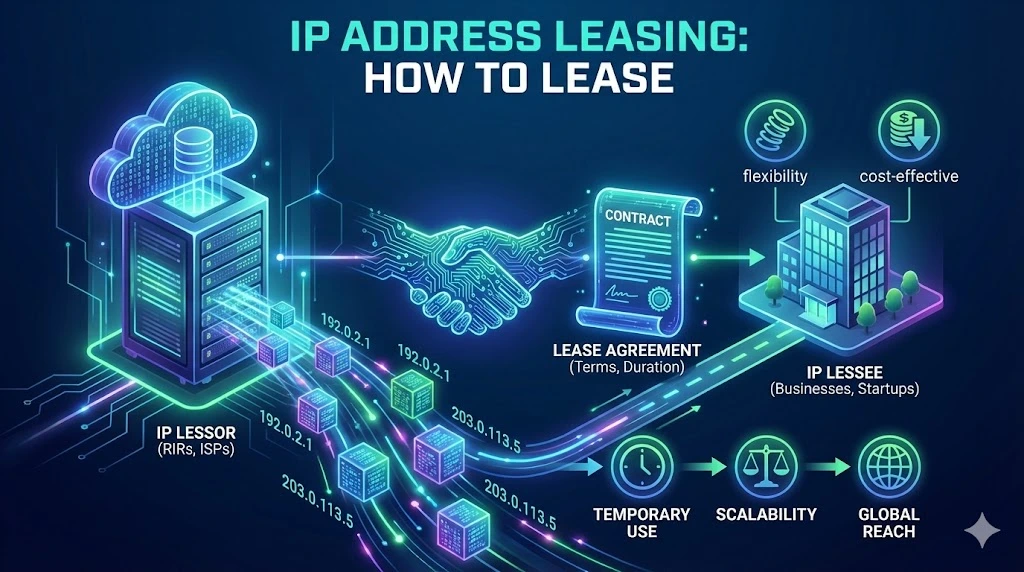
Arrendamiento de direcciones IP: Cómo arrendar direcciones IP
El mundo digital en el que nos movemos hoy depende en gran medida de las direcciones IP, identificadores únicos asignados a los dispositivos conectados a internet o a una red local. A medida que la demanda de direcciones IP sigue aumentando, empresas y particulares exploran diversas opciones para obtener los recursos necesarios. Un método cada vez más popular es el arrendamiento de direcciones IP. Este artículo profundiza en elRead more Related Posts Desbloqueando la privacidad digital con una red privada virtual (VPN) ¿Qué es una VPN? Una red privada virtual (VPN) es una tecnología que permite a los usuarios crear una conexión Comprensión de la traducción de direcciones de red (NAT) En las redes informáticas, gestionar las direcciones IP de forma eficiente es fundamental para garantizar una comunicación fluida entre los ¿Por qué Malasia se está convirtiendo en un centro neurálgico para la infraestructura de nube e IA? Malasia se está convirtiendo en uno de los mercados de crecimiento de centros de datos más importantes del Sudeste Asiático. .related-post {} .related-post .post-list { text-align: left; } .related-post .post-list .item { margin: 5px; padding: 10px; } .related-post .headline { font-size: 18px !important; color: #999999 !important; } .related-post .post-list .item .post_thumb { max-height: 220px; margin: 10px 0px; padding: 0px; display: block; } .related-post .post-list .item .post_title { font-size: 16px; color: #3f3f3f; margin: 10px 0px; padding: 0px; display: block; text-decoration: none; } .related-post .post-list .item .post_excerpt { font-size: 13px; color: #3f3f3f; margin: 10px 0px; padding: 0px; display: block; text-decoration: none; } @media only screen and (min-width: 1024px) { .related-post .post-list .item { width: 30%; } } @media only screen and (min-width: 768px) and (max-width: 1023px) { .related-post .post-list .item { width: 90%; } } @media only screen and (min-width: 0px) and (max-width: 767px) { .related-post .post-list .item { width: 90%; } }
¿Qué es el agotamiento de direcciones IPv4?
IPv4 es la versión inicial del Protocolo de Internet (IP), capaz de generar 4.300 millones de posibles direcciones IPv4. Sin embargo, muchas de estas direcciones están reservadas para fines específicos, como investigación y desarrollo. Esto deja un conjunto limitado disponible para organizaciones e individuos en todo el mundo. Con el crecimiento exponencial de Internet, la demanda de direcciones IPv4 se ha disparado. Esto provocó una rápida disminución de lasRead more Related Posts Desbloqueando la privacidad digital con una red privada virtual (VPN) ¿Qué es una VPN? Una red privada virtual (VPN) es una tecnología que permite a los usuarios crear una conexión Comprensión de la traducción de direcciones de red (NAT) En las redes informáticas, gestionar las direcciones IP de forma eficiente es fundamental para garantizar una comunicación fluida entre los Arrendamiento de direcciones IP: Cómo arrendar direcciones IP El mundo digital en el que nos movemos hoy depende en gran medida de las direcciones IP, identificadores únicos asignados .related-post {} .related-post .post-list { text-align: left; } .related-post .post-list .item { margin: 5px; padding: 10px; } .related-post .headline { font-size: 18px !important; color: #999999 !important; } .related-post .post-list .item .post_thumb { max-height: 220px; margin: 10px 0px; padding: 0px; display: block; } .related-post .post-list .item .post_title { font-size: 16px; color: #3f3f3f; margin: 10px 0px; padding: 0px; display: block; text-decoration: none; } .related-post .post-list .item .post_excerpt { font-size: 13px; color: #3f3f3f; margin: 10px 0px; padding: 0px; display: block; text-decoration: none; } @media only screen and (min-width: 1024px) { .related-post .post-list .item { width: 30%; } } @media only screen and (min-width: 768px) and (max-width: 1023px) { .related-post .post-list .item { width: 90%; } } @media only screen and (min-width: 0px) and (max-width: 767px) { .related-post .post-list .item { width: 90%; } }
