What Is IP Spoofing? How Forged Source Addresses Work and How Networks Defend Against Them
 Stephanie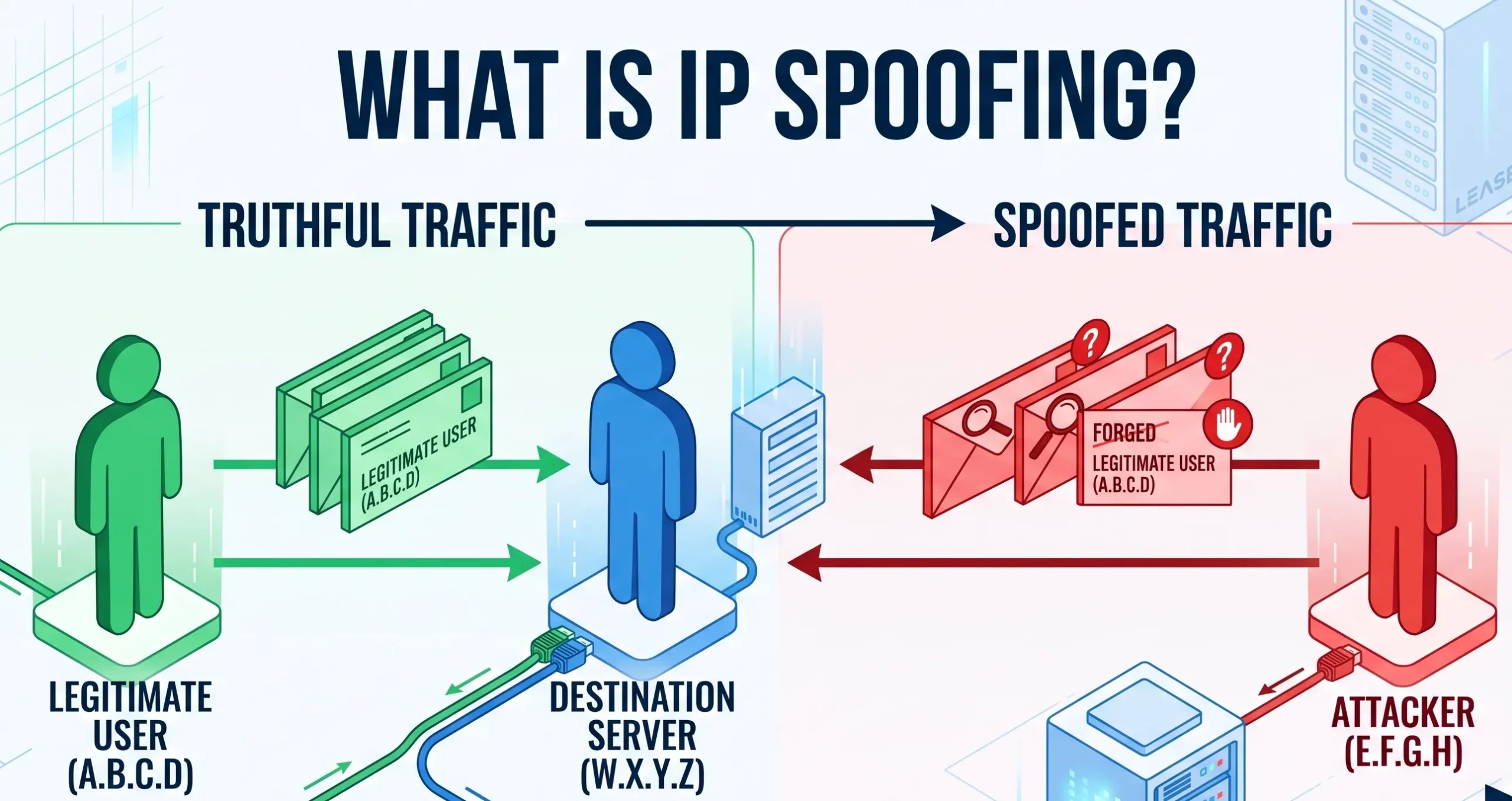
IP spoofing is the practice of sending Internet traffic with a forged source IP address, making packets appear to come from a different machine than the one that actually sent them. It exploits a foundational design fact of the Internet Protocol: routers forward packets based on the destination address and generally do not verify that the source address is genuine.
Table of Contents
Spoofing matters to businesses for two distinct reasons. First, it is the raw material of some of the largest attacks on the Internet — reflection and amplification DDoS attacks depend entirely on forged source addresses, and spoofed floods are harder to filter because they carry no honest return address. Second, and less discussed: your own address space can be the victim of spoofing without your network ever being touched. An attacker anywhere in the world can stamp your IP addresses onto malicious traffic, and the complaints, abuse reports, and reputation damage arrive at the addresses’ registered contacts — yours.
This article explains how spoofing works, the attacks it enables, how the industry defends against it at the network level, and what operators of public IPv4 space — owned or leased — should do about both directions of the problem: preventing spoofed traffic from leaving their networks, and responding when their addresses are impersonated elsewhere.
What Is IP Spoofing?
IP spoofing is the creation of IP packets whose source address field contains an address other than the sender’s real one. Every IP packet carries two addresses in its header: the destination (where it is going) and the source (where replies should be sent). The destination must be accurate for the packet to arrive; the source is simply a claim — and the core routing infrastructure of the Internet does not check it.
A postal analogy captures it exactly: spoofing is writing someone else’s return address on an envelope. The letter still gets delivered to the destination; the postal system never verifies the return address; and if the recipient replies, the reply goes to the innocent party whose address was borrowed.
Two clarifications keep the term precise:
- Spoofing forges packets, not registrations. The attacker’s packets claim your address; nothing changes in any registry, routing table, or DNS record. The forgery exists only inside the traffic itself.
- Spoofing is not the same as using a VPN or proxy. VPNs and proxies route traffic through an intermediary that legitimately holds its own addresses — the source addresses on that traffic are real, they just belong to the intermediary. Spoofing puts a false address directly into the packet header.
How Does IP Spoofing Work?
Spoofing works because packet headers are written by the sending machine, and networks that fail to filter outbound traffic will forward whatever source address that machine chooses. The mechanics, described at the conceptual level:
- The sending system constructs packets with a source address field set to the chosen false address — a capability that requires nothing exotic, only control of a machine on a network that does not validate outgoing sources.
- The packets travel to their destination normally, because forwarding decisions use only the destination address.
- Any replies the destination generates are sent to the forged source address — which means they go to the impersonated party, not the attacker.
That last point defines both the power and the limitation of spoofing. The attacker never sees the replies. Spoofing is therefore a one-way technique: superb for attacks that need no reply (floods) or that weaponize the reply itself (reflection), and largely useless for anything requiring a sustained two-way conversation.
The enabling condition is worth underlining because it locates the responsibility: spoofed packets can only enter the Internet through networks that do not check the source addresses of the traffic they emit. The Internet’s spoofing problem is, concretely, the sum of networks that skip this check — which is why the main defenses (below) target the network edge rather than the victim.
IP Spoofing vs BGP Hijacking: Two Different Forgeries
Spoofing forges the source address inside individual packets; BGP hijacking forges a routing announcement that redirects traffic for a whole prefix. They are frequently confused because both involve “using addresses that aren’t yours,” but they operate at different layers with different consequences:
| Aspect | IP spoofing | BGP hijacking |
|---|---|---|
| What is forged | The source field in packet headers | A route announcement claiming a prefix |
| Layer | Data plane (individual packets) | Control plane (routing system) |
| Effect on traffic | Outbound packets carry a false identity; inbound traffic to the real holder is unaffected | Traffic destined for the prefix is redirected to the hijacker |
| Can the attacker receive replies? | No — replies go to the impersonated address | Yes — that is the point of the hijack |
| Primary defense | Source address validation at network edges (BCP 38, uRPF) | RPKI origin validation, route filtering, monitoring |
Both threats concern anyone responsible for public address space, but they are countered by different mechanisms and detected by different signals. Hijacking risk — including its elevated form during address transfers — is covered in our guide to preventing IPv4 hijacking during a transfer; the rest of this article stays with the packet-level forgery.
What Attacks Does IP Spoofing Enable?
Spoofing’s main uses are hiding the origin of floods, reflecting attacks off innocent servers, and exploiting systems that trust source addresses as identity.
1. Anonymized flood attacks
In direct DDoS floods, spoofed and randomized source addresses serve two purposes: they conceal the true attacking machines, and they defeat simple source-based blocking — the defender cannot filter by sender when every packet claims a different sender. SYN floods, one of the classic protocol attacks covered in our overview of DDoS attack types, traditionally rely on spoofed sources so the half-open connections they create can never be completed or traced.
2. Reflection and amplification attacks
This is spoofing’s most destructive application. The attacker sends requests to legitimate public servers — commonly open DNS resolvers, NTP servers, or other UDP services — with the source address forged to be the victim’s address. Each server dutifully sends its reply to the victim. Because replies for these protocols can be many times larger than requests, the attacker’s bandwidth is multiplied: modest request traffic becomes a massive flood arriving at the victim from hundreds of respectable servers. The victim sees an attack coming from legitimate infrastructure; the reflectors see normal-looking queries; the actual attacker appears nowhere in either party’s traffic. Reflection attacks are impossible without spoofing — which is why source validation is treated as Internet-wide hygiene rather than a private precaution, and why UDP-based amplification features prominently in the mitigation architectures described in our guide to DDoS mitigation.
3. Exploiting address-based trust
Any system that grants access based purely on source IP address — legacy allowlists, some internal service configurations, poorly designed APIs — is structurally vulnerable to a forged source claiming a trusted address. Modern security practice treats a source address as a routing artifact, not an identity: useful as one signal, never sufficient as authentication. This principle is a core motivation behind zero-trust architectures.
4. Evasion and probe obfuscation
Spoofed sources are also used to muddy reconnaissance — burying real scanning activity among decoy sources — and to plant false trails in logs, complicating investigation and attribution.
What Spoofing Cannot Do
A defensively useful section, because overestimating spoofing leads to misdirected worry:
- Spoofing cannot intercept your traffic. Forging your address on outbound packets does not redirect anything destined to your address. Traffic redirection requires a routing-layer attack (hijacking), not spoofing.
- Spoofing cannot sustain modern encrypted sessions. TCP’s handshake requires receiving replies the spoofer never sees, and TLS authentication operates far above the IP layer. An attacker cannot “log in as your server” by spoofing its address.
- Spoofing does not alter registry or DNS records. Your registration, your ROAs, your reverse DNS — none of it is touched. The forgery lives and dies inside the attacker’s packets.
In short: spoofing is an impersonation of your addresses in transit, not a seizure of them. The damage it does to the impersonated party is reputational and administrative — which, as the next sections show, is damage enough.
How Networks Defend Against IP Spoofing
The primary defense is source address validation at the network edge: networks should refuse to emit packets whose source addresses don’t belong to them, and refuse to accept packets that arrive from impossible directions. The main mechanisms:
Ingress filtering — BCP 38
The Internet’s standard anti-spoofing practice, documented as BCP 38 (RFC 2827), asks every network to filter traffic at its edges so that packets leaving the network carry only source addresses the network legitimately holds. If universally deployed, spoofed packets could never enter the Internet at all. Deployment is broad but incomplete — measurement projects that test spoofability continue to find networks that permit it — which is why spoofed attacks persist and why participation is considered a mark of responsible operation. The obligation is notably asymmetric: implementing BCP 38 protects other networks from your customers, not you from attackers. It is Internet citizenship, enforced increasingly by peer expectation and, in some regions, regulatory attention.
Unicast Reverse Path Forwarding (uRPF)
uRPF is the router feature that automates source validation: for each arriving packet, the router checks whether the source address is reachable back through the interface it arrived on (strict mode) or exists in the routing table at all (loose mode). Packets failing the check are dropped. Strict mode suits network edges with symmetric routing — customer connections, server LANs — while loose mode serves multihomed environments where strict checking would discard legitimate asymmetric traffic.
Provider and IX filtering
Transit providers and Internet exchanges increasingly validate that customer and member traffic uses only address space those parties are authorized to announce — tying data-plane filtering to the same authorization records (IRR objects, RPKI) that govern route acceptance. This is the connective tissue between anti-spoofing and routing security: the cleaner a network’s registered authorization data, the more precisely its traffic can be validated.
Protocol- and host-level measures
Above the network layer: modern TCP stacks randomize sequence numbers (closing the classic blind-injection attacks of earlier decades), SYN cookies blunt spoofed SYN floods, and — most importantly — authentication is designed to never rely on source address alone. Cryptographic identity (TLS, mutual authentication, signed tokens) is indifferent to what the IP header claims.
When Your IP Addresses Are the Ones Being Spoofed
If attackers stamp your addresses onto their traffic, the operational consequences arrive at your abuse desk and your reputation profile — even though no packet ever crossed your network. The typical symptoms:
- Abuse complaints for traffic you never sent. Victims and automated systems look up the source address’s registered contacts and complain there. Backscatter — the replies that reflection victims and scanned hosts send to the forged source — can also arrive at your addresses as unexplained inbound traffic.
- Reputation damage. Blocklist operators and reputation systems ingest reports keyed to source addresses. Persistent spoofed abuse citing your space can degrade the standing of addresses that did nothing, with consequences for deliverability and acceptance described in our guide to IP address reputation.
What a responsible operator does about it:
- Prove the traffic did not originate from you. Your own flow records and edge filtering logs demonstrate that the reported traffic never left your network. This is the core evidence for disputing listings and answering complaints — and it exists only if you keep such records.
- Respond to abuse reports rather than ignoring them. A documented “these packets were spoofed; here is our egress filtering posture” response protects reputation; silence reads as guilt to listing operators.
- Demonstrate your own hygiene. A network that visibly implements BCP 38 and keeps clean, verifiable registration data is far more credible when claiming impersonation than one that cannot show its own house is in order.
- Escalate patterns. Sustained spoofed abuse of your space is worth reporting to upstream providers and, where relevant, to the reflector operators involved — the parties actually positioned to trace and filter it.
What This Means for Operators of Public IPv4 Space
For any business running public services on its own or leased IPv4 space, spoofing translates into three standing responsibilities.
First, egress hygiene. Filter outbound traffic so only your legitimate source addresses leave your network — at your edge routers, and contractually downstream if you have customers of your own. This is what keeps your network from becoming a spoofing launchpad if a host is compromised, and it is increasingly expected by upstreams and exchanges as a condition of good standing.
Second, don’t run open reflectors. Publicly answering DNS resolvers, unrestricted NTP, and similar open UDP services on your addresses are the raw material of amplification attacks. Auditing your space for them protects both the Internet and your own reputation, since reflector participation generates exactly the abuse reports described above.
Third, keep your paper trail clean — and this is where address governance meets security. Accurate registration records, working abuse contacts, aligned IRR and RPKI data: these determine whether you can credibly dispute spoofed-abuse reports, whether providers can validate your traffic precisely, and whether your addresses’ reputation can be defended at all. For leased space, this responsibility is shared across the lease relationship, and it belongs on the pre-lease verification list: who receives abuse reports for the block, how are they relayed, and how quickly can records be corrected? A structured arrangement — the kind a IPv4 leasing platform should provide — answers these questions in writing; an informal one leaves the lessee defending reputation with no records and no standing. The same diligence applies to blocks you acquire outright: a block’s spoofing-related abuse history is part of the reputation you inherit, which is one more reason pre-acquisition checks matter whether you lease or Buy IPv4 addresses.
Practical Checklist
- Implement egress source-address filtering (BCP 38) at every network edge you control.
- Enable uRPF on customer-facing and server-facing interfaces — strict mode where routing is symmetric, loose mode where it is not.
- Audit your address space for open reflectors: open resolvers, unrestricted NTP, and other openly answering UDP services.
- Keep flow records or equivalent logs sufficient to prove what traffic did and did not originate from your network.
- Ensure abuse contacts for all your address space are registered, monitored, and answered — including a clear relay path for leased blocks.
- Never use source IP address as sole authentication for anything; treat it as one signal among several.
- Keep IRR objects and RPKI data aligned with reality, so providers can validate your traffic and announcements precisely.
- When leasing or acquiring space, verify abuse-handling responsibilities and the block’s abuse history before committing.
Practical Note from i.lease
Spoofing produces a category of problem that surprises many operators: reputation damage with no incident. Nothing was breached, no traffic crossed your network, no configuration was wrong — yet complaints accumulate against your addresses and a blocklist entry appears, because someone on the far side of the world found it convenient to borrow your numbers. The operators who weather this well all share the same preparation: they can prove a negative. Egress filtering posture documented, flow records retained, abuse contacts responsive, registration data clean. With that file, a spoofed-abuse dispute is a routine exchange; without it, you are asking reputation systems to take your word.
This is, at bottom, the same lesson that runs through routing security, deployment, and DDoS readiness: the value of public IPv4 space depends not only on the addresses but on the governance around them — who answers for them, what records support them, and how fast problems can be corrected. That governance is worth verifying before space enters production, whichever way you source it.
Final Thoughts
IP spoofing exists because the Internet forwards packets on the destination address and takes the source address on faith. That single design fact makes possible anonymized floods, reflection attacks that turn legitimate servers into weapons, and impersonation of address space whose real holders never see the forged traffic. The defenses are correspondingly structural: source validation at network edges (BCP 38 and uRPF) to stop forged packets at their origin, refusal to treat source addresses as identity, and the elimination of open reflectors that give spoofed requests their amplification.
For businesses operating public IPv4 space, the takeaway is double-sided. Outbound, egress filtering is now a baseline expectation of responsible operation — protection you owe the Internet rather than yourself. Inbound, your addresses can be impersonated by anyone, anywhere, at any time, and the defense of their reputation rests on records: proof of what your network did and did not send, working abuse contacts, and clean registration data. Spoofing cannot take your addresses from you — but without that preparation, it can quietly take their good name, which for production infrastructure is much the same loss.
Frequently Asked Questions
What is IP spoofing in simple terms?
IP spoofing is sending Internet traffic with a fake “from” address — like mailing a letter with someone else’s return address. The traffic reaches its destination normally, but it appears to come from a machine that never sent it.
Why is IP spoofing possible?
Because the Internet Protocol forwards packets using only the destination address and does not verify the source address. Spoofed packets enter the Internet through networks that fail to check the source addresses of their outgoing traffic.
Is IP spoofing illegal?
Using spoofing to attack, defraud, or gain unauthorized access is illegal in most jurisdictions under computer misuse and fraud laws. There are narrow legitimate uses in authorized security testing and certain load-testing and load-balancing configurations within networks one controls.
Is using a VPN the same as IP spoofing?
No. A VPN routes your traffic through a server that legitimately holds its own IP addresses — the source addresses are real, they just belong to the VPN provider. Spoofing writes a false address directly into the packet header.
What is the difference between IP spoofing and BGP hijacking?
Spoofing forges the source field inside individual packets; hijacking forges a routing announcement that redirects traffic for an entire prefix. Spoofing cannot intercept traffic destined to the real holder — hijacking can, which is what makes it the more severe routing-layer threat.
How do reflection DDoS attacks use spoofing?
The attacker sends requests to legitimate servers with the source address forged as the victim’s, so every server sends its — often much larger — reply to the victim. The attack is impossible without spoofing, which is why source validation is treated as Internet-wide hygiene.
What is BCP 38?
BCP 38 (RFC 2827) is the Internet best practice of ingress filtering: networks should ensure traffic leaving them carries only source addresses they legitimately hold, preventing spoofed packets from entering the Internet at their edge.
What is uRPF?
Unicast Reverse Path Forwarding is a router feature that validates source addresses automatically: packets are dropped if their claimed source is not reachable back through the arrival interface (strict mode) or absent from the routing table entirely (loose mode).
Can someone spoof my IP address without accessing my network?
Yes. Spoofing requires no access to the impersonated network at all — only a machine on some poorly filtered network elsewhere. Your addresses can appear as the source of traffic you never sent, which is why abuse-report handling and traffic records matter for defending their reputation.
Can IP spoofing be detected?
Individual spoofed packets are hard for the destination to identify with certainty, but networks detect spoofing structurally: uRPF checks catch impossible sources at forwarding time, flow records reveal traffic claiming addresses that never transited the network, and backscatter patterns expose reflection campaigns.
Does spoofing affect leased IP addresses differently?
The mechanics are identical, but responsibility is shared: abuse reports for a leased block may reach the registered holder rather than the lessee, so the lease should define how reports are relayed and who responds. This should be confirmed before leasing, alongside reputation and routing checks.
Also Read
Artículos relacionados
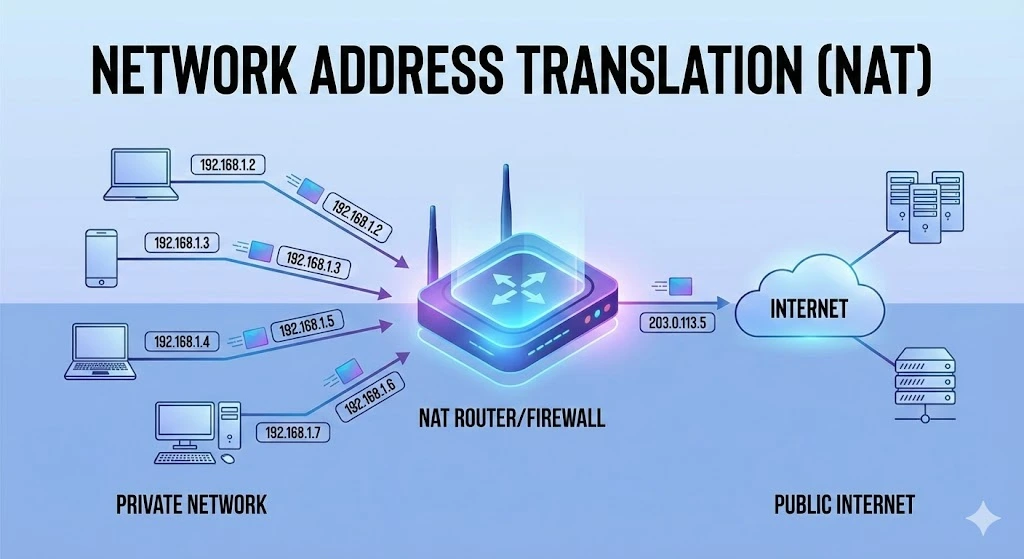
Comprensión de la traducción de direcciones de red (NAT)
En las redes informáticas, gestionar las direcciones IP de forma eficiente es fundamental para garantizar una comunicación fluida entre los dispositivos. Una de las tecnologías clave que ha surgido para afrontar este desafío es la Traducción de Direcciones de Red (NAT, por sus siglas en inglés). En este artículo explicamos qué es NAT, cómo funciona, sus distintos tipos, así como sus ventajas y limitaciones. ¿Qué es la traducción deRead more Related Posts Desbloqueando la privacidad digital con una red privada virtual (VPN) ¿Qué es una VPN? Una red privada virtual (VPN) es una tecnología que permite a los usuarios crear una conexión Comprensión de la traducción de direcciones de red (NAT) En las redes informáticas, gestionar las direcciones IP de forma eficiente es fundamental para garantizar una comunicación fluida entre los ¿Por qué Malasia se está convirtiendo en un centro neurálgico para la infraestructura de nube e IA? Malasia se está convirtiendo en uno de los mercados de crecimiento de centros de datos más importantes del Sudeste Asiático. .related-post {} .related-post .post-list { text-align: left; } .related-post .post-list .item { margin: 5px; padding: 10px; } .related-post .headline { font-size: 18px !important; color: #999999 !important; } .related-post .post-list .item .post_thumb { max-height: 220px; margin: 10px 0px; padding: 0px; display: block; } .related-post .post-list .item .post_title { font-size: 16px; color: #3f3f3f; margin: 10px 0px; padding: 0px; display: block; text-decoration: none; } .related-post .post-list .item .post_excerpt { font-size: 13px; color: #3f3f3f; margin: 10px 0px; padding: 0px; display: block; text-decoration: none; } @media only screen and (min-width: 1024px) { .related-post .post-list .item { width: 30%; } } @media only screen and (min-width: 768px) and (max-width: 1023px) { .related-post .post-list .item { width: 90%; } } @media only screen and (min-width: 0px) and (max-width: 767px) { .related-post .post-list .item { width: 90%; } }
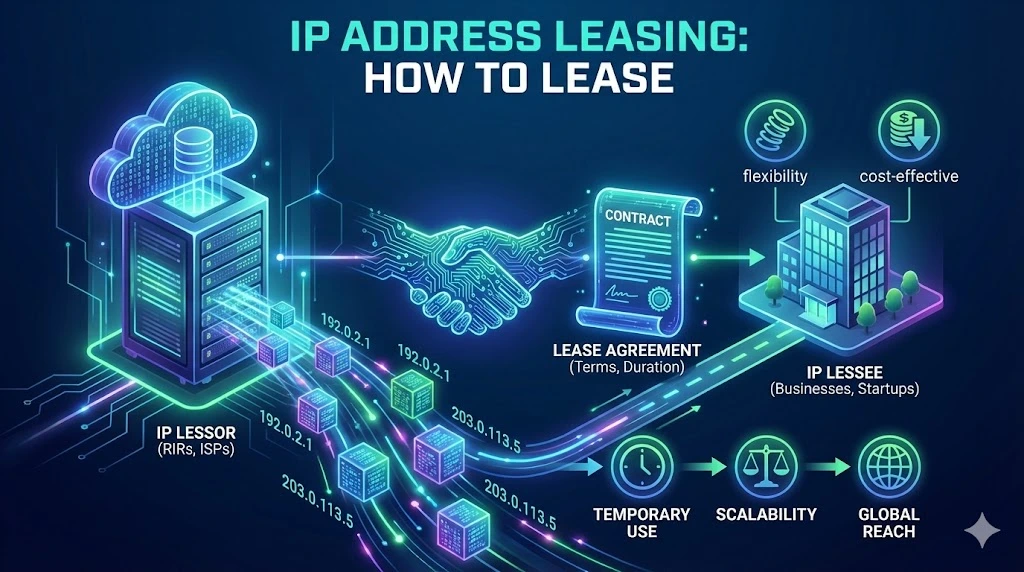
Arrendamiento de direcciones IP: Cómo arrendar direcciones IP
El mundo digital en el que nos movemos hoy depende en gran medida de las direcciones IP, identificadores únicos asignados a los dispositivos conectados a internet o a una red local. A medida que la demanda de direcciones IP sigue aumentando, empresas y particulares exploran diversas opciones para obtener los recursos necesarios. Un método cada vez más popular es el arrendamiento de direcciones IP. Este artículo profundiza en elRead more Related Posts Desbloqueando la privacidad digital con una red privada virtual (VPN) ¿Qué es una VPN? Una red privada virtual (VPN) es una tecnología que permite a los usuarios crear una conexión Comprensión de la traducción de direcciones de red (NAT) En las redes informáticas, gestionar las direcciones IP de forma eficiente es fundamental para garantizar una comunicación fluida entre los ¿Por qué Malasia se está convirtiendo en un centro neurálgico para la infraestructura de nube e IA? Malasia se está convirtiendo en uno de los mercados de crecimiento de centros de datos más importantes del Sudeste Asiático. .related-post {} .related-post .post-list { text-align: left; } .related-post .post-list .item { margin: 5px; padding: 10px; } .related-post .headline { font-size: 18px !important; color: #999999 !important; } .related-post .post-list .item .post_thumb { max-height: 220px; margin: 10px 0px; padding: 0px; display: block; } .related-post .post-list .item .post_title { font-size: 16px; color: #3f3f3f; margin: 10px 0px; padding: 0px; display: block; text-decoration: none; } .related-post .post-list .item .post_excerpt { font-size: 13px; color: #3f3f3f; margin: 10px 0px; padding: 0px; display: block; text-decoration: none; } @media only screen and (min-width: 1024px) { .related-post .post-list .item { width: 30%; } } @media only screen and (min-width: 768px) and (max-width: 1023px) { .related-post .post-list .item { width: 90%; } } @media only screen and (min-width: 0px) and (max-width: 767px) { .related-post .post-list .item { width: 90%; } }
¿Qué es el agotamiento de direcciones IPv4?
IPv4 es la versión inicial del Protocolo de Internet (IP), capaz de generar 4.300 millones de posibles direcciones IPv4. Sin embargo, muchas de estas direcciones están reservadas para fines específicos, como investigación y desarrollo. Esto deja un conjunto limitado disponible para organizaciones e individuos en todo el mundo. Con el crecimiento exponencial de Internet, la demanda de direcciones IPv4 se ha disparado. Esto provocó una rápida disminución de lasRead more Related Posts Desbloqueando la privacidad digital con una red privada virtual (VPN) ¿Qué es una VPN? Una red privada virtual (VPN) es una tecnología que permite a los usuarios crear una conexión Comprensión de la traducción de direcciones de red (NAT) En las redes informáticas, gestionar las direcciones IP de forma eficiente es fundamental para garantizar una comunicación fluida entre los Arrendamiento de direcciones IP: Cómo arrendar direcciones IP El mundo digital en el que nos movemos hoy depende en gran medida de las direcciones IP, identificadores únicos asignados .related-post {} .related-post .post-list { text-align: left; } .related-post .post-list .item { margin: 5px; padding: 10px; } .related-post .headline { font-size: 18px !important; color: #999999 !important; } .related-post .post-list .item .post_thumb { max-height: 220px; margin: 10px 0px; padding: 0px; display: block; } .related-post .post-list .item .post_title { font-size: 16px; color: #3f3f3f; margin: 10px 0px; padding: 0px; display: block; text-decoration: none; } .related-post .post-list .item .post_excerpt { font-size: 13px; color: #3f3f3f; margin: 10px 0px; padding: 0px; display: block; text-decoration: none; } @media only screen and (min-width: 1024px) { .related-post .post-list .item { width: 30%; } } @media only screen and (min-width: 768px) and (max-width: 1023px) { .related-post .post-list .item { width: 90%; } } @media only screen and (min-width: 0px) and (max-width: 767px) { .related-post .post-list .item { width: 90%; } }
