Risques liés au renouvellement d’IPv4 : quand le manque de responsabilisation se transforme en trahison du code en cours d’exécution
 Stephanie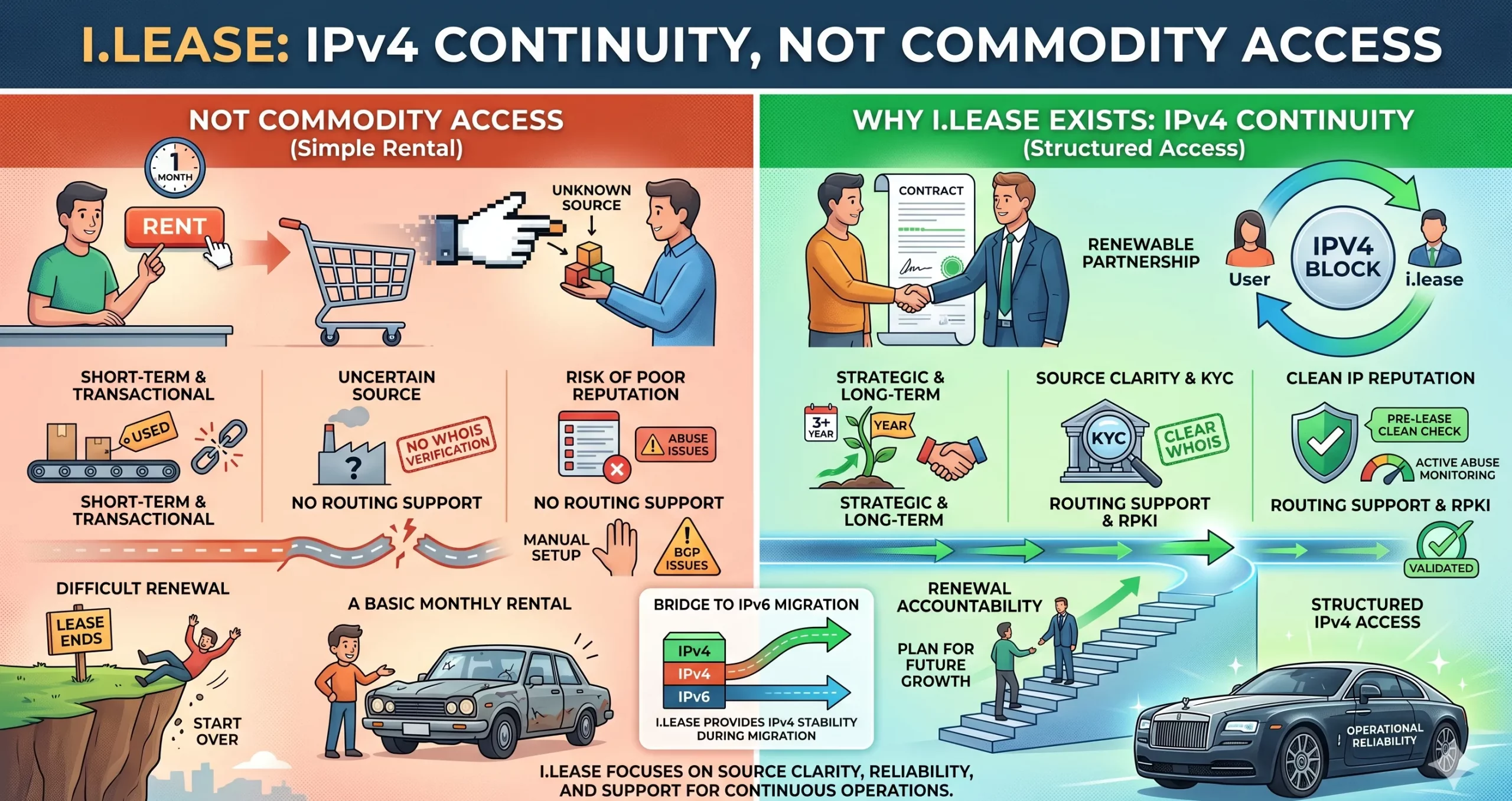
La plupart des entreprises entrent sur le marché IPv4 avec un objectif simple.
Table of Contents
Elles ont besoin d’adresses.
Peut-être en ont-elles besoin pour l’hébergement. Peut-être en ont-elles besoin pour une infrastructure VPN. Peut-être en ont-elles besoin pour des services cloud, des plateformes SaaS, l’expansion télécom, des systèmes e-mail, des outils de cybersécurité ou des applications destinées aux clients.
Elles recherchent donc un fournisseur IPv4.
Elles comparent les prix. Elles vérifient les tailles de blocs. Elles demandent à quelle vitesse la livraison peut avoir lieu. Elles cherchent un vendeur, un courtier ou une plateforme de location capable de fournir le nombre d’adresses dont elles ont besoin.
Cette approche est compréhensible.
Mais elle est incomplète.
Parce que l’accès IPv4 n’est pas seulement un problème d’approvisionnement.
C’est un problème de continuité.
Une entreprise n’a pas seulement besoin qu’un bloc IPv4 existe. Elle a besoin que ce bloc reste utilisable, routable, documenté, renouvelable, sûr sur le plan de la réputation et stable sur le plan opérationnel après que les services ont déjà été construits dessus.
C’est pourquoi i.lease existe.
i.lease ne consiste pas seulement à trouver des adresses IPv4. Il s’agit d’aider les entreprises à éviter les structures IPv4 faibles où le client paie pour l’accès, mais absorbe encore le risque lorsque des problèmes de routage, de renouvellement, de documentation, de réputation ou de chaîne de fournisseurs apparaissent.
C’est le sens commercial pratique de Double Extraction : le client paie pour l’accès IPv4, mais supporte encore les conséquences opérationnelles si la structure derrière cet accès échoue.
Pour les utilisateurs IPv4, cette distinction compte.
Le jeu court traite l’IPv4 comme un inventaire.
Le jeu long traite l’IPv4 comme une infrastructure de continuité.
Un fournisseur IPv4 ordinaire peut ne répondre qu’à une seule question :
Pouvons-nous fournir les adresses ?
Mais une entreprise sérieuse doit poser davantage de questions :
Les adresses peuvent-elles être routées ? La source peut-elle être expliquée ? Le bail peut-il être renouvelé ? Le fournisseur peut-il soutenir la documentation ? Les rapports d’abus peuvent-ils être traités ? Les problèmes de réputation peuvent-ils être vérifiés ? Le client peut-il continuer à fonctionner si quelque chose tourne mal ?
L’accès IPv4 devient dangereux lorsque l’entreprise reçoit un bloc mais ne comprend pas la structure qui se trouve derrière.
Un fournisseur peut avoir une relation commerciale avec le client, mais la source réelle peut se situer en amont. Un courtier peut organiser l’accès, mais une autre partie peut contrôler le renouvellement. Un vendeur peut promettre la livraison, mais le support de routage peut dépendre d’un tiers. Un bail peut sembler stable aujourd’hui, mais le chemin documentaire peut être flou lorsque le renouvellement arrive.
C’est pourquoi un simple accès ordinaire ne suffit pas.
Pour une infrastructure d’entreprise, l’IPv4 doit être traité comme une couche de continuité.
Ce qui différencie l’IPv4 d’un inventaire numérique ordinaire
Les adresses IPv4 ne sont pas des produits numériques ordinaires.
Elles ne sont pas comme des licences logicielles qui peuvent simplement être remplacées du jour au lendemain. Elles ne sont pas comme des instances cloud qui peuvent toujours être recréées en quelques clics. Elles ne sont pas comme des identifiants de compte temporaires qui peuvent être changés sans impact opérationnel.
Les adresses IPv4 peuvent devenir une partie de l’identité d’infrastructure d’une entreprise.
Une seule plage IPv4 peut soutenir :
- serveurs de production
- passerelles VPN
- listes d’autorisation client
- enregistrements DNS
- réputation e-mail
- plateformes SaaS
- systèmes de contrôle de fraude
- services télécoms
- clients d’hébergement
- points de terminaison API
- infrastructure d’accès à distance
- systèmes de surveillance de sécurité
Une fois que les clients, pare-feu, applications, systèmes de messagerie et politiques de routage sont construits autour de ces adresses, les remplacer peut devenir difficile.
C’est pourquoi l’IPv4 ne devrait pas être traité comme une marchandise jetable.
C’est une infrastructure opérationnelle.
Le risque caché dans les chaînes de fournisseurs IPv4 faibles
Le plus grand risque IPv4 n’est pas toujours visible au début.
Au départ, tout peut sembler simple.
Le fournisseur envoie un devis. Le client signe un accord. Le bloc IPv4 est attribué. Le service commence. Le réseau est mis en production.
Le risque apparaît plus tard.
Il apparaît lorsque le renouvellement doit être confirmé. Il apparaît lorsqu’une autorisation de routage est nécessaire. Il apparaît lorsqu’une partie en amont tarde. Il apparaît lorsque la gestion des abus devient urgente. Il apparaît lorsqu’un client demande de la documentation. Il apparaît lorsque la réputation IP n’est pas propre. Il apparaît lorsque le fournisseur ne peut pas expliquer qui contrôle la source.
C’est le risque de chaîne de fournisseurs.
Le client peut croire qu’il a un seul fournisseur IPv4. En réalité, la chaîne peut impliquer plusieurs parties : courtier, détenteur en amont, compte de registre, support de routage, contact d’abus, émetteur de documentation et autorité de renouvellement.
Si le client ne sait pas qui contrôle quoi, il peut ne découvrir la faiblesse que lorsque le réseau dépend déjà des adresses.
C’est pourquoi i.lease se concentre sur la structure, et pas seulement sur l’approvisionnement.
Double Extraction : payer pour l’IPv4 tout en absorbant le risque
C’est ici que Double Extraction devient un problème commercial pratique.
Double Extraction se produit lorsque le client paie pour l’accès IPv4, mais supporte encore le véritable désavantage lorsque la structure située au-dessus de l’espace d’adressage échoue.
Dans un modèle d’approvisionnement IPv4 faible, le client peut payer les frais mensuels de location ou le prix d’achat, tout en absorbant encore :
- temps d’arrêt
- migration d’urgence
- déploiement retardé
- perturbation du routage
- charge de travail d’ingénierie
- nettoyage de réputation
- plaintes clients
- examen de conformité
- pression contractuelle
- incertitude sur le renouvellement
- incertitude sur la documentation
Le fournisseur encaisse les frais.
Le client supporte la perturbation.
C’est la version commerciale de Double Extraction.
Il ne s’agit pas seulement de l’argent payé à l’avance. Il s’agit de savoir qui supporte la conséquence lorsque le bloc d’adresses devient difficile à utiliser.
Une location IPv4 bon marché peut devenir coûteuse si le client doit ensuite payer en travail d’urgence, en préjudice client, en temps d’arrêt ou en coût de remplacement.
Un accord IPv4 rapide peut devenir lent si le support de routage ou de documentation est absent.
Un arrangement par courtier peut devenir fragile si personne ne possède clairement la responsabilité du renouvellement.
La vraie question n’est pas :
Combien coûte ce bloc IPv4 ?
La meilleure question est :
Qui supporte le risque lorsque la structure IPv4 est mise à l’épreuve ?
Pourquoi la continuité compte après le déploiement
La continuité IPv4 compte surtout après le déploiement.
Avant le déploiement, l’entreprise a encore des options.
Elle peut comparer les fournisseurs. Elle peut retarder la sélection. Elle peut négocier. Elle peut demander des documents. Elle peut choisir une autre source.
Après le déploiement, la situation change.
Les clients peuvent déjà être connectés. Les applications peuvent déjà être configurées. Le DNS peut déjà pointer vers les adresses. Les pare-feu peuvent déjà les avoir mises en liste d’autorisation. La réputation e-mail peut déjà être en phase de montée en confiance. Les systèmes de surveillance peuvent déjà en dépendre. Les obligations contractuelles peuvent déjà supposer un accès stable.
À ce stade, le coût du changement devient plus élevé.
C’est pourquoi la continuité doit être vérifiée avant le déploiement, et non après la première perturbation.
Une structure IPv4 fiable devrait répondre à ces questions :
- Comment le bloc d’adresses restera-t-il utilisable ?
- Qui soutient le routage ?
- Qui confirme le renouvellement ?
- Qui gère la documentation ?
- Qui répond aux problèmes d’abus ?
- Qui soutient les problèmes de réputation ?
- Qui escalade si la chaîne de fournisseurs échoue ?
Sans ces réponses, le client peut construire des services critiques sur un terrain fragile.
Pourquoi i.lease se concentre sur la clarté de la source
La clarté de la source est l’un des premiers signes d’un fournisseur IPv4 sérieux.
Une entreprise devrait comprendre d’où vient le bloc IPv4 et qui a l’autorité pour le louer, le router ou le transférer.
Cela ne signifie pas que chaque détail interne doit être exposé publiquement. Mais un client professionnel ne devrait pas se retrouver avec des réponses vagues.
La clarté de la source aide à réduire :
- incertitude de renouvellement
- retard de routage
- lacunes documentaires
- dépendance en amont
- confusion de transfert
- ambiguïté dans la gestion des abus
- risque de chaîne de fournisseurs
Si le fournisseur ne peut pas expliquer la structure assez clairement pour un examen commercial, le client devrait considérer cela comme un signal d’alerte.
La clarté de la source n’est pas de la paperasse pour la paperasse.
C’est le fondement de la continuité.
Pourquoi le support de routage est une exigence commerciale
Les adresses IPv4 n’ont de valeur que si elles peuvent être utilisées.
Pour la plupart des cas d’usage professionnels, cela signifie que les adresses doivent être routables de manière stable et prévisible.
Le support de routage peut inclure :
- planification d’annonce BGP
- création d’objets de route
- support LOA lorsque cela s’applique
- coordination liée à ROA ou RPKI lorsque cela s’applique
- acceptation par le fournisseur en amont
- planification DNS inverse
- planification de géolocalisation
- surveillance du routage
- escalade technique
Un fournisseur qui fournit seulement des adresses mais ne peut pas soutenir le routage expose le client au risque.
Le client peut avoir le bloc, mais pas de chemin clair pour l’utiliser.
Ce n’est pas de la continuité.
C’est un inventaire sans preuve opérationnelle.
Pourquoi la responsabilité du renouvellement ne peut pas être une réflexion après coup
La location IPv4 ne se termine pas lorsque les adresses sont livrées.
Le vrai test est de savoir si l’accès reste stable dans le temps.
La responsabilité du renouvellement compte parce que les entreprises construisent souvent des services de longue durée autour d’adresses IPv4 louées.
Un fournisseur IPv4 sérieux devrait clarifier les responsabilités de renouvellement :
- Quand le renouvellement doit-il être confirmé ?
- Qui contrôle le processus de renouvellement ?
- Que se passe-t-il si une source en amont tarde ?
- Quel préavis le client recevra-t-il ?
- L’autorisation de routage continue-t-elle pendant le renouvellement ?
- Que se passe-t-il si le client doit prolonger ?
- Qui gère les mises à jour de documentation ?
Sans responsabilité de renouvellement, le client peut ne pas savoir si l’accès IPv4 stable d’aujourd’hui restera stable demain.
Pour une infrastructure destinée aux clients, cette incertitude est un risque commercial.
Pourquoi la réputation IP affecte l’utilisabilité réelle
Un bloc peut être techniquement disponible et rester commercialement faible.
La réputation IP affecte la possibilité d’utiliser la plage d’adresses sans difficulté pour :
- livraison d’e-mails
- hébergement
- plateformes SaaS
- services VPN
- outils de sécurité
- intégration des clients
- systèmes de contrôle de fraude
- accès d’entreprise
Si une plage d’adresses a un historique d’abus, des traces de spam, des problèmes de liste noire, des abus de proxy, une association à des malwares ou des plaintes répétées, le client peut rencontrer des problèmes après le déploiement.
Un bloc IPv4 bon marché avec une mauvaise réputation peut nécessiter un nettoyage coûteux.
Un fournisseur devrait aider le client à comprendre l’état de réputation avant que le client construise des services autour du bloc.
C’est une autre raison pour laquelle l’IPv4 ne devrait pas être jugé uniquement par le prix.
Le prix le plus bas peut cacher le coût opérationnel le plus élevé.
Louer, acheter ou vendre : pourquoi la structure compte plus que les étiquettes
De nombreuses entreprises se demandent si elles devraient louer ou acheter de l’IPv4.
C’est une question utile.
Mais ce n’est pas la première question.
La première question est de savoir si la structure soutient la continuité.
La location peut convenir lorsque l’entreprise a besoin de flexibilité, d’un accès plus rapide, d’un coût initial plus faible ou d’une capacité temporaire.
L’achat peut convenir lorsque l’entreprise a besoin d’un contrôle à long terme et dispose du capital, ainsi que des capacités juridiques, techniques et opérationnelles pour gérer l’espace d’adressage.
La vente peut convenir aux détenteurs de ressources IPv4 inutilisées qui souhaitent convertir une capacité inactive en valeur commerciale.
Mais dans tous les cas, la structure compte.
Une location avec une forte clarté de source peut être plus sûre qu’un achat avec une documentation faible.
Un achat avec des enregistrements propres peut être meilleur qu’une location bon marché avec un renouvellement flou.
Une vente via un processus structuré peut réduire le risque par rapport à une chaîne de courtage informelle.
L’étiquette compte moins que la responsabilité qui se trouve derrière.
Comment i.lease aide les entreprises à réduire leur exposition IPv4
i.lease aide les entreprises à aborder l’accès IPv4 avec une approche axée sur la continuité.
Au lieu de traiter l’IPv4 comme un simple article de marketplace, i.lease se concentre sur les questions opérationnelles qui déterminent si l’espace d’adressage peut soutenir une utilisation commerciale réelle.
i.lease aide les entreprises à évaluer :
- clarté de la source
- support de routage
- réputation IP
- responsabilité du renouvellement
- préparation de la documentation
- transparence de la chaîne de fournisseurs
- responsabilité d’escalade
- adéquation location-versus-achat
- fiabilité opérationnelle à long terme
C’est important parce que les entreprises n’ont pas seulement besoin de numéros.
Elles ont besoin d’un espace d’adressage capable de soutenir des services en fonctionnement.
Les entreprises qui ont besoin d’une capacité IPv4 flexible peuvent explorer la location IPv4. Les entreprises qui ont besoin d’un contrôle à long terme peuvent examiner les options pour acheter des adresses IPv4. Les détenteurs d’adresses avec des ressources inutilisées peuvent apprendre comment vendre des adresses IPv4 via un parcours commercial plus clair.
Liste de contrôle pratique pour la continuité IPv4
Avant de choisir un fournisseur IPv4, les entreprises devraient demander :
- Qui contrôle la source du bloc IPv4 ?
- Le fournisseur est-il direct, ou existe-t-il une chaîne de courtage ?
- Qui soutient l’autorisation de routage ?
- Des workflows liés à LOA, objet de route, ROA ou RPKI sont-ils nécessaires ?
- La réputation IP a-t-elle été vérifiée ?
- Existe-t-il des dossiers d’abus ou des préoccupations de liste noire ?
- Qui possède la responsabilité du renouvellement ?
- Que se passe-t-il si la source en amont tarde ?
- Qui gère les rapports d’abus ?
- Qui fournit la documentation si les clients ou les équipes de conformité la demandent ?
- Qui escalade si le routage échoue ?
- Que se passe-t-il si le bloc doit être remplacé ?
- Quel préavis est donné avant tout changement important ?
- Le fournisseur est-il capable de soutenir le cas d’usage prévu ?
- Si la structure échoue, qui supporte le coût commercial ?
Cette dernière question est la plus importante.
Si la réponse est « le client », alors l’entreprise peut déjà être exposée à Double Extraction.
Conclusion
i.lease existe parce que l’accès IPv4 ne devrait pas être réduit à une simple transaction d’inventaire.
Une entreprise n’a pas seulement besoin d’un bloc d’adresses.
Elle a besoin de continuité.
Elle a besoin que le bloc soit routable. Elle a besoin que la source soit claire. Elle a besoin que la réputation soit utilisable. Elle a besoin que le renouvellement soit responsable. Elle a besoin que la documentation résiste à l’examen. Elle a besoin d’une escalade lorsque quelque chose tourne mal.
Le marché IPv4 est rempli d’offres qui semblent simples au début.
Mais le vrai risque apparaît après le déploiement.
C’est pourquoi la stratégie IPv4 la plus sûre n’est pas toujours l’offre la moins chère ou le devis le plus rapide.
La stratégie IPv4 la plus sûre est celle qui protège l’entreprise après que le réseau dépend des adresses.
Avant de louer, d’acheter ou de vendre de l’IPv4, posez une question :
Obtenons-nous seulement un accès, ou sécurisons-nous la continuité ?
Si la réponse n’est pas claire, le risque est déjà dans la structure.
À lire également
- IPv4 Leasing vs Purchasing: Structural Risk in the IPv4 Address Market
- Running-Code Primacy: Why IPv4 Leasing Should Be Judged by Operational Proof
- IPv4 Renewal Risk: When Weak Accountability Becomes Running-Code Betrayal
- Buy IPv4 Address: What Businesses Must Check Before Purchasing IPv4
Foire aux questions
Pourquoi i.lease existe-t-il ?
i.lease a pour vocation d’aider les entreprises à accéder aux adresses IPv4 grâce à une approche axée sur la continuité. Plutôt que de considérer l’IPv4 comme un simple inventaire, i.lease privilégie la transparence de la source, la prise en charge du routage, la réputation de l’adresse IP, la traçabilité des renouvellements, la documentation disponible et la fiabilité opérationnelle.
Qu’est-ce que la double extraction dans l’accès IPv4 ?
La double extraction se produit lorsqu’une entreprise paie pour un accès IPv4 mais supporte toujours les véritables inconvénients opérationnels en cas de problèmes de renouvellement, de routage, de chaîne de fournisseurs, de réputation ou de documentation.
Pourquoi la continuité IPv4 est-elle importante ?
La continuité du réseau IPv4 est essentielle car de nombreuses entreprises bâtissent leur infrastructure en production autour des adresses IP. Si ces adresses deviennent inaccessibles, indisponibles, mal documentées ou si leur réputation est compromise, l’entreprise risque de subir des interruptions de service, des plaintes de clients, une migration d’urgence et des difficultés de mise en conformité.
Le fournisseur IPv4 le moins cher est-il toujours le meilleur choix ?
Non. Un fournisseur IPv4 bon marché peut tout de même présenter des risques si la transparence de la source, la prise en charge du routage, la réputation de l’adresse IP, la responsabilité en matière de renouvellement ou la gestion des incidents sont insuffisantes. Les entreprises doivent comparer le risque global, et pas seulement le prix.
Que doivent vérifier les entreprises avant de louer une adresse IPv4 ?
Les entreprises doivent vérifier la clarté de la source, la prise en charge du routage, les exigences liées à LOA ou ROA/RPKI, la réputation de l’IP, la responsabilité du renouvellement, la gestion des abus, la préparation de la documentation et la transparence de la chaîne de fournisseurs.
La plateforme i.lease peut-elle aider les entreprises à acheter ou à vendre des adresses IPv4 ?
Oui. i.lease prend en charge la location, l’achat et la vente d’adresses IPv4 grâce à une approche structurée axée sur la continuité, la clarté de la source, la disponibilité du routage, la réputation et la fiabilité opérationnelle.
Artículos relacionados
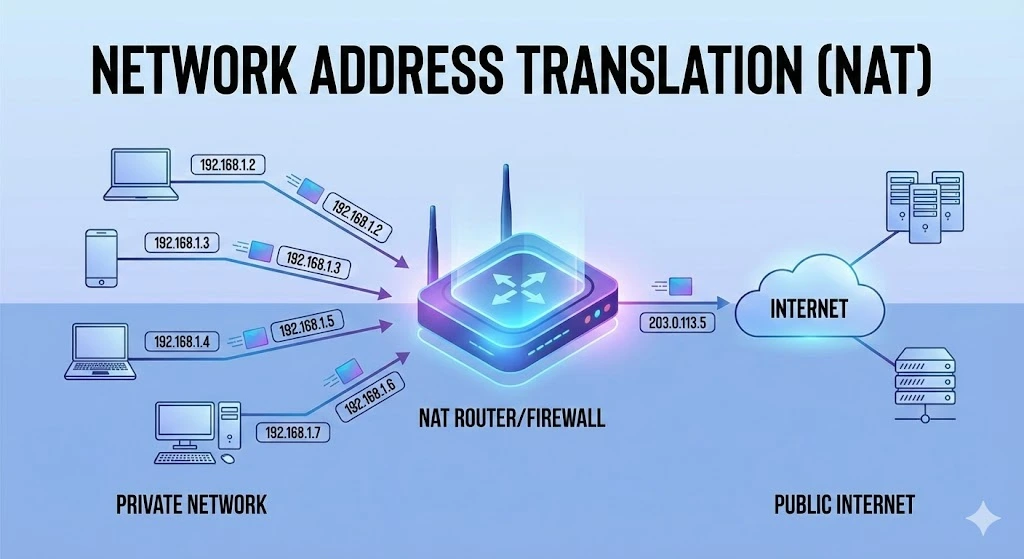
Comprensión de la traducción de direcciones de red (NAT)
En las redes informáticas, gestionar las direcciones IP de forma eficiente es fundamental para garantizar una comunicación fluida entre los dispositivos. Una de las tecnologías clave que ha surgido para afrontar este desafío es la Traducción de Direcciones de Red (NAT, por sus siglas en inglés). En este artículo explicamos qué es NAT, cómo funciona, sus distintos tipos, así como sus ventajas y limitaciones. ¿Qué es la traducción deRead more Related Posts Desbloqueando la privacidad digital con una red privada virtual (VPN) ¿Qué es una VPN? Una red privada virtual (VPN) es una tecnología que permite a los usuarios crear una conexión Comprensión de la traducción de direcciones de red (NAT) En las redes informáticas, gestionar las direcciones IP de forma eficiente es fundamental para garantizar una comunicación fluida entre los ¿Por qué Malasia se está convirtiendo en un centro neurálgico para la infraestructura de nube e IA? Malasia se está convirtiendo en uno de los mercados de crecimiento de centros de datos más importantes del Sudeste Asiático. .related-post {} .related-post .post-list { text-align: left; } .related-post .post-list .item { margin: 5px; padding: 10px; } .related-post .headline { font-size: 18px !important; color: #999999 !important; } .related-post .post-list .item .post_thumb { max-height: 220px; margin: 10px 0px; padding: 0px; display: block; } .related-post .post-list .item .post_title { font-size: 16px; color: #3f3f3f; margin: 10px 0px; padding: 0px; display: block; text-decoration: none; } .related-post .post-list .item .post_excerpt { font-size: 13px; color: #3f3f3f; margin: 10px 0px; padding: 0px; display: block; text-decoration: none; } @media only screen and (min-width: 1024px) { .related-post .post-list .item { width: 30%; } } @media only screen and (min-width: 768px) and (max-width: 1023px) { .related-post .post-list .item { width: 90%; } } @media only screen and (min-width: 0px) and (max-width: 767px) { .related-post .post-list .item { width: 90%; } }
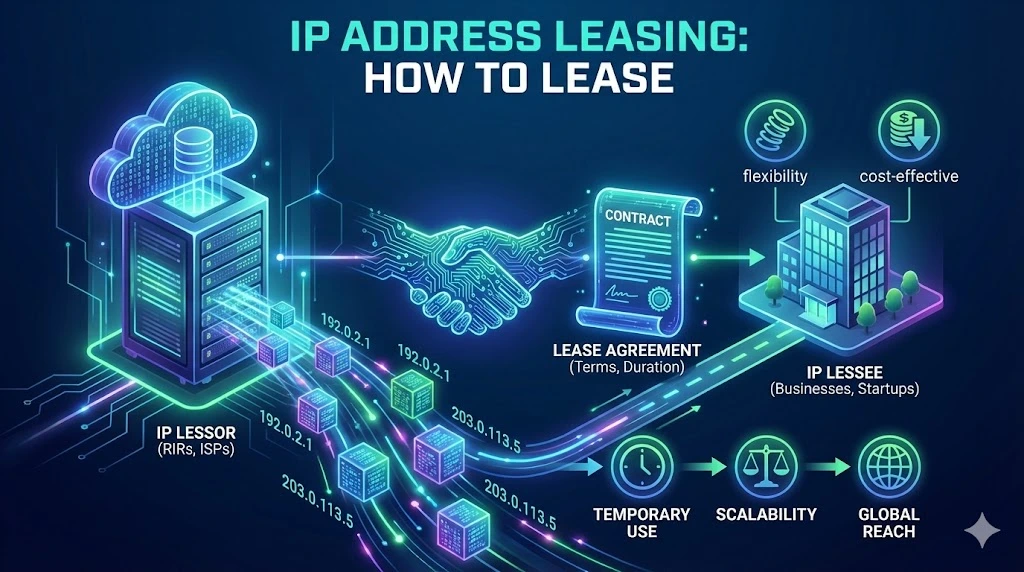
Arrendamiento de direcciones IP: Cómo arrendar direcciones IP
El mundo digital en el que nos movemos hoy depende en gran medida de las direcciones IP, identificadores únicos asignados a los dispositivos conectados a internet o a una red local. A medida que la demanda de direcciones IP sigue aumentando, empresas y particulares exploran diversas opciones para obtener los recursos necesarios. Un método cada vez más popular es el arrendamiento de direcciones IP. Este artículo profundiza en elRead more Related Posts Desbloqueando la privacidad digital con una red privada virtual (VPN) ¿Qué es una VPN? Una red privada virtual (VPN) es una tecnología que permite a los usuarios crear una conexión Comprensión de la traducción de direcciones de red (NAT) En las redes informáticas, gestionar las direcciones IP de forma eficiente es fundamental para garantizar una comunicación fluida entre los ¿Por qué Malasia se está convirtiendo en un centro neurálgico para la infraestructura de nube e IA? Malasia se está convirtiendo en uno de los mercados de crecimiento de centros de datos más importantes del Sudeste Asiático. .related-post {} .related-post .post-list { text-align: left; } .related-post .post-list .item { margin: 5px; padding: 10px; } .related-post .headline { font-size: 18px !important; color: #999999 !important; } .related-post .post-list .item .post_thumb { max-height: 220px; margin: 10px 0px; padding: 0px; display: block; } .related-post .post-list .item .post_title { font-size: 16px; color: #3f3f3f; margin: 10px 0px; padding: 0px; display: block; text-decoration: none; } .related-post .post-list .item .post_excerpt { font-size: 13px; color: #3f3f3f; margin: 10px 0px; padding: 0px; display: block; text-decoration: none; } @media only screen and (min-width: 1024px) { .related-post .post-list .item { width: 30%; } } @media only screen and (min-width: 768px) and (max-width: 1023px) { .related-post .post-list .item { width: 90%; } } @media only screen and (min-width: 0px) and (max-width: 767px) { .related-post .post-list .item { width: 90%; } }
¿Qué es el agotamiento de direcciones IPv4?
IPv4 es la versión inicial del Protocolo de Internet (IP), capaz de generar 4.300 millones de posibles direcciones IPv4. Sin embargo, muchas de estas direcciones están reservadas para fines específicos, como investigación y desarrollo. Esto deja un conjunto limitado disponible para organizaciones e individuos en todo el mundo. Con el crecimiento exponencial de Internet, la demanda de direcciones IPv4 se ha disparado. Esto provocó una rápida disminución de lasRead more Related Posts Desbloqueando la privacidad digital con una red privada virtual (VPN) ¿Qué es una VPN? Una red privada virtual (VPN) es una tecnología que permite a los usuarios crear una conexión Comprensión de la traducción de direcciones de red (NAT) En las redes informáticas, gestionar las direcciones IP de forma eficiente es fundamental para garantizar una comunicación fluida entre los Arrendamiento de direcciones IP: Cómo arrendar direcciones IP El mundo digital en el que nos movemos hoy depende en gran medida de las direcciones IP, identificadores únicos asignados .related-post {} .related-post .post-list { text-align: left; } .related-post .post-list .item { margin: 5px; padding: 10px; } .related-post .headline { font-size: 18px !important; color: #999999 !important; } .related-post .post-list .item .post_thumb { max-height: 220px; margin: 10px 0px; padding: 0px; display: block; } .related-post .post-list .item .post_title { font-size: 16px; color: #3f3f3f; margin: 10px 0px; padding: 0px; display: block; text-decoration: none; } .related-post .post-list .item .post_excerpt { font-size: 13px; color: #3f3f3f; margin: 10px 0px; padding: 0px; display: block; text-decoration: none; } @media only screen and (min-width: 1024px) { .related-post .post-list .item { width: 30%; } } @media only screen and (min-width: 768px) and (max-width: 1023px) { .related-post .post-list .item { width: 90%; } } @media only screen and (min-width: 0px) and (max-width: 767px) { .related-post .post-list .item { width: 90%; } }
