Guía completa del mercado de direcciones IP
 Stephanie
¿Qué es un mercado de direcciones IP?
Un mercado de direcciones IP es una plataforma estructurada donde las organizaciones pueden comprar, vender o arrendar espacio de direcciones IP. En la mayoría de los casos, el enfoque principal es IPv4, porque las direcciones IPv4 siguen siendo ampliamente utilizadas y tienen una oferta limitada.
Table of Contents
En lugar de buscar manualmente compradores, vendedores, brokers o proveedores de arrendamiento, las empresas pueden usar un mercado para comparar bloques IPv4 disponibles, revisar opciones de transacción y completar acuerdos mediante un proceso más organizado.
Un mercado de direcciones IP puede admitir diferentes tipos de transacciones, incluyendo compras de IPv4, ventas de IPv4, subastas de IPv4 y arrendamiento de IPv4. Para las empresas, esto crea una forma más práctica de acceder al espacio de direcciones según el presupuesto, el calendario y las necesidades de infraestructura.
¿Por qué existen los mercados de IPv4?
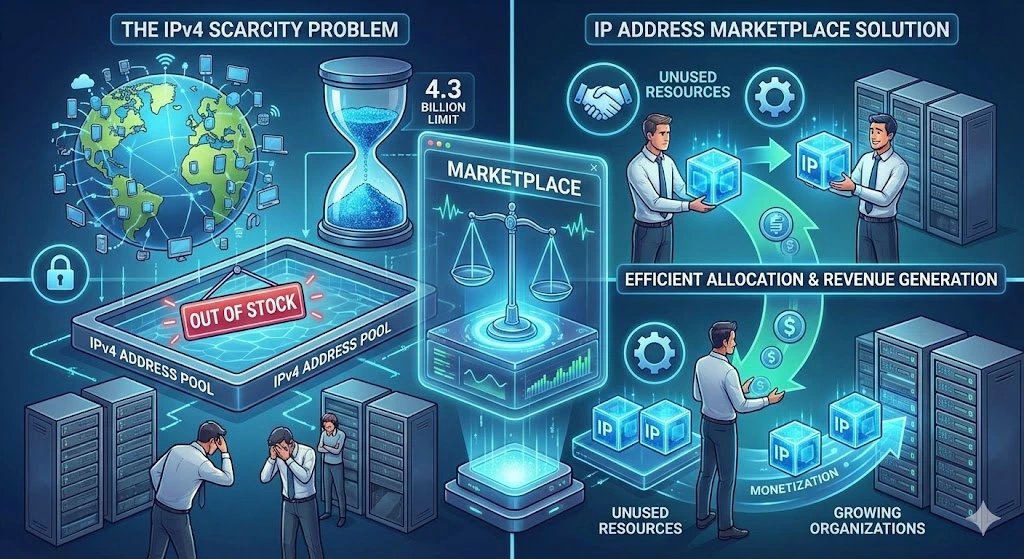
Los mercados de IPv4 existen porque el espacio de direcciones IPv4 sigue siendo importante desde el punto de vista operativo. Muchos proveedores de hosting, plataformas cloud, centros de datos, proveedores de VPN, ISP, empresas SaaS y redes empresariales todavía necesitan conectividad IPv4.
Aunque la adopción de IPv6 continúa creciendo, IPv4 sigue siendo necesario para la compatibilidad con muchos usuarios, sistemas y aplicaciones. Por eso IPv4 sigue comprándose, vendiéndose, transfiriéndose y arrendándose.
Los Registros Regionales de Internet respaldan procesos formales de transferencia. Por ejemplo, RIPE NCC afirma que una transferencia de recursos cambia la titularidad de los recursos numéricos de Internet de una parte a otra, mientras que APNIC describe las transferencias como una forma de que las direcciones IPv4 y los números AS no utilizados o excedentes pasen a organizaciones que los necesitan. IPv4 respalda ingresos, infraestructura, servicios, clientes, financiación y continuidad.
Cómo funciona un mercado de direcciones IP
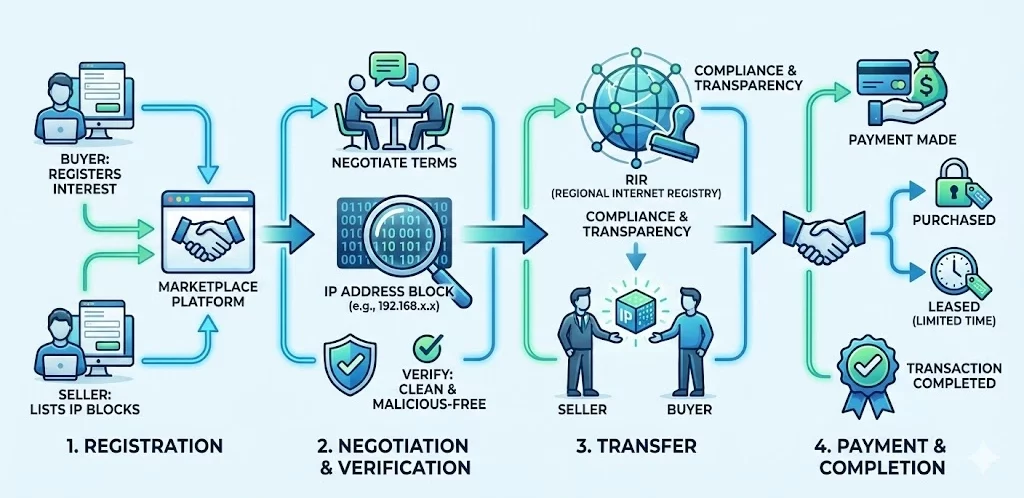
Un mercado de direcciones IP normalmente conecta a tres tipos de usuarios:
- Compradores que necesitan espacio de direcciones IPv4 para uso de infraestructura a largo plazo.
- Vendedores que poseen recursos IPv4 no utilizados o infrautilizados y desean monetizarlos.
- Arrendatarios que necesitan acceso a IPv4 sin comprarlas directamente.
Un proceso típico de mercado incluye:
1. Publicación de inventario o envío de solicitud del comprador
2. Verificación de propiedad o control
3. Revisión de reputación IP y listas negras
4. Negociación de precio o participación en subasta
5. Acuerdo de depósito en garantía o pago
6. Documentación de transferencia o arrendamiento alineada con el registro
7. Enrutamiento, LOA y configuración operativa cuando sea necesario
El proceso exacto depende de si el usuario está comprando, vendiendo o arrendando.
Comprar direcciones IPv4 a través de un mercado
Buying IPv4 addresses may be suitable for organizations that need long-term address control for infrastructure, hosting, customer services, or network expansion.
On i.lease, businesses can buy IP through a marketplace process designed around verified IPv4 blocks, reputation checks, escrow protection, and RIR-aligned transfers.
Before buying IPv4 addresses, businesses should check:
- Whether the seller has authority to transfer the IP block
- Whether the IP range has blacklist or abuse history
- Whether the block is suitable for routing and BGP announcement
- Which RIR policy applies to the transaction
- Whether the buyer needs pre-approval or documentation
- How payment and transfer completion will be protected
Buying IPv4 can provide long-term control, but it also places more responsibility on the buyer. The buyer must manage registry requirements, routing, reputation, renewal obligations, and operational use. Learn how to Buy IP Address on i.lease
Selling IPv4 addresses through a marketplace
Selling IPv4 addresses may be useful for organizations that hold unused or underused address space. Instead of leaving address blocks idle, sellers can convert them into capital by listing them for qualified buyers.
Through i.lease, organizations can sell IP using a structured marketplace process that supports reputation screening, buyer access, escrow protection, and policy-aligned transfer handling.
Sellers should prepare the following before listing IPv4 resources:
- Proof of valid control or holdership
- Accurate registry records
- Clear block size and prefix information
- Reputation and blacklist review
- Transfer eligibility checks
- Expected price range and transaction timeline
A clean and well-documented IPv4 block is usually easier for buyers to evaluate. Sellers should also understand the relevant transfer rules in their RIR region. ARIN, RIPE NCC, and APNIC each maintain their own transfer frameworks and requirements. Learn how to Sell IP Address on i.lease
Leasing IPv4 Addresses Marketplace
IPv4 leasing allows businesses to use address space without buying it outright. This is often useful for companies that need flexibility, faster deployment, or temporary capacity.
i.lease provides IPv4 leasing for organizations that need managed access to IPv4 address space. This can support hosting, VPN services, data centres, SaaS platforms, enterprise networks, and infrastructure expansion.
Leasing can be suitable when:
- The business needs IPv4 quickly
- The project has a temporary or scalable requirement
- The company wants to avoid a large upfront purchase
- The network needs IPv4 continuity during IPv6 transition
- The organization prefers managed documentation and support
This aligns with the doctrine that ownership alone does not automatically remove operational risk. Structure, continuity, routing readiness, and documentation matter. The Larus core note specifically frames leasing as a continuity structure where risk can be managed through contract, control, and operational preparedness.
What to check before using an IP address marketplace
Before buying, selling, or leasing IPv4 addresses, businesses should review both the commercial and technical quality of the transaction.
- Ownership or control: Confirm the party listing the IP block has the authority to sell or lease it.
- Registry eligibility: Check whether the transfer or lease structure aligns with the relevant RIR process.
- IP reputation: Review blacklist, spam, abuse, and routing history.
- Routing readiness: Confirm whether the IP block can be announced and used as expected.
- LOA support: For leasing, check whether a Letter of Authorization is available if needed.
- Escrow or payment protection: Use structured payment protection for purchase transactions.
- Contract clarity: Review term, renewal, acceptable use, termination, and support obligations.
These checks are important because IP addresses are tied to real infrastructure. A poor transaction can affect routing, email deliverability, customer access, platform stability, or business continuity.
Common risks in IP address marketplaces
An IP address marketplace can make transactions easier, but users still need to manage risk carefully.
1. Unclear ownership or control
If the seller or lessor does not have clear authority over the IP block, the transaction may fail or create future disputes.
2. Poor IP reputation
Some IP ranges may have abuse, spam, malware, or blacklist history. This can affect hosting, email, VPN, and customer-facing services.
3. Transfer delays
RIR requirements, documentation issues, or policy restrictions may delay a transfer. RIPE NCC, APNIC, and ARIN all operate under specific transfer procedures.
4. Routing and LOA problems
Even after a commercial agreement is signed, the IP block still needs to be routed correctly. For leased IPv4, LOA support and BGP readiness are especially important.
5. Treating IP addresses as simple commodities
IPv4 addresses are not only numbers on a list. They are used by running networks, services, customers, and revenue systems. The heng.lu doctrine warns against treating number resources as merely clerical records when they are embedded in functioning networks.
Why Use i.lease?
i.lease is designed for organizations that need a structured way to access IPv4 address space through buying, selling, or leasing.
Instead of treating IPv4 as a simple listing item, i.lease focuses on practical transaction quality: verified listings, reputation awareness, policy alignment, escrow support, leasing documentation, and operational usability.
Businesses can use i.lease to:
- buy IP for long-term infrastructure needs
- sell IP to monetize unused IPv4 assets
- IPv4 leasing for flexible, managed address access
This makes i.lease different from a general broker directory. It should be positioned as a marketplace for structured IPv4 access, where users can evaluate transaction type, operational needs, and risk before committing.
Final thoughts
An IP address marketplace helps organizations buy, sell, and lease IPv4 addresses in a more structured way. It supports buyers that need address space, sellers that want to monetize unused resources, and businesses that prefer leasing for flexibility.
However, the quality of the marketplace matters. Businesses should check ownership, registry eligibility, IP reputation, routing readiness, LOA support, escrow protection, and contract clarity before completing a transaction.
IPv4 address space remains part of real network operations. It supports hosting, cloud services, VPNs, data centres, customers, and business continuity. That is why the best marketplace is not only a place to list addresses. It is a platform that helps users manage access, risk, and operational readiness.
Also Read
- Lease IP Addresses: Why Businesses Lease IPv4 and What to Check First
- IPv4 Leasing vs Purchasing: Structural Risk in the IPv4 Address Market
- What Are the Risks of Buying IPv4 from the Wrong Source?
- IPv4 Leasing for Data Centres: What You Need To Know
Frequently Asked Questions (FAQs)
What is an IP address marketplace?
An IP address marketplace is a platform where organizations can buy, sell, or lease IP address space, especially IPv4 addresses.
Why do businesses use an IPv4 marketplace?
Businesses use an IPv4 marketplace to access address space for hosting, cloud services, VPNs, data centres, ISP networks, SaaS platforms, and enterprise infrastructure.
Can I buy IPv4 addresses on i.lease?
Yes. Businesses can buy IP through i.lease using a structured marketplace process for verified IPv4 blocks and policy-aligned transfers.
Can I sell IPv4 addresses on i.lease?
Yes. Organizations with unused or underused IPv4 address space can sell IP through i.lease and reach potential buyers through a structured marketplace.
Does i.lease provide IPv4 leasing?
Yes. i.lease provides IPv4 leasing for businesses that need flexible access to IPv4 address space without buying it outright.
What should I check before buying IPv4 addresses?
You should check seller authority, registry transfer eligibility, IP reputation, blacklist history, routing readiness, escrow protection, and transfer documentation.
What should I check before leasing IPv4 addresses?
You should check lease terms, LOA availability, routing support, IP reputation, acceptable-use rules, renewal conditions, and provider reliability.
Is IPv4 still needed if IPv6 exists?
Yes. IPv6 adoption is growing, but many networks, applications, customers, and services still rely on IPv4. Many businesses continue to use IPv4 and IPv6 together.
Artículos relacionados

Las 5 principales ventajas de alquilar direcciones IP para empresas globales
¿Qué significa alquilar direcciones IP para las empresas globales? En lugar de comprar bloques IPv4 o IPv6 por completo, el alquiler consiste en rentarlos a un proveedor. Esto proporciona acceso rápido al espacio de direcciones en varias regiones, algo esencial para las empresas multinacionales debido a la escasez de IPv4. Mediante el alquiler, las expansiones y las necesidades a corto plazo pueden cubrirse con mayor facilidad, trasladando el costeRead more Related Posts Les 5 principaux avantages de la location d’adresses IP pour les entreprises internationales La location d'adresses IP offre un accès évolutif et économique à un espace d'adressage sans les contraintes liées à la Read more Votre bail IPv4 n’est pas sûr si personne n’assume le risque de renouvellement Qui est réellement responsable du maintien de cet accès IPv4 ? Ni celui qui l’a vendu. Ni celui qui l’a mis Read more Principaux points à prendre en compte lors du commerce d’adresses IPv4 sur le marché secondaire Naviguer sur le marché secondaire de l’IPv4 exige une attention particulière à la légalité, à la réputation, à la tarification, Read more .related-post {} .related-post .post-list { text-align: left; } .related-post .post-list .item { margin: 5px; padding: 10px; } .related-post .headline { font-size: 18px !important; color: #999999 !important; } .related-post .post-list .item .post_thumb { max-height: 220px; margin: 10px 0px; padding: 0px; display: block; } .related-post .post-list .item .post_title { font-size: 16px; color: #3f3f3f; margin: 10px 0px; padding: 0px; display: block; text-decoration: none; } .related-post .post-list .item .post_excerpt { font-size: 13px; color: #3f3f3f; margin: 10px 0px; padding: 0px; display: block; text-decoration: none; } @media only screen and (min-width: 1024px) { .related-post .post-list .item { width: 30%; } } @media only screen and (min-width: 768px) and (max-width: 1023px) { .related-post .post-list .item { width: 90%; } } @media only screen and (min-width: 0px) and (max-width: 767px) { .related-post .post-list .item { width: 90%; } }
Arrendamiento de direcciones IPv4 a corto plazo frente a arrendamiento a largo plazo
Ante la escasez de IPv4, las empresas deben sopesar el costo, la velocidad y el crecimiento de la red al elegir un plan de arrendamiento. El arrendamiento a corto plazo permite aumentar o disminuir los recursos fácilmente, pero resulta más costoso a largo plazo y ofrece menor certeza de suministro. El arrendamiento a largo plazo proporciona precios estables y un acceso más fiable, pero dificulta la adaptación de laRead more Related Posts Les 5 principaux avantages de la location d’adresses IP pour les entreprises internationales La location d'adresses IP offre un accès évolutif et économique à un espace d'adressage sans les contraintes liées à la Read more Votre bail IPv4 n’est pas sûr si personne n’assume le risque de renouvellement Qui est réellement responsable du maintien de cet accès IPv4 ? Ni celui qui l’a vendu. Ni celui qui l’a mis Read more Que se passe-t-il lorsque les ressources IP sont mal gérées ? Une mauvaise gestion des ressources IP peut entraîner des pannes, des failles de sécurité, des mises sur liste noire, une Read more .related-post {} .related-post .post-list { text-align: left; } .related-post .post-list .item { margin: 5px; padding: 10px; } .related-post .headline { font-size: 18px !important; color: #999999 !important; } .related-post .post-list .item .post_thumb { max-height: 220px; margin: 10px 0px; padding: 0px; display: block; } .related-post .post-list .item .post_title { font-size: 16px; color: #3f3f3f; margin: 10px 0px; padding: 0px; display: block; text-decoration: none; } .related-post .post-list .item .post_excerpt { font-size: 13px; color: #3f3f3f; margin: 10px 0px; padding: 0px; display: block; text-decoration: none; } @media only screen and (min-width: 1024px) { .related-post .post-list .item { width: 30%; } } @media only screen and (min-width: 768px) and (max-width: 1023px) { .related-post .post-list .item { width: 90%; } } @media only screen and (min-width: 0px) and (max-width: 767px) { .related-post .post-list .item { width: 90%; } }

¿Cuánto costará un bloque IPv4 /24 en 2026?
Related Posts Las 5 principales ventajas de alquilar direcciones IP para empresas globales El arrendamiento de direcciones IP ofrece un acceso escalable y rentable al espacio de direcciones sin la carga de la Read more Arrendamiento de direcciones IPv4 a corto plazo frente a arrendamiento a largo plazo Ante la escasez de IPv4, las empresas deben sopesar el costo, la velocidad y el crecimiento de la red al ReadRead more Related Posts Las 5 principales ventajas de alquilar direcciones IP para empresas globales El arrendamiento de direcciones IP ofrece un acceso escalable y rentable al espacio de direcciones sin la carga de la Read more Arrendamiento de direcciones IPv4 a corto plazo frente a arrendamiento a largo plazo Ante la escasez de IPv4, las empresas deben sopesar el costo, la velocidad y el crecimiento de la red al Read more Guía completa del mercado de direcciones IP ¿Qué es un mercado de direcciones IP? Un mercado de direcciones IP es una plataforma estructurada donde las organizaciones pueden Read more .related-post {} .related-post .post-list { text-align: left; } .related-post .post-list .item { margin: 5px; padding: 10px; } .related-post .headline { font-size: 18px !important; color: #999999 !important; } .related-post .post-list .item .post_thumb { max-height: 220px; margin: 10px 0px; padding: 0px; display: block; } .related-post .post-list .item .post_title { font-size: 16px; color: #3f3f3f; margin: 10px 0px; padding: 0px; display: block; text-decoration: none; } .related-post .post-list .item .post_excerpt { font-size: 13px; color: #3f3f3f; margin: 10px 0px; padding: 0px; display: block; text-decoration: none; } @media only screen and (min-width: 1024px) { .related-post .post-list .item { width: 30%; } } @media only screen and (min-width: 768px) and (max-width: 1023px) { .related-post .post-list .item { width: 90%; } } @media only screen and (min-width: 0px) and (max-width: 767px) { .related-post .post-list .item { width: 90%; } }
