Différence entre les attaques DoS et DDoS
 Stephanie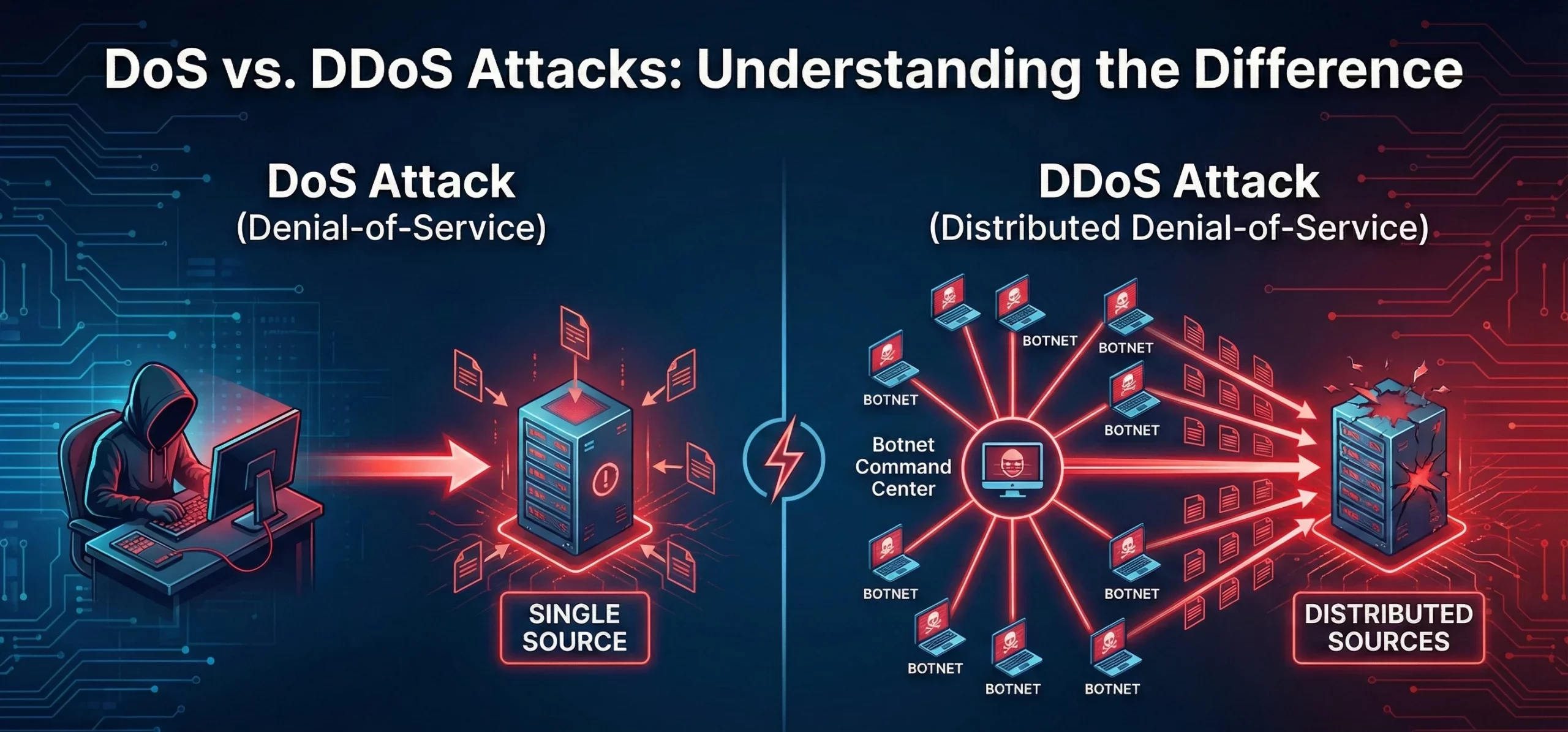
Que sont les attaques DoS et DDoS ?
Une attaque par déni de service (DoS) vise à rendre une machine, un réseau ou un service inaccessible aux utilisateurs en saturant le trafic ou les requêtes. Elle provient généralement d’une source unique.
Table of Contents
Une attaque par déni de service distribué (DDoS) a une intention similaire, mais implique plusieurs systèmes (souvent un réseau de zombies) ciblant simultanément la victime, ce qui la rend plus difficile à bloquer ou à tracer.
Caractéristiques clés des attaques DoS et DDoS
Attaque par déni de service (DoS)
- Source unique de trafic.
- Plus facile à atténuer grâce à son origine identifiable.
- Moins importante et complexe qu’une attaque par déni de service distribué (DDoS).
Attaque par déni de service distribué (DDoS)
- Répartie sur plusieurs systèmes compromis.
- Extrêmement importante et sophistiquée.
- Plus difficile à bloquer en raison de la diversité des sources de trafic.
Outils d'attaque DoS/DDoS couramment utilisés
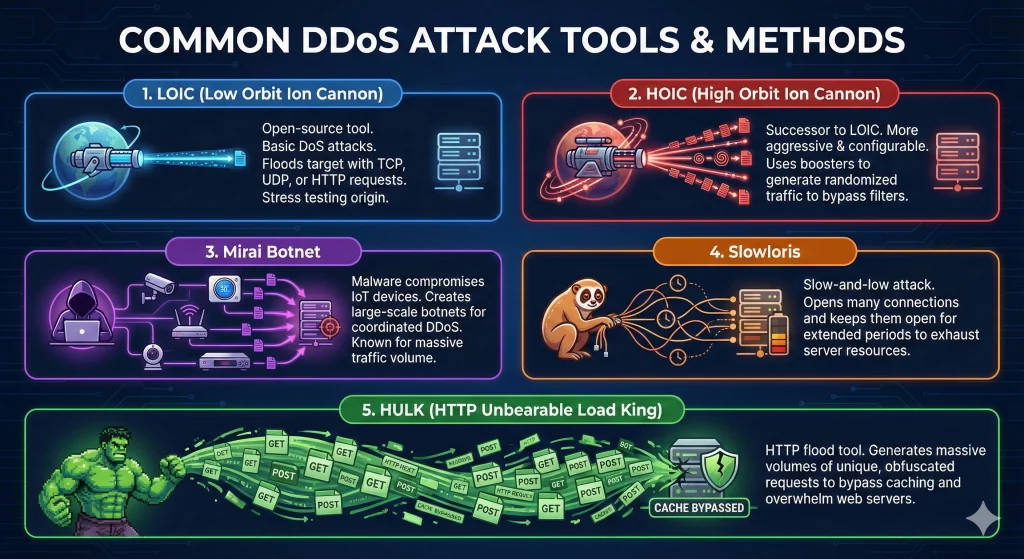
1. Low Orbit Ion Cannon (LOIC) : Outil open source utilisé pour les attaques DoS basiques.
2. HOIC (High Orbit Ion Cannon) : Successeur de LOIC, avec un mécanisme d’attaque plus agressif et configurable.
3. Mirai Botnet : Logiciel malveillant qui compromet les objets connectés pour lancer des attaques DDoS à grande échelle.
4. Slowloris : Outil qui maintient les connexions ouvertes pendant de longues périodes, épuisant ainsi les ressources du serveur.
5. HTTP Unbearable Load King (HULK) : Génère un grand nombre de requêtes uniques pour saturer les serveurs.
Comment puis-je me défendre contre les attaques DoS/DDoS ?
1. Investissez dans un réseau de diffusion de contenu (CDN) : des CDN comme Cloudflare ou Akamai répartissent le trafic sur plusieurs serveurs, atténuant ainsi les attaques.
2. Utilisez des services de protection contre les attaques DDoS : des services comme AWS Shield et Arbor Networks détectent et atténuent les attaques de grande envergure.
3. Configurez des pare-feu et des limitations de débit : mettez en place des règles de pare-feu pour détecter le trafic inhabituel et des limitations de débit pour restreindre les requêtes provenant d’une même adresse IP.
4. Mettez régulièrement à jour vos systèmes : assurez-vous que vos logiciels et systèmes sont à jour afin d’éviter les vulnérabilités exploitées par les attaquants.
5. Surveillez les schémas de trafic : utilisez des outils comme Nagios ou Zabbix pour détecter rapidement les anomalies dans les schémas de trafic.
6. Mettez en œuvre des mesures de sécurité avancées : déployez des pare-feu d’applications web (WAF) et des systèmes de prévention des intrusions (IPS) pour filtrer le trafic malveillant.
Réflexions finales sur les attaques DoS et DDoS
Les attaques DoS et DDoS peuvent paraître complexes, mais les comprendre est essentiel pour protéger votre vie numérique. Ces cybermenaces peuvent perturber considérablement les entreprises et les services, mais avec les bons outils et des mesures proactives, elles peuvent être gérées efficacement. Rester informé et préparé garantit la sécurité et le bon fonctionnement de votre vie numérique.
Trusted IPv4 Leasing for Business Growth
Get enterprise-grade IPv4 space quickly, with seamless deployment and end-to-end management.
Get Started with i.leaseArtículos relacionados
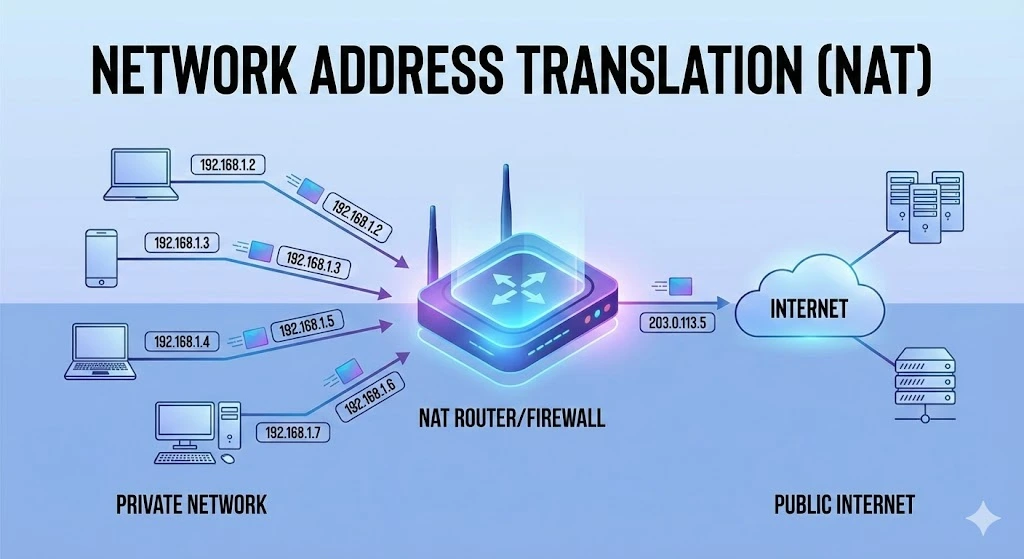
Comprensión de la traducción de direcciones de red (NAT)
En las redes informáticas, gestionar las direcciones IP de forma eficiente es fundamental para garantizar una comunicación fluida entre los dispositivos. Una de las tecnologías clave que ha surgido para afrontar este desafío es la Traducción de Direcciones de Red (NAT, por sus siglas en inglés). En este artículo explicamos qué es NAT, cómo funciona, sus distintos tipos, así como sus ventajas y limitaciones. ¿Qué es la traducción deRead more Related Posts Desbloqueando la privacidad digital con una red privada virtual (VPN) ¿Qué es una VPN? Una red privada virtual (VPN) es una tecnología que permite a los usuarios crear una conexión Comprensión de la traducción de direcciones de red (NAT) En las redes informáticas, gestionar las direcciones IP de forma eficiente es fundamental para garantizar una comunicación fluida entre los ¿Por qué Malasia se está convirtiendo en un centro neurálgico para la infraestructura de nube e IA? Malasia se está convirtiendo en uno de los mercados de crecimiento de centros de datos más importantes del Sudeste Asiático. .related-post {} .related-post .post-list { text-align: left; } .related-post .post-list .item { margin: 5px; padding: 10px; } .related-post .headline { font-size: 18px !important; color: #999999 !important; } .related-post .post-list .item .post_thumb { max-height: 220px; margin: 10px 0px; padding: 0px; display: block; } .related-post .post-list .item .post_title { font-size: 16px; color: #3f3f3f; margin: 10px 0px; padding: 0px; display: block; text-decoration: none; } .related-post .post-list .item .post_excerpt { font-size: 13px; color: #3f3f3f; margin: 10px 0px; padding: 0px; display: block; text-decoration: none; } @media only screen and (min-width: 1024px) { .related-post .post-list .item { width: 30%; } } @media only screen and (min-width: 768px) and (max-width: 1023px) { .related-post .post-list .item { width: 90%; } } @media only screen and (min-width: 0px) and (max-width: 767px) { .related-post .post-list .item { width: 90%; } }
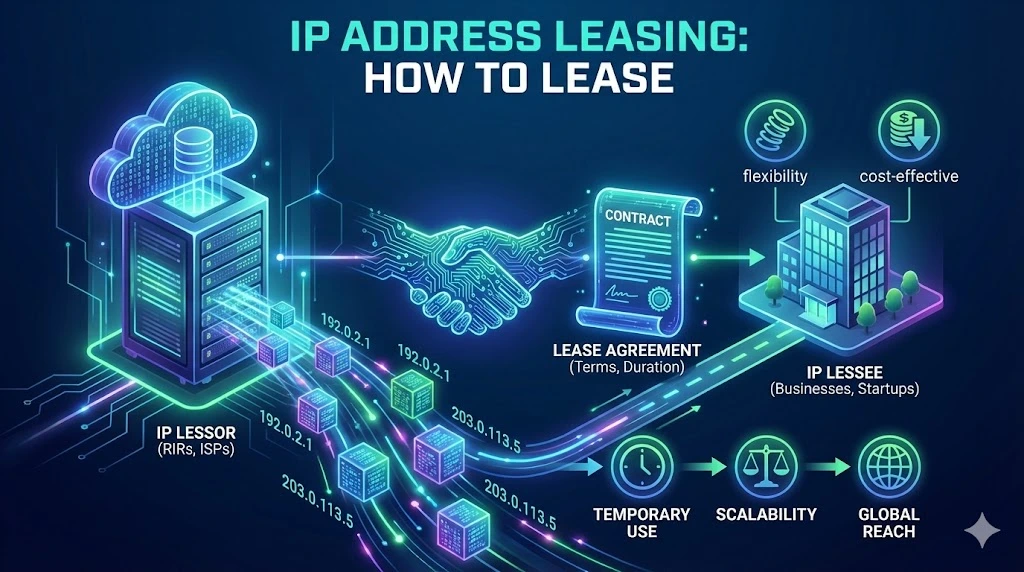
Arrendamiento de direcciones IP: Cómo arrendar direcciones IP
El mundo digital en el que nos movemos hoy depende en gran medida de las direcciones IP, identificadores únicos asignados a los dispositivos conectados a internet o a una red local. A medida que la demanda de direcciones IP sigue aumentando, empresas y particulares exploran diversas opciones para obtener los recursos necesarios. Un método cada vez más popular es el arrendamiento de direcciones IP. Este artículo profundiza en elRead more Related Posts Desbloqueando la privacidad digital con una red privada virtual (VPN) ¿Qué es una VPN? Una red privada virtual (VPN) es una tecnología que permite a los usuarios crear una conexión Comprensión de la traducción de direcciones de red (NAT) En las redes informáticas, gestionar las direcciones IP de forma eficiente es fundamental para garantizar una comunicación fluida entre los ¿Por qué Malasia se está convirtiendo en un centro neurálgico para la infraestructura de nube e IA? Malasia se está convirtiendo en uno de los mercados de crecimiento de centros de datos más importantes del Sudeste Asiático. .related-post {} .related-post .post-list { text-align: left; } .related-post .post-list .item { margin: 5px; padding: 10px; } .related-post .headline { font-size: 18px !important; color: #999999 !important; } .related-post .post-list .item .post_thumb { max-height: 220px; margin: 10px 0px; padding: 0px; display: block; } .related-post .post-list .item .post_title { font-size: 16px; color: #3f3f3f; margin: 10px 0px; padding: 0px; display: block; text-decoration: none; } .related-post .post-list .item .post_excerpt { font-size: 13px; color: #3f3f3f; margin: 10px 0px; padding: 0px; display: block; text-decoration: none; } @media only screen and (min-width: 1024px) { .related-post .post-list .item { width: 30%; } } @media only screen and (min-width: 768px) and (max-width: 1023px) { .related-post .post-list .item { width: 90%; } } @media only screen and (min-width: 0px) and (max-width: 767px) { .related-post .post-list .item { width: 90%; } }
¿Qué es el agotamiento de direcciones IPv4?
IPv4 es la versión inicial del Protocolo de Internet (IP), capaz de generar 4.300 millones de posibles direcciones IPv4. Sin embargo, muchas de estas direcciones están reservadas para fines específicos, como investigación y desarrollo. Esto deja un conjunto limitado disponible para organizaciones e individuos en todo el mundo. Con el crecimiento exponencial de Internet, la demanda de direcciones IPv4 se ha disparado. Esto provocó una rápida disminución de lasRead more Related Posts Desbloqueando la privacidad digital con una red privada virtual (VPN) ¿Qué es una VPN? Una red privada virtual (VPN) es una tecnología que permite a los usuarios crear una conexión Comprensión de la traducción de direcciones de red (NAT) En las redes informáticas, gestionar las direcciones IP de forma eficiente es fundamental para garantizar una comunicación fluida entre los Arrendamiento de direcciones IP: Cómo arrendar direcciones IP El mundo digital en el que nos movemos hoy depende en gran medida de las direcciones IP, identificadores únicos asignados .related-post {} .related-post .post-list { text-align: left; } .related-post .post-list .item { margin: 5px; padding: 10px; } .related-post .headline { font-size: 18px !important; color: #999999 !important; } .related-post .post-list .item .post_thumb { max-height: 220px; margin: 10px 0px; padding: 0px; display: block; } .related-post .post-list .item .post_title { font-size: 16px; color: #3f3f3f; margin: 10px 0px; padding: 0px; display: block; text-decoration: none; } .related-post .post-list .item .post_excerpt { font-size: 13px; color: #3f3f3f; margin: 10px 0px; padding: 0px; display: block; text-decoration: none; } @media only screen and (min-width: 1024px) { .related-post .post-list .item { width: 30%; } } @media only screen and (min-width: 768px) and (max-width: 1023px) { .related-post .post-list .item { width: 90%; } } @media only screen and (min-width: 0px) and (max-width: 767px) { .related-post .post-list .item { width: 90%; } }
