Comprendre la différence entre IPv4 et IPv6
 Stephanie
Lorsqu’un appareil se connecte à un réseau, il doit respecter une norme spécifique. Cette norme, appelée protocole Internet, permet à un appareil de communiquer avec d’autres appareils.
Table of Contents
Table of Contents
Que ce soit via Internet ou sur un réseau local (comme un réseau domestique ou professionnel), un appareil a besoin d’une adresse réseau. Il reçoit cette adresse une fois connecté au réseau, généralement par l’intermédiaire d’un routeur.
Pour communiquer sur Internet, un appareil utilise une adresse IP. Le protocole Internet (IP) normalise la structure des données et le format des adresses sur Internet afin d’acheminer les données à destination.
1.0 Types d’adresses IP
Tout appareil utilisant le protocole Internet (IP) peut communiquer avec d’autres appareils utilisant le même protocole. Il peut s’agir d’ordinateurs, de téléphones ou même de grille-pain. Les adresses IP peuvent être publiques ou privées.
a. Adresses IP publiques
Les adresses IP publiques offrent un accès direct à Internet. Un fournisseur d’accès à Internet (FAI) attribue ces adresses aux appareils, comme votre routeur domestique. Elles permettent aux appareils d’être accessibles depuis l’extérieur.
b. Adresses IP privées
Les adresses IP privées n’ont pas d’accès direct à Internet et transitent par votre routeur domestique ou professionnel. Ces adresses sont accessibles uniquement au sein de réseaux privés, tels que les réseaux locaux (LAN) ou les réseaux privés virtuels (VPN).
Votre routeur domestique ou professionnel possède une adresse IP publique. Cependant, il attribue également des adresses IP privées aux appareils de votre réseau privé. Ce processus est lié à la NAT (Network Address Translation), que nous aborderons plus loin.
Traduction d’adresses réseau (NAT)
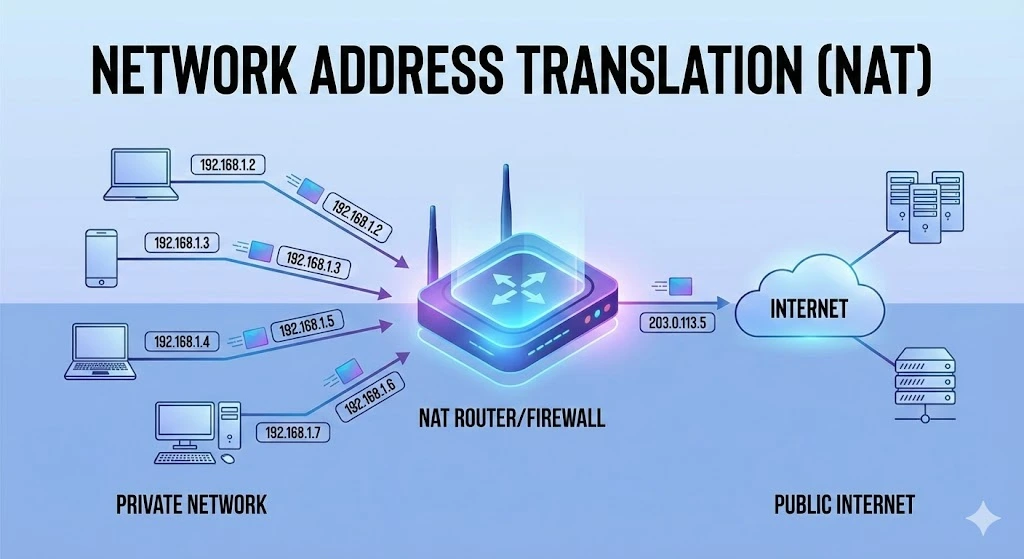
Lorsqu’un réseau privé se connecte à Internet et envoie des données via un routeur, ce dernier utilise la traduction d’adresses réseau (NAT). La NAT permet à plusieurs appareils d’un réseau privé de partager une seule adresse IP publique.
Cependant, elle complique la fourniture de services sur Internet pour les appareils disposant d’adresses privées, car ces derniers ne sont pas facilement accessibles depuis l’extérieur.
2.0 What is IPv4?
You can use NAT only in the fourth version of the Internet Protocol, known as IP version 4 (IPv4). An IPv4 address is made up of four blocks of numbers ranging from 0 to 255 separated by dots.
These four numbers are four groups of eight binary digits (bits). IPv4 addresses are expressed as decimal numbers for readability.For clarity, let’s look at a common IP address: 192.168.0.1.
The table below shows how IPv4 is a binary system represented by decimal digits, for easier readability.
| Decimal | Binary |
| 192 | 11000000 |
| 168 | 10101000 |
| 0 | 00000000 |
| 1 | 00000001 |
3.0 What is IPv6?
The problem with IPv4 is that it provides only approximately 4.3 billion addresses.
4.3 billion is such a small number when we factor in the increasing number of devices connecting to the internet.
To address this limitation, IPv6 was introduced. An IPv6 address is made up of eight blocks of 16-bit numbers. Each block is separated by colons and represented in hexadecimal format. IPv6 uses 128 bits for each address.
In plain speak, an IPv6 address is much longer compared to an IPv4 address. Letters and numbers make up an IPv6 address.
This is an example of an IPv6 address:2001:0db8:85a3:0000:0000:8a2e:0370:7334
4.0 Ipv4 vs IPv6 : A Comparison
IPv4 is still the most commonly used version of the Internet Protocol. That’s why there’s a huge demand for it. However, IPv6 offers more in terms of performance and security. In this section, we’ll look into IPv4 vs. IPv6.
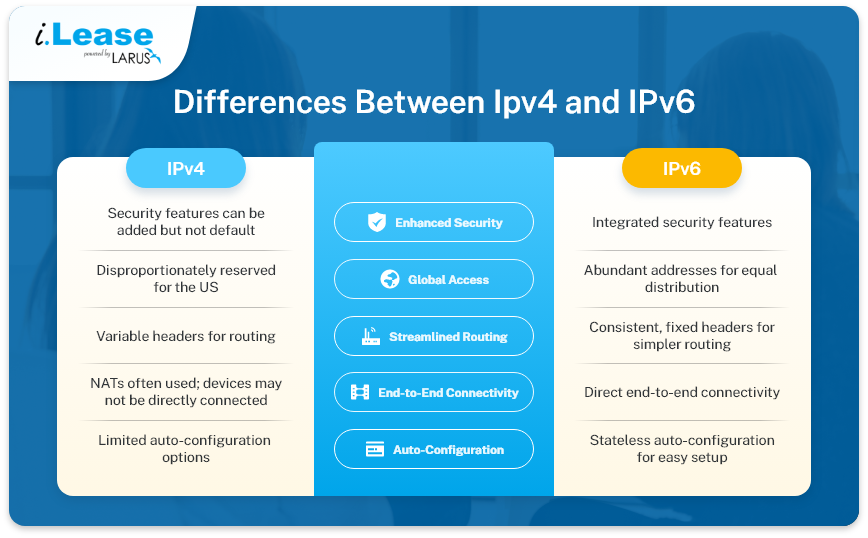
1. Enhanced Security
IPv6 was designed with integrated security features. While these features can be added to IPv4, they don’t come pre-configured as in the case with IPv6.
2. Global Access
Around 50% of IPv4 addresses were initially reserved for the US, leading to uneven distribution worldwide. In contrast, IPv6 addresses are in higher abundance. Therefore, they can be equally distributed worldwide.
3. Potential for Streamlined Routing
Each IP version has a certain number of headers (or information fields). Some of these fields tell the computers about the type of data, the size of the packet (the data being sent), the source address (where it’s coming from), and the destination address (where it’s going).
IPv6 employs consistent and fixed headers, unlike IPv4’s variable headers. This could simplify the routing code and reduce hardware processing requirements.
4. Direct End-to-End Connectivity
There is enough IPv6 to go around, leaving NATs unnecessary.
With IPv6, each device can directly connect to the internet and communicate with websites without intermediary network address translations.
However, this creates a potential downside: devices that use IPv6 might be more vulnerable if they use the same address over the Internet all the time. The fix is to use a temporary IPv6 address that changes regularly.
5. Effortless Auto-Configuration
IPv6 offers a feature called stateless auto-configuration. Devices can autonomously assign themselves IP addresses based on their unique MAC addresses. Self-configuration makes it easy for devices to find and connect within the same network.
Artículos relacionados
Comprensión de la traducción de direcciones de red (NAT)
En las redes informáticas, gestionar las direcciones IP de forma eficiente es fundamental para garantizar una comunicación fluida entre los dispositivos. Una de las tecnologías clave que ha surgido para afrontar este desafío es la Traducción de Direcciones de Red (NAT, por sus siglas en inglés). En este artículo explicamos qué es NAT, cómo funciona, sus distintos tipos, así como sus ventajas y limitaciones. ¿Qué es la traducción deRead more Related Posts Desbloqueando la privacidad digital con una red privada virtual (VPN) ¿Qué es una VPN? Una red privada virtual (VPN) es una tecnología que permite a los usuarios crear una conexión Comprensión de la traducción de direcciones de red (NAT) En las redes informáticas, gestionar las direcciones IP de forma eficiente es fundamental para garantizar una comunicación fluida entre los ¿Por qué Malasia se está convirtiendo en un centro neurálgico para la infraestructura de nube e IA? Malasia se está convirtiendo en uno de los mercados de crecimiento de centros de datos más importantes del Sudeste Asiático. .related-post {} .related-post .post-list { text-align: left; } .related-post .post-list .item { margin: 5px; padding: 10px; } .related-post .headline { font-size: 18px !important; color: #999999 !important; } .related-post .post-list .item .post_thumb { max-height: 220px; margin: 10px 0px; padding: 0px; display: block; } .related-post .post-list .item .post_title { font-size: 16px; color: #3f3f3f; margin: 10px 0px; padding: 0px; display: block; text-decoration: none; } .related-post .post-list .item .post_excerpt { font-size: 13px; color: #3f3f3f; margin: 10px 0px; padding: 0px; display: block; text-decoration: none; } @media only screen and (min-width: 1024px) { .related-post .post-list .item { width: 30%; } } @media only screen and (min-width: 768px) and (max-width: 1023px) { .related-post .post-list .item { width: 90%; } } @media only screen and (min-width: 0px) and (max-width: 767px) { .related-post .post-list .item { width: 90%; } }
Arrendamiento de direcciones IP: Cómo arrendar direcciones IP
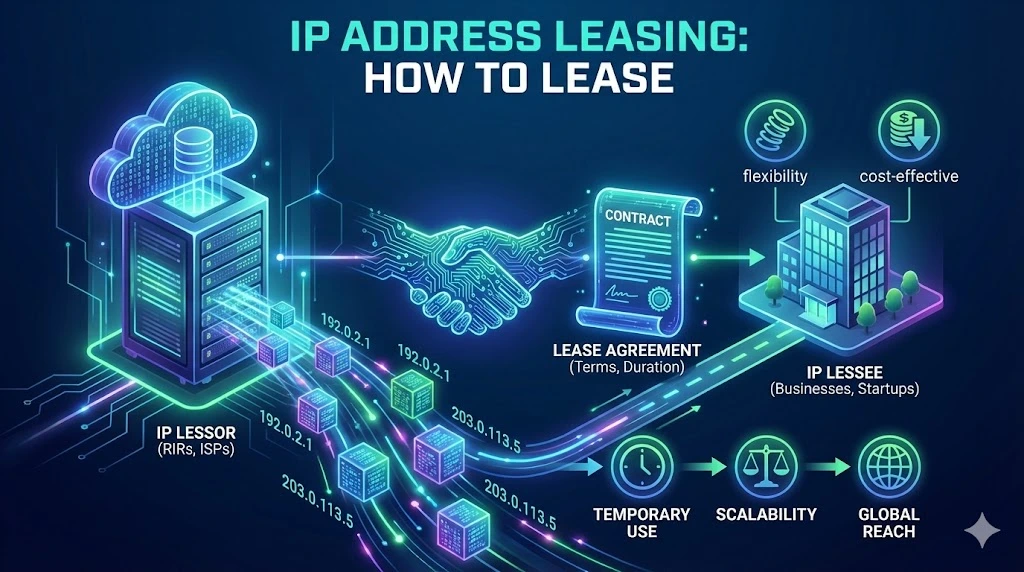
El mundo digital en el que nos movemos hoy depende en gran medida de las direcciones IP, identificadores únicos asignados a los dispositivos conectados a internet o a una red local. A medida que la demanda de direcciones IP sigue aumentando, empresas y particulares exploran diversas opciones para obtener los recursos necesarios. Un método cada vez más popular es el arrendamiento de direcciones IP. Este artículo profundiza en elRead more Related Posts Desbloqueando la privacidad digital con una red privada virtual (VPN) ¿Qué es una VPN? Una red privada virtual (VPN) es una tecnología que permite a los usuarios crear una conexión Comprensión de la traducción de direcciones de red (NAT) En las redes informáticas, gestionar las direcciones IP de forma eficiente es fundamental para garantizar una comunicación fluida entre los ¿Por qué Malasia se está convirtiendo en un centro neurálgico para la infraestructura de nube e IA? Malasia se está convirtiendo en uno de los mercados de crecimiento de centros de datos más importantes del Sudeste Asiático. .related-post {} .related-post .post-list { text-align: left; } .related-post .post-list .item { margin: 5px; padding: 10px; } .related-post .headline { font-size: 18px !important; color: #999999 !important; } .related-post .post-list .item .post_thumb { max-height: 220px; margin: 10px 0px; padding: 0px; display: block; } .related-post .post-list .item .post_title { font-size: 16px; color: #3f3f3f; margin: 10px 0px; padding: 0px; display: block; text-decoration: none; } .related-post .post-list .item .post_excerpt { font-size: 13px; color: #3f3f3f; margin: 10px 0px; padding: 0px; display: block; text-decoration: none; } @media only screen and (min-width: 1024px) { .related-post .post-list .item { width: 30%; } } @media only screen and (min-width: 768px) and (max-width: 1023px) { .related-post .post-list .item { width: 90%; } } @media only screen and (min-width: 0px) and (max-width: 767px) { .related-post .post-list .item { width: 90%; } }
¿Qué es el agotamiento de direcciones IPv4?
IPv4 es la versión inicial del Protocolo de Internet (IP), capaz de generar 4.300 millones de posibles direcciones IPv4. Sin embargo, muchas de estas direcciones están reservadas para fines específicos, como investigación y desarrollo. Esto deja un conjunto limitado disponible para organizaciones e individuos en todo el mundo. Con el crecimiento exponencial de Internet, la demanda de direcciones IPv4 se ha disparado. Esto provocó una rápida disminución de lasRead more Related Posts Desbloqueando la privacidad digital con una red privada virtual (VPN) ¿Qué es una VPN? Una red privada virtual (VPN) es una tecnología que permite a los usuarios crear una conexión Comprensión de la traducción de direcciones de red (NAT) En las redes informáticas, gestionar las direcciones IP de forma eficiente es fundamental para garantizar una comunicación fluida entre los Arrendamiento de direcciones IP: Cómo arrendar direcciones IP El mundo digital en el que nos movemos hoy depende en gran medida de las direcciones IP, identificadores únicos asignados .related-post {} .related-post .post-list { text-align: left; } .related-post .post-list .item { margin: 5px; padding: 10px; } .related-post .headline { font-size: 18px !important; color: #999999 !important; } .related-post .post-list .item .post_thumb { max-height: 220px; margin: 10px 0px; padding: 0px; display: block; } .related-post .post-list .item .post_title { font-size: 16px; color: #3f3f3f; margin: 10px 0px; padding: 0px; display: block; text-decoration: none; } .related-post .post-list .item .post_excerpt { font-size: 13px; color: #3f3f3f; margin: 10px 0px; padding: 0px; display: block; text-decoration: none; } @media only screen and (min-width: 1024px) { .related-post .post-list .item { width: 30%; } } @media only screen and (min-width: 768px) and (max-width: 1023px) { .related-post .post-list .item { width: 90%; } } @media only screen and (min-width: 0px) and (max-width: 767px) { .related-post .post-list .item { width: 90%; } }
