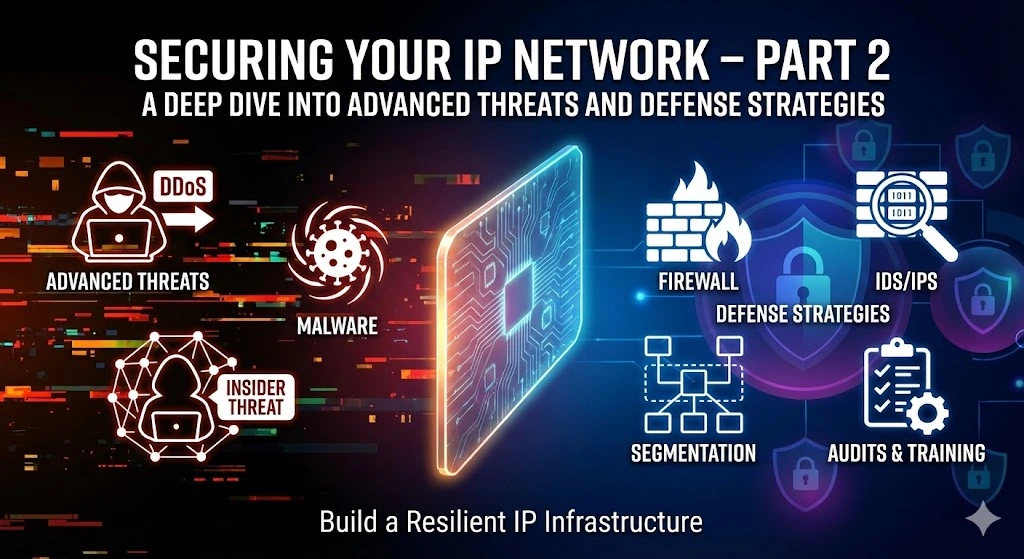
Securing Your IP Network, Part 2: How to secure IP address

In Part 1 of our series, we explored the importance of securing your IP network and outlined fundamental strategies for enhancing network security. In this instalment, we will delve deeper into the specific measures and best practices for securing your IP addresses and safeguarding your network against cyber threats and unauthorized access.
Table of Contents
In this article, we will guide you through 6 methods of securing your IP network. Refer to Part 1 to check out the importance of securing an IP network.
How to secure an IP address
Implement IP address whitelisting
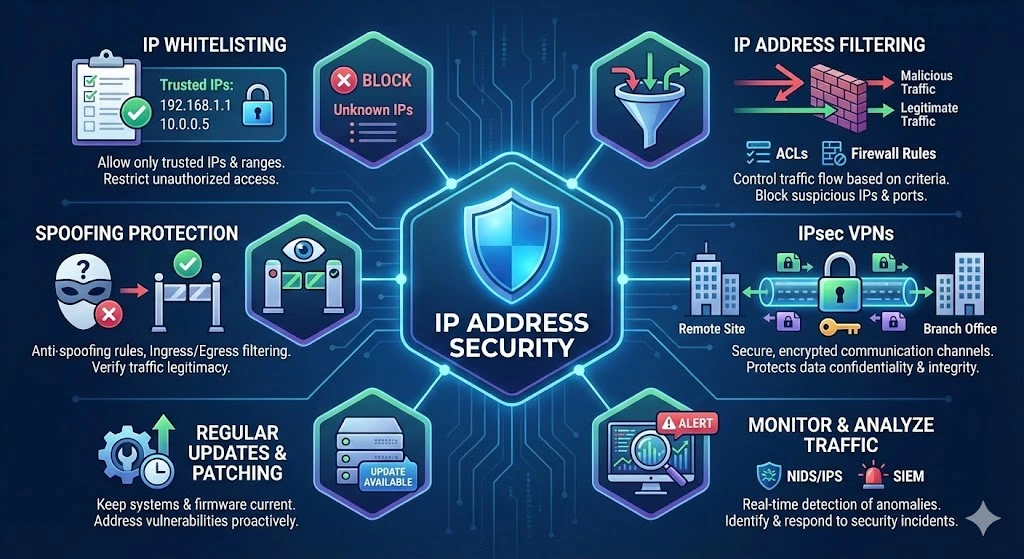
One effective way to enhance IP address security is by implementing IP address whitelisting. Whitelisting involves creating a list of trusted IP addresses or ranges that are allowed to access your network resources. By restricting access to only authorized IP addresses, you can mitigate the risk of unauthorized access and malicious activity.
Utilize IP Address Filtering
IP address filtering allows you to control the flow of traffic to and from your network based on specific criteria, such as source or destination IP addresses, protocols, and ports. By configuring firewall rules and access control lists (ACLs) to filter incoming and outgoing traffic, you can block suspicious IP addresses, prevent unauthorized access attempts, and filter out malicious traffic.
Enable IP Address Spoofing Protection
IP address spoofing is a common technique attackers use to disguise their identity and bypass network security measures. To prevent IP address spoofing attacks, it is essential to enable IP address spoofing protection mechanisms, such as ingress and egress filtering, anti-spoofing rules, and network ingress validation. These measures help verify the legitimacy of incoming and outgoing traffic, preventing spoofed IP addresses from infiltrating your network.
Deploy IPsec VPNs for Secure Communication
IPsec (Internet Protocol Security) VPNs (Virtual Private Networks) provide a secure and encrypted communication channel for transmitting data over IP networks. By deploying IPsec VPNs, you can establish secure connections between remote sites, branch offices, or individual devices, ensuring the confidentiality, integrity, and authenticity of transmitted data. IPsec VPNs protect against eavesdropping, data tampering, and man-in-the-middle attacks, making them an essential component of IP address security.
Regularly Update and Patch Systems
Keeping your network infrastructure, operating systems, and network devices up-to-date with the latest security patches and firmware updates is crucial for addressing vulnerabilities and mitigating security risks.
Regularly monitor vendor advisories, security bulletins, and vulnerability databases to identify and remediate potential security vulnerabilities in your IP network components. Additionally, establish a proactive patch management process to ensure the timely deployment of patches and updates across your network infrastructure.
Monitor and Analyze IP Traffic
Effective IP address security requires continuous monitoring and analysis of IP traffic to detect and respond to security incidents in real time.
Implement network intrusion detection systems (NIDS), intrusion prevention systems (IPS), and security information and event management (SIEM) solutions to monitor network traffic, detect suspicious activities, and generate alerts for potential security threats.
By analyzing IP traffic patterns, anomalies, and security events, you can identify and mitigate security breaches, unauthorized access attempts, and malicious activities on your IP network.
Part 2: How to secure IP address in a brief
Securing your IP addresses is a critical aspect of maintaining a secure and resilient network infrastructure. By implementing robust security measures such as IP address whitelisting, filtering, spoofing protection, VPNs, patch management, and traffic monitoring, you can effectively safeguard your IP network against cyber threats, unauthorized access, and data breaches.
Trusted IPv4 Leasing for Business Growth
Get enterprise-grade IPv4 space quickly, with seamless deployment and end-to-end management.
Get Started with i.leaseFAQs
What is the difference between IP Security (IPsec) and a standard Firewall?
A firewall is a gatekeeper that allows or blocks traffic based on rules (ports, IPs, protocols). IPsec, however, is a suite of protocols that provides security at the IP layer by encrypting the data and authenticating the sender. While a firewall prevents unauthorized entry, IPsec ensures that even if traffic is intercepted, it cannot be read or altered.
Does securing an IP network cause latency or slow down internet speeds?
Yes, introducing security layers like Deep Packet Inspection (DPI) or Encryption (VPN/IPsec) adds “overhead” because the hardware must process and decrypt every packet. To mitigate this, businesses should use high-performance hardware with dedicated encryption chips or Next-Generation Firewalls (NGFW) designed to handle high-throughput traffic without significant lag.
How can I protect my network from IP Spoofing attacks?
The most effective way to prevent IP Spoofing is by implementing Ingress and Egress Filtering. This ensures that incoming packets have a source IP that matches their actual entry point and outgoing packets don’t have “fake” internal addresses. Modern routers can automate this using Unicast Reverse Path Forwarding (uRPF).
Related Posts

What Is a /24 IPv4 Subnet and Why Is It Popular for Leasing?
A /24 IPv4 subnet is one of the most common block sizes in the IPv4 leasing market. For hosting providers, SaaS platforms, VPN operators, ISPs, cloud infrastructure teams, and enterprises, it offers a practical balance between address capacity, routing usability, and cost control. As IPv4 scarcity continues, businesses are no longer treating IP addresses as simple technical resources. IPv4 space has become operational infrastructure. The question is no longerRead more Related Posts What Is a /24 IPv4 Subnet and Why Is It Popular for Leasing? A /24 IPv4 subnet is one of the most common block sizes in the IPv4 leasing market. For hosting providers, How to Avoid Downtime When Deploying Leased IPv4 Blocks Leased IPv4 blocks are often used by hosting providers, cloud platforms, ISPs, SaaS companies, data centers, and enterprise networks that Rent IPv4 Addresses: The Enterprise Guide to Building Long-Term IPv4 Continuity If you're looking to rent IPv4 addresses, you're not alone.Businesses worldwide continue to need IPv4 resources to support growth, expand .related-post {} .related-post .post-list { text-align: left; } .related-post .post-list .item { margin: 5px; padding: 10px; } .related-post .headline { font-size: 18px !important; color: #999999 !important; } .related-post .post-list .item .post_thumb { max-height: 220px; margin: 10px 0px; padding: 0px; display: block; } .related-post .post-list .item .post_title { font-size: 16px; color: #3f3f3f; margin: 10px 0px; padding: 0px; display: block; text-decoration: none; } .related-post .post-list .item .post_excerpt { font-size: 13px; color: #3f3f3f; margin: 10px 0px; padding: 0px; display: block; text-decoration: none; } @media only screen and (min-width: 1024px) { .related-post .post-list .item { width: 30%; } } @media only screen and (min-width: 768px) and (max-width: 1023px) { .related-post .post-list .item { width: 90%; } } @media only screen and (min-width: 0px) and (max-width: 767px) { .related-post .post-list .item { width: 90%; } }

How to Avoid Downtime When Deploying Leased IPv4 Blocks
Leased IPv4 blocks are often used by hosting providers, cloud platforms, ISPs, SaaS companies, data centers, and enterprise networks that need public IPv4 resources without purchasing address space outright. Leasing can be a practical way to support infrastructure growth, customer services, migration projects, and temporary deployment needs. However, getting access to IPv4 space is only the first step. The real challenge is deploying the leased IPv4 block without causingRead more Related Posts What Is a /24 IPv4 Subnet and Why Is It Popular for Leasing? A /24 IPv4 subnet is one of the most common block sizes in the IPv4 leasing market. For hosting providers, How to Avoid Downtime When Deploying Leased IPv4 Blocks Leased IPv4 blocks are often used by hosting providers, cloud platforms, ISPs, SaaS companies, data centers, and enterprise networks that Rent IPv4 Addresses: The Enterprise Guide to Building Long-Term IPv4 Continuity If you're looking to rent IPv4 addresses, you're not alone.Businesses worldwide continue to need IPv4 resources to support growth, expand .related-post {} .related-post .post-list { text-align: left; } .related-post .post-list .item { margin: 5px; padding: 10px; } .related-post .headline { font-size: 18px !important; color: #999999 !important; } .related-post .post-list .item .post_thumb { max-height: 220px; margin: 10px 0px; padding: 0px; display: block; } .related-post .post-list .item .post_title { font-size: 16px; color: #3f3f3f; margin: 10px 0px; padding: 0px; display: block; text-decoration: none; } .related-post .post-list .item .post_excerpt { font-size: 13px; color: #3f3f3f; margin: 10px 0px; padding: 0px; display: block; text-decoration: none; } @media only screen and (min-width: 1024px) { .related-post .post-list .item { width: 30%; } } @media only screen and (min-width: 768px) and (max-width: 1023px) { .related-post .post-list .item { width: 90%; } } @media only screen and (min-width: 0px) and (max-width: 767px) { .related-post .post-list .item { width: 90%; } }

Understanding RIR Transfer Rules Across Regions
Understanding RIR Transfer Rules Across Regions IPv4 addresses have become valuable operational assets. For ISPs, hosting providers, cloud platforms, enterprises, and network operators, obtaining IPv4 space is no longer just a technical task. It often involves policy review, registry approval, documentation, and regional compliance. At the center of this process are the five Regional Internet Registries, commonly known as RIRs: ARIN RIPE NCC APNIC LACNIC AFRINIC Each RIR managesRead more Related Posts What Is a /24 IPv4 Subnet and Why Is It Popular for Leasing? A /24 IPv4 subnet is one of the most common block sizes in the IPv4 leasing market. For hosting providers, How to Avoid Downtime When Deploying Leased IPv4 Blocks Leased IPv4 blocks are often used by hosting providers, cloud platforms, ISPs, SaaS companies, data centers, and enterprise networks that Rent IPv4 Addresses: The Enterprise Guide to Building Long-Term IPv4 Continuity If you're looking to rent IPv4 addresses, you're not alone.Businesses worldwide continue to need IPv4 resources to support growth, expand .related-post {} .related-post .post-list { text-align: left; } .related-post .post-list .item { margin: 5px; padding: 10px; } .related-post .headline { font-size: 18px !important; color: #999999 !important; } .related-post .post-list .item .post_thumb { max-height: 220px; margin: 10px 0px; padding: 0px; display: block; } .related-post .post-list .item .post_title { font-size: 16px; color: #3f3f3f; margin: 10px 0px; padding: 0px; display: block; text-decoration: none; } .related-post .post-list .item .post_excerpt { font-size: 13px; color: #3f3f3f; margin: 10px 0px; padding: 0px; display: block; text-decoration: none; } @media only screen and (min-width: 1024px) { .related-post .post-list .item { width: 30%; } } @media only screen and (min-width: 768px) and (max-width: 1023px) { .related-post .post-list .item { width: 90%; } } @media only screen and (min-width: 0px) and (max-width: 767px) { .related-post .post-list .item { width: 90%; } }