What is SSH? | Secure Shell (SSH) Protocol

Securing communications between devices is important, especially when managing remote systems. One of the most widely used and trusted protocols for secure remote access is SSH (Secure Shell). This article will dive into what SSH is, how it works, and why it’s so important for network security.
Table of Contents
What is SSH?
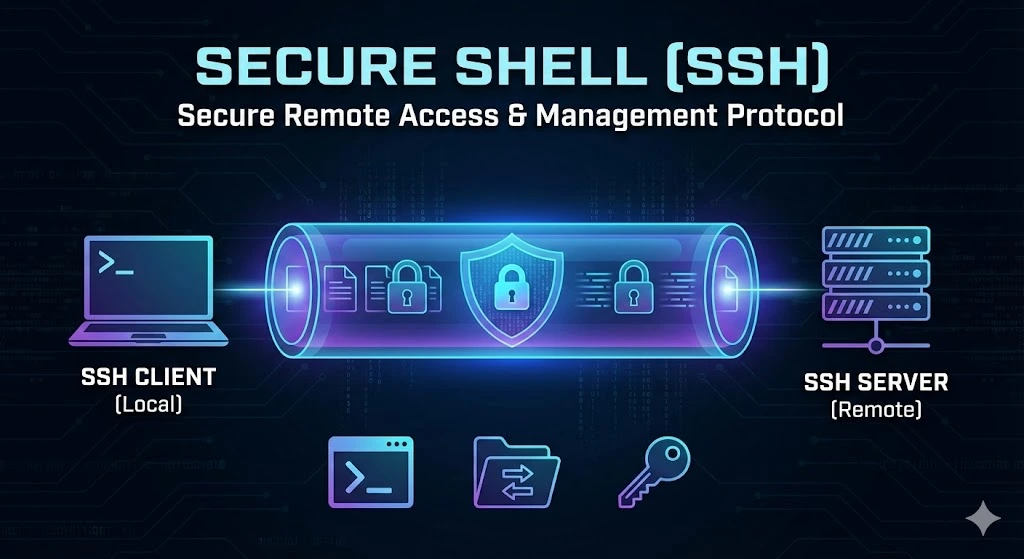
SSH (Secure Shell) is a network protocol that allows users to access and manage remote computers securely over an unsecured network, such as the Internet. SSH encrypts the communication between the client (your computer) and the remote server, ensuring that sensitive data like login credentials and commands cannot be intercepted by third parties.
It is a preferred method for system administrators, developers, and IT professionals to control remote servers and devices, providing a safer alternative to older protocols like Telnet, which send data in plain text.
How SSH Works
SSH operates using a client-server model, meaning a user connects from their local device (client) to a remote machine (server). Here’s how the process typically works:
Firstly, Establishing Connection: The user initiates a connection by using an SSH client (software) to communicate with the SSH server running on the remote machine.
Secondly, Authentication: The server authenticates the client using one of several methods, including password-based authentication or public key authentication. Once the authentication is successful, the user gains access to the server.
Thirdly, Encryption: During the session, all data transferred between the client and the server is encrypted, ensuring that even if someone intercepts the data, they cannot read or modify it.
Key Features of Secure Shell Protocols
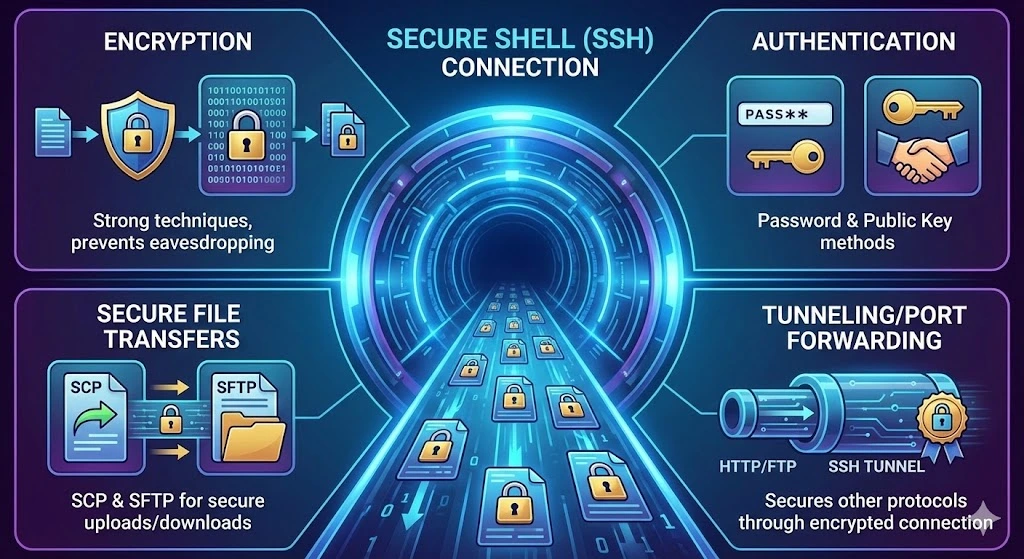
Encryption: SSH uses strong encryption techniques to ensure that all data exchanged between the client and the server is secure. This prevents eavesdropping and tampering by malicious actors.
Authentication: SSH supports several methods of authentication, including password authentication and public Key Authentication.
Secure File Transfers: SSH supports secure file transfers using protocols like SCP (Secure Copy) and SFTP (Secure File Transfer Protocol). This allows users to upload or download files to and from the remote server without worrying about security risks.
Tunneling/Port Forwarding: SSH can securely “tunnel” other protocols (such as HTTP or FTP) through the encrypted SSH connection, enabling secure communication for otherwise unsecured applications.
Common uses of SSH
SSH is primarily used for remote login, enabling system administrators and developers to access and manage remote machines anywhere securely. In addition, SSH is commonly used for file transfers, allowing users to securely move files between a local machine and a remote server using tools like SCP or SFTP.
Another important use of SSH is in automating tasks, such as deploying code, running scripts, or performing backups on remote systems. Additionally, SSH can be used for tunneling services, securely routing insecure network traffic through an encrypted connection to protect sensitive data.
Trusted IPv4 Leasing for Business Growth
Get enterprise-grade IPv4 space quickly, with seamless deployment and end-to-end management.
Get Started with i.leaseFAQs
What is the default port for SSH, and should I change it?
The default port for SSH is Port 22. It is highly recommended to change this default port to a custom number (e.g., 2222 or 1022) on your server. This simple security measure, known as “security through obscurity,” helps reduce the number of automated brute-force attacks and unauthorized login attempts from bots scanning for open default ports.
What is the difference between SSH and Telnet?
The main difference is security. Telnet transmits data, including usernames and passwords, in plain text, meaning anyone intercepting the network traffic can read the credentials. SSH (Secure Shell) uses encryption to scramble data during transmission, making it unreadable to hackers. SSH effectively replaced Telnet for this reason.
Is SSH the same as a VPN?
No, they serve different purposes. SSH is primarily used to securely access and manage a specific remote computer or server via a command line. A VPN (Virtual Private Network) encrypts the internet traffic for an entire device or network, effectively masking your location and securing all browser and app activity. However, SSH tunneling can mimic some VPN features by routing traffic through a secure server.
Can SSH be used on Windows?
Yes. While SSH is native to Linux and macOS terminals, Windows users can use SSH via Windows PowerShell, the Command Prompt (in newer versions of Windows 10/11), or by using third-party clients like PuTTY or MobaXterm.
Related Posts

Running-Code Primacy: Why IPv4 Leasing Should Be Judged by Operational Proof
IPv4 leasing often begins with a simple question: Can this provider give us the addresses? But for businesses that depend on IPv4 for hosting, VPN, SaaS, cloud, telecom, security, email delivery, or customer-facing platforms, that question is not enough. A better question is: Can this IPv4 structure prove that it works operationally? That is where Running-Code Primacy matters. Running-Code Primacy means that live operational reality should come before institutionalRead more Related Posts IPv4 Poverty Penalty: Why Small Networks Pay More IPv4 access can look equal on paper.The same registry forms.The same transfer rules.The same provider contracts.The same compliance language.The same Read more IPv4 Renewal Risk: When Weak Accountability Becomes Running-Code Betrayal Who is actually responsible for keeping this IPv4 access alive? Not who sold it.Not who introduced it.Not who issued the Read more Why self-holding can expose IPv4 assets to registry risk Self-holding IPv4 assets increases exposure to registry risk as compliance responsibility, transfer validation, and governance pressure are concentrated internally.Key points Self-holding Read more .related-post {} .related-post .post-list { text-align: left; } .related-post .post-list .item { margin: 5px; padding: 10px; } .related-post .headline { font-size: 18px !important; color: #999999 !important; } .related-post .post-list .item .post_thumb { max-height: 220px; margin: 10px 0px; padding: 0px; display: block; } .related-post .post-list .item .post_title { font-size: 16px; color: #3f3f3f; margin: 10px 0px; padding: 0px; display: block; text-decoration: none; } .related-post .post-list .item .post_excerpt { font-size: 13px; color: #3f3f3f; margin: 10px 0px; padding: 0px; display: block; text-decoration: none; } @media only screen and (min-width: 1024px) { .related-post .post-list .item { width: 30%; } } @media only screen and (min-width: 768px) and (max-width: 1023px) { .related-post .post-list .item { width: 90%; } } @media only screen and (min-width: 0px) and (max-width: 767px) { .related-post .post-list .item { width: 90%; } }

IPv4 Poverty Penalty: Why Small Networks Pay More
IPv4 access can look equal on paper. The same registry forms.The same transfer rules.The same provider contracts.The same compliance language.The same renewal process. But equal paperwork does not always create equal outcomes. For large operators, IPv4 friction may be manageable. They may have legal teams, policy staff, network engineers, compliance support, capital reserves, and enough customers to spread the cost of delay across a larger business. For smaller operators,Read more Related Posts مخاطر تجديد بروتوكول IPv4: عندما تتحول المساءلة الضعيفة إلى خيانة في تنفيذ التعليمات البرمجية من المسؤول فعليًا عن إبقاء هذا الوصول إلى IPv4 قائمًا؟ ليس من باعه.وليس من قدّمه لك.وليس من أصدر الفاتورة.وليس من Read more Riesgo de renovación de IPv4: Cuando la falta de rendición de cuentas se convierte en traición al código en ejecución ¿Quién es realmente responsable de mantener vivo este acceso IPv4? No quién lo vendió.No quién lo presentó.No quién emitió la Read more Running-Code Primacy: Why IPv4 Leasing Should Be Judged by Operational Proof IPv4 leasing often begins with a simple question:Can this provider give us the addresses?But for businesses that depend on IPv4 Read more .related-post {} .related-post .post-list { text-align: left; } .related-post .post-list .item { margin: 5px; padding: 10px; } .related-post .headline { font-size: 18px !important; color: #999999 !important; } .related-post .post-list .item .post_thumb { max-height: 220px; margin: 10px 0px; padding: 0px; display: block; } .related-post .post-list .item .post_title { font-size: 16px; color: #3f3f3f; margin: 10px 0px; padding: 0px; display: block; text-decoration: none; } .related-post .post-list .item .post_excerpt { font-size: 13px; color: #3f3f3f; margin: 10px 0px; padding: 0px; display: block; text-decoration: none; } @media only screen and (min-width: 1024px) { .related-post .post-list .item { width: 30%; } } @media only screen and (min-width: 768px) and (max-width: 1023px) { .related-post .post-list .item { width: 90%; } } @media only screen and (min-width: 0px) and (max-width: 767px) { .related-post .post-list .item { width: 90%; } }

IPv4 Renewal Risk: When Weak Accountability Becomes Running-Code Betrayal
Who is actually responsible for keeping this IPv4 access alive? Not who sold it.Not who introduced it.Not who issued the invoice.Not who sent the first LOA. Who owns the renewal risk when the relationship becomes stressed, the upstream source changes position, the documentation is questioned, or the provider chain no longer responds? For businesses that depend on IPv4 for hosting, SaaS, VPN, telecom, cloud, security, email delivery, or customerRead more Related Posts IPv4 Poverty Penalty: Why Small Networks Pay More IPv4 access can look equal on paper.The same registry forms.The same transfer rules.The same provider contracts.The same compliance language.The same Read more IPv4 Renewal Risk: When Weak Accountability Becomes Running-Code Betrayal Who is actually responsible for keeping this IPv4 access alive? Not who sold it.Not who introduced it.Not who issued the Read more Why self-holding can expose IPv4 assets to registry risk Self-holding IPv4 assets increases exposure to registry risk as compliance responsibility, transfer validation, and governance pressure are concentrated internally.Key points Self-holding Read more .related-post {} .related-post .post-list { text-align: left; } .related-post .post-list .item { margin: 5px; padding: 10px; } .related-post .headline { font-size: 18px !important; color: #999999 !important; } .related-post .post-list .item .post_thumb { max-height: 220px; margin: 10px 0px; padding: 0px; display: block; } .related-post .post-list .item .post_title { font-size: 16px; color: #3f3f3f; margin: 10px 0px; padding: 0px; display: block; text-decoration: none; } .related-post .post-list .item .post_excerpt { font-size: 13px; color: #3f3f3f; margin: 10px 0px; padding: 0px; display: block; text-decoration: none; } @media only screen and (min-width: 1024px) { .related-post .post-list .item { width: 30%; } } @media only screen and (min-width: 768px) and (max-width: 1023px) { .related-post .post-list .item { width: 90%; } } @media only screen and (min-width: 0px) and (max-width: 767px) { .related-post .post-list .item { width: 90%; } }