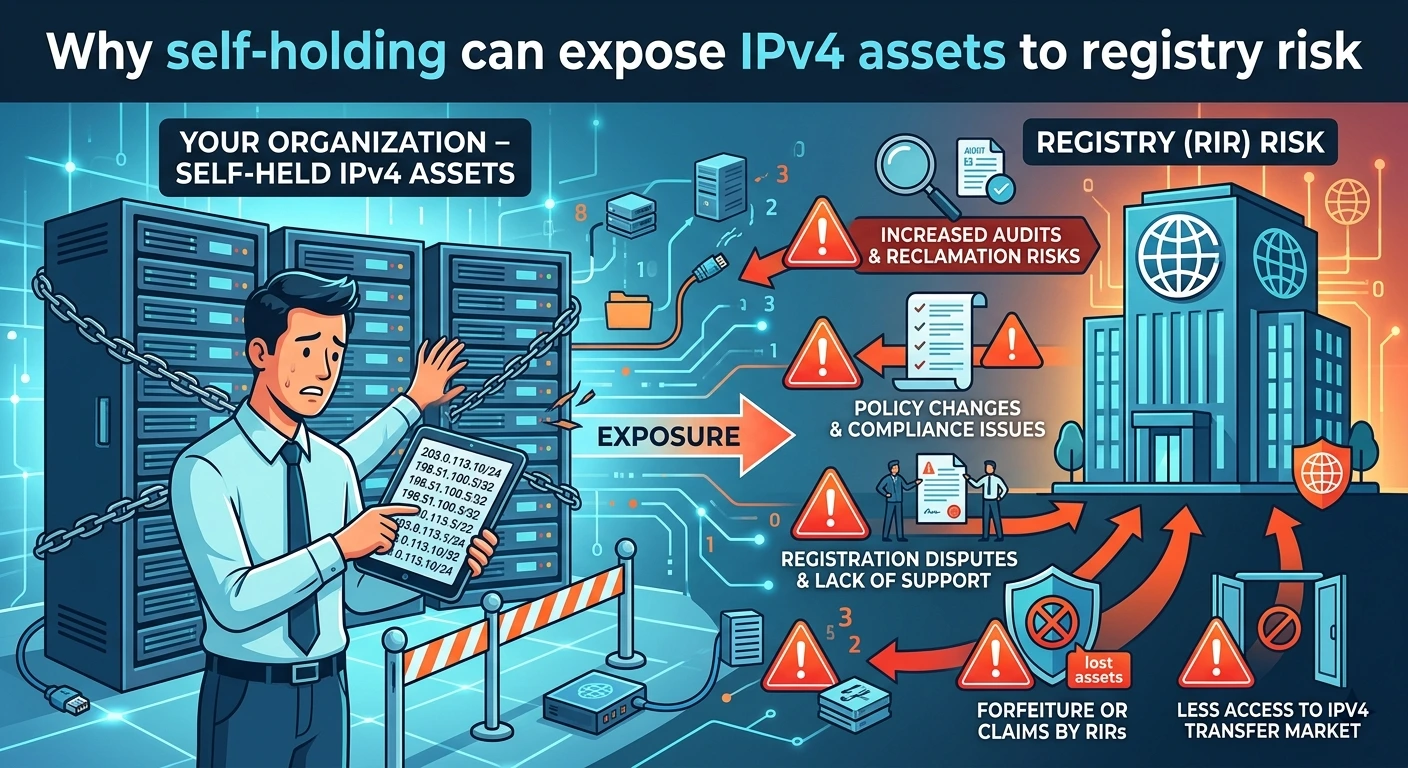
Self-holding IPv4 assets increases exposure to registry risk as compliance responsibility, transfer validation, and governance pressure are concentrated internally.
Table of Contents
Key points
- Self-holding IPv4 assets concentrate registry compliance responsibility, increasing exposure to audits, transfer validation issues, and documentation gaps.
- As IPv4 scarcity grows, registry governance becomes stricter, making ownership structure a key factor in operational risk.
IPv4 ownership is now defined by governance, not possession
IPv4 addresses are no longer simply technical resources assigned for connectivity. In today’s internet infrastructure, they operate under strict governance frameworks managed by Regional Internet Registries (RIRs), where usage, ownership records, and transfers must remain continuously verifiable.
This shift means that holding IPv4 assets is not just about control, but about maintaining ongoing compliance with registry systems.
As a result, the structure of ownership has become just as important as the assets themselves.
What self-holding IPv4 assets actually means
Self-holding refers to organisations directly managing their IPv4 allocations within RIR systems, without relying on third-party leasing or managed intermediaries.
This model gives full operational control, including routing decisions and internal allocation. However, it also means that all registry obligations sit entirely within the organisation, including:
- Maintaining accurate WHOIS and RDAP records
- Ensuring organisational identity consistency
- Managing historical allocation documentation
- Handling transfer approvals and validations
In practice, this creates a direct link between internal governance and external registry compliance.
Registry systems are becoming more enforcement-driven
RIRs such as RIPE NCC, ARIN, APNIC, LACNIC, and AFRINIC operate under policy frameworks designed to ensure global routing stability and resource legitimacy.
Over time, these systems have become more enforcement-oriented, particularly due to:
- IPv4 exhaustion and limited availability
- Increased secondary market transfers
- Greater focus on routing security and abuse prevention
Registry operators now place stronger emphasis on verifying that address space is:
- Properly registered
- Actively justified
- Consistently documented across its lifecycle
This increases the importance of accurate and up-to-date registry data.
Why self-holding increases registry exposure
While self-holding provides direct control, it also concentrates responsibility. This creates a structural condition where any mismatch between operational usage and registry records becomes immediately exposed at the organisational level.
In other words, registry compliance is no longer distributed across providers or intermediaries—it is fully internalised.
This leads to several practical risks:
1. Documentation dependency
IPv4 assets often have long and complex histories. Without complete documentation, organisations may struggle to prove:
- Allocation origin
- Transfer legitimacy
- Continuity of usage
2. Audit sensitivity
Registry systems may request verification during:
- Transfers
- Policy updates
- Dispute resolution
- Routine compliance checks
Incomplete records can delay or block these processes.
3. Operational vs registry mismatch
In some cases, IP usage evolves faster than registry updates. This creates discrepancies that may trigger compliance reviews or corrections.
IPv4 scarcity intensifies governance pressure
- As IPv4 exhaustion continues globally, address space has become increasingly valuable and tightly managed. This has led to:
- Expansion of secondary transfer markets
- Greater scrutiny of ownership chains
- Increased focus on historical legitimacy
Registry systems are now designed not only to allocate resources, but also to validate their ongoing legitimacy across time.
This naturally increases compliance overhead for directly held assets.
Transfer markets add another layer of validation
IPv4 transfers are now a standard part of address lifecycle management. However, each transfer introduces additional verification requirements.
These include:
- Confirming ownership eligibility
- Validating previous allocation history
- Ensuring policy compliance across regions
- Updating registry databases accurately
As transfer activity increases, so does the need for precise and consistent documentation.
This makes registry accuracy a continuous requirement rather than a one-time process.
Legacy allocations increase complexity
Many organisations still hold legacy IPv4 space allocated before modern RIR policies were fully established.
These allocations may lack:
- Complete historical records
- Updated organisational contact data
- Clear transfer chains
When self-held, these gaps become the responsibility of the holder to resolve, especially during audits or changes in usage.
The core trade-off in self-holding IPv4 assets
The key tension in self-holding models is not about control, but about risk concentration.
On one side, organisations gain:
- Full operational autonomy
- Direct control over routing and allocation
- Independence from external leasing models
On the other side, they assume:
- Full registry compliance responsibility
- Continuous documentation obligations
- Direct exposure to audit and policy enforcement
This creates a structural trade-off between autonomy and administrative burden.
Self-Holding and Sovereignty Inversion
Self-holding can create the impression that the business fully controls its IPv4 future. The company holds the resources directly, manages routing decisions, and keeps the address space inside its own operating structure.
But direct holding does not automatically remove every control risk. This is where Sovereignty Inversion becomes relevant in practical business terms: the business may operate the network, finance the infrastructure, serve the customers, and depend on the IPv4 assets every day, while key control points such as registry recognition, transfer validation, documentation review, and administrative standing still sit above the business.
In other words, the company may hold the IPv4 assets, but the conditions that keep those assets recognized, transferable, and administratively stable may still depend on systems the company does not fully control.
This does not mean self-holding is always wrong. For some organizations, direct IPv4 holding may be appropriate. The issue is whether the organization has the legal, registry, documentation, routing, compliance, and continuity capacity to absorb the full exposure internally.
If that capacity is weak, self-holding can create a form of Double Extraction. The business carries the asset and funds the infrastructure, but it also carries the full downside if registry checks, documentation gaps, transfer issues, policy changes, or administrative disputes affect the address space.
That is why self-holding should not be judged only by control. It should be judged by whether the business can sustain continuous registry alignment, routing readiness, documentation quality, and operational continuity over time.
Conclusion
Self-holding IPv4 assets does not eliminate registry risk—it consolidates it.
As IPv4 governance systems become more structured and enforcement-driven, the accuracy of registry data and the ability to maintain compliance over time have become central to operational stability.
In this environment, IPv4 ownership is increasingly defined not by possession, but by the ability to sustain continuous alignment with registry requirements.
Frequently Asked Questions
1. What is registry risk in IPv4 assets?
IPv4 shock-absorber risk happens when a business carries the real operational, financial, or customer-facing damage from IPv4 problems, even when the source of the issue comes from a provider, registry process, contract term, or upstream dependency.
2. Why does self-holding increase IPv4 risk?
Because all compliance responsibilities are concentrated within the organisation rather than distributed across intermediaries.
3. Are IPv4 addresses permanent assets?
No. IPv4 allocations are governed resources that require ongoing compliance with RIR policies.
4. How does IPv4 scarcity affect registry governance?
Scarcity increases transfer activity and regulatory scrutiny, making registry accuracy more critical.
5. What is the main trade-off in self-holding IPv4?
It balances operational control against increased compliance and registry management responsibility.