IPv4 /24 price in 2026: the short answer
A /24 contains 256 total IPv4 addresses, but it does not have one universal purchase or lease price. One provider's report published on 2 July 2026 says its Q2 sample contained 312 reported transactions covering 1,660,928 addresses at an average of $20.16 per address. Multiplying that sample average by 256 gives $5,160.96 for the address-price component of a /24.
$20.16 × 256 = $5,160.96. This is a dated market sample, not a live quote, appraisal, completed price for a particular prefix, or total acquisition cost. The source, block size, registry region, currency, eligibility, history, payment terms, and included services can materially change a real offer. Ask for the exact CIDR and a validity date before budgeting.
A second provider's Q2 2026 report gives a useful cross-check rather than a universal range: its small-block category covered /24 through /22 and reported 25.0 EUR per address for RIPE NCC, 21.3 EUR for ARIN, and 20.3 EUR for APNIC. Keep those regional, currency, size-band, and methodology labels attached. Do not blend the USD and EUR observations into a single “market price.”
What does a /24 IPv4 block include?
Classless Inter-Domain Routing notation uses the prefix length to identify how many address bits describe the network. An IPv4 address has 32 bits, so a /24 leaves eight bits for values inside the prefix: 28 = 256 total addresses. That arithmetic does not mean every deployment can assign all 256 to customer workloads.
Subnet design can reserve network, broadcast, gateway, infrastructure, failover, or operational addresses. A provider may also impose a different usable-address model. A /24 is often considered for independent routing because many operators filter more-specific IPv4 announcements, but no prefix length guarantees global acceptance, propagation, valid RPKI state, or application reachability. Confirm upstream policy and test the exact route.
Before comparing prices, write down whether the requirement is one contiguous /24, 256 total addresses, a smaller number of usable endpoints, or several prefixes. Those are different requirements and can produce different quotes, transfer paths, and operating costs.
Dated 2026 IPv4 price benchmarks
Published market reports can establish a budget starting point only when their scope remains visible. RIR transfer logs can show that registration changed, but they generally do not disclose confidential commercial consideration. The two reports below describe provider datasets, so treat them as observations from those providers rather than an authoritative index.
| Source and publication date | Reported scope | Reported observation | Safe use |
|---|---|---|---|
| IPv4Center, 2 July 2026 | Provider-reported Q2 sample of 312 transactions and 1,660,928 addresses across sizes and regions | $20.16 average per address; multiplying by 256 gives $5,160.96 | Budget scenario only; not a /24 quote, universal average, or proof of one completed price |
| IPv4market.eu, Q2 2026 | Provider-reported /24–/22 category split by RIR region | 25.0 EUR for RIPE NCC, 21.3 EUR for ARIN, and 20.3 EUR for APNIC per address | Regional cross-check with EUR, size-band, period, and provider methodology preserved |
Why do the figures differ? They do not describe exactly the same population. One is a blended USD sample across transaction sizes and regions; the other is a EUR small-block category split by region. A quote for one /24 may sit above or below either observation because the exact resource, counterparties, contract, timing, and services differ.
For historical trends rather than a current purchasing decision, use the IPv4 price history guide. It explains how changing sample composition and block size affect comparisons. Return to this page when the task is to normalize an exact /24 quote.
How to calculate a /24 purchase quote
Start with the seller or broker's actual unit. If the quote is per address and covers the entire prefix, the arithmetic is:
Quoted prefix price = per-address quote × 256.
If the offer already states one price for the whole CIDR, do not multiply it again. Record the currency, tax treatment, evidence date, validity window, exact CIDR, source and recipient RIRs, transfer type, and what the figure includes. An asking price is not an accepted offer, an accepted offer is not a completed registry transfer, and a registry transfer does not prove that every operating handover is finished.
The $5,160.96 example above is intentionally narrow: it multiplies one Q2 2026 sampled average by 256. It excludes every fee and case-specific adjustment below. Use the IPv4 cost calculator with the real quote, then keep the calculation alongside the source evidence so reviewers can reproduce it.
What belongs in the all-in /24 purchase cost?
All-in purchase cost means the quoted prefix price plus the transaction and operating work required to make the exact resource usable. Some rows may be zero, bundled, paid by the other party, or inapplicable. Confirm responsibility in writing instead of automatically adding a generic percentage.
| Cost input | Evidence to request | Common boundary |
|---|---|---|
| Quoted prefix price | Exact CIDR, unit, currency, date, validity, offer status, and included services | Not proof of eligibility, approval, route acceptance, or completion |
| RIR and account fees | Current official schedule for both source and recipient paths, aggregate holdings, and account type | Fees and billing models differ by RIR, year, transfer type, and party |
| Broker and coordination | Written scope, fee basis, conflicts, milestones, and refund treatment | An intermediary cannot grant registry approval or guarantee timing |
| Escrow and payment | Provider identity, currency conversion, release conditions, disputes, and bank charges | Payment protection does not validate the prefix or contract by itself |
| Legal and tax | Party-specific contract, sanctions, tax, accounting, and jurisdiction review | No universal legal or tax treatment applies to every transaction |
| Network handover | BGP, upstream filters, ROA, IRR, LOA, reverse DNS, geofeed, monitoring, and rollback plan | Registry completion does not perform these operating changes |
| Reputation and remediation | Time-stamped route history, blocklists, abuse records, mail observations, geolocation, and open cases | Third-party observations can be wrong, stale, or change after transfer |
| Integration and renumbering | Inventory, address plan, automation, firewall, allowlist, DNS, certificate, and migration work | The purchase price does not measure internal change effort |
| Continuing operations | Annual registry relationship, monitoring, abuse response, DNS, route security, and staff ownership | Acquisition does not remove ongoing operational responsibility |
A useful worksheet keeps a source, owner, observation date, currency, confidence note, and inclusion status for every line. It also separates one-time cash outlay from recurring annual cost. That prevents a low headline number from hiding a required account relationship, network migration, or unresolved reputation problem.
2026 ARIN fee example
Official registry schedules demonstrate why a generic “transfer fee” range is unreliable. ARIN's schedule effective 1 January 2026 lists a $500 source transfer-request fee for specified-recipient and outbound inter-RIR requests, a $187.50 recipient processing fee for a /24 under the listed NRPM 8.3/8.4 category, and a $275 annual 3X-Small Registration Services Plan category for aggregate IPv4 holdings of /24 or smaller. See the current ARIN fee schedule and the current ARIN transfer requirements.
Do not add every published fee automatically. The applicable party, transfer type, existing account, aggregate holdings, agreement, and current schedule determine which charges apply. The recipient's annual service category is not the seller's price, and a paid fee does not guarantee approval. Recheck the official page at action time because registry schedules can change.
Other regions use different models. RIPE NCC says transfers within its service region are free of charge, while membership, sponsorship, account, or other service costs can still exist. APNIC says an approved transfer can require a recipient transfer fee, subject to its account and NIR rules. Use the RIPE NCC transfer process and APNIC IPv4 transfer guide for the exact path.
Should you buy or lease a /24?
A purchase and a lease grant different rights and create different cash flows. Do not compare a one-time purchase quote with one month of lease rent. Normalize the same 256-address requirement, currency, operating scope, and planning horizon.
| Decision input | Buy and transfer | Lease |
|---|---|---|
| Price unit | Per address or whole prefix, usually a larger initial outlay | Per address per month, whole prefix per month, or contracted term |
| Rights | Registry-recognized holdership changes after the applicable approved transfer | Time-limited contractual use; registry holdership commonly remains with the source |
| Cost formula | Quote plus applicable transaction, integration, and recurring operating costs | Monthly rate × 256 × months, plus setup, routing, support, renewal, and exit costs |
| Control horizon | Can fit durable capacity when the organization can fund and operate the resource | Can fit temporary, uncertain, or staged capacity with a defined return plan |
| Key risk | Eligibility, capital commitment, integration, policy, routing, history, and uncertain future value | Source authority, term, renewal, restrictions, continuity, abuse handling, withdrawal, and return |
| Exit assumption | Do not assume a resale price, eligible buyer, approval, or timetable | Plan renumbering, route withdrawal, data updates, and service continuity before the term ends |
All-in lease cost = monthly lease unit × 256 × number of months + setup, routing, support, renewal, and exit costs. If the provider quotes one whole-prefix monthly price, use it instead of multiplying again. For current recurring-rate methodology, read how much it costs to lease IPv4 addresses.
A simple cash break-even divides the all-in purchase outlay by the all-in monthly lease cost. It is only a screening calculation. A real decision can also include cost of capital, contract flexibility, taxes, staffing, changing demand, IPv6 migration, continuity risk, and an intentionally conservative or zero resale assumption.
How to compare two /24 quotes
- Match the unit. Convert only after identifying per-address, per-prefix, per-month, or per-term pricing.
- Match the date and currency. Record the evidence date, quote expiry, exchange-rate source, and tax basis.
- Match the resource. Require the exact CIDR, RIR status, registered organization, prefix history, and proposed transfer path.
- Match the service scope. Identify who handles registry coordination, escrow, documents, route objects, ROAs, reverse DNS, geofeed, monitoring, and post-transfer support.
- Match the acceptance criteria. Define required evidence, permitted history, routing tests, payment milestones, rejection treatment, and fallback before choosing the lower number.
- Match the operating horizon. Compare one-time and recurring costs across the same months and include migration at both the start and the end.
Do not pay a premium for labels such as “premium” or “ready” without measurable criteria. Ask which observation, source, timestamp, threshold, and limitation supports the label. A blocklist check alone does not establish authority, routing acceptance, geolocation accuracy, mail deliverability, or future reputation.
Verify transfer eligibility before negotiating price
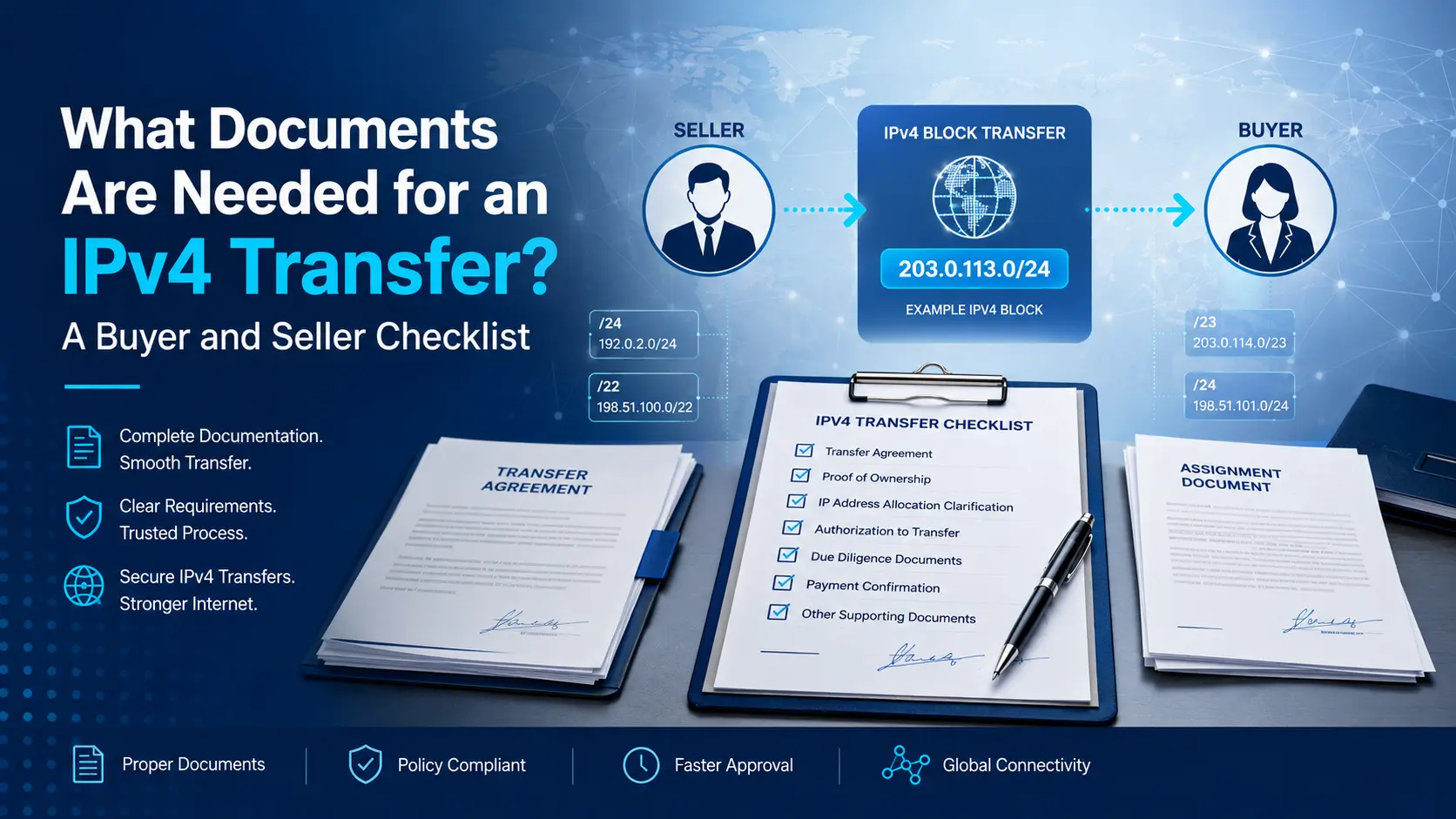
A low price is irrelevant if the resource cannot follow the proposed registry path. Identify the source and recipient organizations, current RIR, resource status, prior-transfer restrictions, contractual relationships, disputes, liens or commitments, current use, and the person authorized to act. Obtain pre-approval where the registry offers it and where it fits the case.
ARIN states that transfer requests must meet its policy requirements and that recipients may need to demonstrate need. RIPE NCC explains that intra-region and inter-RIR scenarios have different requirements and that both RIRs must approve an inter-RIR transfer. APNIC requires source and recipient entities to meet its transfer criteria. The applicable policy is current operational evidence, not a broker's summary or an old checklist.
A registered holder is not automatically a seller, and a seller's commercial contract is not registry approval. Conversely, registry approval updates registration records but does not settle every private representation, payment dispute, route, geolocation feed, or application dependency. Keep commercial closing and technical acceptance as linked but distinct milestones.
Plan routing, RPKI, DNS, and reputation handover
The purchase is not usable merely because a registry record changed. Name the current and intended origin ASN, upstreams, accepted prefix lengths, route window, ROA owner, IRR maintainer, LOA status, reverse-DNS authority, geofeed owner, monitoring views, and rollback actor. Sequence removal and creation so the old route does not disappear before the replacement is accepted and so conflicting authority does not remain indefinitely.
Check RDAP or Whois, BGP origin and history, RPKI state, IRR objects, reverse DNS, geolocation sources, public blocklists, mail-provider observations where relevant, abuse contacts, and open complaints. Save timestamps and raw evidence. Reputation is a changing set of third-party observations, not a permanent property transferred with the prefix.
RFC 4632 defines CIDR behavior and route aggregation, but standards compliance does not force every network to accept one announcement. See RFC 4632 and the IANA IPv4 address-space registry for protocol and top-level registration context. Then validate the exact prefix from independent operational views.
What to include in a /24 purchase request
- One /24 or another exact quantity, including whether multiple prefixes are acceptable.
- Source and recipient RIR regions, recipient organization readiness, and any pre-approval.
- Intended workload, prohibited uses, geography, origin ASN, upstream, start date, and migration deadline.
- Per-address or whole-prefix budget unit, currency, tax basis, evidence date, and quote validity needed.
- Minimum authority, registration, routing, RPKI, IRR, DNS, geolocation, reputation, and abuse evidence.
- Broker, escrow, legal, payment, registry, and operating tasks that must be included or itemized.
- Acceptance tests, rejection rights, payment-release milestones, fallback, and post-transfer support period.
Use the IPv4 purchase request to submit those facts. Current marketplace listings can help with discovery, but a listing is not a reservation, accepted quote, authority proof, or transfer approval.
IPv4 /24 cost FAQ
How much does a /24 IPv4 block cost in 2026?
There is no universal price. IPv4Center's Q2 2026 provider sample reported a $20.16 per-address average; multiplying by 256 gives $5,160.96. That is a dated budget example, not a live /24 quote or total cost. Obtain an exact CIDR quote and add applicable transaction and operating costs.
How many IP addresses are in a /24?
A /24 contains 256 total IPv4 addresses because eight of the 32 address bits remain after the 24-bit prefix. Usable workload capacity can be lower after network, broadcast, gateway, infrastructure, or provider reservations.
What is the IPv4 price per address in 2026?
No authoritative global price exists. Two provider reports for Q2 2026 published different scoped observations: a $20.16 blended per-address sample and regional /24–/22 averages of 25.0 EUR for RIPE NCC, 21.3 EUR for ARIN, and 20.3 EUR for APNIC. Preserve source, date, currency, region, and block-size scope.
How much does it cost to lease a /24 per month?
There is no universal monthly rate. Ask whether the quote is per address per month or for the whole prefix, then include setup, routing, support, minimum term, renewal, deposit, abuse response, and exit costs. Compare the same 256-address requirement and period with a purchase.
Is an asking price the same as a completed IPv4 transaction?
No. A listing or asking price can change during diligence and negotiation. An accepted offer still depends on contract, payment conditions, registry eligibility and approval, and operating handover. Record the stage represented by every figure.
Why can a /24 cost more per address than a larger block?
Some buyers need a smaller total commitment, while diligence and coordination include fixed work regardless of prefix size. That can produce a small-block premium in some samples, but it is not a rule. Region, history, eligibility, supply, timing, and services can reverse the comparison.
What costs sit outside the advertised /24 price?
Depending on the case, separate costs can include RIR accounts and processing, broker work, escrow and payment, legal and tax review, routing, ROAs and IRR objects, reverse DNS, geofeed, reputation remediation, integration, renumbering, monitoring, and ongoing abuse response.
Should I buy or lease a /24?
Buying can fit a durable requirement and greater post-transfer control when the organization can fund and operate the prefix. Leasing can fit temporary or uncertain demand with a lower initial commitment. Compare all-in cost over the same horizon, authority, routing, renewal, continuity, and exit risks without assuming future resale value.
Sources and update boundary
Market observations were reviewed on 8 September 2026. They remain historical Q2 samples even after this page's publication date. Recheck a live quote and current official policy before acting.
- IPv4Center: Q2 2026 market report and stated sample
- IPv4market.eu: Q2 2026 small-block regional observations
- ARIN: fee schedule effective 1 January 2026
- ARIN: current transfer requirements
- RIPE NCC: how to transfer IP addresses and ASNs
- APNIC: IPv4 transfer guide
- IANA: IPv4 address-space registry
- IETF: RFC 4632, Classless Inter-domain Routing