What Is an IP Address Risk Score
 Stephanie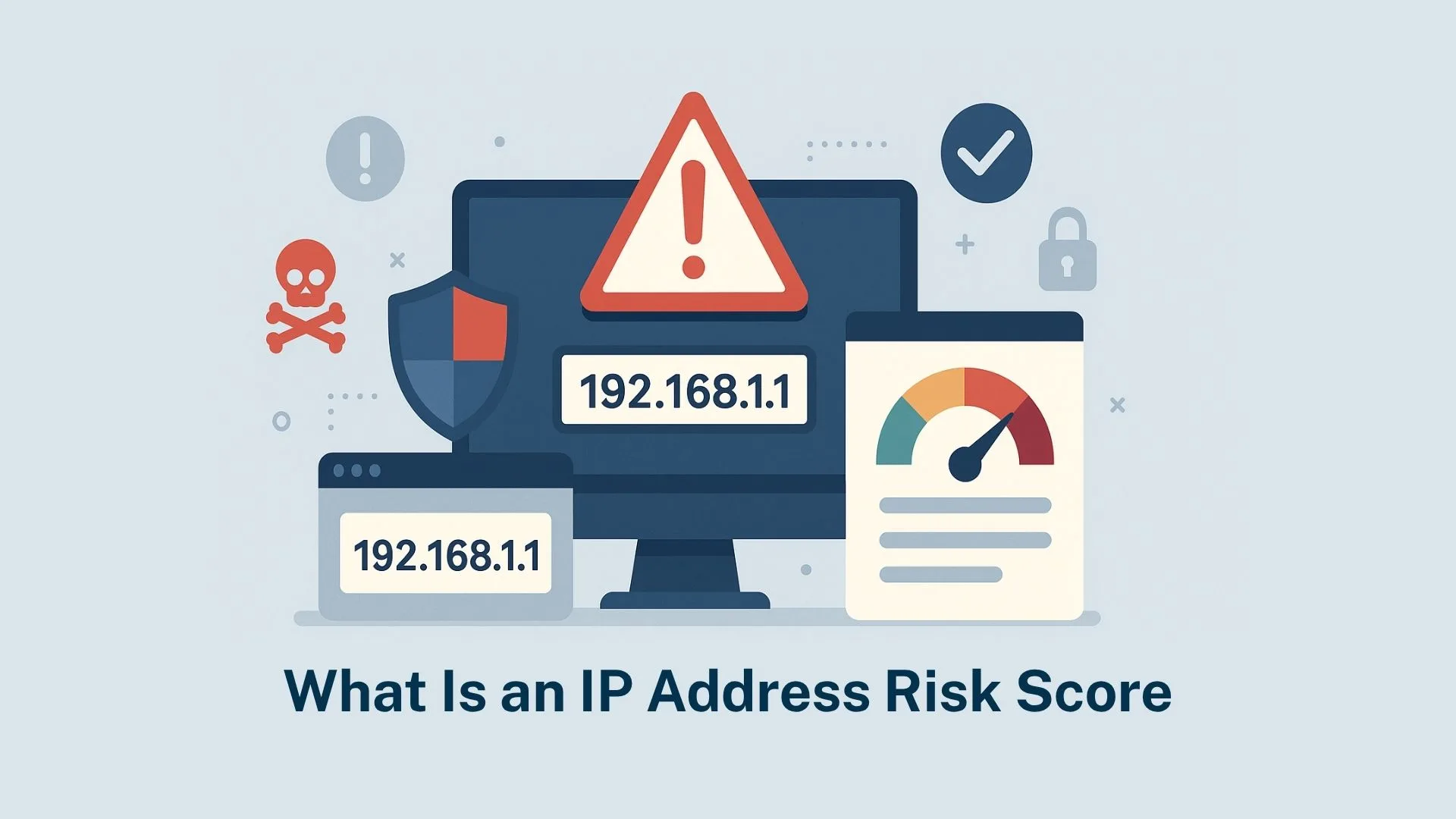
IP address risk scores help organisations assess potential threats. They detect malicious activity. They improve cybersecurity across networks. They strengthen protection for cloud systems.
Table of Contents
Key Points
IP risk scores turn risk into a number. This number shows how likely an IP address is linked to malicious behaviour. It also reflects chances of suspicious activity.
Organisations use IP risk scores in many ways. They block threats. They prioritise security alerts. They reduce the chance of cyberattacks.
Understanding IP Address Risk Scores
An IP address risk score is a numerical value. It is assigned to each IP address. This value tells the probability of the address being in malicious activity.
These scores come from multiple factors. One factor is the address’s historical behaviour. Reputation data matters too. Geolocation is another key point. Connections to known threat actors also influence the score.
Also Read: Lease IP Address: How IPv4 Leasing Works
From my experience in cybersecurity, an IP address risk score is a critical metric that quantifies the probability of an IP being involved in malicious activity. These scores are calculated using historical behavior, reputation data, geolocation, and known threat actor associations. Understanding and leveraging IP risk scores allows security teams to make informed, proactive decisions to protect their networks."
— Dr. Emily Chen, Cybersecurity Analyst
Many groups rely on these scores. Internet service providers (ISPs) use them. Data centres find them useful. Cloud service providers depend on them. Enterprise security teams use them to assess risk right away.
How IP Address Risk Scores Are Calculated
IP risk scoring uses several elements together. These elements work as a combination.
Threat intelligence feeds are important. These are databases. They track IPs used in malware campaigns. They also follow IPs linked to phishing. Botnet activity IPs are recorded too.
Geolocation analysis plays a role. Unusual locations can affect the score. High-risk locations also influence it.
Historical activity is a key factor. Previous malicious behaviour raises risk. Repeated suspicious connections also push the risk level up.
Connection patterns matter as well. IPs with unusual traffic volumes may be a red flag. Scanning behaviour can indicate automated attacks.
Scores usually go from low to high. Often, they use a 0–100 scale. Sometimes, they are put into brackets. Common brackets are “safe,” “suspicious,” and “malicious.”
Why IP Risk Scores Matter for Cybersecurity
IP risk scores give organisations useful insights. These insights help reduce exposure to cyber threats. The scores are built into various systems.
Firewalls use them. Intrusion detection systems integrate them. Cloud security platforms rely on them. They block high-risk traffic. They also flag suspicious activity.
"IP risk scores are a cornerstone of modern cybersecurity. By quantifying the likelihood that an IP address is involved in malicious activity, these scores provide organizations with actionable insights to reduce exposure to threats. Integrated into firewalls, intrusion detection systems, and cloud security platforms, IP risk scores help block high-risk traffic and flag suspicious behavior before it can impact critical systems."
— Dr. Michael Tan, Senior Cybersecurity Strategist
Applications Across Industries
ISPs and cloud providers use these scores. They protect users from malware. They block spam. They defend against DDoS attacks.
E-commerce and financial services benefit too. They screen high-risk IP addresses. This prevents fraud. It stops unauthorised access.
Enterprise networks use the scores effectively. They detect insider threats. They spot lateral movement within corporate networks.
Benefits of Implementing IP Risk Scores
False positives are reduced. Security teams focus on real threats. They don’t waste time on benign traffic.
Threats are mitigated proactively. Early detection stops large-scale attacks from happening.
Compliance is enhanced. Organisations meet regulatory requirements. These requirements cover cybersecurity. They also include data protection.
Limitations and Considerations
IP risk scores are useful. But they are not perfect. IP addresses can be spoofed. Attackers may change addresses to avoid detection.
Risk scoring needs other security measures. Behavioural analytics is one. User authentication is another. Endpoint monitoring is also necessary.
Future Trends in IP Risk Scoring
New AI and machine learning tools are emerging. They improve the accuracy of IP risk assessments. Predictive models are a key part.
These models can identify threats early. They spot risks before they occur. This enables dynamic scoring in real time.
Integration with threat-hunting platforms helps. Security teams can automate responses. These responses target high-risk traffic.
Future Trends in IP Risk Scoring
i.lease helps businesses approach IPv4 access as a structured market decision instead of a blind dependency on unclear sourcing or informal arrangements.
For companies that need flexibility, Lease IPv4 Address can support deployment with operational assistance, LOA-related workflows, and registry-aware coordination. For organisations that need long-term control, Buy IPv4 address through a structured marketplace can help reduce sourcing and transfer uncertainty. For holders of unused address space, Sell IPv4 address through a marketplace can help turn idle resources into business value through a more organized process.
The goal is not only to obtain IPv4. The goal is to avoid being trapped by hidden authority claims, unclear provider chains, weak documentation, or governance friction that only becomes visible when your business is already exposed.
A safer IPv4 strategy should consider supply, contract structure, transfer path, routing readiness, reputation, provider accountability, and registry-related risk. Waiting until a policy issue or transfer delay affects your business gives you fewer options and less control.
If your business depends on IPv4, do not wait until someone else’s interpretation controls your timeline. Plan your IPv4 access before governance risk becomes a business problem.
Also Read: The Impact of IPv4 Shortage on IP Allocation
Also Read: What Is IPv4 Address Exhaustion?
FAQs
What is an IP address risk score?
It is a numerical value. It assesses the likelihood of an IP address being in malicious activity. It also checks for suspicious activity.
Who uses IP risk scores?
ISPs use them. Cloud providers rely on them. Enterprises and cybersecurity teams use them too. They manage threat exposure with these scores.
How is an IP risk score calculated?
It is calculated by analysing multiple factors. Threat intelligence is one factor. Historical activity is another. Geolocation and unusual connection patterns are also considered.
Can IP risk scores prevent cyberattacks?
They cannot prevent attacks by themselves. But they help security teams identify risks. They enable proactive mitigation.
Are IP risk scores always accurate?
No, they are not. Scores are an estimation. They should be combined with other security tools and measures.
Articles connexes

Que sont les entreprises de télécommunications ? Comment les fournisseurs de télécommunications assurent la connectivité au Royaume-Uni, aux États-Unis et au Canada
Les entreprises de télécommunications, également appelées opérateurs télécoms, fournissent des services de communication et de connectivité. Ces services peuvent inclure les réseaux mobiles, l’Internet haut débit, les connexions fibre, les services de téléphonie fixe, la connectivité pour les entreprises, l’accès au cloud, les services réseau gérés et la connectivité aux centres de données. Pour les consommateurs, les entreprises de télécommunications sont souvent connues comme des fournisseurs de services mobilesRead more Related Posts Desbloqueando la privacidad digital con una red privada virtual (VPN) ¿Qué es una VPN? Una red privada virtual (VPN) es una tecnología que permite a los usuarios crear una conexión Comprensión de la traducción de direcciones de red (NAT) En las redes informáticas, gestionar las direcciones IP de forma eficiente es fundamental para garantizar una comunicación fluida entre los Arrendamiento de direcciones IP: Cómo arrendar direcciones IP El mundo digital en el que nos movemos hoy depende en gran medida de las direcciones IP, identificadores únicos asignados .related-post {} .related-post .post-list { text-align: left; } .related-post .post-list .item { margin: 5px; padding: 10px; } .related-post .headline { font-size: 18px !important; color: #999999 !important; } .related-post .post-list .item .post_thumb { max-height: 220px; margin: 10px 0px; padding: 0px; display: block; } .related-post .post-list .item .post_title { font-size: 16px; color: #3f3f3f; margin: 10px 0px; padding: 0px; display: block; text-decoration: none; } .related-post .post-list .item .post_excerpt { font-size: 13px; color: #3f3f3f; margin: 10px 0px; padding: 0px; display: block; text-decoration: none; } @media only screen and (min-width: 1024px) { .related-post .post-list .item { width: 30%; } } @media only screen and (min-width: 768px) and (max-width: 1023px) { .related-post .post-list .item { width: 90%; } } @media only screen and (min-width: 0px) and (max-width: 767px) { .related-post .post-list .item { width: 90%; } }
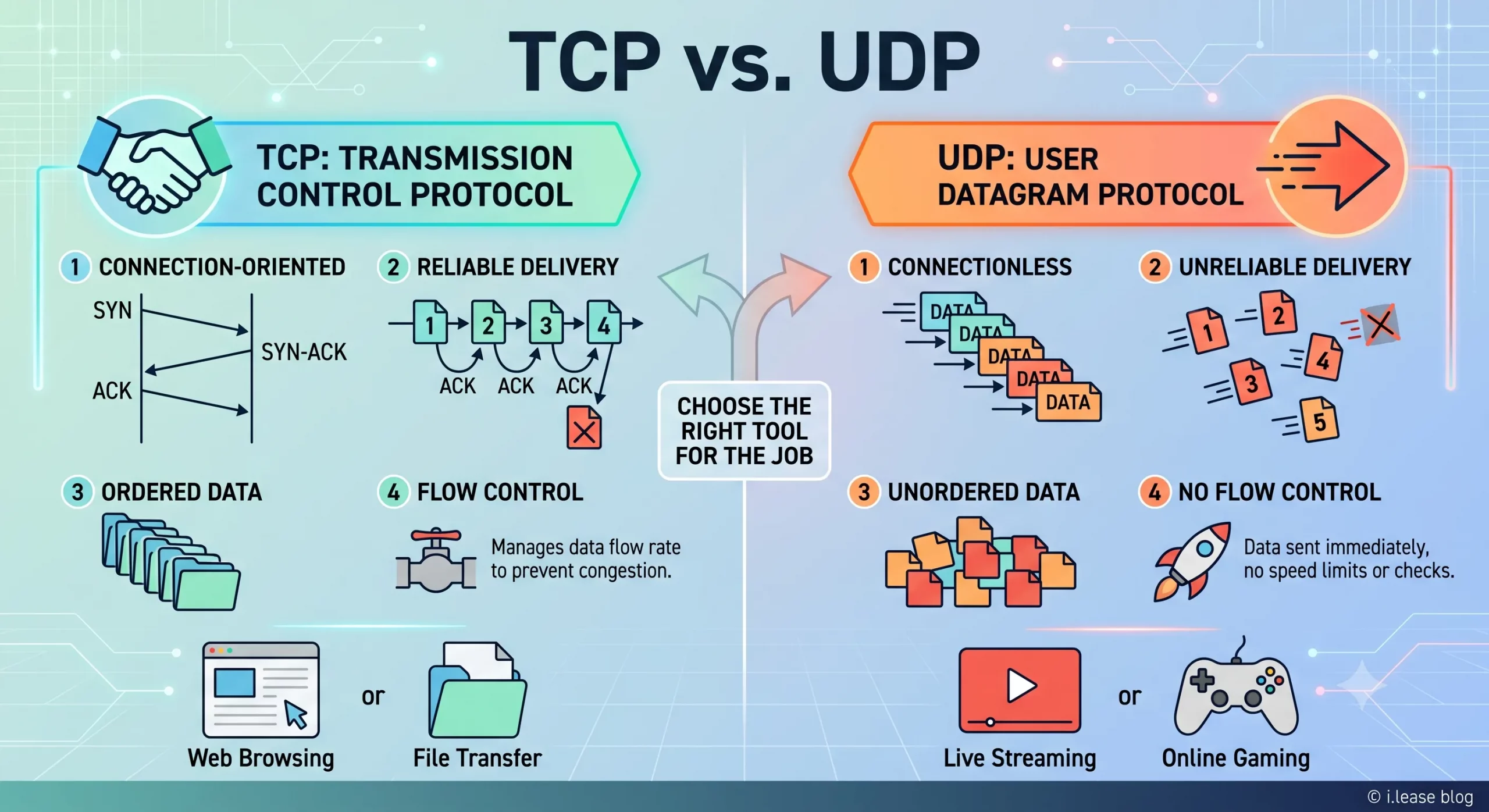
TCP vs UDP : guide de location IPv4 et de réseau d’entreprise
TCP et UDP sont deux des protocoles de transport les plus importants sur Internet. Ils déterminent la circulation des données entre les appareils, les serveurs, les plateformes cloud, les passerelles VPN, les résolveurs DNS, les systèmes de messagerie, les plateformes de streaming et les applications métier. Pour les entreprises, TCP et UDP ne sont pas de simples termes techniques. Ils ont un impact direct sur les performances de l’infrastructure. Related Posts What Is BGP Hijacking? How Route Hijacks Work, Famous Incidents, and How Networks Prevent Them BGP hijacking is the illegitimate takeover of traffic destined for IP address space, carried out by announcing routes for prefixes Which RIRs Support Inter-RIR IPv4 Transfers in 2026? IPv4 addresses may be globally routable, but transferring their registration from one organization to another is governed by Regional Internet What Is BGP? How Border Gateway Protocol Turns IP Addresses into Reachable Services BGP (Border Gateway Protocol) is the routing protocol that connects independent networks across the Internet. It allows networks to announce .related-post {} .related-post .post-list { text-align: left; } .related-post .post-list .item { margin: 5px; padding: 10px; } .related-post .headline { font-size: 18px !important; color: #999999 !important; } .related-post .post-list .item .post_thumb { max-height: 220px; margin: 10px 0px; padding: 0px; display: block; } .related-post .post-list .item .post_title { font-size: 16px; color: #3f3f3f; margin: 10px 0px; padding: 0px; display: block; text-decoration: none; } .related-post .post-list .item .post_excerpt { font-size: 13px; color: #3f3f3f; margin: 10px 0px; padding: 0px; display: block; text-decoration: none; } @media only screen and (min-width: 1024px) { .related-post .post-list .item { width: 30%; } } @media only screen and (min-width: 768px) and (max-width: 1023px) { .related-post .post-list .item { width: 90%; } } @media only screen and (min-width: 0px) and (max-width: 767px) { .related-post .post-list .item { width: 90%; } }

Pourquoi la Malaisie devient-elle un pôle de centres de données pour les infrastructures cloud et d’intelligence artificielle ?
La Malaisie devient l’un des marchés de croissance les plus importants d’Asie du Sud-Est dans le secteur des centres de données. La demande en cloud computing, intelligence artificielle, applications d’entreprise, paiements numériques, commerce électronique, cybersécurité et services régionaux à faible latence pousse les entreprises à construire davantage d’infrastructures au plus près des utilisateurs. Cette croissance ne repose pas uniquement sur un effet de mode. La Malaisie a attiré desRead more Related Posts Desbloqueando la privacidad digital con una red privada virtual (VPN) ¿Qué es una VPN? Una red privada virtual (VPN) es una tecnología que permite a los usuarios crear una conexión Comprensión de la traducción de direcciones de red (NAT) En las redes informáticas, gestionar las direcciones IP de forma eficiente es fundamental para garantizar una comunicación fluida entre los ¿Por qué Malasia se está convirtiendo en un centro neurálgico para la infraestructura de nube e IA? Malasia se está convirtiendo en uno de los mercados de crecimiento de centros de datos más importantes del Sudeste Asiático. .related-post {} .related-post .post-list { text-align: left; } .related-post .post-list .item { margin: 5px; padding: 10px; } .related-post .headline { font-size: 18px !important; color: #999999 !important; } .related-post .post-list .item .post_thumb { max-height: 220px; margin: 10px 0px; padding: 0px; display: block; } .related-post .post-list .item .post_title { font-size: 16px; color: #3f3f3f; margin: 10px 0px; padding: 0px; display: block; text-decoration: none; } .related-post .post-list .item .post_excerpt { font-size: 13px; color: #3f3f3f; margin: 10px 0px; padding: 0px; display: block; text-decoration: none; } @media only screen and (min-width: 1024px) { .related-post .post-list .item { width: 30%; } } @media only screen and (min-width: 768px) and (max-width: 1023px) { .related-post .post-list .item { width: 90%; } } @media only screen and (min-width: 0px) and (max-width: 767px) { .related-post .post-list .item { width: 90%; } }
