What is a Proxy IP?
 Chan
Chan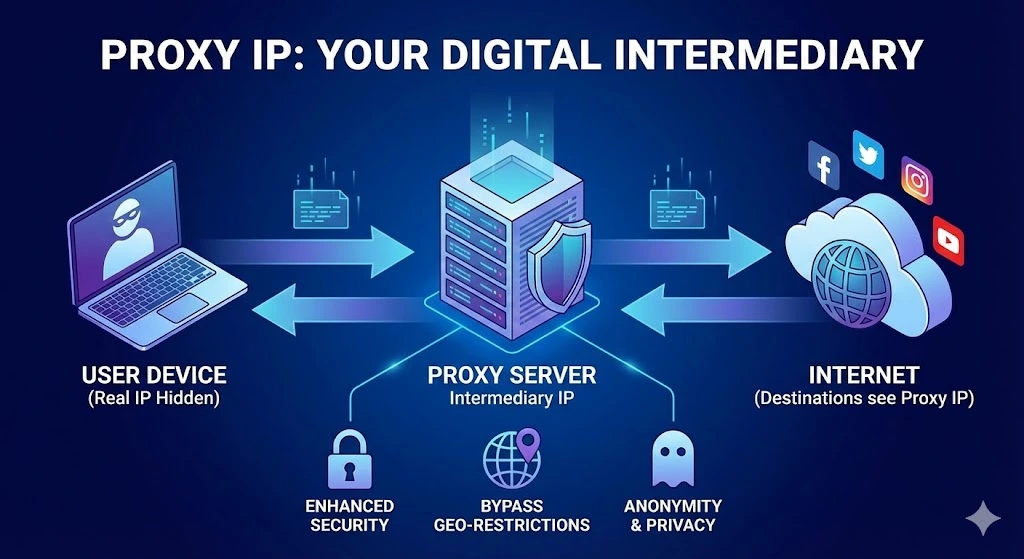
A proxy IP is an intermediary IP address used to mask or relay your original IP address when accessing the Internet. It acts as a gateway between the user and the web. When a request is made to access a website, the proxy server (which uses the proxy IP) forwards that request, hiding the user’s real IP address from the website. This allows for increased privacy and anonymity when browsing online.
Table of Contents
How Proxy IP Works
When you use a proxy, your device sends a request to the proxy server, which forwards it to the target website. The website then sees the request as coming from the proxy server, not your IP. This shields your original identity and location from the website. Afterward, the website’s response is returned to the proxy server, which forwards it to you.
Types of Proxy IPs
HTTP Proxies: These only work for web pages and are great for browsing.
SOCKS Proxies: They handle a wider range of traffic, including emails, torrent files, and FTP.
Transparent Proxies: These identify themselves and pass the original IP address, often used in caching.
Anonymous Proxies: These hide the user’s IP address but identify themselves as proxies.
High Anonymity Proxies: These provide maximum privacy by not identifying themselves as proxies and completely hiding the user’s IP.
Key Functions and Use Cases
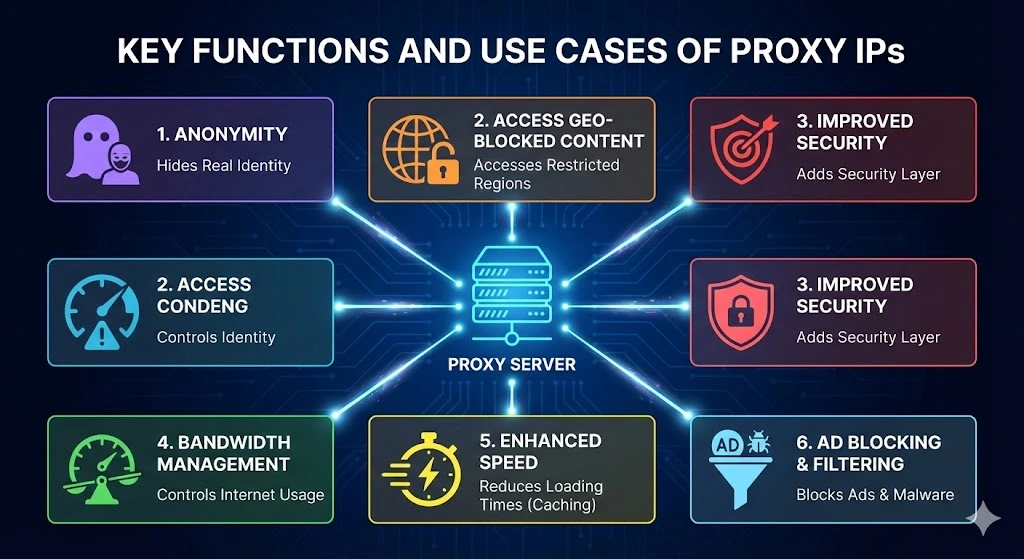
1. Anonymity: Proxy IPs hide your real identity online, allowing you to browse the web without revealing personal information.
2. Access Geo-Blocked Content: Proxies enable users to access content that is restricted in certain regions by assigning IPs from specific locations.
3. Improved Security: By masking the original IP address, proxy servers add a layer of security, making it harder for hackers to target the user directly.
4. Bandwidth Management: Proxies can help organizations manage and control internet bandwidth usage, preventing congestion.
5. Enhanced Speed: Certain proxies can cache web pages, reducing loading times for frequently accessed websites.
6. Ad Blocking and Filtering: Proxy servers can block ads, malware, or filter content to ensure a safer browsing experience.
Common Use Cases for Proxy IPs
1. Businesses: Companies use proxies for security, load balancing, and to prevent unauthorized access to their internal systems.
2. SEO and Marketing: Marketers use proxies to gather competitor data or analyze web traffic from different locations.
3. Streaming: Users rely on proxy IPs to bypass geo-restrictions and access content not available in their regions.
4. Privacy Enthusiasts: Those concerned with online privacy use proxy IPs to hide their real IP address while browsing.
The Difference Between Proxy and VPN
While both proxies and VPNs hide your IP address, a VPN encrypts all your internet traffic, offering a more secure connection. Proxies generally do not encrypt data, but they can be faster than VPNs for some use cases since they don’t handle heavy encryption.
Final Thoughts
Proxy IPs are essential tools for maintaining privacy, accessing restricted content, and improving online security. Whether for personal use, business operations, or marketing analysis, proxies offer a flexible solution to interact with the web more effectively. Some of the most popular proxy providers include Luminati, Smartproxy, and Bright Data, offering a range of services tailored to different needs.
Trusted IPv4 Leasing for Business Growth
Get enterprise-grade IPv4 space quickly, with seamless deployment and end-to-end management.
Get Started with i.leaseArtículos relacionados

¿Qué es una Carta de Autorización (LOA) en el arrendamiento de propiedad intelectual? LOA vs. ROA y qué verificar
Una Carta de Autorización (LOA) es un documento formal mediante el cual el titular registrado de un bloque de direcciones IP autoriza a otra parte a anunciar ese espacio de direcciones desde un Número de Sistema Autónomo especificado. Es el permiso escrito que conecta el derecho contractual de utilizar un espacio de direcciones con el acto técnico de enrutarlo y, sin él, los proveedores upstream generalmente se negarán aRead more Related Posts IP地址租赁中的授权书 (LOA) 是什么?LOA 与 ROA 的区别以及需要核实的内容 授权书(Letter of Authorization,LOA)是一份正式文件,由 IP 地址块的注册持有者授权另一方通过指定的自治系统编号(ASN)公告该地址空间。 它是一份书面授权,将使用地址空间的合同权利与实际进行路由公告的技术行为连接起来——如果没有 LOA,上游服务提供商通常会拒绝接受你的路由公告。 正是这种拒绝,使 LOA 在运营上具有决定性意义,而不仅仅是一项行政文件。Transit 服务提供商、数据中心和电信运营商都需要证明,公告某个前缀的一方确实获得了授权,因为接受未经授权的公告就意味着参与了一次路由劫持。Cloudflare 的 BYOIP 文档对此说明得非常明确:其 Transit 服务提供商要求在接受 Cloudflare 代表客户公告的路由之前提供 LOA,而且文件必须明确列出获得授权的前缀以及将用于公告这些前缀的 ASN。整个行业普遍都有类似要求。一家企业即使已经签署租赁协议、完成路由器配置,仍然可能因为 Qu’est-ce qu’une lettre d’autorisation (LOA) dans le cadre d’un bail de propriété intellectuelle ? LOA vs ROA et points à vérifier Une Lettre d’Autorisation (LOA) est un document officiel dans lequel le titulaire enregistré d’un bloc d’adresses IP autorise une autre What Is a Letter of Authorization (LOA) in IP Leasing? LOA vs ROA and What to Verify A Letter of Authorization (LOA) is a formal document in which the registered holder of an IP address block authorizes .related-post {} .related-post .post-list { text-align: left; } .related-post .post-list .item { margin: 5px; padding: 10px; } .related-post .headline { font-size: 18px !important; color: #999999 !important; } .related-post .post-list .item .post_thumb { max-height: 220px; margin: 10px 0px; padding: 0px; display: block; } .related-post .post-list .item .post_title { font-size: 16px; color: #3f3f3f; margin: 10px 0px; padding: 0px; display: block; text-decoration: none; } .related-post .post-list .item .post_excerpt { font-size: 13px; color: #3f3f3f; margin: 10px 0px; padding: 0px; display: block; text-decoration: none; } @media only screen and (min-width: 1024px) { .related-post .post-list .item { width: 30%; } } @media only screen and (min-width: 768px) and (max-width: 1023px) { .related-post .post-list .item { width: 90%; } } @media only screen and (min-width: 0px) and (max-width: 767px) { .related-post .post-list .item { width: 90%; } }
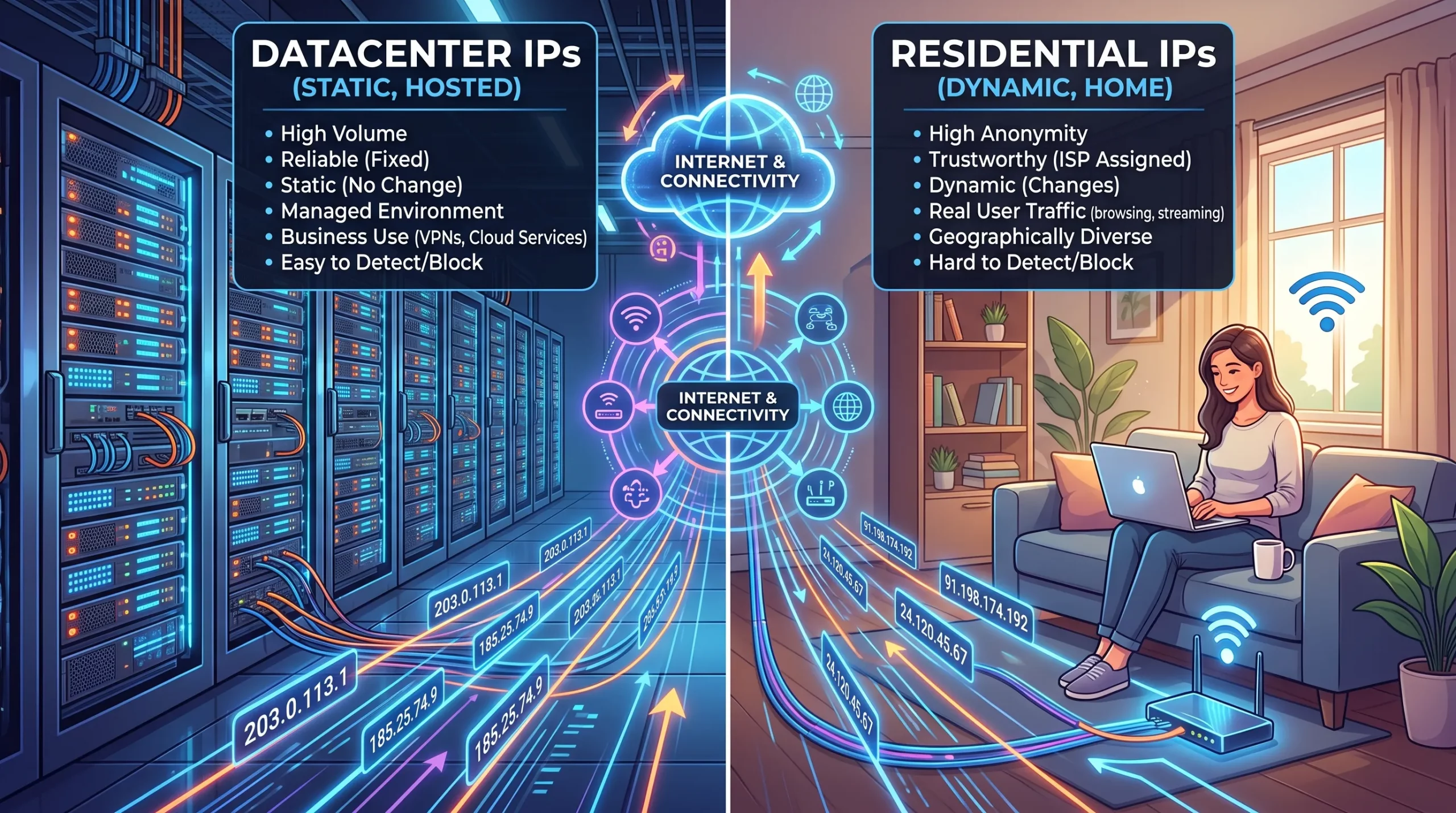
Direcciones IP de centros de datos frente a direcciones IP residenciales: ¿Cuál es la diferencia y por qué es importante?
A data center IP address originates from a commercial data center, cloud provider, or hosting company, while a residential IP address is assigned by an internet service provider to a home or business user. The difference lies in the origin: one comes from infrastructure designed to run servers; the other, from a connection designed to serve an end user. This single distinction determines how the rest of the internetRead more Related Posts ¿Qué es una Carta de Autorización (LOA) en el arrendamiento de propiedad intelectual? LOA vs. ROA y qué verificar Una Carta de Autorización (LOA) es un documento formal mediante el cual el titular registrado de un bloque de direcciones 数据中心IP地址与住宅IP地址:区别是什么?为什么这很重要? 常见问题解答 数据中心 IP 地址来源于商业数据中心、云服务提供商或托管公司,而住宅 IP 地址则由互联网服务提供商分配给家庭或企业用户。 两者的区别在于来源:一种来自为运行服务器而建设的基础设施,另一种来自为终端用户提供连接而建设的网络。正是这一根本区别,决定了互联网其他系统如何看待来自这两类地址的流量。 这个话题通常只会在代理和反检测的狭窄语境下被讨论,因此很容易形成片面的认知。实际上,数据中心 IP 与住宅 IP 的区别,对任何运营互联网基础设施的人都很重要,因为它会影响一个地址天然具有多少信任度、网站和安全系统如何响应它,以及这个地址适合什么用途。几乎所有合法的商业互联网基础设施——包括你使用的每个网站、API、邮件服务器和云服务——都运行在数据中心 IP 地址空间上,而这本来就是正确的使用方式。重点并不是哪一种更好、哪一种更差;而是它们服务于不同目的,也会受到不同方式的对待。了解自己正在使用或真正需要哪一种,可以避免许多本来可以避免的问题。 本文将解释这两种 IP 地址分别是什么、系统如何区分它们、为什么它们会受到不同对待,以及这种差异对于在公共 IPv4 地址空间上部署真实服务的企业意味着什么——包括它与地址信誉、地理定位以及不同使用场景究竟需要哪种地址空间之间的关系。 数据中心 Adresses IP de centres de données vs adresses IP résidentielles : quelle est la différence ? Pourquoi est-ce important ? Une adresse IP de centre de données provient d’un centre de données commercial, d’un fournisseur cloud ou d’une société d’hébergement, .related-post {} .related-post .post-list { text-align: left; } .related-post .post-list .item { margin: 5px; padding: 10px; } .related-post .headline { font-size: 18px !important; color: #999999 !important; } .related-post .post-list .item .post_thumb { max-height: 220px; margin: 10px 0px; padding: 0px; display: block; } .related-post .post-list .item .post_title { font-size: 16px; color: #3f3f3f; margin: 10px 0px; padding: 0px; display: block; text-decoration: none; } .related-post .post-list .item .post_excerpt { font-size: 13px; color: #3f3f3f; margin: 10px 0px; padding: 0px; display: block; text-decoration: none; } @media only screen and (min-width: 1024px) { .related-post .post-list .item { width: 30%; } } @media only screen and (min-width: 768px) and (max-width: 1023px) { .related-post .post-list .item { width: 90%; } } @media only screen and (min-width: 0px) and (max-width: 767px) { .related-post .post-list .item { width: 90%; } }
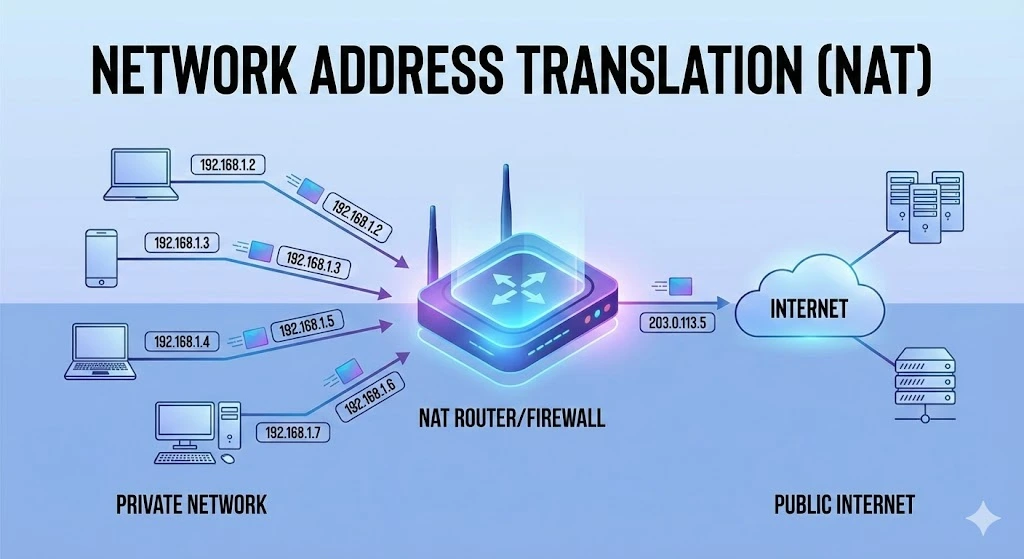
Comprensión de la traducción de direcciones de red (NAT)
En las redes informáticas, gestionar las direcciones IP de forma eficiente es fundamental para garantizar una comunicación fluida entre los dispositivos. Una de las tecnologías clave que ha surgido para afrontar este desafío es la Traducción de Direcciones de Red (NAT, por sus siglas en inglés). En este artículo explicamos qué es NAT, cómo funciona, sus distintos tipos, así como sus ventajas y limitaciones. ¿Qué es la traducción deRead more Related Posts ¿Qué es una Carta de Autorización (LOA) en el arrendamiento de propiedad intelectual? LOA vs. ROA y qué verificar Una Carta de Autorización (LOA) es un documento formal mediante el cual el titular registrado de un bloque de direcciones Direcciones IP de centros de datos frente a direcciones IP residenciales: ¿Cuál es la diferencia y por qué es importante? A data center IP address originates from a commercial data center, cloud provider, or hosting company, while a residential IP Desbloqueando la privacidad digital con una red privada virtual (VPN) ¿Qué es una VPN? Una red privada virtual (VPN) es una tecnología que permite a los usuarios crear una conexión .related-post {} .related-post .post-list { text-align: left; } .related-post .post-list .item { margin: 5px; padding: 10px; } .related-post .headline { font-size: 18px !important; color: #999999 !important; } .related-post .post-list .item .post_thumb { max-height: 220px; margin: 10px 0px; padding: 0px; display: block; } .related-post .post-list .item .post_title { font-size: 16px; color: #3f3f3f; margin: 10px 0px; padding: 0px; display: block; text-decoration: none; } .related-post .post-list .item .post_excerpt { font-size: 13px; color: #3f3f3f; margin: 10px 0px; padding: 0px; display: block; text-decoration: none; } @media only screen and (min-width: 1024px) { .related-post .post-list .item { width: 30%; } } @media only screen and (min-width: 768px) and (max-width: 1023px) { .related-post .post-list .item { width: 90%; } } @media only screen and (min-width: 0px) and (max-width: 767px) { .related-post .post-list .item { width: 90%; } }
