Why Enterprises are Adopting BYOIP
 Stephanie
As organizations around the world accelerate their digital transformation processes, the adoption of cloud technology has no longer merely been a technological trend but has become a strategically significant initiative. Enterprises are migrating critical workloads to cloud environments at an unprecedented speed to enhance flexibility, scalability, and cost-effectiveness. However, this transformation is not without challenges. One of the most pressing issues in cloud migration is the need to maintain full control over network configurations, ensure robust security policies, and maintain service continuity – especially those services that are closely linked to the existing infrastructure.
Table of Contents
The introduction of the practical solution “Bring Your Own Internal Network” (BYOIP) is rapidly gaining widespread application among enterprises facing these complex situations. BYOIP enables organizations to migrate to cloud service providers while still retaining their pre-allocated IP addresses. This means they can continue to operate with the same digital identities established over the years – maintaining reputation, simplifying configuration, and avoiding high interruption costs.
This article explores why enterprises adopt the practice of “Bring Your Own Internet Access Point” (BYOIP), delves into the commercial drivers behind this trend, the benefits it brings in practical scenarios, the technical and regulatory considerations involved, and how leading cloud platforms such as Amazon Web Services (AWS), Microsoft Azure, and Google Cloud can facilitate its application. From email delivery rates to compliance with data sovereignty regulations, BYOIP is gradually becoming a key strategy for modern IT leaders to achieve operational resilience and network control in the cloud-first world.
BYOIP enables enterprises to bring their own public IP address ranges into cloud service providers (CSPs). This approach ensures that enterprises can retain their existing IP addresses, thereby maintaining their reputation and simplifying security configurations during the cloud migration process. Major cloud service providers such as Amazon Web Services (AWS), Microsoft Azure, Google Cloud Platform (GCP), IBM Cloud, and Oracle Cloud Infrastructure (OCI) all support BYOIP, allowing it to be easily and seamlessly integrated into these platforms.
In the increasingly interconnected digital world, IP addresses are regarded as a crucial resource. They are not only technical identifiers but also essential for an organization’s online identity and credibility. Email deliverability, firewalls, API whitelists, and location-based access control all rely on stable and consistent IP addresses. Losing or changing these addresses during the cloud migration process may disrupt business operations, reduce customer trust, and even trigger regulatory consequences in fields such as finance or healthcare.
Understanding BYOIP
This is why “bring your own IP” (BYOIP) has become an important choice. When migrating infrastructure to the cloud environment, it enables enterprises to retain their own IP ranges – whether obtained directly from regional internet registration agencies like ARIN, RIPE NCC, or APNIC, or purchased from legitimate IP resellers. Enterprises no longer rely solely on IP addresses allocated by cloud providers but can directly map their ranges into the cloud network, thereby achieving greater continuity and control.
For example, AWS supports BYOIP functionality through its Elastic IP Address service, allowing organizations to publish their IP ranges through Amazon’s network and use these IPs within virtual private clouds (VPCs). Similarly, Azure allows customers to use their own IP prefixes in services such as application gateways and Azure firewalls. Google Cloud provides similar support through its BYOIP feature, which allows IP ranges to be imported into virtual private clouds and managed as regional resources.
The support for “bring your own internet access point” (BYOIP) by major cloud service providers is not merely a matter of technical convenience; it actually reflects the growing consensus in the entire industry regarding the importance of retaining digital identities in the cloud. Whether to minimize downtime, ensure seamless failover between different regions, or to preserve the years-long domain name reputation related to email traffic, BYOIP builds a crucial bridge between traditional systems and the cloud-native future.
Benefits of BYOIP Adoption
Preserving IP reputation
Maintaining existing IP addresses helps businesses preserve their established reputation, especially important for services like email delivery where IP reputation affects deliverability. Changing IP addresses can lead to emails being marked as spam or blocked, impacting communication with clients and partners.
Using familiar IP addresses allows for easier transfer of existing security policies, reducing the complexity of reconfiguring firewalls and access controls in new environments. This continuity ensures that security measures remain consistent during and after migration.
Simplifying security policies
Using familiar IP addresses allows for easier transfer of existing security policies, reducing the complexity of reconfiguring firewalls and access controls in new environments. This continuity ensures that security measures remain consistent during and after migration.
Ensuring regulatory compliance
BYOIP facilitates compliance with industry-specific regulations and data sovereignty laws by allowing businesses to maintain control over their IP resources. This is particularly crucial for organisations operating in regions with strict data residency requirements.
Streamlining cloud migrations
Retaining IP addresses during cloud transitions minimises disruptions, ensuring a smoother migration process and continuity of services. This approach reduces the need for extensive reconfiguration and testing, accelerating the overall migration timeline.
Implementing BYOIP across cloud platforms

Amazon Web Services (AWS)
AWS allows customers to bring their own IP addresses to services like EC2 and Global Accelerator. This capability helps maintain consistent IP addresses across AWS deployments, preserving brand identity and simplifying network configurations.
Microsoft Azure
Azure supports BYOIP through its Custom IP Prefix feature, enabling businesses to integrate their IP ranges into Azure’s network infrastructure. This integration facilitates seamless migration and consistent network policies across on-premises and cloud environments.
GCP offers BYOIP functionality via Public Advertised Prefixes, allowing organisations to use their IP addresses within Google’s cloud services. This feature aids in accelerating migration while minimising downtime and preserving existing configurations.
Google Cloud Platform (GCP)
IBM Cloud
IBM Cloud provides BYOIP support, facilitating the integration of existing IP addresses into IBM’s cloud environment. This is beneficial for hybrid cloud strategies, ensuring consistency across various deployment models.
Oracle Cloud Infrastructure (OCI)
OCI enables customers to bring their own IP address space, aligning with their existing network configurations and policies. This support ensures that businesses can maintain their IP resources and associated configurations during migration.
Challenges and considerations
Technical complexity
Implementing BYOIP requires careful planning and coordination with cloud providers to ensure proper routing and integration. This process may involve configuring Route Origin Authorisations (ROAs) and updating Registry Data Access Protocol (RDAP) records.
Regulatory requirements
Organisations must ensure that their use of BYOIP complies with relevant regulations and policies. This includes verifying IP ownership and ensuring that the IP addresses are properly registered with regional internet registries.
Cost implications
There may be costs associated with bringing IP addresses to cloud platforms, including potential charges from cloud providers. However, BYOIP can also lead to cost savings by avoiding fees associated with using provider-assigned IP addresses.
Conclusion
Businesses are increasingly adopting the “Bring Your Own Internet Protocol” (BYOIP) approach to finely manage their network resources, ensure compliance with regulatory requirements, and facilitate a smooth and low-disturbance transition to the cloud environment. As the acceleration of the shift towards hybrid and multi-cloud strategies continues, retaining existing public IP address ranges is no longer merely a technical preference but has become a strategic necessity.
For many organizations, IP addresses are much more than just routing identifiers – they are an important part of the digital infrastructure that underpins customer trust and operational continuity. For example, a long-used IP range may be included in the whitelist of customers, business partners, or critical applications. The email delivery rate closely related to IP reputation may drop significantly due to address changes that are not adequately verified. By using the “Bring Your Own IP” (BYOIP) solution, enterprises can avoid such risks and continue to use the same IP addresses that their domain names, mail servers, and APIs have been using. This reduces the likelihood of being marked as spam or being intercepted by security filters, which can cause significant losses in revenue and brand value.
Furthermore, BYOIP makes it easier to implement consistent security policies between cloud systems and local systems. Firewalls, intrusion detection systems, and access control lists (ACLs) typically rely on IP-based rules. Without BYOIP, security teams must reconfigure and verify these rules every time there is an infrastructure migration or expansion to a new region – this is an error-prone and time-consuming process. By using the own IP addresses, enterprises can maintain a consistent network boundary, significantly simplifying the process of implementing security protocols and monitoring traffic behavior in different environments.
From a compliance perspective, BYOIP (that is, “Bring Your Own IP Address“) can help organizations meet local or specific industry data processing regulations requirements. In industries such as finance, healthcare, or government contracts that have extremely high requirements for data residency and traceability, being able to use and manage IP addresses still within a specific jurisdiction can provide additional safeguards. It can also assist in the auditing process, ensuring that data flows and network boundaries are well-documented and under the control of the enterprise, rather than that of the cloud provider.
Ultimately, BYOIP integrates operational flexibility, security continuity, and strategic autonomy. As the cloud ecosystem becomes increasingly complex and interrelated, those enterprises that adopt BYOIP can adapt to the environment more quickly, operate more reliably, and avoid many risks associated with relying solely on cloud-native IP allocation.
Also Read: BYOIP vs IP Leasing
Also Read: Private vs Private IP Addresses
FAQs
What is BYOIP?
BYOIP stands for “Bring Your Own IP,” a practice that allows businesses to use their existing IP address ranges within cloud environments, maintaining continuity and control over their network resources.
Which cloud providers support BYOIP?
Major cloud providers, including AWS, Microsoft Azure, Google Cloud Platform, IBM Cloud, and Oracle Cloud Infrastructure, offer BYOIP support, enabling businesses to integrate their IP addresses into cloud services.
What are the benefits of BYOIP?
BYOIP offers several benefits, such as preserving IP reputation, simplifying security policy transfers, ensuring regulatory compliance, and facilitating smoother cloud migrations.
Are there challenges associated with BYOIP?
Yes, implementing BYOIP can involve technical complexities, regulatory considerations, and potential costs, requiring careful planning and coordination with cloud providers.
How does BYOIP impact cloud migration?
BYOIP simplifies cloud migration by allowing businesses to retain their existing IP addresses, reducing the need for reconfiguration and minimising service disruptions during the transition.
Related Posts
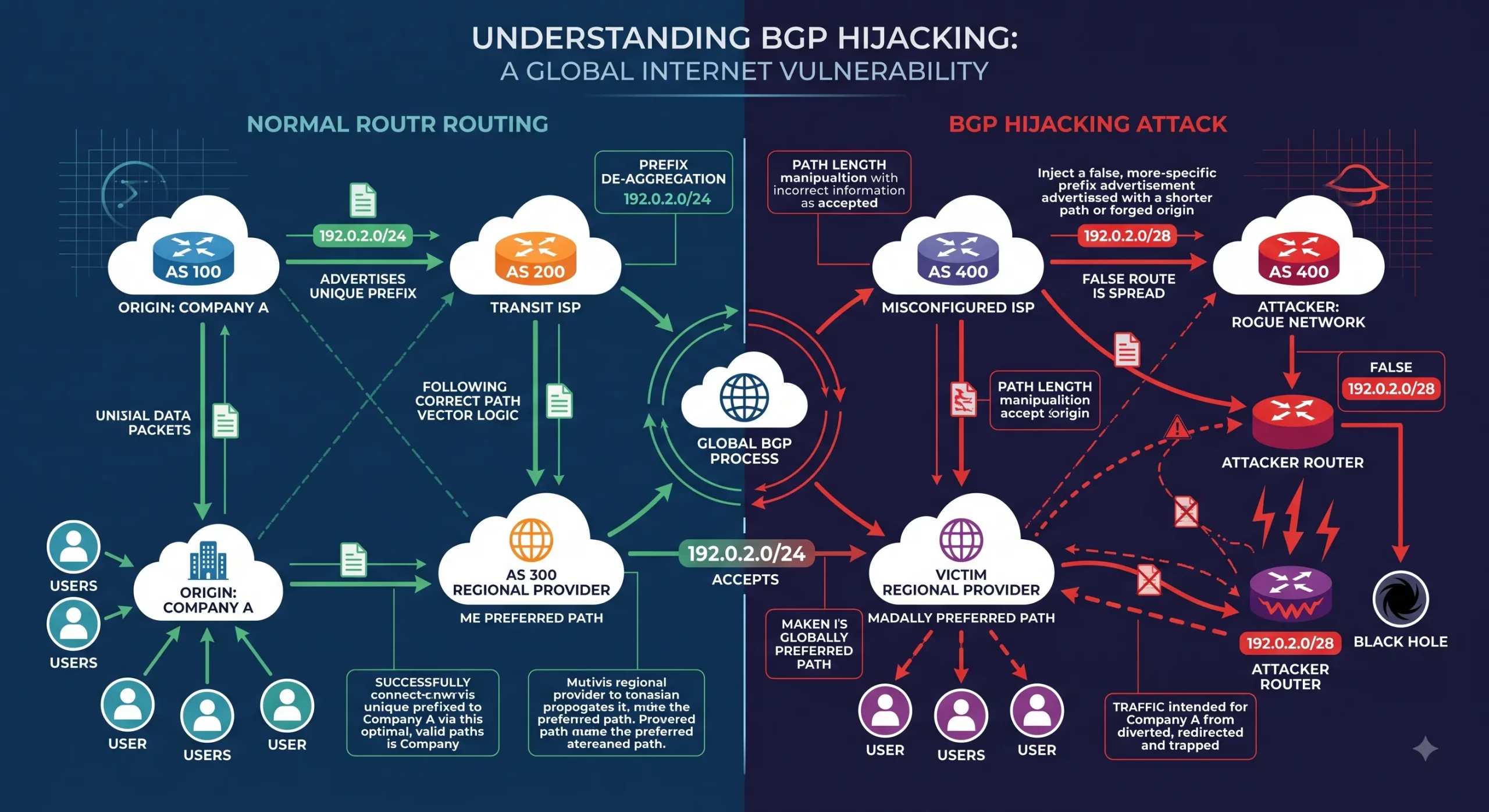
What Is BGP Hijacking? How Route Hijacks Work, Famous Incidents, and How Networks Prevent Them
BGP hijacking is the illegitimate takeover of traffic destined for IP address space, carried out by announcing routes for prefixes the announcer is not authorized to originate. Also called prefix hijacking, route hijacking, or IP hijacking, it corrupts the Internet’s routing tables themselves: networks around the world are told that the wrong party can deliver traffic for an address block, and they believe it. This makes hijacking fundamentally differentRead more Related Posts What Is BGP Hijacking? How Route Hijacks Work, Famous Incidents, and How Networks Prevent Them BGP hijacking is the illegitimate takeover of traffic destined for IP address space, carried out by announcing routes for prefixes Which RIRs Support Inter-RIR IPv4 Transfers in 2026? IPv4 addresses may be globally routable, but transferring their registration from one organization to another is governed by Regional Internet What Is BGP? How Border Gateway Protocol Turns IP Addresses into Reachable Services BGP (Border Gateway Protocol) is the routing protocol that connects independent networks across the Internet. It allows networks to announce .related-post {} .related-post .post-list { text-align: left; } .related-post .post-list .item { margin: 5px; padding: 10px; } .related-post .headline { font-size: 18px !important; color: #999999 !important; } .related-post .post-list .item .post_thumb { max-height: 220px; margin: 10px 0px; padding: 0px; display: block; } .related-post .post-list .item .post_title { font-size: 16px; color: #3f3f3f; margin: 10px 0px; padding: 0px; display: block; text-decoration: none; } .related-post .post-list .item .post_excerpt { font-size: 13px; color: #3f3f3f; margin: 10px 0px; padding: 0px; display: block; text-decoration: none; } @media only screen and (min-width: 1024px) { .related-post .post-list .item { width: 30%; } } @media only screen and (min-width: 768px) and (max-width: 1023px) { .related-post .post-list .item { width: 90%; } } @media only screen and (min-width: 0px) and (max-width: 767px) { .related-post .post-list .item { width: 90%; } }
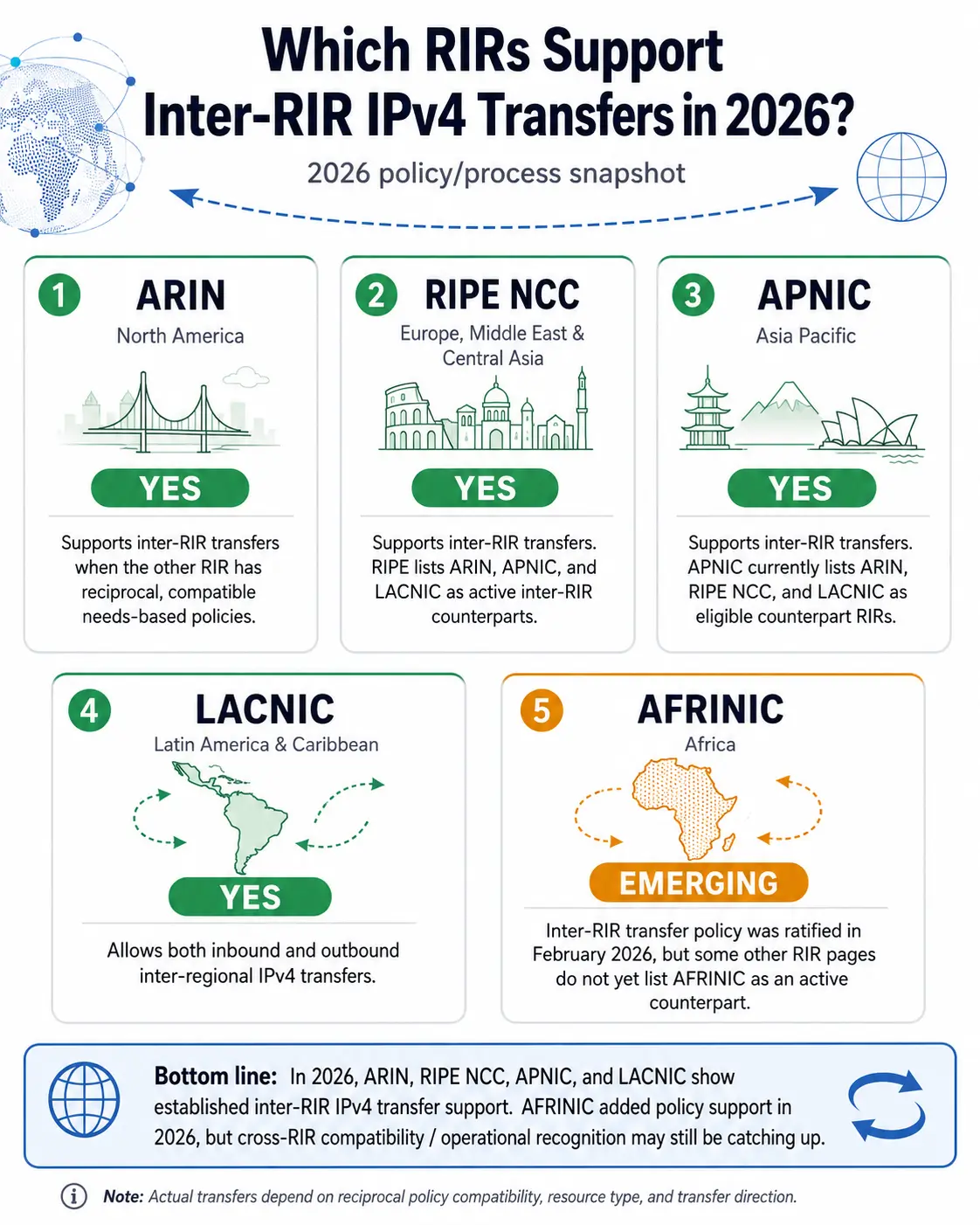
Which RIRs Support Inter-RIR IPv4 Transfers in 2026?
IPv4 addresses may be globally routable, but transferring their registration from one organization to another is governed by Regional Internet Registry (RIR) policy. For organizations buying or selling IPv4 address space internationally, this creates an important question: Which RIRs support inter-RIR IPv4 transfers in 2026? As of August 2026, ARIN, RIPE NCC, APNIC, and LACNIC have established frameworks for inter-RIR IPv4 transfers, subject to compatibility between the RIRs andRead more Related Posts What Is BGP Hijacking? How Route Hijacks Work, Famous Incidents, and How Networks Prevent Them BGP hijacking is the illegitimate takeover of traffic destined for IP address space, carried out by announcing routes for prefixes Which RIRs Support Inter-RIR IPv4 Transfers in 2026? IPv4 addresses may be globally routable, but transferring their registration from one organization to another is governed by Regional Internet What Is BGP? How Border Gateway Protocol Turns IP Addresses into Reachable Services BGP (Border Gateway Protocol) is the routing protocol that connects independent networks across the Internet. It allows networks to announce .related-post {} .related-post .post-list { text-align: left; } .related-post .post-list .item { margin: 5px; padding: 10px; } .related-post .headline { font-size: 18px !important; color: #999999 !important; } .related-post .post-list .item .post_thumb { max-height: 220px; margin: 10px 0px; padding: 0px; display: block; } .related-post .post-list .item .post_title { font-size: 16px; color: #3f3f3f; margin: 10px 0px; padding: 0px; display: block; text-decoration: none; } .related-post .post-list .item .post_excerpt { font-size: 13px; color: #3f3f3f; margin: 10px 0px; padding: 0px; display: block; text-decoration: none; } @media only screen and (min-width: 1024px) { .related-post .post-list .item { width: 30%; } } @media only screen and (min-width: 768px) and (max-width: 1023px) { .related-post .post-list .item { width: 90%; } } @media only screen and (min-width: 0px) and (max-width: 767px) { .related-post .post-list .item { width: 90%; } }
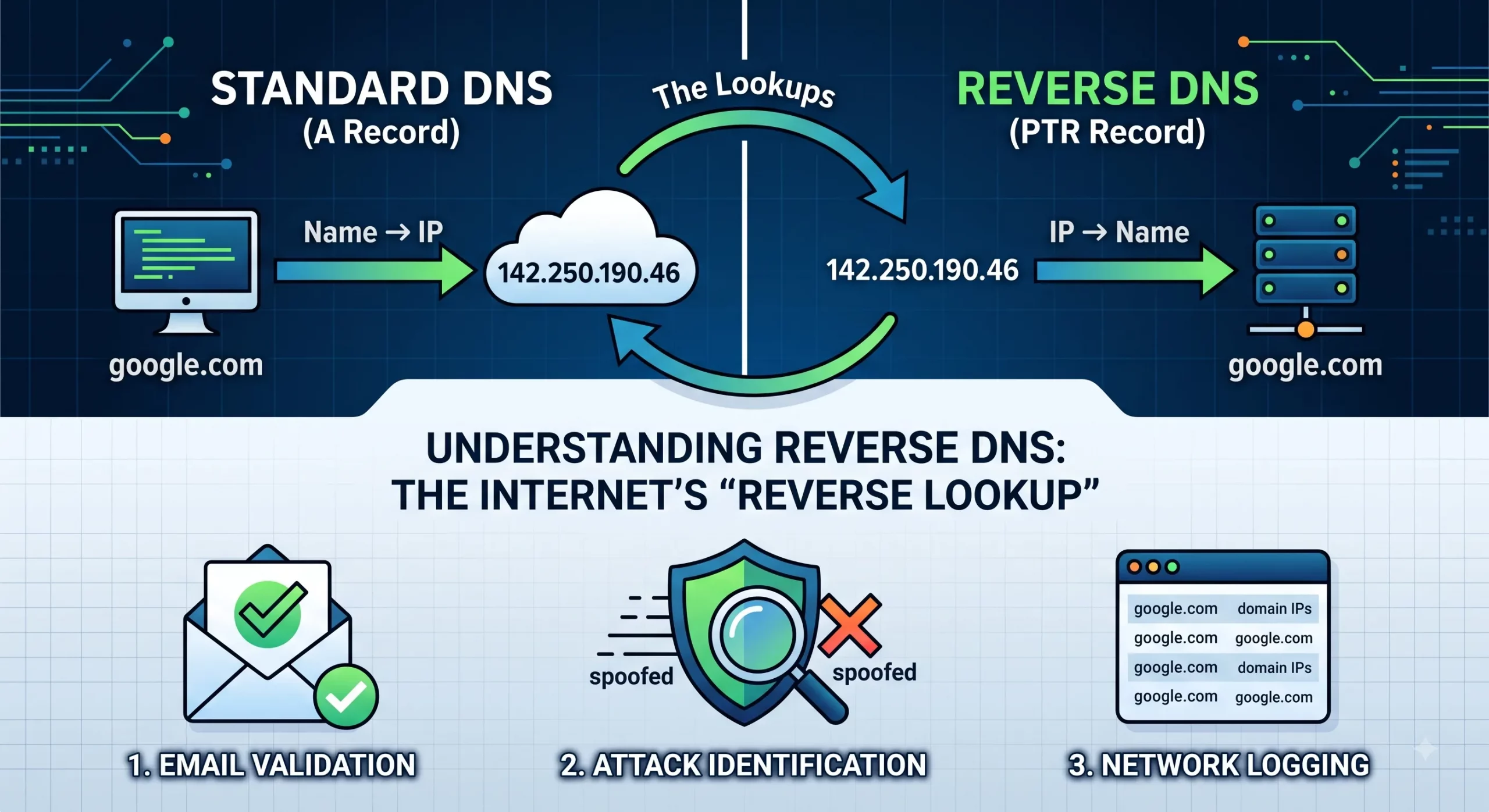
What Is Reverse DNS (rDNS)? Why PTR Records Matter for Email, Hosting, and Leased IPv4
Reverse DNS (rDNS) is the process of resolving an IP address back to a domain name. It is the mirror image of the DNS lookups most people know: forward DNS translates a name like mail.example.com into an IP address, while reverse DNS translates an IP address back into a name. The record type that stores this answer is called a PTR record. For most of the Internet’s history, reverseRead more Related Posts What Is BGP Hijacking? How Route Hijacks Work, Famous Incidents, and How Networks Prevent Them BGP hijacking is the illegitimate takeover of traffic destined for IP address space, carried out by announcing routes for prefixes Which RIRs Support Inter-RIR IPv4 Transfers in 2026? IPv4 addresses may be globally routable, but transferring their registration from one organization to another is governed by Regional Internet What Is BGP? How Border Gateway Protocol Turns IP Addresses into Reachable Services BGP (Border Gateway Protocol) is the routing protocol that connects independent networks across the Internet. It allows networks to announce .related-post {} .related-post .post-list { text-align: left; } .related-post .post-list .item { margin: 5px; padding: 10px; } .related-post .headline { font-size: 18px !important; color: #999999 !important; } .related-post .post-list .item .post_thumb { max-height: 220px; margin: 10px 0px; padding: 0px; display: block; } .related-post .post-list .item .post_title { font-size: 16px; color: #3f3f3f; margin: 10px 0px; padding: 0px; display: block; text-decoration: none; } .related-post .post-list .item .post_excerpt { font-size: 13px; color: #3f3f3f; margin: 10px 0px; padding: 0px; display: block; text-decoration: none; } @media only screen and (min-width: 1024px) { .related-post .post-list .item { width: 30%; } } @media only screen and (min-width: 768px) and (max-width: 1023px) { .related-post .post-list .item { width: 90%; } } @media only screen and (min-width: 0px) and (max-width: 767px) { .related-post .post-list .item { width: 90%; } }
