What is IP Forwarding?

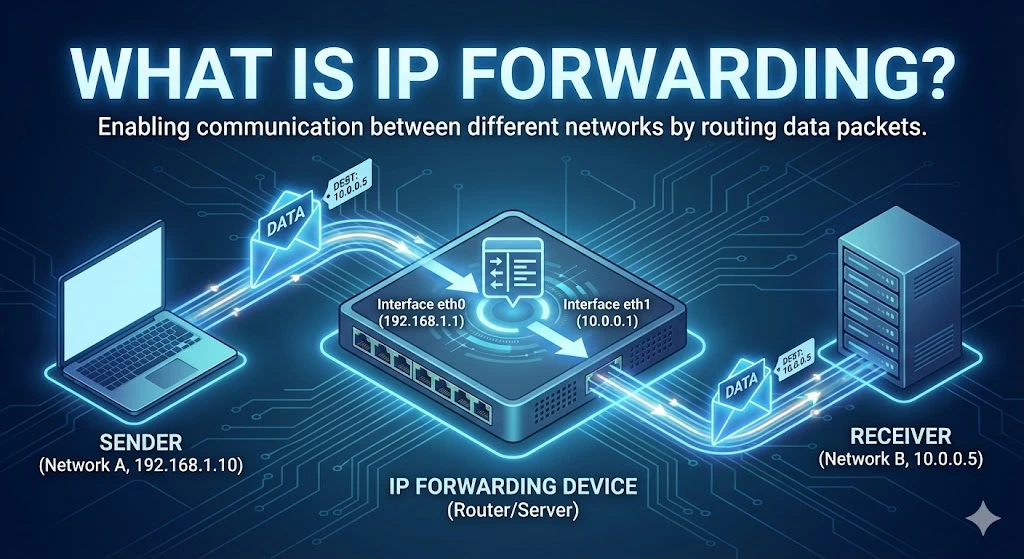
IP forwarding is the process by which a network device, such as a router, forwards or relays IP (Internet Protocol) packets from one network to another. It enables communication between different network segments by directing data packets to their appropriate destination IP addresses. When a device forwards packets that are not destined for its IP address, it acts as a gateway, passing data from one network to another, typically between different subnets or networks.
Table of Contents
IP forwarding is crucial in routers but can also be enabled on computers or other network devices to allow them to act as intermediaries between networks. Without IP forwarding, devices within a local network could not communicate with devices outside their immediate network.
Use Cases of IP Forwarding
1. Router Functionality
The most common use case for IP forwarding is in routers, which form the backbone of any network communication infrastructure. Routers forward packets between local networks and larger networks, such as the Internet, ensuring data reaches its destination across multiple hops or networks. This is the core functionality of routers in homes, offices, and data centers.
2. Network Address Translation (NAT)
In NAT-enabled environments, IP forwarding is essential. NAT allows multiple devices on a local network to share a single public IP address for Internet access. A router with IP forwarding forwards packets from internal private IP addresses to external IP addresses, enabling communication between internal users and external resources like websites or servers.
3. Firewall Configurations
In enterprise environments, IP forwarding can be part of complex firewall setups, where packets are forwarded through a firewall to reach internal servers, subnets, or specific services. Firewalls can allow or block packets while forwarding them based on rules.
4. Virtual Private Networks (VPNs)
When users connect to a VPN, IP forwarding is used to forward traffic from the user’s local network to a company’s remote servers or internal networks. This ensures secure, encrypted communication across networks, often bypassing geographical or security restrictions.
5. Load Balancers
In large-scale web applications or services, load balancers use IP forwarding to distribute incoming traffic to multiple servers. By forwarding requests to different servers, the load balancer ensures that no single server is overwhelmed, improving reliability and performance.
6. Network Bridging
IP forwarding is also used when creating network bridges between two separate networks. This helps organizations manage traffic and resources more efficiently by forwarding packets between different network segments without creating a unified network.
Purpose of IP Forwarding
I) Network Segmentation
One of the primary purposes of IP forwarding is to allow communication between different network segments or subnets. By forwarding packets, one network can access services, devices, or resources in another network, such as accessing shared drives or using remote servers.
II) Traffic Management
Forwarding packets, routers, and network devices help manage network traffic, ensuring that data takes the most efficient route. This helps optimize network performance, reduces congestion, and minimizes latency in communication.
III) Network Security
IP forwarding also plays a critical role in securing network communication. Firewalls use IP forwarding to control traffic between different networks, ensuring that unauthorized data packets do not enter or leave protected networks. Additionally, IP forwarding is often used in conjunction with network security rules, such as access control lists (ACLs), to regulate traffic.
IV) Inter-Subnet Communication
In large networks, subnets are used to divide network traffic into smaller, more manageable segments. IP forwarding ensures that devices in different subnets can still communicate with each other, which is essential for larger organizations with complex network architectures.
How IP Forwarding Works
When a packet is received by a device (e.g., a router), it checks the destination IP address to determine whether the packet is meant for itself or another device. If the packet is not intended for the router itself, the device uses its routing table to determine the best path to forward the packet. The packet is then passed to the next device along the route until it reaches its destination.
In simple terms:
-
- A data packet is received by a router or device with IP forwarding enabled.
- The device checks the destination IP address of the packet.
- If the packet is not meant for the device, the routing table is consulted to find the next hop.
- The packet is forwarded to the next device or network.
- The process continues until the packet reaches its intended destination.
Trusted IPv4 Leasing for Business Growth
Get enterprise-grade IPv4 space quickly, with seamless deployment and end-to-end management.
Get Started with i.leaseFAQs
How do I enable IP forwarding on Linux?
To enable IP forwarding temporarily, run the command sysctl -w net.ipv4.ip_forward=1 in your terminal. To make it permanent, edit the /etc/sysctl.conf file and add or uncomment the line net.ipv4.ip_forward = 1, then run sysctl -p to apply the changes.
Is IP forwarding a security risk?
Yes, if not configured correctly. Enabling IP forwarding turns a device into a router. If you don’t have proper firewall rules (iptables/nftables) in place, malicious actors could use your device to route traffic between networks you intended to keep separate, potentially leading to Man-in-the-Middle (MITM) attacks or unauthorized access to private subnets.
What is the difference between IP forwarding and routing?
While often used interchangeably, they are distinct steps. Routing is the decision-making process where the device looks at its routing table to decide where to send a packet (like planning a route on a map). IP Forwarding is the actual physical action of moving the packet from one network interface to another based on that decision (like actually driving the car).
Related Posts

IPv4 leasing vs purchasing: structural risk in the IPv4 address market
IPv4 leasing vs purchasing reflects a structural shift in IP address markets, balancing cost, control, scarcity, and operational risk in 2026. Key points IPv4 leasing has become a flexible operating model, with stable monthly pricing driven by scarcity and fast deployment needs. IPv4 purchasing is shifting into a long-term asset strategy, but exposed to price cycles, liquidity changes, and capital lock-in. IPv4 is no longer just infrastructure — itRead more Related Posts IPv4 租赁 vs 购买|2026 年 IPv4 市场结构性风险解析 在 IPv4 稀缺持续加剧的市场中,租赁与购买已不只是价格差异,而是两种不同的风险结构。本文解析 IPv4 租赁与购买的成本、控制权、连续性、市场风险与适用场景,帮助企业制定更合适的 IP 策略。 重点摘要 到了 2026 年,IPv4 租赁已经成为一种更灵活的运营模式,月租价格相对稳定,主要由稀缺性和快速部署需求驱动。IPv4 购买则越来越像一种长期资产策略,但也会暴露在价格周期、流动性变化和资金锁定风险之下。 IPv4 已经不只是基础设施,它是一个稀缺市场 IPv4 地址系统已经完全转入二级市场生态。自从 IANA 的免费分配耗尽后,组织现在主要依赖以下方式取得 IPv4:通过区域互联网注册机构(RIR)的转移经纪撮合的二级市场买卖像 Read more IPv4 leasing vs purchasing: structural risk in the IPv4 address market IPv4 leasing vs purchasing reflects a structural shift in IP address markets, balancing cost, control, scarcity, and operational risk in Read more تأجير IPv4 لمراكز البيانات: ما الذي تحتاج إلى معرفته مع تزايد ندرة IPv4، تعتمد مراكز البيانات بشكل متزايد على التأجير لتوسيع البنية التحتية، والتحكم في التكاليف، والحفاظ على اتصال Read more .related-post {} .related-post .post-list { text-align: left; } .related-post .post-list .item { margin: 5px; padding: 10px; } .related-post .headline { font-size: 18px !important; color: #999999 !important; } .related-post .post-list .item .post_thumb { max-height: 220px; margin: 10px 0px; padding: 0px; display: block; } .related-post .post-list .item .post_title { font-size: 16px; color: #3f3f3f; margin: 10px 0px; padding: 0px; display: block; text-decoration: none; } .related-post .post-list .item .post_excerpt { font-size: 13px; color: #3f3f3f; margin: 10px 0px; padding: 0px; display: block; text-decoration: none; } @media only screen and (min-width: 1024px) { .related-post .post-list .item { width: 30%; } } @media only screen and (min-width: 768px) and (max-width: 1023px) { .related-post .post-list .item { width: 90%; } } @media only screen and (min-width: 0px) and (max-width: 767px) { .related-post .post-list .item { width: 90%; } }

IPv4 Leasing for Data Centres: What You Need To Know
As IPv4 scarcity intensifies, data centres increasingly rely on leasing to scale infrastructure, control costs, and maintain reliable connectivity worldwide. IPv4 leasing has become a critical strategy for data centres facing address shortages and rising acquisition costs Leasing offers flexibility and scalability, but introduces risks around reputation, compliance, and long-term dependency Understanding IPv4 and why data centres still depend on it Despite years of tech progress IPv4 is stillRead more Related Posts IPv4 租赁 vs 购买|2026 年 IPv4 市场结构性风险解析 在 IPv4 稀缺持续加剧的市场中,租赁与购买已不只是价格差异,而是两种不同的风险结构。本文解析 IPv4 租赁与购买的成本、控制权、连续性、市场风险与适用场景,帮助企业制定更合适的 IP 策略。 重点摘要 到了 2026 年,IPv4 租赁已经成为一种更灵活的运营模式,月租价格相对稳定,主要由稀缺性和快速部署需求驱动。IPv4 购买则越来越像一种长期资产策略,但也会暴露在价格周期、流动性变化和资金锁定风险之下。 IPv4 已经不只是基础设施,它是一个稀缺市场 IPv4 地址系统已经完全转入二级市场生态。自从 IANA 的免费分配耗尽后,组织现在主要依赖以下方式取得 IPv4:通过区域互联网注册机构(RIR)的转移经纪撮合的二级市场买卖像 Read more IPv4 leasing vs purchasing: structural risk in the IPv4 address market IPv4 leasing vs purchasing reflects a structural shift in IP address markets, balancing cost, control, scarcity, and operational risk in Read more تأجير IPv4 لمراكز البيانات: ما الذي تحتاج إلى معرفته مع تزايد ندرة IPv4، تعتمد مراكز البيانات بشكل متزايد على التأجير لتوسيع البنية التحتية، والتحكم في التكاليف، والحفاظ على اتصال Read more .related-post {} .related-post .post-list { text-align: left; } .related-post .post-list .item { margin: 5px; padding: 10px; } .related-post .headline { font-size: 18px !important; color: #999999 !important; } .related-post .post-list .item .post_thumb { max-height: 220px; margin: 10px 0px; padding: 0px; display: block; } .related-post .post-list .item .post_title { font-size: 16px; color: #3f3f3f; margin: 10px 0px; padding: 0px; display: block; text-decoration: none; } .related-post .post-list .item .post_excerpt { font-size: 13px; color: #3f3f3f; margin: 10px 0px; padding: 0px; display: block; text-decoration: none; } @media only screen and (min-width: 1024px) { .related-post .post-list .item { width: 30%; } } @media only screen and (min-width: 768px) and (max-width: 1023px) { .related-post .post-list .item { width: 90%; } } @media only screen and (min-width: 0px) and (max-width: 767px) { .related-post .post-list .item { width: 90%; } }

What are the risks of buying IPv4 from the wrong source?
Buying IPv4 addresses outside proper IP Allocation channels exposes organisations to fraud, legal disputes, operational failures and long-term governance risks. Key points: Poorly governed IPv4 transactions can fail regional internet registry checks, leading to loss of assets or invalid transfers. Cheap or unverified sources often hide risks including hijacked IP space, blacklisting, and non-compliance with centralized IP allocation policies. Introduction: scarcity fuels risk in the IPv4 market The globalRead more Related Posts IPv4 租赁 vs 购买|2026 年 IPv4 市场结构性风险解析 在 IPv4 稀缺持续加剧的市场中,租赁与购买已不只是价格差异,而是两种不同的风险结构。本文解析 IPv4 租赁与购买的成本、控制权、连续性、市场风险与适用场景,帮助企业制定更合适的 IP 策略。 重点摘要 到了 2026 年,IPv4 租赁已经成为一种更灵活的运营模式,月租价格相对稳定,主要由稀缺性和快速部署需求驱动。IPv4 购买则越来越像一种长期资产策略,但也会暴露在价格周期、流动性变化和资金锁定风险之下。 IPv4 已经不只是基础设施,它是一个稀缺市场 IPv4 地址系统已经完全转入二级市场生态。自从 IANA 的免费分配耗尽后,组织现在主要依赖以下方式取得 IPv4:通过区域互联网注册机构(RIR)的转移经纪撮合的二级市场买卖像 Read more IPv4 leasing vs purchasing: structural risk in the IPv4 address market IPv4 leasing vs purchasing reflects a structural shift in IP address markets, balancing cost, control, scarcity, and operational risk in Read more تأجير IPv4 لمراكز البيانات: ما الذي تحتاج إلى معرفته مع تزايد ندرة IPv4، تعتمد مراكز البيانات بشكل متزايد على التأجير لتوسيع البنية التحتية، والتحكم في التكاليف، والحفاظ على اتصال Read more .related-post {} .related-post .post-list { text-align: left; } .related-post .post-list .item { margin: 5px; padding: 10px; } .related-post .headline { font-size: 18px !important; color: #999999 !important; } .related-post .post-list .item .post_thumb { max-height: 220px; margin: 10px 0px; padding: 0px; display: block; } .related-post .post-list .item .post_title { font-size: 16px; color: #3f3f3f; margin: 10px 0px; padding: 0px; display: block; text-decoration: none; } .related-post .post-list .item .post_excerpt { font-size: 13px; color: #3f3f3f; margin: 10px 0px; padding: 0px; display: block; text-decoration: none; } @media only screen and (min-width: 1024px) { .related-post .post-list .item { width: 30%; } } @media only screen and (min-width: 768px) and (max-width: 1023px) { .related-post .post-list .item { width: 90%; } } @media only screen and (min-width: 0px) and (max-width: 767px) { .related-post .post-list .item { width: 90%; } }