IPv4 and IPv6. What’s the difference?
 Chan
Chan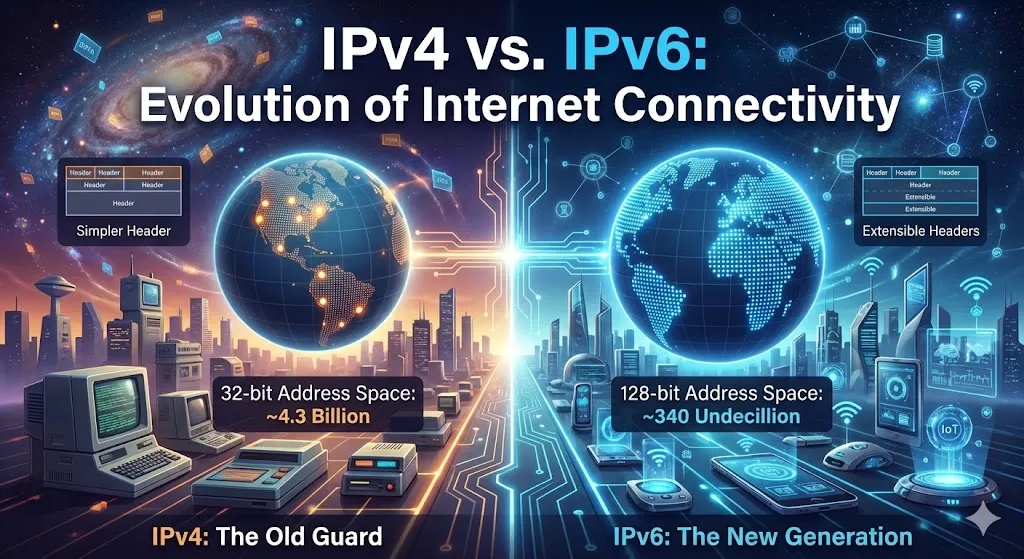
Foreword: In today’s interconnected world, where virtually every aspect of our lives relies on the internet, understanding the fundamentals of internet protocols is essential.
Table of Contents
Among these protocols, IPv4 (Internet Protocol version 4) and IPv6 (Internet Protocol version 6) are two of the most vital components that govern how devices communicate over the Internet. Despite their shared purpose of facilitating data transmission, IPv4 and IPv6 have distinct characteristics and play different roles in shaping the future of the Internet.
In this comprehensive guide, we’ll delve into the key differences between IPv4 and IPv6, exploring their features, limitations, and implications for the digital landscape.
IPv4: The Old Guard
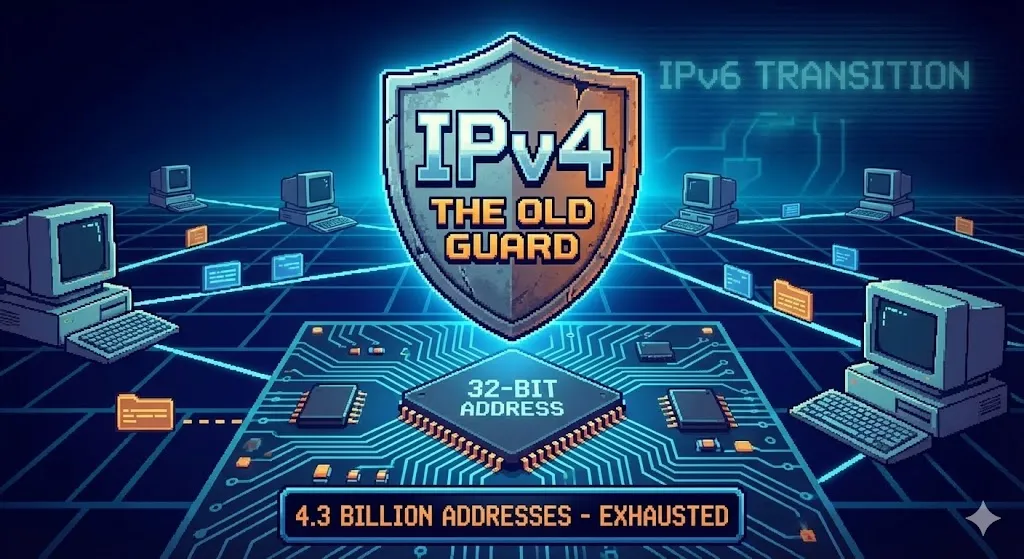
IPv4, the fourth version of the Internet Protocol, has been the cornerstone of Internet communication since its inception. Launched in the early 1980s, IPv4 introduced a standardized method for identifying and routing data packets across computer networks. At the heart of IPv4 is its 32-bit address format, which allows for approximately 4.3 billion unique addresses. While this seemed like an ample supply at the time of its creation, the explosive growth of the internet and the proliferation of internet-connected devices have led to the exhaustion of available IPv4 addresses. Today, IPv4’s limitations are evident as organizations scramble to obtain scarce IPv4 addresses or transition to IPv6.
IPv6: The New Generation
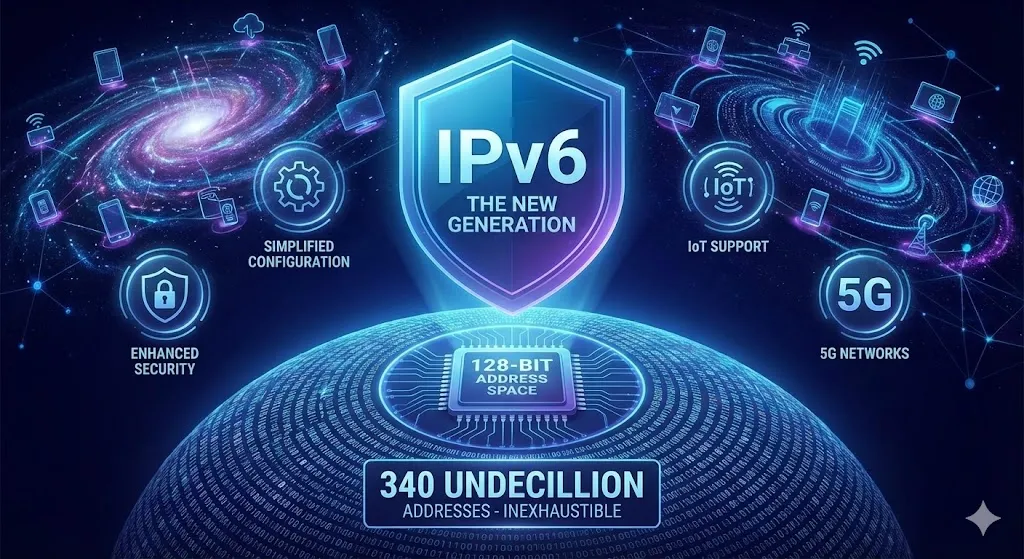
Enter IPv6, the successor to IPv4 designed to address the limitations of its predecessor. IPv6 adopts a 128-bit address format, providing an astronomical number of unique addresses—approximately 340 undecillion (3.4×10^38). This vast address space ensures an inexhaustible supply of addresses, accommodating the exponential growth of internet-connected devices for generations to come. Beyond address space, IPv6 offers several improvements over IPv4, including enhanced security, simplified network configuration, and support for emerging technologies such as the Internet of Things (IoT) and 5G networks.
Key Differences Between IPv4 and IPv6
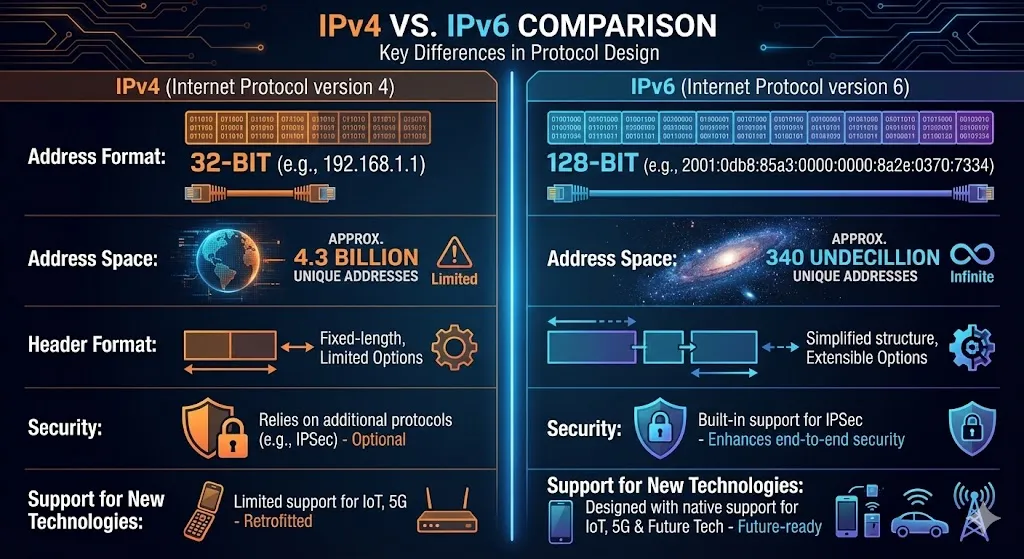
Address Format:
IPv4: 32-bit address format (e.g., 192.168.1.1)
IPv6: 128-bit address format (e.g., 2001:0db8:85a3:0000:0000:8a2e:0370:7334)
Address Space:
IPv4: Approximately 4.3 billion unique addresses
IPv6: Approximately 340 undecillion unique addresses
Header Format:
IPv4: Fixed-length header with limited options
IPv6: Simplified header structure with extensible options
Security:
IPv4: Relies on additional protocols (e.g., IPSec) for security
IPv6: Built-in support for IPSec, enhancing end-to-end security
Support for New Technologies:
IPv4: Limited support for emerging technologies such as IoT and 5G
IPv6: Designed with native support for IoT, 5G, and other future technologies
IP Industry Implications and Future Outlook
As the transition from IPv4 to IPv6 gains momentum, organizations could adapt to the evolving internet landscape. While IPv4 will continue to coexist with IPv6 for the foreseeable future, the long-term sustainability of the internet relies on widespread IPv6 adoption. Embracing IPv6 not only addresses the pressing issue of IPv4 address exhaustion but also unlocks new possibilities for innovation and connectivity in the digital age.
IPv4 and IPv6 in a nutshell
In summary, IPv4 and IPv6 represent two distinct eras in internet communication, each with its own strengths and limitations. While IPv4 has served as the backbone of the internet for decades, the rapid expansion of the digital ecosystem necessitates the adoption of IPv6 to ensure continued growth and connectivity. By understanding the differences between IPv4 and IPv6 and embracing the transition to IPv6, organizations can future-proof their networks and pave the way for a more robust and interconnected internet infrastructure.
Trusted IPv4 Leasing for Business Growth
Get enterprise-grade IPv4 space quickly, with seamless deployment and end-to-end management.
Get Started with i.leaseFAQs
Is IPv6 faster than IPv4?
In many cases, yes. IPv6 is designed to be more efficient. It eliminates the need for NAT (Network Address Translation), which allows for direct end-to-end communication. This reduces the processing overhead at the router level, leading to lower latency and a more efficient routing process for high-bandwidth applications like gaming and VoIP.
Can IPv4 and IPv6 communicate with each other directly?
No, they are not directly compatible. An IPv4-only device cannot talk to an IPv6-only device without a “translator.” Organizations solve this using Dual-Stack (running both protocols simultaneously) or Tunneling (wrapping IPv6 packets inside IPv4 packets) to ensure seamless communication during the transition period.
Why is the world still using IPv4 if it has run out of addresses?
The main reason is legacy infrastructure. Much of the world’s current hardware, software, and enterprise systems were built specifically for IPv4. Replacing or upgrading all this equipment is expensive and time-consuming. This is why a massive market for IPv4 leasing and brokerage exists—to provide businesses with the “old guard” addresses they still need to operate.
Related Posts
IPv4 leasing vs purchasing: structural risk in the IPv4 address market
IPv4 leasing vs purchasing reflects a structural shift in IP address markets, balancing cost, control, scarcity, and operational risk in 2026. Key points IPv4 leasing has become a flexible operating model, with stable monthly pricing driven by scarcity and fast deployment needs. IPv4 purchasing is shifting into a long-term asset strategy, but exposed to price cycles, liquidity changes, and capital lock-in. IPv4 is no longer just infrastructure — itRead more Related Posts IPv4 leasing vs purchasing: structural risk in the IPv4 address market IPv4 leasing vs purchasing reflects a structural shift in IP address markets, balancing cost, control, scarcity, and operational risk in Read more IPv4 数据中心租赁:你需要了解的事项 随着 IPv4 稀缺性持续加剧,越来越多数据中心开始通过IPv4 租赁来扩展基础设施、控制成本,并维持稳定的公网连通性。原文开篇就指出,IPv4 地址短缺正在推动数据中心更频繁地采用租赁模式,以支持扩容、成本管理与全球连接需求。 对许多数据中心来说,IPv4 已不只是一个技术资源,而是一项必须被规划与管理的关键基础设施。特别是在云服务、SaaS、邮件服务和混合云架构持续扩张的情况下,如何取得可用、可部署、可管理的 IPv4 地址,已经成为实际营运问题。原文列出数据中心仍依赖 IPv4 的核心原因,包括托管公网服务、兼容旧系统,以及支撑全球路由与可达性。 为什么数据中心至今仍然离不开 IPv4? 虽然 IPv6 已推出多年,但 IPv4 仍然是全球互联网的重要组成部分。原文指出,IPv4 诞生于 1980 年代,总地址量约为 Read more IPv4 Leasing for Data Centres: What You Need To Know As IPv4 scarcity intensifies, data centres increasingly rely on leasing to scale infrastructure, control costs, and maintain reliable connectivity worldwide.IPv4 Read more .related-post {} .related-post .post-list { text-align: left; } .related-post .post-list .item { margin: 5px; padding: 10px; } .related-post .headline { font-size: 18px !important; color: #999999 !important; } .related-post .post-list .item .post_thumb { max-height: 220px; margin: 10px 0px; padding: 0px; display: block; } .related-post .post-list .item .post_title { font-size: 16px; color: #3f3f3f; margin: 10px 0px; padding: 0px; display: block; text-decoration: none; } .related-post .post-list .item .post_excerpt { font-size: 13px; color: #3f3f3f; margin: 10px 0px; padding: 0px; display: block; text-decoration: none; } @media only screen and (min-width: 1024px) { .related-post .post-list .item { width: 30%; } } @media only screen and (min-width: 768px) and (max-width: 1023px) { .related-post .post-list .item { width: 90%; } } @media only screen and (min-width: 0px) and (max-width: 767px) { .related-post .post-list .item { width: 90%; } }
IPv4 Leasing for Data Centres: What You Need To Know
As IPv4 scarcity intensifies, data centres increasingly rely on leasing to scale infrastructure, control costs, and maintain reliable connectivity worldwide. IPv4 leasing has become a critical strategy for data centres facing address shortages and rising acquisition costs Leasing offers flexibility and scalability, but introduces risks around reputation, compliance, and long-term dependency Understanding IPv4 and why data centres still depend on it Despite years of tech progress IPv4 is stillRead more Related Posts IPv4 leasing vs purchasing: structural risk in the IPv4 address market IPv4 leasing vs purchasing reflects a structural shift in IP address markets, balancing cost, control, scarcity, and operational risk in Read more IPv4 数据中心租赁:你需要了解的事项 随着 IPv4 稀缺性持续加剧,越来越多数据中心开始通过IPv4 租赁来扩展基础设施、控制成本,并维持稳定的公网连通性。原文开篇就指出,IPv4 地址短缺正在推动数据中心更频繁地采用租赁模式,以支持扩容、成本管理与全球连接需求。 对许多数据中心来说,IPv4 已不只是一个技术资源,而是一项必须被规划与管理的关键基础设施。特别是在云服务、SaaS、邮件服务和混合云架构持续扩张的情况下,如何取得可用、可部署、可管理的 IPv4 地址,已经成为实际营运问题。原文列出数据中心仍依赖 IPv4 的核心原因,包括托管公网服务、兼容旧系统,以及支撑全球路由与可达性。 为什么数据中心至今仍然离不开 IPv4? 虽然 IPv6 已推出多年,但 IPv4 仍然是全球互联网的重要组成部分。原文指出,IPv4 诞生于 1980 年代,总地址量约为 Read more IPv4 Leasing for Data Centres: What You Need To Know As IPv4 scarcity intensifies, data centres increasingly rely on leasing to scale infrastructure, control costs, and maintain reliable connectivity worldwide.IPv4 Read more .related-post {} .related-post .post-list { text-align: left; } .related-post .post-list .item { margin: 5px; padding: 10px; } .related-post .headline { font-size: 18px !important; color: #999999 !important; } .related-post .post-list .item .post_thumb { max-height: 220px; margin: 10px 0px; padding: 0px; display: block; } .related-post .post-list .item .post_title { font-size: 16px; color: #3f3f3f; margin: 10px 0px; padding: 0px; display: block; text-decoration: none; } .related-post .post-list .item .post_excerpt { font-size: 13px; color: #3f3f3f; margin: 10px 0px; padding: 0px; display: block; text-decoration: none; } @media only screen and (min-width: 1024px) { .related-post .post-list .item { width: 30%; } } @media only screen and (min-width: 768px) and (max-width: 1023px) { .related-post .post-list .item { width: 90%; } } @media only screen and (min-width: 0px) and (max-width: 767px) { .related-post .post-list .item { width: 90%; } }

What are the risks of buying IPv4 from the wrong source?
Buying IPv4 addresses outside proper IP Allocation channels exposes organisations to fraud, legal disputes, operational failures and long-term governance risks. Key points: Poorly governed IPv4 transactions can fail regional internet registry checks, leading to loss of assets or invalid transfers. Cheap or unverified sources often hide risks including hijacked IP space, blacklisting, and non-compliance with centralized IP allocation policies. Introduction: scarcity fuels risk in the IPv4 market The globalRead more Related Posts IPv4 leasing vs purchasing: structural risk in the IPv4 address market IPv4 leasing vs purchasing reflects a structural shift in IP address markets, balancing cost, control, scarcity, and operational risk in Read more IPv4 数据中心租赁:你需要了解的事项 随着 IPv4 稀缺性持续加剧,越来越多数据中心开始通过IPv4 租赁来扩展基础设施、控制成本,并维持稳定的公网连通性。原文开篇就指出,IPv4 地址短缺正在推动数据中心更频繁地采用租赁模式,以支持扩容、成本管理与全球连接需求。 对许多数据中心来说,IPv4 已不只是一个技术资源,而是一项必须被规划与管理的关键基础设施。特别是在云服务、SaaS、邮件服务和混合云架构持续扩张的情况下,如何取得可用、可部署、可管理的 IPv4 地址,已经成为实际营运问题。原文列出数据中心仍依赖 IPv4 的核心原因,包括托管公网服务、兼容旧系统,以及支撑全球路由与可达性。 为什么数据中心至今仍然离不开 IPv4? 虽然 IPv6 已推出多年,但 IPv4 仍然是全球互联网的重要组成部分。原文指出,IPv4 诞生于 1980 年代,总地址量约为 Read more IPv4 Leasing for Data Centres: What You Need To Know As IPv4 scarcity intensifies, data centres increasingly rely on leasing to scale infrastructure, control costs, and maintain reliable connectivity worldwide.IPv4 Read more .related-post {} .related-post .post-list { text-align: left; } .related-post .post-list .item { margin: 5px; padding: 10px; } .related-post .headline { font-size: 18px !important; color: #999999 !important; } .related-post .post-list .item .post_thumb { max-height: 220px; margin: 10px 0px; padding: 0px; display: block; } .related-post .post-list .item .post_title { font-size: 16px; color: #3f3f3f; margin: 10px 0px; padding: 0px; display: block; text-decoration: none; } .related-post .post-list .item .post_excerpt { font-size: 13px; color: #3f3f3f; margin: 10px 0px; padding: 0px; display: block; text-decoration: none; } @media only screen and (min-width: 1024px) { .related-post .post-list .item { width: 30%; } } @media only screen and (min-width: 768px) and (max-width: 1023px) { .related-post .post-list .item { width: 90%; } } @media only screen and (min-width: 0px) and (max-width: 767px) { .related-post .post-list .item { width: 90%; } }
