IPv4 provider-chain risk: the short answer
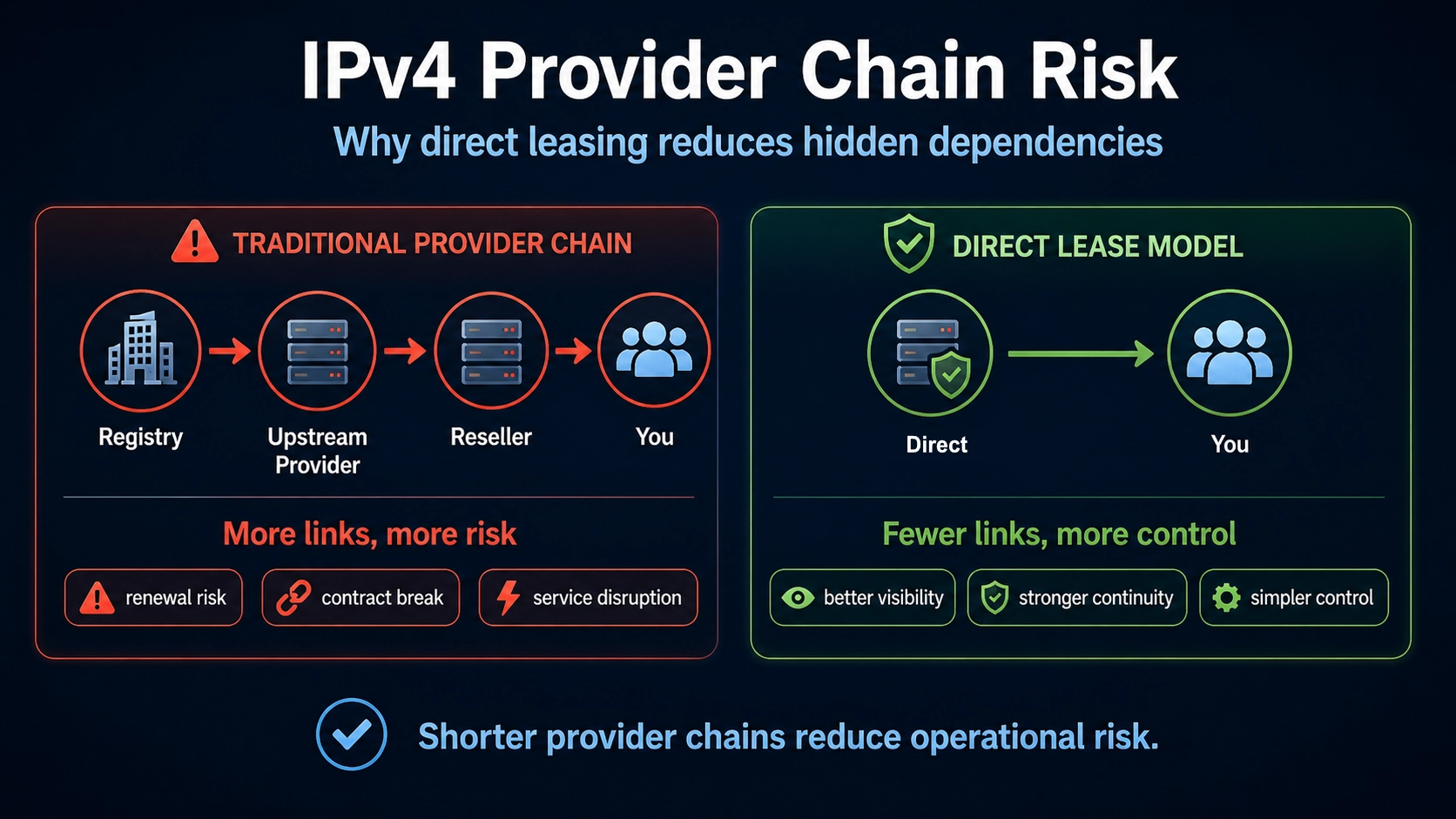
A prefix working today is not proof that your organization can keep using and routing it tomorrow. Provider-chain risk appears when registration authority, contractual permission, route authorization, transit, abuse handling, renewal, and exit depend on different parties without a verified handover path.
A multi-party chain is not automatically unsafe. The risk is an unnamed responsibility, an unverifiable authority, or a dependency that can disappear before replacement capacity is ready. Before production use, map every party from the registered resource holder to the network announcing the prefix and the operator carrying the traffic.
Map the IPv4 control chain
| Layer | Question to answer | Evidence to retain |
|---|---|---|
| Registration | Which organization and RIR account control the exact prefix? | Dated RDAP or Whois result, resource status, organization identity, and an authorized account contact |
| Right to use | Which contract permits your use, for which workload and term? | Exact CIDR, parties, permitted use, downstream rights, start and end dates, fees, renewal, suspension, termination, and replacement terms |
| Route origin | Who can authorize the intended origin ASN? | ROA covering the prefix, origin ASN, and intended maximum length, plus an external RPKI validation result |
| Route filtering | Who can create or change the relevant IRR route object and provider filters? | Maintainer authority, exact route object, accepted prefix and ASN, ticket or change record, and filter confirmation |
| Transit | Which network will announce and carry the route? | BGP design, ASN, peers or upstreams, accepted prefix lengths, activation window, escalation path, and observed route |
| Operations | Who owns abuse, rDNS, geofeed, reputation, monitoring, and incident response? | Named contacts, service levels, change authority, evidence sources, response workflow, and tested escalation |
| Exit | What happens if any party, route, or agreement ends? | Notice dates, replacement capacity, renumbering plan, route and ROA withdrawal order, data export, quarantine, and rollback owner |
Do not infer control from a logo, invoice, dashboard, or currently visible route. A reseller may have a valid commercial role without controlling the RIR account. An announcing network may operate the BGP session without being able to create the ROA. A registered holder may control the resource but not your transit or application migration.
LOA, ROA, IRR, and BGP are different controls
| Control | What it supports | What it does not prove by itself |
|---|---|---|
| LOA | A written statement that a holder or provider authorizes a named network action. Acceptance and format depend on the receiving operator. | RIR registration, cryptographic route-origin authorization, a live BGP route, or a continuing contract |
| RPKI ROA | A digitally signed object authorizing an ASN to originate a prefix, with a maximum prefix length. | That BGP is configured, every network will accept the route, or the customer has a commercial right to use the addresses |
| IRR route object | Registry data that operators can use to build prefix and origin filters, subject to the database's authorization model. | A cryptographic authorization, a current route, or identical filtering by every upstream |
| BGP announcement | The route actually exchanged between autonomous systems at an observed time. | Resource ownership, contract validity, future continuity, or correct abuse and registration records |
RFC 9582 defines a ROA as authorization from an IP address block holder for an AS to originate routes. ARIN also states that downstream organizations may need the upstream holder to create ROAs on their behalf. That dependency should be named in the agreement, assigned to a person, and tested before activation.
IPv4 provider-chain due diligence checklist
- Freeze the requested object. Record the exact CIDR, required prefix lengths, origin ASN, RIR, use case, regions, start date, term, and evidence timestamp.
- Identify every party. List the resource holder, lessor or seller, reseller, route sponsor, origin network, transit providers, platform operator, and your contracting entity. Record which relationships are direct.
- Match authority to evidence. Confirm who can update registration, sign the agreement, issue an LOA, create or change a ROA, maintain IRR objects, open routing tickets, and approve emergency changes.
- Read the applicable resource status and policy. Allocation, assignment, sub-allocation, transferred space, and provider-dependent space can have different portability and return conditions. Check the current RIR source for the exact resource.
- Make the contract operational. Name the prefix, permitted uses, all material dependencies, response times, renewal method, price changes, suspension triggers, abuse process, data handling, termination, replacement, and liability boundaries.
- Prepare routing before traffic. Create the intended ROA, IRR objects, provider filters, LOA if required, BGP configuration, rDNS delegation, geofeed plan, and monitored contacts. Avoid a ROA maximum length broader than the announcement plan.
- Run a staged acceptance test. Announce only in the approved window. Verify the origin and path from independent views, RPKI state, expected prefix length, reachability from representative networks, and rollback.
- Test application fit. Use dated, workload-relevant checks for reputation, geolocation, mail or platform acceptance, DNS, latency, and abuse history. No single score proves a whole prefix clean or suitable.
- Rehearse renewal and exit. Put notice dates on a shared calendar, identify replacement lead time, document renumbering, and confirm the order for traffic migration, route withdrawal, ROA and IRR changes, rDNS, and address return.
Test continuity before production
| Scenario | Control to prepare | Acceptance evidence |
|---|---|---|
| Upstream relationship ends | Replacement provider and renumbering or re-origination plan | Named owner, lead time, configuration inventory, test window, and rollback criteria |
| Origin ASN changes | Coordinated ROA, IRR, filters, BGP, monitoring, and withdrawal sequence | Both authorization states checked and the new origin observed before the old path is removed |
| Route is withdrawn | Independent route alerts and a 24/7 escalation path | Alert reaches the accountable person and the provider can identify or restore the exact prefix |
| Resource authority changes | Contractual notification and current RIR-account contact | Dated registration check, authorized confirmation, and a documented decision on continued use |
| Abuse or reputation incident | Usage controls, evidence retention, response workflow, and replacement criteria | Tested contact path, case ownership, remediation steps, and a workload-specific revalidation plan |
BGP can withdraw a previously announced route or remove routes when a session closes, as described in RFC 4271. RPKI and IRR records help networks validate or filter announcements, but neither keeps a failed commercial or transit relationship alive. Continuity therefore needs both technical controls and a contractual exit path.
Lease, sub-lease, or buy: compare dependencies
A direct transfer accepted by the applicable RIR can remove some commercial intermediaries, but it does not eliminate routing, RPKI, IRR, abuse, reputation, or migration work. A lease can be appropriate for variable or time-bounded demand if the holder's authority and each operating responsibility are verifiable.
Sub-leasing adds at least one relationship, so ask whether downstream use is permitted and who remains accountable to the resource holder and RIR. In the RIPE NCC service region, current policy distinguishes provider-aggregatable assignments and sub-allocations and explains that some provider-dependent space must be returned when service ends. Other regions and resource statuses differ; verify the current policy rather than generalizing from one registry.
Questions every IPv4 provider should answer
- What is the exact prefix, RIR, resource status, and registered organization?
- Are you the resource holder, an authorized provider, a reseller, or the routing operator?
- Does the holder permit this exact downstream use and any intended sub-delegation?
- Who creates the ROA, and what origin ASN and maximum length will it authorize?
- Who creates the IRR route object and confirms every required upstream filter?
- Who issues an LOA if a network requires one, and how is the issuer's authority verified?
- Who handles BGP incidents, rDNS, geofeed changes, reputation, and abuse reports?
- What are the renewal date, notice window, price mechanism, suspension rights, and termination conditions?
- What happens if an upstream, reseller, resource holder, or routing operator leaves the chain?
- What replacement, renumbering, evidence export, route withdrawal, and address-return process applies?
Where i.lease fits
i.lease can help turn an IPv4 request into a defined operating requirement: prefix size, region, use, origin ASN, routing model, evidence, timing, renewal, and exit. Review managed IPv4 leasing for a service-led path, inspect current marketplace listings, or use the IPv4 risk-assessment checklist before comparing supply.
No provider can guarantee permanent global route acceptance, instant third-party reputation changes, or zero future incidents. The useful promise is a clear scope, verifiable authority, named operations, tested escalation, and an exit plan that exists before traffic depends on the prefix.
IPv4 provider-chain risk FAQ
What is IPv4 provider-chain risk?
It is the continuity risk created when the right to use, register, authorize, route, support, renew, or return a prefix depends on multiple parties. The number of parties matters less than whether every dependency and handover is explicit and testable.
Does a live BGP route prove that a provider controls the prefix?
No. It proves that a route was observed from an origin and path at that time. Check RIR registration, contractual authority, ROA, IRR data, provider filters, and the operating relationship separately.
Is an LOA the same as an RPKI ROA?
No. An LOA is a document accepted according to an operator's process. A ROA is a digitally signed RPKI object authorizing an origin ASN for a prefix and maximum length. Neither alone creates the BGP route or the lease contract.
Can buying IPv4 remove provider-chain risk?
It can remove some lease or reseller dependencies after a valid transfer, but routing, registry accounts, RPKI, IRR, transit, reputation, abuse response, and migration still need owners and evidence.
What is the most important renewal check?
Confirm who has authority to renew, the exact notice and decision dates, any price or eligibility conditions, upstream dependencies, and how much lead time your replacement and renumbering plan requires.
How should a provider-chain failure be tested?
Use a controlled exercise: alert on a route change, reach the named escalation contacts, validate the intended ROA and IRR changes, rehearse migration or withdrawal, and record objective pass, rollback, and ownership criteria.
Primary sources for verification
- RFC 4271: A Border Gateway Protocol 4 (BGP-4)
- RFC 7454: BGP Operations and Security
- RFC 7908: Problem Definition and Classification of BGP Route Leaks
- RFC 9582: A Profile for Route Origin Authorizations
- ARIN: RPKI deployment options and downstream authorization
- RIPE-826: IPv4 Address Allocation and Assignment Policies
- RIPE Database: route-object authorization
- APNIC: RPKI, ROAs, and route-origin validation