IPv4 price history: the short answer
There is no single historical or current price for an IPv4 address. Public figures are dated observations from particular marketplaces, block sizes, regions, and transaction types. They can show direction and dispersion, but they are not a universal market index, a live i.lease quote, or evidence that a specific prefix is transferable or suitable.
The most useful reading of IPv4 price history is therefore a comparison method: preserve the source and observation date, compare the same CIDR size and RIR path, separate completed sales from asking prices, and add transfer and operating work before choosing purchase or lease.
Evidence boundary: the public sources in this guide were reviewed on 5 September 2026. Replace historical inputs with a dated written quote before making a budget or transaction decision.
How should you read public IPv4 price data?
RIR transfer logs record changes handled under registry policy, but they generally do not publish the commercial price. Marketplace reports can add transaction-price evidence, yet they describe that platform's own mix of blocks and deals. A listed price, a broker estimate, and a completed sale are different observations.
| Evidence | Useful for | Does not prove |
|---|---|---|
| RIR transfer record | Registry, source and recipient, date, and transferred prefix under that RIR's published data model | The sale price, full contract, routing readiness, or application suitability |
| Marketplace completed-sale sample | Dated transaction observations from one venue, often grouped by block size | A complete global market average or the price of an uninspected prefix |
| Listing or asking price | What a seller or venue is inviting buyers to consider at that moment | That a sale closed at that number or that the block can pass transfer review |
| Broker or platform commentary | Context about that participant's inventory, demand, and completed activity | An independent forecast or a guaranteed future direction |
| Written quote for one prefix | The starting commercial input for a defined transaction | Total cost until fees, authority, transfer, routing, reputation, tax, and operating scope are confirmed |
What does public 2015–2026 IPv4 price history show?
The timeline below deliberately attributes each observation to IPv4.Global's published marketplace sample. It is a useful long-running public series, but it is still one venue rather than an independent census of every private IPv4 transaction.
| Period | Published observation | Decision boundary |
|---|---|---|
| 2015–2020 | Its historical review describes per-address prices in its sample rising from roughly $10 to $25 over this period. | A multi-year direction does not price a particular registry, prefix size, or transaction today. |
| 2021 | The same review reports rapid appreciation, a wider range of completed prices, and some observations near $60 per address. | A peak or outlier is not a reusable baseline for a later budget. |
| 2024 | Its year-in-review chart shows meaningful movement by block size and convergence around the low-to-mid $30s late in the year. | The chart is a marketplace average by size; individual transactions can differ. |
| 2025 | Monthly reports describe large-block prices declining more sharply; the June report says average /16 pricing in its sample fell below $20 while smaller sizes were steadier. | Do not apply a /16 average to a /24, or assume supply and terms are interchangeable. |
| 2026 through July | The monthly series describes early-year weakness followed by firmer pricing as available inventory tightened in its marketplace. | This is a dated directional observation, not a prediction that the movement will continue. |
For the latest chart and the report behind each month, use the IPv4.Global pricing-data archive. The archive can change after this article's review date, so retain the report date used in any decision record.
Why can IPv4 prices differ so much?
- Prefix size: A /24 contains 256 addresses while a /16 contains 65,536. Different buyer pools, subdivision options, and operational needs can produce different per-address prices.
- RIR and transfer path: Eligibility, documentation, fees, timelines, and inter-RIR options follow the applicable registry policy and the parties' status.
- Address condition: Registration, routing history, RPKI, IRR, reverse DNS, geolocation, blocklist, abuse, and application-specific observations can change diligence and remediation work. No single “clean” label settles every system.
- Commercial structure: Auctions, private sales, bundles, deposits, escrow, broker fees, taxes, currency, payment timing, and warranties make headline prices hard to compare.
- Operational readiness: A transferred block still needs an authorized route, accepted prefix length, origin ASN, upstream coordination, monitoring, abuse handling, and a rollback plan before it serves traffic.
- Date and liquidity: Available supply and buyer urgency change. A report from another quarter is context, not a standing offer.
What does IPv4 exhaustion explain—and what does it not?
IANA states that its general IPv4 supply is exhausted. Regional policy is more nuanced. RIPE NCC recovers small amounts of address space and allocates qualifying /24s through a waiting list, while APNIC documents limited final-/8 availability under its community policy. Returned and reclaimed resources therefore make “nothing new ever enters supply” too absolute.
Exhaustion explains why unrestricted new allocation cannot satisfy ordinary demand. It does not prove that every holder can transfer, every applicant qualifies for recovered space, every registered prefix is available, or every observed price must rise. Transfer supply, recovered space, operational need, and IPv6 deployment are separate facts.
How do you compare an IPv4 purchase with leasing?
Normalize both paths to the same address count, operating horizon, currency, and required service. A purchase price per address is an upfront capital input; a lease rate per address per month is a recurring input. Neither number includes every cost by default.
Purchase base = quoted price per address × transferred address count
Lease base = monthly rate per billed address × billed address count × term months
| Layer | Purchase questions | Lease questions |
|---|---|---|
| Commercial unit | Exact CIDR, per-address or whole-block quote, currency, taxes, payment milestones | Exact CIDR, billed count, monthly or annual rate, deposit, minimum term, taxes |
| Authority and registry | Registered holder, transfer eligibility, RIR request, agreement, escrow, closing evidence | Holder and lessor authority, permitted use, LOA or other route authority, registry-record scope |
| Activation | RPKI/ROA, IRR, rDNS, geofeed, origin ASN, upstream acceptance, migration | Who performs and pays for each route, record, DNS, geolocation, and activation change |
| Operations | Monitoring, abuse response, reputation work, registry upkeep, route security | Included support, incident path, replacement boundary, renewal, repricing, return |
| End of horizon | Residual value is uncertain; a later transfer requires its own eligibility and costs | Renewal or renumbering cost, notice period, route withdrawal, data and record cleanup |
Use the IPv4 cost calculator to put dated purchase and lease inputs on the same horizon. Treat its result as scenario arithmetic, then add the case-specific items that the quote excludes.
What should you verify before relying on a price?
- Freeze the requirement. Record CIDR size, RIR, intended use, geography, origin ASN, start date, growth margin, and whether multiple blocks are acceptable.
- Name the evidence. Preserve the source, observation date, completed-sale or asking-price status, included block sizes, exclusions, and currency.
- Verify the prefix and party. Inspect authoritative RIR registration, the counterparty's authority, transfer path, liens or disputes addressed by the agreement, and escrow conditions.
- Inspect technical history. Review current and historical routes, origin changes, RPKI, IRR, reverse DNS, geolocation, reputation, abuse observations, and application fit with timestamps.
- Define acceptance. State which registry, routing, and application checks must pass, who accepts them, and what happens if a condition fails.
- Compare total cost. Keep price, fees, financing, activation, operations, renewal, replacement, and exit or renumbering visible as separate lines.
- Do not forecast by extrapolation. Run several dated scenarios instead of presenting one historical slope as a guaranteed future value.
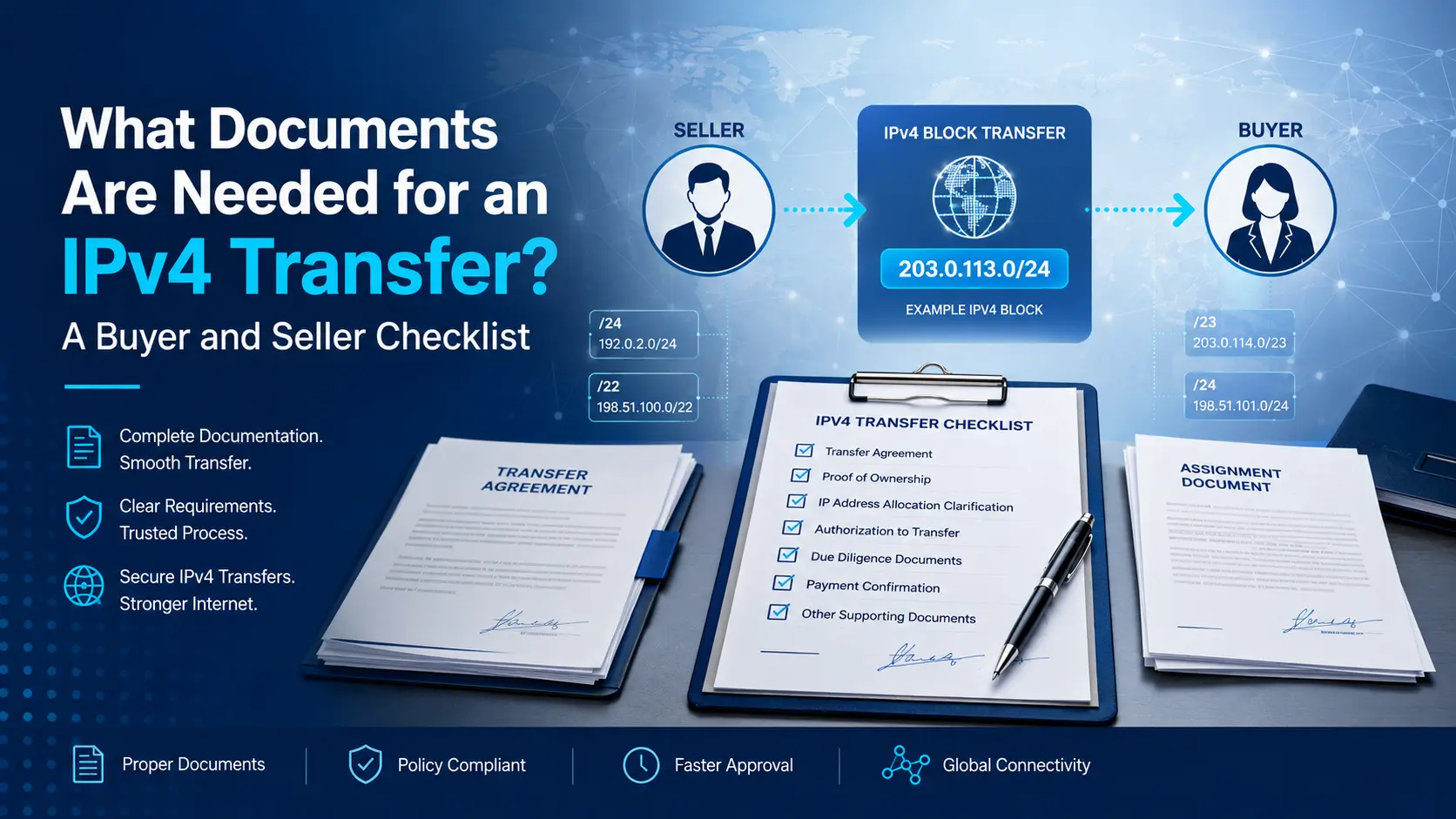
For an ARIN-region purchase, the ARIN transfer pre-approval guide explains the current recipient process and projected-need review. Other RIRs use their own policies; confirm the exact registry path rather than carrying one region's rules into another.
IPv4 price history FAQ
What is the current price of an IPv4 address?
There is no universal current price. Ask for a dated quote tied to an exact CIDR, RIR, transaction type, currency, and scope, then compare it with dated completed-sale evidence for similar blocks.
How much did IPv4 addresses cost in 2021?
IPv4.Global's marketplace review describes rapid appreciation during 2021, a wider range of results, and some observations near $60 per address. That venue-specific history is not a price for every 2021 transfer or a current valuation.
Why does a /24 have a different per-address price from a /16?
The buyer pool, supply, subdivision options, routing use, registry path, and commercial terms differ by size. Compare completed observations for the same size band instead of multiplying a large-block average into a /24 estimate.
Do RIR transfer logs publish IPv4 sale prices?
RIR transfer data documents registry events under each registry's data model. It generally does not disclose the private commercial price or all contract terms, so a transfer count and a market-price series answer different questions.
Does IPv4 exhaustion guarantee prices will rise?
No. Exhaustion limits ordinary new supply, but price still reflects available transfer supply, block size, buyer demand, region, liquidity, condition, and transaction terms. Recovered space and limited policy allocations also exist.
Is the cheapest IPv4 block the best option?
No. A low price does not prove transfer eligibility, authority, routing readiness, reputation, geolocation, DNS control, application acceptance, or support. Compare total cost and acceptance evidence for the exact prefix.
When is leasing more useful than buying?
Leasing can fit temporary, uncertain, or changing demand and usually reduces upfront capital. Buying can fit a durable eligible need and a different long-term control model. Compare the same block size and horizon, including setup, operations, renewal, and exit.
Can IPv4 price history predict a 2027 price?
No. Historical observations can support scenarios, not a guaranteed forecast. Record the assumptions and run several cases for supply, quote, holding period, and lease rate instead of extending one past trend.
Sources and live data
- IPv4.Global: historical pricing method and marketplace observations
- IPv4.Global: current and archived monthly marketplace reports
- IPv4.Global: 2024 year-in-review pricing chart
- IANA: number resource allocation data and IPv4 exhaustion note
- RIPE NCC: recovered IPv4 waiting-list process
- APNIC: IPv4 exhaustion and limited availability
- ARIN: transfer pre-approval and recipient requirements