Pourquoi utiliser IPv6? Avantages et cas d’utilisation en entreprise
 Stephanie
Introduction
Table of Contents
L’IPv6 prend une importance croissante à mesure que les entreprises se préparent à la croissance à long terme d’Internet. Elle offre un espace d’adressage bien plus vaste que l’IPv4 et prend en charge l’expansion moderne des réseaux, notamment pour les services cloud, les réseaux mobiles, l’IoT, l’hébergement et l’infrastructure numérique mondiale.
Cependant, l’adoption de l’IPv6 n’est pas encore achevée. De nombreuses entreprises dépendent encore de l’IPv4 pour des raisons de compatibilité, d’accès client, de messagerie, d’hébergement et d’applications existantes. La véritable question n’est donc pas de savoir si l’IPv6 est utile, mais comment les entreprises doivent l’adopter tout en assurant la continuité de l’IPv4.
Pour de nombreuses organisations, la meilleure stratégie est pragmatique : se préparer à l’IPv6, tout en maintenant la disponibilité de l’IPv4 là où les clients et les systèmes en dépendent encore.
Qu’est-ce que l’IPv6 ?
L’IPv6, ou protocole Internet version 6, est la version la plus récente du protocole Internet utilisé pour identifier et connecter les appareils sur Internet. Il a été créé pour pallier la limitation d’adresses de l’IPv4, qui utilise un système d’adressage 32 bits et prend en charge environ 4,3 milliards d’adresses uniques.
L’IPv6 utilise un système d’adressage 128 bits, offrant ainsi aux réseaux un nombre d’adresses disponibles beaucoup plus important. Cela le rend adapté à la croissance à long terme d’Internet, notamment avec l’augmentation du nombre d’appareils, d’applications et de services en ligne nécessitant une connectivité directe.
Pourquoi les entreprises utilisent-elles l’IPv6 ?
Les entreprises utilisent l’IPv6 car Internet continue de se développer au-delà des limites de l’IPv4. Les plateformes cloud, les réseaux mobiles, les objets connectés, les systèmes de diffusion de contenu et les fournisseurs d’hébergement mondiaux ont tous besoin d’un adressage évolutif.
L’IPv6 aide les organisations à se préparer à la demande future en simplifiant l’attribution d’adresses uniques sur les grands réseaux. Il favorise également une architecture réseau plus propre dans les environnements où la communication directe entre appareils est essentielle.
Pour les entreprises qui planifient leur infrastructure à long terme, l’IPv6 n’est pas qu’une simple mise à niveau technique. Il s’inscrit pleinement dans une stratégie de planification réseau évolutive.
Principaux avantages de l’IPv6
- Espace d’adressage plus étendu
Le principal avantage de l’IPv6 réside dans son espace d’adressage considérablement plus vaste. La disponibilité des adresses IPv4 étant limitée, l’IPv6 offre une capacité d’adressage suffisante pour accompagner la croissance future d’Internet.
Ceci est crucial pour les entreprises qui gèrent de nombreux serveurs, appareils clients, machines virtuelles, charges de travail cloud ou produits connectés.
- Meilleure gestion de la croissance du réseau
L’IPv6 facilite l’évolutivité des réseaux. Au lieu de dépendre fortement du partage d’adresses ou de solutions de contournement complexes, les entreprises peuvent concevoir des réseaux avec un adressage plus direct et des structures d’allocation plus claires.
Ceci peut s’avérer utile pour les fournisseurs d’accès Internet, les hébergeurs, les centres de données, les plateformes SaaS et les entreprises dont les besoins en infrastructure sont en constante augmentation.
- Dépendance réduite à la NAT
De nombreux réseaux IPv4 s’appuient sur la traduction d’adresses réseau (NAT), car les adresses IPv4 publiques sont limitées. La NAT permet à plusieurs appareils de partager une même adresse IPv4 publique, mais elle peut aussi complexifier le dépannage, le routage, les performances des applications et la conception du réseau.
L’IPv6 réduit le besoin de NAT en permettant à un plus grand nombre d’appareils de disposer d’adresses uniques. Cela peut simplifier certains environnements réseau, notamment à grande échelle.
- Meilleure préparation à l’IoT et aux objets connectés
Les objets connectés, les capteurs, les appareils mobiles, les systèmes intelligents et les réseaux périphériques augmentent tous la demande en adresses IP. L’IPv6 est conçu pour soutenir cette croissance.
Pour les entreprises qui développent des produits connectés ou gèrent de vastes réseaux d’appareils, l’IPv6 peut fournir une base plus solide pour les déploiements futurs.
- Compatibilité à long terme avec l’infrastructure Internet moderne
À mesure que de plus en plus de réseaux, de plateformes et de services prennent en charge l’IPv6, les entreprises qui se préparent tôt peuvent éviter les futurs problèmes de compatibilité. La compatibilité avec l’IPv6 pourrait devenir de plus en plus importante pour les services cloud, les réseaux de télécommunications, les systèmes gouvernementaux et la connectivité internationale.
IPv6 et sécurité réseau
L’IPv6 peut contribuer à une conception de réseau sécurisée, mais il ne doit pas être considéré comme automatiquement sécurisé par défaut. Tout comme IPv4, IPv6 exige des règles de pare-feu appropriées, une surveillance, un contrôle d’accès, des politiques de routage et une configuration de sécurité adéquates.
Une erreur fréquente consiste à activer IPv6 sans mettre à jour les outils et politiques de sécurité. Si une entreprise ne surveille que le trafic IPv4 alors qu’IPv6 est actif, cela peut engendrer des failles de sécurité.
C’est pourquoi l’adoption d’IPv6 doit toujours s’accompagner d’un audit de sécurité. Les entreprises doivent vérifier que leurs pare-feu, leurs outils de détection d’intrusion, leurs systèmes de journalisation et leurs équipes réseau sont prêts à gérer correctement le trafic IPv6.
Les défis de l’adoption d’IPv6
Bien qu’IPv6 présente de nombreux avantages, son adoption peut s’avérer complexe. IPv6 n’est pas toujours un simple remplacement d’IPv4.
Les défis courants incluent :
- Systèmes existants ne prenant en charge que l’IPv4
- Applications non entièrement testées sur IPv6
- Équipes réseau ayant une expérience limitée de l’IPv6
- Outils de sécurité encore principalement axés sur l’IPv4
- Clients ou partenaires dépendants de l’IPv4
- Complexité opérationnelle liée à l’utilisation conjointe d’IPv4 et d’IPv6
C’est pourquoi de nombreuses entreprises adoptent l’IPv6 progressivement plutôt que de tout migrer d’un coup.
Pourquoi l’IPv4 reste important
Malgré l’adoption croissante de l’IPv6, l’IPv4 demeure largement utilisé sur Internet. De nombreux utilisateurs, services, appareils et systèmes d’entreprise dépendent encore de la connectivité IPv4.
Pour les entreprises, l’IPv4 reste essentiel pour l’accès aux sites web, l’hébergement, la délivrabilité des e-mails, les VPN, les systèmes d’entreprise, les réseaux clients et la compatibilité avec les infrastructures existantes.
Par conséquent, l’IPv6 doit être envisagé comme un élément d’une stratégie de transition, et non comme un remplacement immédiat de l’IPv4 dans tous les environnements.
IPv6 et IPv4 : une stratégie à double pile
De nombreuses entreprises adoptent une stratégie à double pile. Cela signifie que leur réseau prend en charge simultanément IPv4 et IPv6.
La double pile permet à une entreprise de servir les utilisateurs compatibles IPv6 tout en continuant à prendre en charge les clients, les applications et les systèmes qui dépendent d’IPv4. C’est souvent l’approche la plus sûre pendant la période de transition.
Par exemple, un fournisseur d’hébergement peut activer IPv6 pour ses clients modernes tout en continuant à louer des adresses IPv4 pour les clients qui ont encore besoin d’un accès IPv4. Une entreprise SaaS peut préparer son infrastructure pour IPv6 tout en maintenant la disponibilité d’IPv4 pour les utilisateurs professionnels et les intégrations existantes.
Que doivent prévoir les entreprises avant d’utiliser IPv6 ?
Avant de migrer vers IPv6, les entreprises doivent évaluer leur préparation technique et leurs besoins en matière de continuité d’activité.
Questions clés :
- Votre FAI ou votre fournisseur d’hébergement prend-il en charge IPv6 ?
- Vos applications sont-elles testées sur IPv6 ?
- Vos systèmes DNS, pare-feu et de surveillance sont-ils compatibles avec IPv6 ?
- Vos clients ont-ils toujours besoin d’un accès IPv4 ?
- Votre équipe gérera-t-elle conjointement les protocoles IPv4 et IPv6 ?
- Avez-vous besoin de louer des adresses IPv4 pendant la transition ?
Un plan IPv6 solide devrait réduire les risques futurs sans perturber les opérations actuelles. Pour de nombreuses entreprises, cela signifie se préparer à l’IPv6 tout en conservant des ressources IPv4 fiables.
En conclusion
L’IPv6 est important car il permet à Internet de se développer. Il prend en charge des réseaux plus vastes, un plus grand nombre d’appareils connectés et une planification des infrastructures à long terme.
Cependant, l’IPv4 joue encore un rôle majeur sur Internet. De nombreuses entreprises ne peuvent pas abandonner l’IPv4 immédiatement car leurs clients, applications et systèmes en dépendent encore.
La solution pratique consiste à se préparer à l’IPv6 tout en assurant la continuité de l’IPv4. Les entreprises qui planifient les deux seront mieux placées pour la croissance future, une migration plus fluide et une connectivité plus fiable.
Si votre organisation a besoin de ressources IPv4 pendant la transition, i.lease propose une plateforme permettant aux entreprises d’accéder à un espace d’adressage IP avec une plus grande flexibilité.
Foire Aux Questions (FAQs)
- À quoi sert l’IPv6 ?
L’IPv6 sert à identifier et à connecter les appareils sur Internet. Il offre un espace d’adressage beaucoup plus vaste que l’IPv4 et permet une croissance durable du réseau.
- Pourquoi les entreprises devraient-elles utiliser l’IPv6 ?
Les entreprises devraient utiliser l’IPv6 pour anticiper la croissance future d’Internet, prendre en charge davantage d’appareils, améliorer l’évolutivité du réseau et réduire leur dépendance à long terme à l’espace d’adressage limité de l’IPv4.
- L’IPv6 est-il plus rapide que l’IPv4 ?
L’IPv6 n’est pas systématiquement plus rapide que l’IPv4. Ses performances dépendent du routage réseau, de la prise en charge par le fournisseur d’accès, de la configuration et de l’emplacement. Sur certains réseaux, l’IPv6 peut être plus performant, tandis que sur d’autres, l’IPv4 peut rester plus fiable.
- L’IPv6 remplace-t-il l’IPv4 ?
L’IPv6 a été conçu pour pallier les limitations d’adresses de l’IPv4, mais ce dernier n’a pas disparu. De nombreuses entreprises utilisent encore conjointement l’IPv4 et l’IPv6 via une architecture à double pile.
- Ai-je encore besoin d’IPv4 si j’utilise IPv6 ?
Dans de nombreux cas, oui. Les entreprises peuvent avoir encore besoin d’IPv4 pour assurer la compatibilité avec leurs clients, applications, systèmes de messagerie, environnements d’hébergement et réseaux existants qui ne sont pas entièrement compatibles avec IPv6.
- Qu’est-ce qu’un réseau double pile ?
Un réseau double pile permet d’exécuter simultanément IPv4 et IPv6. Il permet aux entreprises de prendre en charge la connectivité IPv6 moderne tout en maintenant la compatibilité avec les utilisateurs et systèmes IPv4.
- La location d’adresses IPv4 peut-elle faciliter la transition vers IPv6 ?
Oui. La location d’adresses IPv4 peut aider les entreprises à maintenir leur connectivité IPv4 pendant qu’elles préparent, testent et déploient progressivement IPv6 sur leurs réseaux.
Also Read: Qu’est-ce que la location d’adresses IPv4 ?
Also Read: À propos d’IPv6 : avantages, adoption et planification de la transition vers IPv4
Articles connexes

Comprendre la délégation IP dans les réseaux modernes
En optimisant l’allocation des ressources, la délégation d’adresses IP permet de gérer les réseaux de manière sécurisée et évolutive, au-delà des frontières organisationnelles et géographiques. Une délégation d’adresses IP efficace améliore les performances du réseau, favorise l’automatisation et garantit la conformité aux normes internationales de gouvernance d’Internet. Introduction à la délégation IP L’attribution et la gestion correctes des adresses IP (Internet Protocol) sont essentielles au bon fonctionnement d’unRead more Related Posts Comprendre la délégation IP dans les réseaux modernes En optimisant l'allocation des ressources, la délégation d'adresses IP permet de gérer les réseaux de manière sécurisée et évolutive, au-delà Read more Pourquoi les entreprises adoptent le BYOIP Alors que les organisations du monde entier accélèrent leur transformation numérique, l'adoption du cloud n'est plus une simple tendance technologique, Read more Combien y a-t-il d’adresses IPv4 au total ? Il existe environ 4,3 milliards d'adresses IPv4. Plus précisément, 4 294 967 296. Bien que 10 chiffres puissent paraître beaucoup, nous n'avons plus Read more .related-post {} .related-post .post-list { text-align: left; } .related-post .post-list .item { margin: 5px; padding: 10px; } .related-post .headline { font-size: 18px !important; color: #999999 !important; } .related-post .post-list .item .post_thumb { max-height: 220px; margin: 10px 0px; padding: 0px; display: block; } .related-post .post-list .item .post_title { font-size: 16px; color: #3f3f3f; margin: 10px 0px; padding: 0px; display: block; text-decoration: none; } .related-post .post-list .item .post_excerpt { font-size: 13px; color: #3f3f3f; margin: 10px 0px; padding: 0px; display: block; text-decoration: none; } @media only screen and (min-width: 1024px) { .related-post .post-list .item { width: 30%; } } @media only screen and (min-width: 768px) and (max-width: 1023px) { .related-post .post-list .item { width: 90%; } } @media only screen and (min-width: 0px) and (max-width: 767px) { .related-post .post-list .item { width: 90%; } }

Pourquoi les entreprises adoptent le BYOIP
Alors que les organisations du monde entier accélèrent leur transformation numérique, l’adoption du cloud n’est plus une simple tendance technologique, mais une initiative stratégique majeure. Les entreprises migrent leurs charges de travail critiques vers le cloud à un rythme sans précédent afin d’améliorer leur flexibilité, leur évolutivité et leur rentabilité. Cependant, cette transformation n’est pas sans défis. L’un des enjeux les plus pressants de la migration vers le cloudRead more Related Posts Comprendre la délégation IP dans les réseaux modernes En optimisant l'allocation des ressources, la délégation d'adresses IP permet de gérer les réseaux de manière sécurisée et évolutive, au-delà Read more Pourquoi les entreprises adoptent le BYOIP Alors que les organisations du monde entier accélèrent leur transformation numérique, l'adoption du cloud n'est plus une simple tendance technologique, Read more Combien y a-t-il d’adresses IPv4 au total ? Il existe environ 4,3 milliards d'adresses IPv4. Plus précisément, 4 294 967 296. Bien que 10 chiffres puissent paraître beaucoup, nous n'avons plus Read more .related-post {} .related-post .post-list { text-align: left; } .related-post .post-list .item { margin: 5px; padding: 10px; } .related-post .headline { font-size: 18px !important; color: #999999 !important; } .related-post .post-list .item .post_thumb { max-height: 220px; margin: 10px 0px; padding: 0px; display: block; } .related-post .post-list .item .post_title { font-size: 16px; color: #3f3f3f; margin: 10px 0px; padding: 0px; display: block; text-decoration: none; } .related-post .post-list .item .post_excerpt { font-size: 13px; color: #3f3f3f; margin: 10px 0px; padding: 0px; display: block; text-decoration: none; } @media only screen and (min-width: 1024px) { .related-post .post-list .item { width: 30%; } } @media only screen and (min-width: 768px) and (max-width: 1023px) { .related-post .post-list .item { width: 90%; } } @media only screen and (min-width: 0px) and (max-width: 767px) { .related-post .post-list .item { width: 90%; } }
Qu’est-ce qu’une adresse IP élastique ? Guide complet pour les utilisateurs AWS
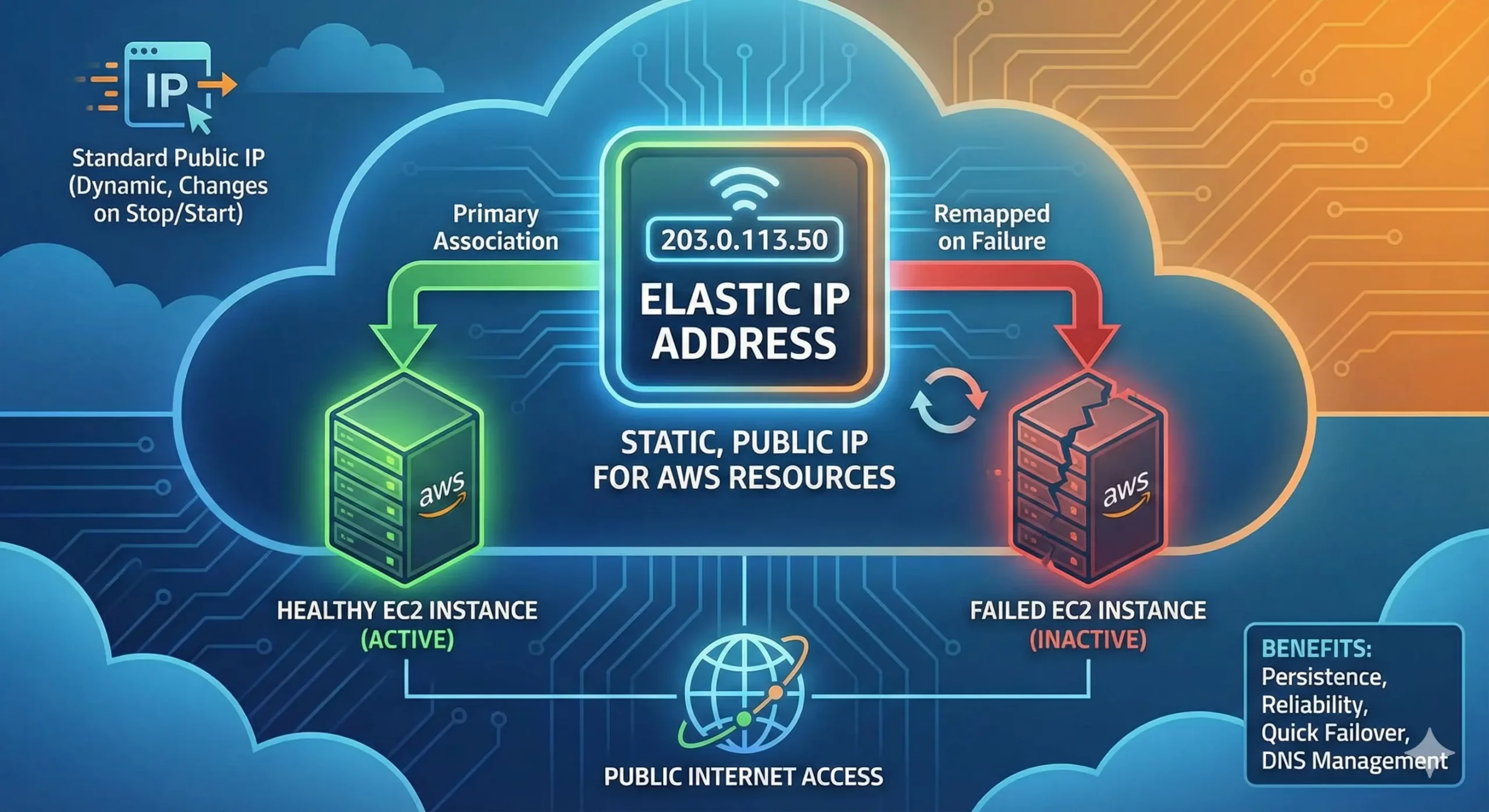
Maintenir une adresse IP stable dans le cloud est crucial pour l’hébergement web, les applications et la mise en réseau. C’est là qu’interviennent les adresses IP élastiques (EIP). Si vous utilisez Amazon Web Services (AWS), comprendre le fonctionnement des adresses IP élastiques peut vous aider à améliorer la fiabilité, à prévenir les interruptions de service et à optimiser vos coûts cloud. Ce guide vous expliquera en détail ce queRead more Related Posts Comprendre la délégation IP dans les réseaux modernes En optimisant l'allocation des ressources, la délégation d'adresses IP permet de gérer les réseaux de manière sécurisée et évolutive, au-delà Read more Pourquoi les entreprises adoptent le BYOIP Alors que les organisations du monde entier accélèrent leur transformation numérique, l'adoption du cloud n'est plus une simple tendance technologique, Read more Combien y a-t-il d’adresses IPv4 au total ? Il existe environ 4,3 milliards d'adresses IPv4. Plus précisément, 4 294 967 296. Bien que 10 chiffres puissent paraître beaucoup, nous n'avons plus Read more .related-post {} .related-post .post-list { text-align: left; } .related-post .post-list .item { margin: 5px; padding: 10px; } .related-post .headline { font-size: 18px !important; color: #999999 !important; } .related-post .post-list .item .post_thumb { max-height: 220px; margin: 10px 0px; padding: 0px; display: block; } .related-post .post-list .item .post_title { font-size: 16px; color: #3f3f3f; margin: 10px 0px; padding: 0px; display: block; text-decoration: none; } .related-post .post-list .item .post_excerpt { font-size: 13px; color: #3f3f3f; margin: 10px 0px; padding: 0px; display: block; text-decoration: none; } @media only screen and (min-width: 1024px) { .related-post .post-list .item { width: 30%; } } @media only screen and (min-width: 768px) and (max-width: 1023px) { .related-post .post-list .item { width: 90%; } } @media only screen and (min-width: 0px) and (max-width: 767px) { .related-post .post-list .item { width: 90%; } }
