VENDU:/24 ARIN @ 32 US$/IP
LOUE:/18 RIPE @ 0.45 US$/IP
VENDU:/24 ARIN @ 32 US$/IP/mois
VENDU:/24 ARIN @ 32 US$/IP
LOUE:/18 RIPE @ 0.45 US$/IP
VENDU:/24 ARIN @ 32 US$/IP/mois
VENDU:/24 ARIN @ 32 US$/IP

What is an Elastic IP address? Complete Guide for AWS Users

ChanChan
What is an Elastic IP address? Complete Guide for AWS Users

Maintaining a stable IP address in cloud computing is crucial for web hosting, applications, and networking. This is where Elastic IP addresses (EIPs) come into play. If you’re using Amazon Web Services (AWS), understanding how Elastic IPs work can help you improve reliability, prevent downtime, and optimize cloud costs. In this guide, we’ll break down what Elastic IPs are, how they work, their benefits, and best practices.

What is an Elastic IP Address?

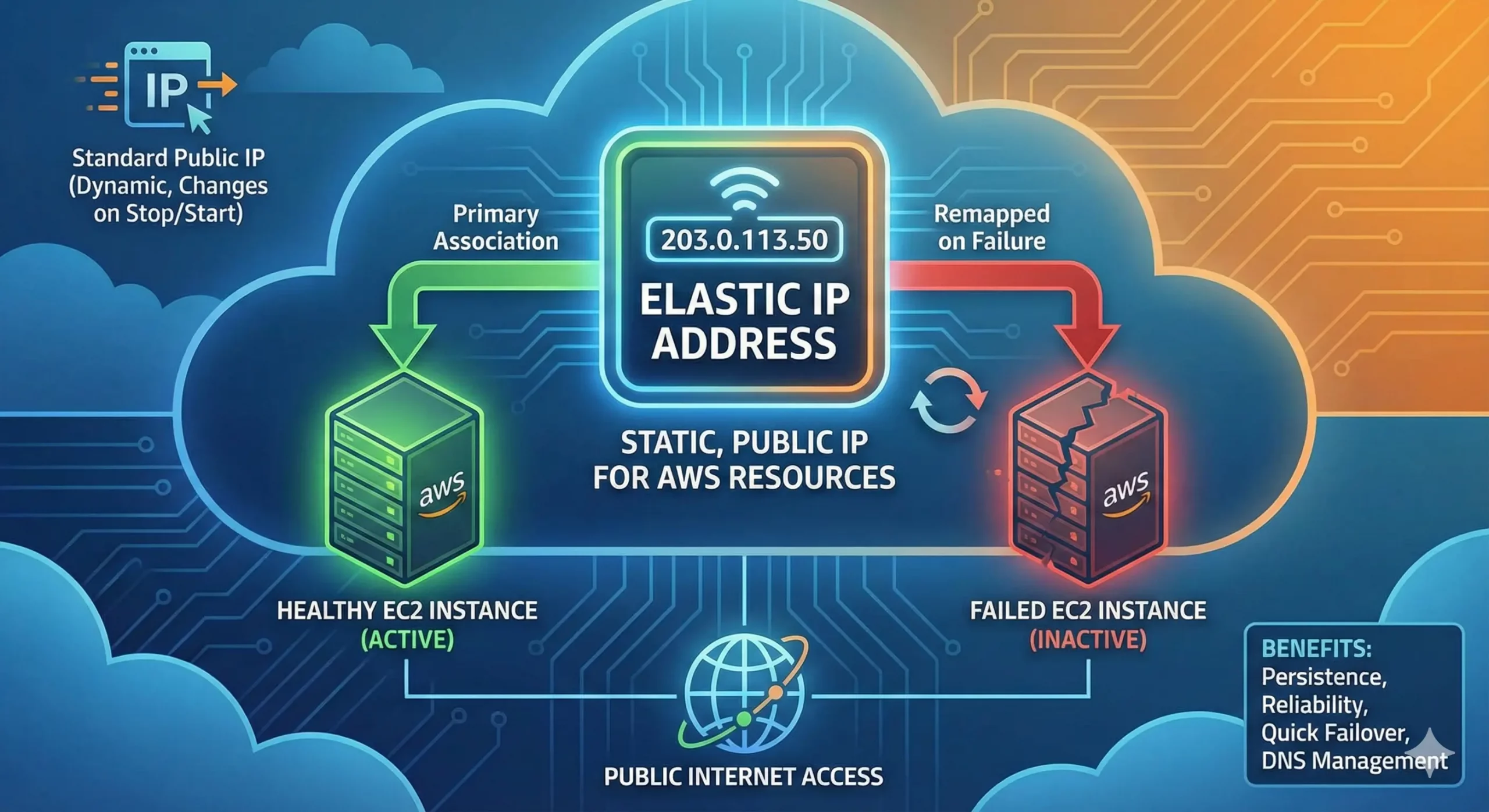
An Elastic IP address is a static, public IPv4 address provided by AWS that you can assign to an Amazon EC2 (Elastic Compute Cloud) instance. Unlike regular public IPs, which change when an instance is restarted, an Elastic IP remains the same, ensuring continuous connectivity.

How Does an Elastic IP Address Work?

Elastic IPs are allocated from AWS’s IP pool and can be associated with an EC2 instance at any time. If an instance fails, you can remap the Elastic IP to another instance, reducing downtime and ensuring uninterrupted service.


🔹 Key Features of Elastic IPs:

Static IP Address: Unlike dynamically assigned public IPs, an Elastic IP stays constant.
Easily Reassignable: You can move an Elastic IP to a different instance within the same AWS region.
Failover Support: If your instance crashes, you can quickly redirect traffic to a backup instance.
Cost Efficiency: You are charged only if the Elastic IP is not associated with a running instance.

Why Use an Elastic IP Address?

Elastic IPs are ideal for high-availability cloud deployments. Here are some common use cases:

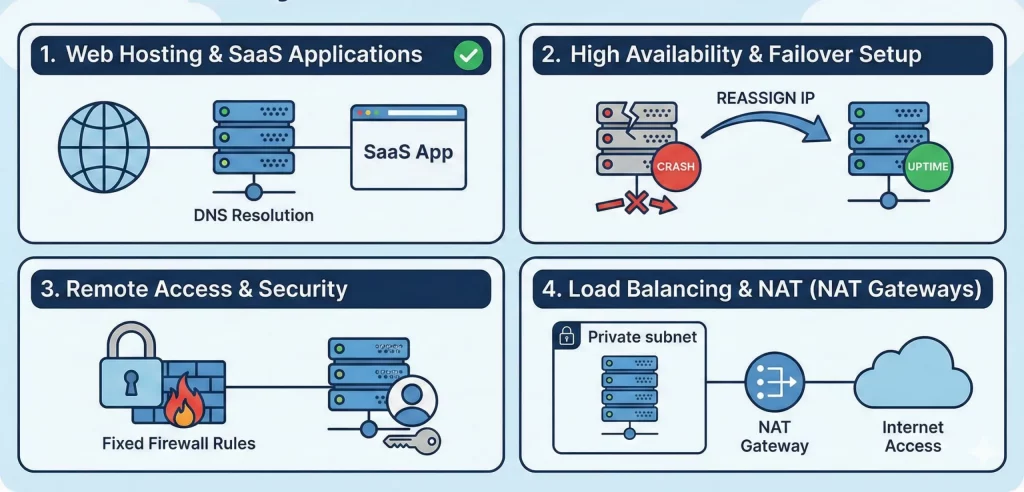
✅ 1. Web Hosting & SaaS Applications

Websites, SaaS applications, and services that require a fixed IP for DNS resolution benefit from Elastic IPs.

✅ 2. High Availability & Failover Setup

If an EC2 instance crashes, you can quickly reassign the Elastic IP to a backup instance, ensuring uptime.

✅ 3. Remote Access & Security

Elastic IPs allow businesses to set fixed firewall rules, ensuring secure access to AWS instances.

✅ 4. Load Balancing & Network Address Translation (NAT)

Elastic IPs are used in NAT Gateways for internet access in private AWS subnets.

Elastic IP vs. Regular Public IP in AWS

An Elastic IP Address in AWS remains persistent, meaning it stays the same even if the associated instance is restarted, whereas a regular public IP changes upon reboot. Elastic IPs can be reassigned to different EC2 instances, making them ideal for high availability and failover scenarios, while regular public IPs are tied to a single instance and cannot be transferred.


In terms of cost, Elastic IPs are free when actively associated with a running instance but incur charges if left idle, whereas regular public IPs remain free as long as the instance is running. Due to these differences, Elastic IPs are preferred for mission-critical applications, while regular public IPs are suited for general-purpose instances.

Best Practices for Using Elastic IPs

To optimize Elastic IP usage, only use them when necessary—if a standard public IP works, stick with it. AWS allows up to 5 Elastic IPs per region, so allocate them wisely. Regularly monitor usage and release idle Elastic IPs to avoid unnecessary costs. For failover automation, leverage AWS Lambda or scripts to reassign Elastic IPs in case of instance failure.

Conclusion

Elastic IPs play a crucial role in cloud networking, failover management, and high-availability setups in AWS. By understanding how Elastic IPs work when to use them, and how to optimize costs, you can ensure a more resilient and cost-effective cloud deployment.

Trusted IPv4 Leasing for Business Growth

Get enterprise-grade IPv4 space quickly, with seamless deployment and end-to-end management.
Get Started with i.lease

Articles connexes

Qu’est-ce qu’une adresse IP proxy ?

Une adresse IP proxy est une adresse IP intermédiaire utilisée pour masquer ou relayer votre adresse IP d’origine lors de l’accès à Internet. Elle agit comme une passerelle entre l’utilisateur et le web. Lorsqu’une demande d’accès à un site Web est effectuée, le serveur proxy (qui utilise l’adresse IP proxy) transmet cette demande, cachant ainsi la véritable adresse IP de l’utilisateur au site. Cela permet d’augmenter la confidentialité etRead more Related Posts How much does a /24 IPv4 block cost in 2026? IPv4 scarcity continues to shape internet infrastructure, with /24 blocks still trading actively on global markets despite growing IPv6 adoption. Key Read more The future of IPv4 markets Despite IPv6 expansion, scarcity keeps IPv4 valuable, sustaining a global secondary market where addresses increasingly function as tradable digital assets.Finite Read more Common Myths About Selling IP Addresses The IPv4 secondary market is often shrouded in mystery, leading many organizations to sit on valuable digital assets because they Read more .related-post {} .related-post .post-list { text-align: left; } .related-post .post-list .item { margin: 5px; padding: 10px; } .related-post .headline { font-size: 18px !important; color: #999999 !important; } .related-post .post-list .item .post_thumb { max-height: 220px; margin: 10px 0px; padding: 0px; display: block; } .related-post .post-list .item .post_title { font-size: 16px; color: #3f3f3f; margin: 10px 0px; padding: 0px; display: block; text-decoration: none; } .related-post .post-list .item .post_excerpt { font-size: 13px; color: #3f3f3f; margin: 10px 0px; padding: 0px; display: block; text-decoration: none; } @media only screen and (min-width: 1024px) { .related-post .post-list .item { width: 30%; } } @media only screen and (min-width: 768px) and (max-width: 1023px) { .related-post .post-list .item { width: 90%; } } @media only screen and (min-width: 0px) and (max-width: 767px) { .related-post .post-list .item { width: 90%; } }

Guide complet du marché des adresses IP

Les adresses IP sont essentielles pour identifier les appareils et permettre la communication entre les réseaux. Avec l’expansion continue d’Internet, la demande d’adresses IP a considérablement augmenté, entraînant l’essor du marché des adresses IP. Ce marché unique permet aux entreprises et aux particuliers d’acheter, de vendre ou de louer des adresses IP, assurant ainsi une utilisation optimale des ressources dans un monde où les adresses IPv4 deviennent rares. Qu’est-ceRead more Related Posts How much does a /24 IPv4 block cost in 2026? IPv4 scarcity continues to shape internet infrastructure, with /24 blocks still trading actively on global markets despite growing IPv6 adoption. Key Read more The future of IPv4 markets Despite IPv6 expansion, scarcity keeps IPv4 valuable, sustaining a global secondary market where addresses increasingly function as tradable digital assets.Finite Read more Common Myths About Selling IP Addresses The IPv4 secondary market is often shrouded in mystery, leading many organizations to sit on valuable digital assets because they Read more .related-post {} .related-post .post-list { text-align: left; } .related-post .post-list .item { margin: 5px; padding: 10px; } .related-post .headline { font-size: 18px !important; color: #999999 !important; } .related-post .post-list .item .post_thumb { max-height: 220px; margin: 10px 0px; padding: 0px; display: block; } .related-post .post-list .item .post_title { font-size: 16px; color: #3f3f3f; margin: 10px 0px; padding: 0px; display: block; text-decoration: none; } .related-post .post-list .item .post_excerpt { font-size: 13px; color: #3f3f3f; margin: 10px 0px; padding: 0px; display: block; text-decoration: none; } @media only screen and (min-width: 1024px) { .related-post .post-list .item { width: 30%; } } @media only screen and (min-width: 768px) and (max-width: 1023px) { .related-post .post-list .item { width: 90%; } } @media only screen and (min-width: 0px) and (max-width: 767px) { .related-post .post-list .item { width: 90%; } }

Qu’est-ce que SSH ? | Protocole Secure Shell (SSH)

Sécuriser les communications entre appareils est essentiel, surtout lors de la gestion de systèmes distants. L’un des protocoles les plus largement utilisés et fiables pour un accès distant sécurisé est SSH (Secure Shell). Cet article explore ce qu’est SSH, comment il fonctionne et pourquoi il est crucial pour la sécurité des réseaux. Qu’est-ce que SSH ? SSH (Secure Shell) est un protocole réseau qui permet aux utilisateurs d’accéder etRead more Related Posts Qu’est-ce qu’une adresse IP proxy ? Une adresse IP proxy est une adresse IP intermédiaire utilisée pour masquer ou relayer votre adresse IP d'origine lors de Read more Guide complet du marché des adresses IP Les adresses IP sont essentielles pour identifier les appareils et permettre la communication entre les réseaux. Avec l'expansion continue d'Internet, Read more ما هو SSH؟ | بروتوكول القشرة الآمنة (SSH) يعد تأمين الاتصالات بين الأجهزة أمراً مهماً، خاصة عند إدارة الأنظمة البعيدة. أحد البروتوكولات الأكثر استخدامًا وموثوقية للوصول الآمن عن Read more .related-post {} .related-post .post-list { text-align: left; } .related-post .post-list .item { margin: 5px; padding: 10px; } .related-post .headline { font-size: 18px !important; color: #999999 !important; } .related-post .post-list .item .post_thumb { max-height: 220px; margin: 10px 0px; padding: 0px; display: block; } .related-post .post-list .item .post_title { font-size: 16px; color: #3f3f3f; margin: 10px 0px; padding: 0px; display: block; text-decoration: none; } .related-post .post-list .item .post_excerpt { font-size: 13px; color: #3f3f3f; margin: 10px 0px; padding: 0px; display: block; text-decoration: none; } @media only screen and (min-width: 1024px) { .related-post .post-list .item { width: 30%; } } @media only screen and (min-width: 768px) and (max-width: 1023px) { .related-post .post-list .item { width: 90%; } } @media only screen and (min-width: 0px) and (max-width: 767px) { .related-post .post-list .item { width: 90%; } }