How to Get an IPv4 Address
 admin
admin
The demand for Internet-based services and tools has gone up drastically. This created a huge increase in the need for IP addresses. This guide will walk you through the process of how to get an IPv4 address.
Table of Contents
What are IPv4 Blocks?
If you want to know how to get an IPv4 address, first we’ll need to discuss what IPv4 blocks are. This is because you cannot acquire IP addresses individually. Instead, IPv4s are distributed in blocks.An IPv4 block refers to a set of IP addresses that you can get as an end-user or as a business owner.
The Internet Assigned Numbers Authority (IANA) manages these resources on a global scale. Consequently, these blocks are distributed to Regional Internet Registries (RIRs). In turn, RIRs allocate smaller blocks to Internet Service Providers (ISPs) or directly to end users.

Reasons for Acquiring IPv4 Blocks
You may need IPv4 blocks for various purposes. As your business expands its online presence, you’ll need IPv4 addresses for the following reasons:
a. To support your growing network.
As your business grows, you will need more IP addresses to support the devices connected to your network.
b. To host websites and applications.
You can use a third-party hosting service for your applications and websites. But if you prefer a more secure connection, you will need a dedicated pool of IP addresses.
c. To enable remote access.
If you want to allow your employees to access your network remotely, you will need dedicated IP addresses for them to use.To future-proof your network infrastructure.
The IPv4 address pool is finite and there will not enough to go around in the future. It is important to acquire IPv4 blocks now to ensure that your network will be able to grow in the future.
How to Get IPv4 Addresses Through a Broker
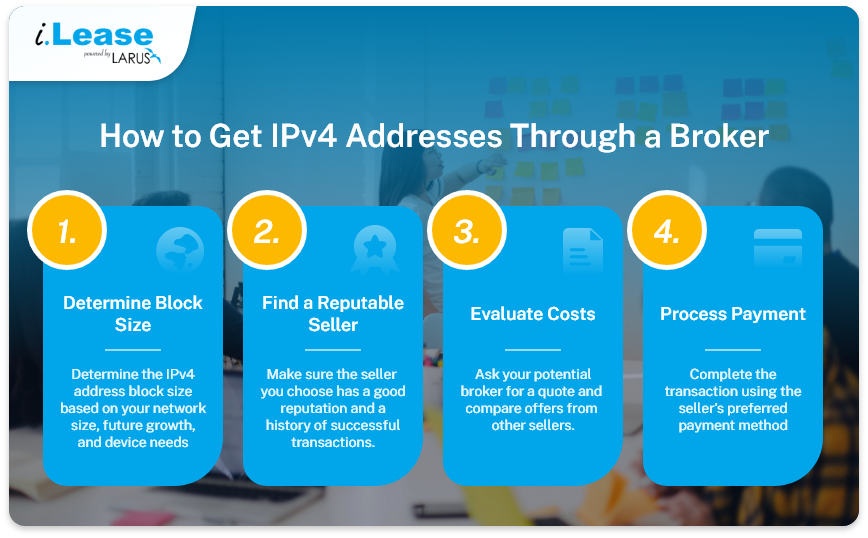
An IP address broker can simplify the process of IP address acquisition.
IPv4 brokers serve as intermediaries, connecting sellers and buyers in the market. They can simplify the acquisition of IPv4 addresses.
They can help you access a wider range of addresses, guide you through legalities, and negotiate fair prices. They also help businesses like yours comply with policies and regulations in your region.
These are the general steps on how to get an IPv4 address block with the help of a broker:
1. Determine the block size that you need
Evaluate the size of the IP block you need based on your network size, anticipated growth, and device requirements.
2. Find a reputable seller
Some brokers may sell IP addresses that are not secure or addresses that have been previously used for spamming.
Evaluate the reputation of a seller before signing up their services. Work with reputable IP brokers who have a track record of successful transactions and reputable deals.
3. Evaluate the costs
Request a quote from your potential broker and consider the price. Compare offers from other sellers while keeping in mind the cost per block size, the current demand, and market value. This helps you ensure that you get a fair deal.
Generally, these are the factors that affect the cost of IPv4 Blocks:
a. Location:
Prices may vary based on regional demand, with certain areas experiencing higher costs.
b. Size:
Larger IPv4 blocks tend to be more expensive due to their scarcity and appeal to larger organizations.
c. Quality:
The history and reputation of IP addresses within a block may impact its price.
4. Process your payment
Once you have evaluated the costs of your IPv4 blocks and the reputation of your seller, it’s time to close the transaction. Each seller will have their own transaction method. Typically, you can purchase your IP address blocks with online payments and credit cards.
How to Get IP Address Blocks with a Regional Internet
Registry (RIR)
Alternatively, you have the option to request IPv4 blocks from a regional Internet registry directly. Here are the general steps to follow:
1. Join your region’s registry as a member. In most cases, RIRs will ask you to become a member before you can request an IPv4 block.
2. Demonstrate your need for IP assets. You’ll need to fill out forms and provide documentation to justify the valid uses for the IP blocks you’re requesting.
3. Expect a representative to reach out. A representative from your RIR will contact you to discuss your request and requirements.
4. Complete the necessary payments. Some RIRs will require you to pay fees as part of your application process. Once your application is approved and the payments are processed, the transfer of IP address blocks will begin.Keep in mind that your RIR may put you on a waiting list instead of immediately providing the IP blocks you request.
Some important points to remember
If you’re thinking about getting IPv4 blocks in the near future, there are some important points to consider:
1. IPv4 block prices are on the rise.
Over the past few years, the cost of IPv4 blocks has been steadily increasing. Acting promptly will ensure you secure them at a more reasonable price.
2. Limited availability of IPv4 blocks.
Since the pool of IPv4 addresses is finite, there’s a restricted supply of IPv4 blocks. Waiting too long may result in not being able to obtain the required blocks.
3. Challenges in acquiring IPv4 addresses.
To simplify the process, save time, and minimize risks, it’s beneficial to collaborate with reputable IPv4 brokers. This way, you’ll gain a better understanding of how to obtain an IPv4 address block.
Trusted IPv4 Leasing for Business Growth
Get enterprise-grade IPv4 space quickly, with seamless deployment and end-to-end management.
Get Started with i.leaseArticles connexes
Tarification IPv4 : Aperçu du coût de l’IPv4
Au début des années 1980, les adresses IPv4 étaient distribuées gratuitement à tous ceux qui en avaient besoin. Les géants de la technologie comme Microsoft, Hewlett-Packard et Xerox en ont accumulé d’énormes quantités. Cependant, une mauvaise gestion et une demande imprévue ont rapidement épuisé ces ressources. En 2011, nous sommes arrivés à un tournant décisif. Ce fut le point de bascule qui a conduit à l’épuisement des adresses IPv4Read more Related Posts Tarification IPv4 : Aperçu du coût de l’IPv4 Au début des années 1980, les adresses IPv4 étaient distribuées gratuitement à tous ceux qui en avaient besoin. Les géants Read more Qu’est-ce qu’un registre Internet régional (RIR) ? Un registre Internet régional (RIR) est une organisation chargée de l'attribution et de la gestion des ressources de numérotation Internet Read more Qu’est-ce que GeoIP et comment ça fonctionne ? La géolocalisation IP est essentielle pour personnaliser les expériences en ligne, renforcer la cybersécurité et alimenter d'innombrables applications professionnelles. Mais Read more .related-post {} .related-post .post-list { text-align: left; } .related-post .post-list .item { margin: 5px; padding: 10px; } .related-post .headline { font-size: 18px !important; color: #999999 !important; } .related-post .post-list .item .post_thumb { max-height: 220px; margin: 10px 0px; padding: 0px; display: block; } .related-post .post-list .item .post_title { font-size: 16px; color: #3f3f3f; margin: 10px 0px; padding: 0px; display: block; text-decoration: none; } .related-post .post-list .item .post_excerpt { font-size: 13px; color: #3f3f3f; margin: 10px 0px; padding: 0px; display: block; text-decoration: none; } @media only screen and (min-width: 1024px) { .related-post .post-list .item { width: 30%; } } @media only screen and (min-width: 768px) and (max-width: 1023px) { .related-post .post-list .item { width: 90%; } } @media only screen and (min-width: 0px) and (max-width: 767px) { .related-post .post-list .item { width: 90%; } }
Qu’est-ce qu’un registre Internet régional (RIR) ?
Un registre Internet régional (RIR) est une organisation chargée de l’attribution et de la gestion des ressources de numérotation Internet au sein d’une région géographique spécifique. Ces ressources comprennent principalement les adresses IP (IPv4 et IPv6) et les numéros de système autonome (ASN), éléments essentiels permettant aux appareils et aux réseaux de communiquer sur Internet. Internet ne peut fonctionner sans un système performant d’attribution d’adresses IP uniques etRead more Related Posts Tarification IPv4 : Aperçu du coût de l’IPv4 Au début des années 1980, les adresses IPv4 étaient distribuées gratuitement à tous ceux qui en avaient besoin. Les géants Read more Qu’est-ce qu’un registre Internet régional (RIR) ? Un registre Internet régional (RIR) est une organisation chargée de l'attribution et de la gestion des ressources de numérotation Internet Read more Qu’est-ce que GeoIP et comment ça fonctionne ? La géolocalisation IP est essentielle pour personnaliser les expériences en ligne, renforcer la cybersécurité et alimenter d'innombrables applications professionnelles. Mais Read more .related-post {} .related-post .post-list { text-align: left; } .related-post .post-list .item { margin: 5px; padding: 10px; } .related-post .headline { font-size: 18px !important; color: #999999 !important; } .related-post .post-list .item .post_thumb { max-height: 220px; margin: 10px 0px; padding: 0px; display: block; } .related-post .post-list .item .post_title { font-size: 16px; color: #3f3f3f; margin: 10px 0px; padding: 0px; display: block; text-decoration: none; } .related-post .post-list .item .post_excerpt { font-size: 13px; color: #3f3f3f; margin: 10px 0px; padding: 0px; display: block; text-decoration: none; } @media only screen and (min-width: 1024px) { .related-post .post-list .item { width: 30%; } } @media only screen and (min-width: 768px) and (max-width: 1023px) { .related-post .post-list .item { width: 90%; } } @media only screen and (min-width: 0px) and (max-width: 767px) { .related-post .post-list .item { width: 90%; } }

Pourquoi n’y a-t-il pas d’IPv5 ? L’histoire du protocole Internet manquant
Lorsqu’on parle de protocoles Internet, la plupart des gens connaissent IPv4 et IPv6. Mais vous vous demandez peut-être : qu’est-il arrivé à IPv5 ? Pourquoi a-t-on l’impression qu’Internet est passé directement d’IPv4 à IPv6 ? Plongeons-nous dans l’histoire fascinante de ce protocole « manquant ». Qu’est-ce que l’IPv5 ? Le protocole IPv5, officiellement appelé Internet Stream Protocol (ST), était un protocole expérimental développé à la fin des années 1970 et dans les années 1980. IlRead more Related Posts Tarification IPv4 : Aperçu du coût de l’IPv4 Au début des années 1980, les adresses IPv4 étaient distribuées gratuitement à tous ceux qui en avaient besoin. Les géants Read more Qu’est-ce qu’un registre Internet régional (RIR) ? Un registre Internet régional (RIR) est une organisation chargée de l'attribution et de la gestion des ressources de numérotation Internet Read more Qu’est-ce que GeoIP et comment ça fonctionne ? La géolocalisation IP est essentielle pour personnaliser les expériences en ligne, renforcer la cybersécurité et alimenter d'innombrables applications professionnelles. Mais Read more .related-post {} .related-post .post-list { text-align: left; } .related-post .post-list .item { margin: 5px; padding: 10px; } .related-post .headline { font-size: 18px !important; color: #999999 !important; } .related-post .post-list .item .post_thumb { max-height: 220px; margin: 10px 0px; padding: 0px; display: block; } .related-post .post-list .item .post_title { font-size: 16px; color: #3f3f3f; margin: 10px 0px; padding: 0px; display: block; text-decoration: none; } .related-post .post-list .item .post_excerpt { font-size: 13px; color: #3f3f3f; margin: 10px 0px; padding: 0px; display: block; text-decoration: none; } @media only screen and (min-width: 1024px) { .related-post .post-list .item { width: 30%; } } @media only screen and (min-width: 768px) and (max-width: 1023px) { .related-post .post-list .item { width: 90%; } } @media only screen and (min-width: 0px) and (max-width: 767px) { .related-post .post-list .item { width: 90%; } }
