How much does a /24 IPv4 block cost in 2026?
 Stephanie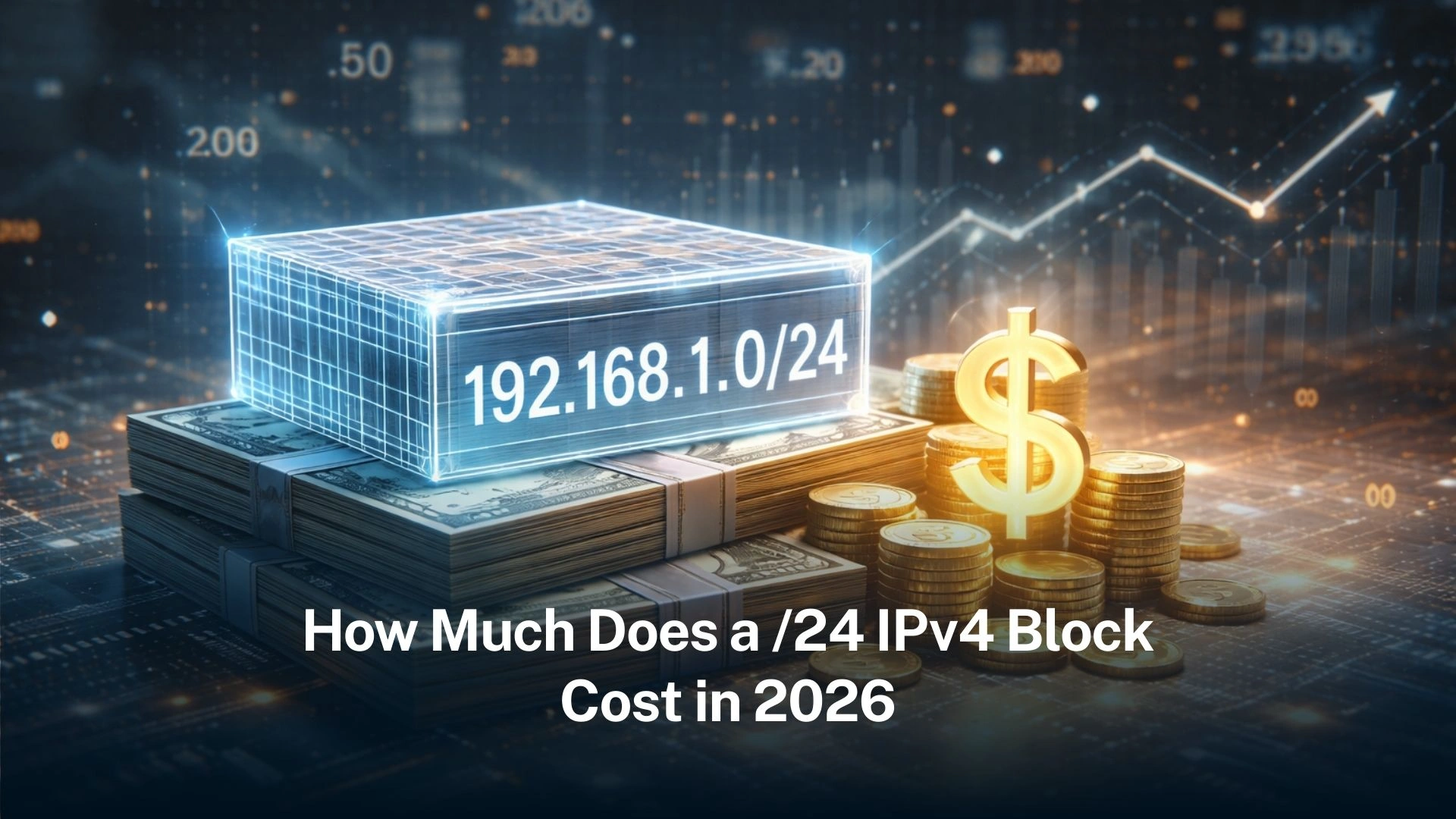
IPv4 scarcity continues to shape internet infrastructure, with /24 blocks still trading actively on global markets despite growing IPv6 adoption.
Table of Contents
Key points
A /24 IPv4 block usually costs between $6,000 and $15,000 in 2026.
Cloud providers, hosting companies and SaaS providers need IPv4 addresses so prices stay high.
IPv4 addresses are like an asset because they are scarce.
What is a /24 IPv4 block
A /24 IPv4 block is a group of IP addresses that organisations use so their devices can talk to each other on the internet. These IP addresses are like numbers that have 32 bits. There are about 4.3 billion of these IP addresses. We used them all up a while back.
A /24 IPv4 block has 256 of these addresses. It is the group that usually works on the whole internet because it follows the rules that internet service providers and networks use.
For companies that host websites provide cloud services and run networks a /24 block is often the step to getting public IP address space. Because many people want these blocks IPv4 addresses have become very valuable.
People who study the industry often say that IPv4 address space is like something you can buy and sell. Organisations usually get IPv4 addresses by buying them from someone or through a broker because you can not get new ones, from the people who give them out.
The cost of an IPv4 block in 2026
The price of a IPv4 block varies. It depends on where you buy it and the quality of the block. Some people think the average price per IPv4 address is between thirty dollars and sixty dollars.
A block has 256 addresses. So the price for a block is between seven thousand five hundred dollars and fifteen thousand dollars.
Some places say the price is lower. They say it is around six thousand dollars to eight thousand seven hundred dollars for a block. That is twenty-three dollars and fifty cents to thirty-four dollars per address.
Other guides say the price is higher. They say it is thirty-five dollars to fifty-five dollars per address. This is for blocks that’re easy to use.
Organisations will pay thirty dollars to sixty dollars per address and seven thousand five hundred dollars to fifteen thousand dollars per block. Some deals are lower and are around six thousand dollars, while premium IPv4 blocks cost up to fifteen thousand dollars. These prices change often as people sell IPv4 addresses on special websites.
Why are IPv4 addresses expensive
IPv4 addresses are still valuable today because the internet still uses them a lot.
The main reason IPv4 blocks cost a lot is that there are not enough of them. The IPv4 address space was fully used up years ago so new IPv4 addresses can only be gotten by buying or leasing from someone who already has them.
This means companies have to buy IPv4 addresses from people who already own them which makes the prices go up.
Many internet services still need IPv4 to work. Lots of people want them in areas like:
Cloud computing
Web hosting
VPN services
SaaS platforms
Cybersecurity
These industries often need their special IP addresses, which keeps the demand higher than the supply.
The switch to IPv6 has been slow. Even though, than 40% of the world uses IPv6 now many networks still use IPv4 or use both IPv4 and IPv6.
So companies still need IPv4 addresses to work with the systems and users they already have. IPv4 addresses are still very important.
Why small IPv4 blocks like /24 cost more per IP
Small IPv4 blocks cost more per IP than larger blocks because they are easier to add to existing networks and fit well with internet routing rules. Many companies only need a few hundred IP addresses, so they prefer smaller allocations. This makes small blocks more popular and often more expensive.
As a result, /24 blocks are considered the standard size for IPv4 addresses and typically cost more per IP than larger allocations such as /20 or /16. Many organisations buy these blocks and are willing to pay more for them, so the demand for /24 blocks remains high and their price per IP is higher.
The rise of IPv4 leasing markets is a thing
For organisations it is not always easy to buy IPv4 address space outright, so they lease IPv4 addresses from brokers or address owners instead.
The cost of leasing IPv4 addresses is usually around $0.25 to $0.55 per IPv4 address per month. This means that leasing a /24 block of IPv4 addresses typically costs about $64 to $141 per month.
IPv4 leasing is very common among groups, such as:
Startups
Temporary cloud workloads
Proxy and VPN operators
Organisations that are testing infrastructure expansion
The good thing about leasing IPv4 addresses is that it allows organisations to use IPv4 address space without having to pay a lot of money upfront to buy it.
This makes IPv4 leasing a choice, for many organisations that need IPv4 addresses.
-IPv4 is the Internet’s most important service enabler; a device or server cannot be online without it.
– Heng.Lu, CEO of LARUS Limited and founder of the LARUS Foundation
Factors that affect IPv4 block cost
Things influence the price of a /24 IPv4 block.
IPv4 block reputation
A clean IPv4 block is more valuable. If a block was used for spam or abuse it may be on blacklists and lose value until the issue is fixed. A clean IPv4 block reputation matters.
Registry region
IPv4 blocks are tied to internet registries like:
ARIN (North America)
RIPE NCC (Europe)
APNIC (Asia-Pacific)
Demand for IPv4 space varies by region, which affects the market price of IPv4 blocks. IPv4 block demand is different in each region.
Registry fees
Buyers pay registry transfer fees when buying IPv4 blocks. These fees range from $500 to $5,000 depending on the registry and IPv4 block size. IPv4 block registry fees are a factor.
Market timing
IPv4 prices change based on supply and demand. As cloud computing and hosting grow, demand, for IPv4 space increases and IPv4 block prices go up. The IPv4 block market is always changing.
IPv4 is like a thing that people own
In the ten years people have started to think of IPv4 addresses as things that are worth money.
Big companies that do technology and hosting have a lot of IPv4 addresses, which means they have something valuable.
Some companies buy groups of IPv4 addresses. They do not just buy them to use them they also buy them because they think they will be worth money later.
They think that because there are not enough IPv4 addresses the ones they have will become more valuable.
The internet still needs IPv4 today. Even though more and more people are starting to use IPv6 IPv4 is still very important, for making sure everything works on the internet.
Where organisations get IPv4 blocks
Companies get IPv4 address space in ways.
Common methods include:
-
IPv4 brokers and marketplaces
-
Direct transfers between organisations
-
Leasing providers
-
Cloud platforms that give out IPv4 addresses
IPv4 brokers help organisations with the transfer process. They check who owns the addresses get approval from the registry and handle payments.
Completing an IPv4 transfer can take 30 to 90 days. This depends on the registry. How big the block is.
What will happen to IPv4 prices in the future
The future price of IPv4 blocks is hard to say. On one hand IPv4 addresses are scarce and many organisations still use them, which supports demand. On the other hand more organisations are starting to use IPv6.
As more networks switch to IPv6 the demand for IPv4 addresses may go down. For now the internet still relies heavily on IPv4, so organisations continue to buy, sell and lease IPv4 blocks for their networks.
Frequently Asked Questions
1. What is IPv4?
IPv4 (Internet Protocol version 4) is the original addressing system used to identify devices on the internet, providing about 4.3 billion unique addresses.
2. Why is IPv4 still valuable?
The global pool of IPv4 addresses is effectively exhausted, and many networks still require IPv4 compatibility. This scarcity has created a secondary market where addresses can be bought, sold or leased.
3. How much does an IPv4 address cost?
Prices vary depending on block size and market conditions. Historically, addresses have traded between roughly $30 and $60 per address, although prices fluctuate with supply and demand.
4. What is an IPv4 broker?
An IPv4 broker is an intermediary that facilitates address transfers between buyers and sellers, ensuring compliance with registry rules and helping manage transaction risks.
5. Will IPv6 eliminate the IPv4 market?
Eventually, widespread IPv6 adoption may reduce the need for IPv4 trading. However, dual-stack networks and legacy systems mean IPv4 demand is likely to persist for many years.
Related Blogs
Articles connexes
Quels sont les facteurs qui déterminent le prix de IPv4 sur le marché actuel ?
La rareté, l’évolution de la demande et les plateformes de location comme i.lease redéfinissent la valorisation et le commerce des adresses IPv4 à l’échelle mondiale. Le prix des adresses IPv4 est principalement déterminé par leur rareté, la taille des blocs et les fluctuations de la demande selon les régions et les secteurs. Les modèles de location, notamment les plateformes comme i.lease, contribuent à stabiliser les coûts face à laRead more Related Posts Short-term vs long-term IPv4 leasing Facing IPv4 shortages, companies must weigh cost, speed, and network growth when choosing a lease plan.Short-term leasing lets you scale Read more Why IPv4 scarcity drives economic value for operators IPv4 地址曾经只是互联网运行所需的基础资源。但在今天,它越来越像一种具有市场价格、可交易、可租赁的数字资产。造成这一变化的原因并不复杂:IPv4 的总量有限,而全球互联网对 IPv4 的需求并没有消失;与此同时,IPv6 虽然早已出现,但迁移进度依然缓慢。这三股力量叠加,正在重新塑造运营商对 IP 地址的看法,也改变了互联网基础设施的经济逻辑。原文将这点概括为“有限供给、持续需求与缓慢转型”,并指出这正在推动 IP 地址成为影响全球电信经济的可交易资产。 IPv4 稀缺并不是新问题 全球互联网至今仍大量依赖 IPv4。这个协议诞生于更早的时代,只能提供大约 43 亿个地址。这个数量在互联网初期似乎足够庞大,但在今天已经明显不够。原文指出,IANA 在 2011 年就已将最后一批大型 IPv4 Read more What Determines IPv4 Pricing in Today’s Market? Scarcity, shifting demand, and leasing platforms such as i.lease are reshaping how IPv4 addresses are valued and traded globally.IPv4 pricing is driven Read more .related-post {} .related-post .post-list { text-align: left; } .related-post .post-list .item { margin: 5px; padding: 10px; } .related-post .headline { font-size: 18px !important; color: #999999 !important; } .related-post .post-list .item .post_thumb { max-height: 220px; margin: 10px 0px; padding: 0px; display: block; } .related-post .post-list .item .post_title { font-size: 16px; color: #3f3f3f; margin: 10px 0px; padding: 0px; display: block; text-decoration: none; } .related-post .post-list .item .post_excerpt { font-size: 13px; color: #3f3f3f; margin: 10px 0px; padding: 0px; display: block; text-decoration: none; } @media only screen and (min-width: 1024px) { .related-post .post-list .item { width: 30%; } } @media only screen and (min-width: 768px) and (max-width: 1023px) { .related-post .post-list .item { width: 90%; } } @media only screen and (min-width: 0px) and (max-width: 767px) { .related-post .post-list .item { width: 90%; } }
Pourquoi la rareté des adresses IPv4 génère de la valeur économique pour les opérateurs
La rareté des adresses IPv4, la demande persistante et la lenteur de la transition vers l’IPv6 transforment les adresses IP en actifs négociables, remodelant ainsi l’économie des télécommunications à l’échelle mondiale. L’épuisement des adresses IPv4 a fait de ces dernières des ressources numériques rares, dont les prix sont déterminés par le déséquilibre entre l’offre et la demande. Les opérateurs monétisent de plus en plus l’espace d’adressage inutilisé via desRead more Related Posts Short-term vs long-term IPv4 leasing Facing IPv4 shortages, companies must weigh cost, speed, and network growth when choosing a lease plan.Short-term leasing lets you scale Read more Why IPv4 scarcity drives economic value for operators IPv4 地址曾经只是互联网运行所需的基础资源。但在今天,它越来越像一种具有市场价格、可交易、可租赁的数字资产。造成这一变化的原因并不复杂:IPv4 的总量有限,而全球互联网对 IPv4 的需求并没有消失;与此同时,IPv6 虽然早已出现,但迁移进度依然缓慢。这三股力量叠加,正在重新塑造运营商对 IP 地址的看法,也改变了互联网基础设施的经济逻辑。原文将这点概括为“有限供给、持续需求与缓慢转型”,并指出这正在推动 IP 地址成为影响全球电信经济的可交易资产。 IPv4 稀缺并不是新问题 全球互联网至今仍大量依赖 IPv4。这个协议诞生于更早的时代,只能提供大约 43 亿个地址。这个数量在互联网初期似乎足够庞大,但在今天已经明显不够。原文指出,IANA 在 2011 年就已将最后一批大型 IPv4 Read more How much does a /24 IPv4 block cost in 2026? IPv4 scarcity continues to shape internet infrastructure, with /24 blocks still trading actively on global markets despite growing IPv6 adoption. Key Read more .related-post {} .related-post .post-list { text-align: left; } .related-post .post-list .item { margin: 5px; padding: 10px; } .related-post .headline { font-size: 18px !important; color: #999999 !important; } .related-post .post-list .item .post_thumb { max-height: 220px; margin: 10px 0px; padding: 0px; display: block; } .related-post .post-list .item .post_title { font-size: 16px; color: #3f3f3f; margin: 10px 0px; padding: 0px; display: block; text-decoration: none; } .related-post .post-list .item .post_excerpt { font-size: 13px; color: #3f3f3f; margin: 10px 0px; padding: 0px; display: block; text-decoration: none; } @media only screen and (min-width: 1024px) { .related-post .post-list .item { width: 30%; } } @media only screen and (min-width: 768px) and (max-width: 1023px) { .related-post .post-list .item { width: 90%; } } @media only screen and (min-width: 0px) and (max-width: 767px) { .related-post .post-list .item { width: 90%; } }
Qu’est-ce qu’une adresse IP proxy ?
Une adresse IP proxy est une adresse IP intermédiaire utilisée pour masquer ou relayer votre adresse IP d’origine lors de l’accès à Internet. Elle agit comme une passerelle entre l’utilisateur et le web. Lorsqu’une demande d’accès à un site Web est effectuée, le serveur proxy (qui utilise l’adresse IP proxy) transmet cette demande, cachant ainsi la véritable adresse IP de l’utilisateur au site. Cela permet d’augmenter la confidentialité etRead more Related Posts Short-term vs long-term IPv4 leasing Facing IPv4 shortages, companies must weigh cost, speed, and network growth when choosing a lease plan.Short-term leasing lets you scale Read more Why IPv4 scarcity drives economic value for operators IPv4 地址曾经只是互联网运行所需的基础资源。但在今天,它越来越像一种具有市场价格、可交易、可租赁的数字资产。造成这一变化的原因并不复杂:IPv4 的总量有限,而全球互联网对 IPv4 的需求并没有消失;与此同时,IPv6 虽然早已出现,但迁移进度依然缓慢。这三股力量叠加,正在重新塑造运营商对 IP 地址的看法,也改变了互联网基础设施的经济逻辑。原文将这点概括为“有限供给、持续需求与缓慢转型”,并指出这正在推动 IP 地址成为影响全球电信经济的可交易资产。 IPv4 稀缺并不是新问题 全球互联网至今仍大量依赖 IPv4。这个协议诞生于更早的时代,只能提供大约 43 亿个地址。这个数量在互联网初期似乎足够庞大,但在今天已经明显不够。原文指出,IANA 在 2011 年就已将最后一批大型 IPv4 Read more What Determines IPv4 Pricing in Today’s Market? Scarcity, shifting demand, and leasing platforms such as i.lease are reshaping how IPv4 addresses are valued and traded globally.IPv4 pricing is driven Read more .related-post {} .related-post .post-list { text-align: left; } .related-post .post-list .item { margin: 5px; padding: 10px; } .related-post .headline { font-size: 18px !important; color: #999999 !important; } .related-post .post-list .item .post_thumb { max-height: 220px; margin: 10px 0px; padding: 0px; display: block; } .related-post .post-list .item .post_title { font-size: 16px; color: #3f3f3f; margin: 10px 0px; padding: 0px; display: block; text-decoration: none; } .related-post .post-list .item .post_excerpt { font-size: 13px; color: #3f3f3f; margin: 10px 0px; padding: 0px; display: block; text-decoration: none; } @media only screen and (min-width: 1024px) { .related-post .post-list .item { width: 30%; } } @media only screen and (min-width: 768px) and (max-width: 1023px) { .related-post .post-list .item { width: 90%; } } @media only screen and (min-width: 0px) and (max-width: 767px) { .related-post .post-list .item { width: 90%; } }