What is a Proxy IP?
 Chan
Chan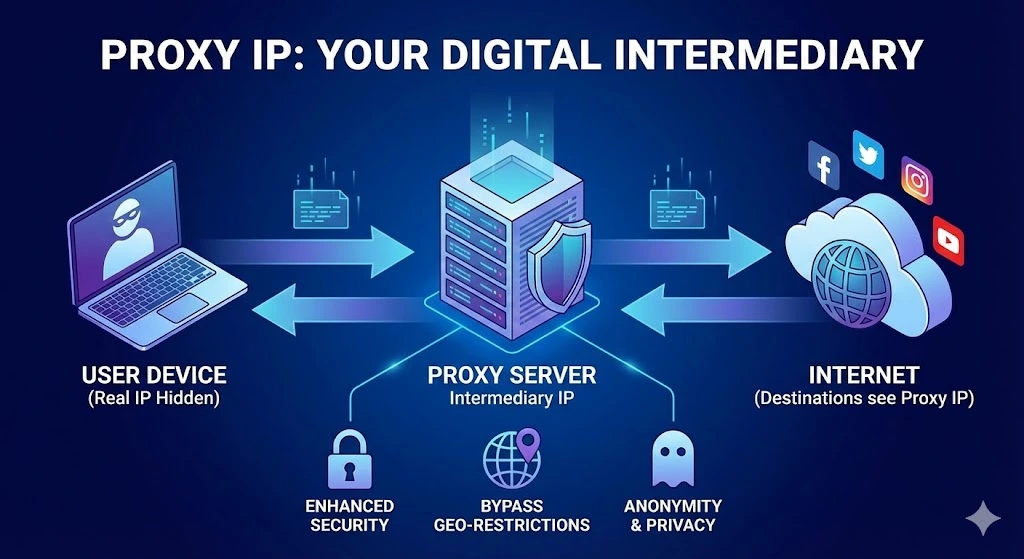
A proxy IP is an intermediary IP address used to mask or relay your original IP address when accessing the Internet. It acts as a gateway between the user and the web. When a request is made to access a website, the proxy server (which uses the proxy IP) forwards that request, hiding the user’s real IP address from the website. This allows for increased privacy and anonymity when browsing online.
Table of Contents
How Proxy IP Works
When you use a proxy, your device sends a request to the proxy server, which forwards it to the target website. The website then sees the request as coming from the proxy server, not your IP. This shields your original identity and location from the website. Afterward, the website’s response is returned to the proxy server, which forwards it to you.
Types of Proxy IPs
HTTP Proxies: These only work for web pages and are great for browsing.
SOCKS Proxies: They handle a wider range of traffic, including emails, torrent files, and FTP.
Transparent Proxies: These identify themselves and pass the original IP address, often used in caching.
Anonymous Proxies: These hide the user’s IP address but identify themselves as proxies.
High Anonymity Proxies: These provide maximum privacy by not identifying themselves as proxies and completely hiding the user’s IP.
Key Functions and Use Cases
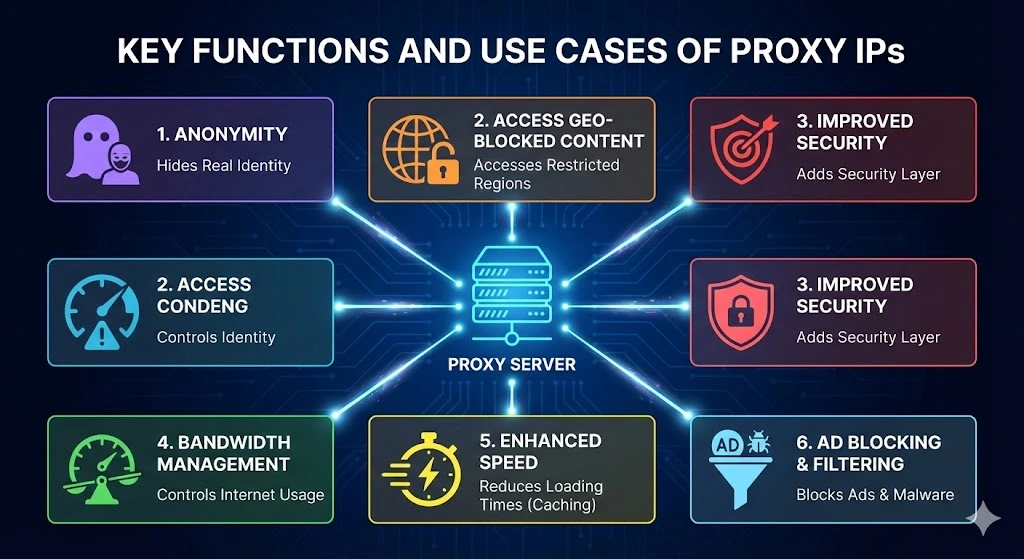
1. Anonymity: Proxy IPs hide your real identity online, allowing you to browse the web without revealing personal information.
2. Access Geo-Blocked Content: Proxies enable users to access content that is restricted in certain regions by assigning IPs from specific locations.
3. Improved Security: By masking the original IP address, proxy servers add a layer of security, making it harder for hackers to target the user directly.
4. Bandwidth Management: Proxies can help organizations manage and control internet bandwidth usage, preventing congestion.
5. Enhanced Speed: Certain proxies can cache web pages, reducing loading times for frequently accessed websites.
6. Ad Blocking and Filtering: Proxy servers can block ads, malware, or filter content to ensure a safer browsing experience.
Common Use Cases for Proxy IPs
1. Businesses: Companies use proxies for security, load balancing, and to prevent unauthorized access to their internal systems.
2. SEO and Marketing: Marketers use proxies to gather competitor data or analyze web traffic from different locations.
3. Streaming: Users rely on proxy IPs to bypass geo-restrictions and access content not available in their regions.
4. Privacy Enthusiasts: Those concerned with online privacy use proxy IPs to hide their real IP address while browsing.
The Difference Between Proxy and VPN
While both proxies and VPNs hide your IP address, a VPN encrypts all your internet traffic, offering a more secure connection. Proxies generally do not encrypt data, but they can be faster than VPNs for some use cases since they don’t handle heavy encryption.
Final Thoughts
Proxy IPs are essential tools for maintaining privacy, accessing restricted content, and improving online security. Whether for personal use, business operations, or marketing analysis, proxies offer a flexible solution to interact with the web more effectively. Some of the most popular proxy providers include Luminati, Smartproxy, and Bright Data, offering a range of services tailored to different needs.
Trusted IPv4 Leasing for Business Growth
Get enterprise-grade IPv4 space quickly, with seamless deployment and end-to-end management.
Get Started with i.leaseArticles connexes

Qu’est-ce que l’APNIC ?
Une introduction simple au Centre d’information du réseau Asie-Pacifique Lorsque vous naviguez sur Internet, vous ne pensez probablement pas beaucoup aux systèmes techniques qui fonctionnent en arrière-plan. Pourtant, la vérité est que de nombreux processus sont mis en œuvre pour garantir le bon fonctionnement des sites web, l’envoi des e-mails et la lecture fluide des vidéos. Parmi les organisations qui contribuent à ce bon fonctionnement d’Internet, du moins dansRead more Related Posts Qu’est-ce que GeoIP et comment ça fonctionne ? La géolocalisation IP est essentielle pour personnaliser les expériences en ligne, renforcer la cybersécurité et alimenter d'innombrables applications professionnelles. Mais Read more Qu’est-ce que l’APNIC ? Une introduction simple au Centre d'information du réseau Asie-Pacifique Lorsque vous naviguez sur Internet, vous ne pensez probablement pas beaucoup Read more Comprendre HTML, CSS, JavaScript et PHP : un guide pour les non-initiés Le monde du développement web peut paraître intimidant, mais la compréhension de ses langages fondamentaux (HTML, CSS, JavaScript et PHP) Read more .related-post {} .related-post .post-list { text-align: left; } .related-post .post-list .item { margin: 5px; padding: 10px; } .related-post .headline { font-size: 18px !important; color: #999999 !important; } .related-post .post-list .item .post_thumb { max-height: 220px; margin: 10px 0px; padding: 0px; display: block; } .related-post .post-list .item .post_title { font-size: 16px; color: #3f3f3f; margin: 10px 0px; padding: 0px; display: block; text-decoration: none; } .related-post .post-list .item .post_excerpt { font-size: 13px; color: #3f3f3f; margin: 10px 0px; padding: 0px; display: block; text-decoration: none; } @media only screen and (min-width: 1024px) { .related-post .post-list .item { width: 30%; } } @media only screen and (min-width: 768px) and (max-width: 1023px) { .related-post .post-list .item { width: 90%; } } @media only screen and (min-width: 0px) and (max-width: 767px) { .related-post .post-list .item { width: 90%; } }
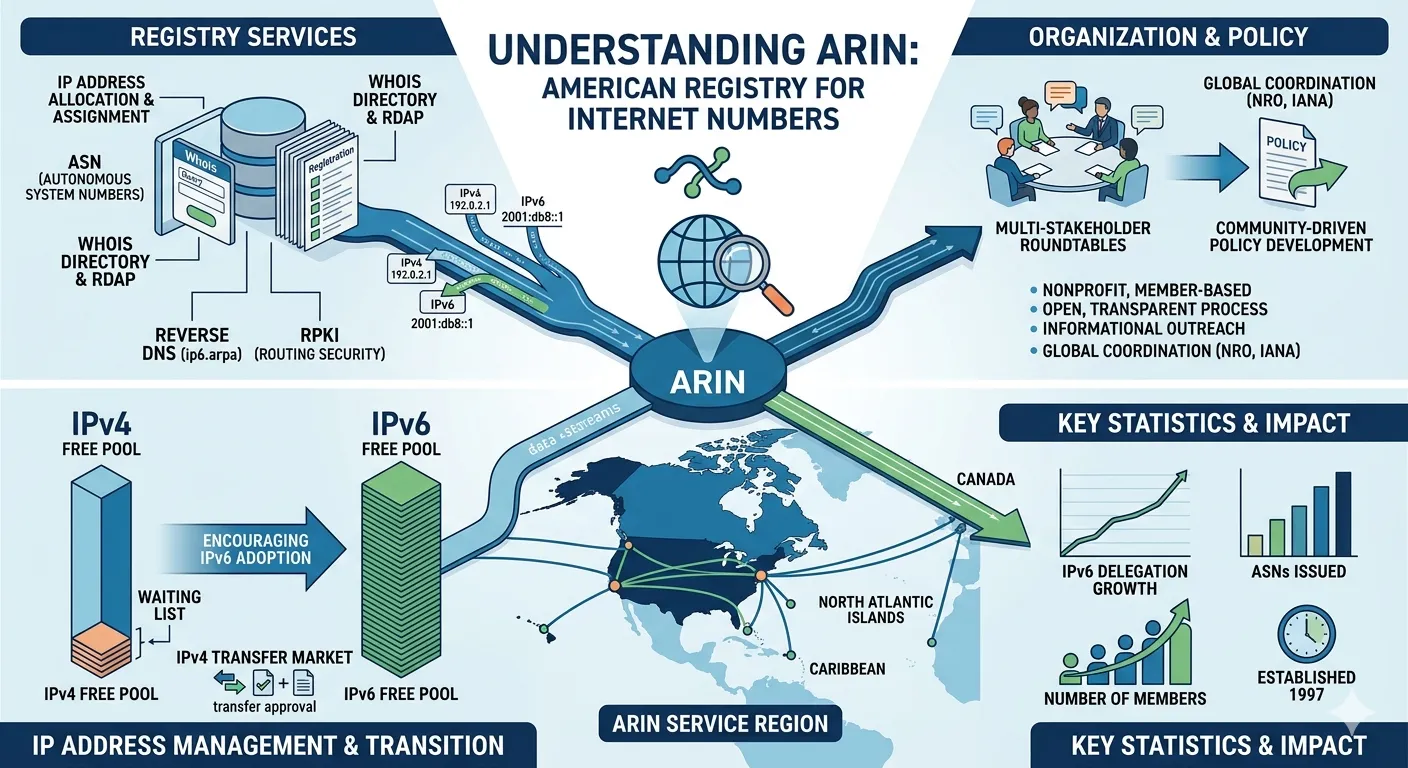
Qu’est-ce que l’ARIN ? Comprendre le Registre américain des numéros Internet
L’American Registry for Internet Numbers (ARIN) est une organisation à but non lucratif qui joue un rôle essentiel dans la gestion et la distribution des ressources de numérotation Internet. Ces ressources comprennent les adresses IP (Internet Protocol) et les numéros de système autonome (ASN), indispensables pour garantir la fiabilité de la transmission des données sur Internet. ARIN est l’un des cinq registres Internet régionaux (RIR) au monde. SaRead more Related Posts Qu’est-ce que GeoIP et comment ça fonctionne ? La géolocalisation IP est essentielle pour personnaliser les expériences en ligne, renforcer la cybersécurité et alimenter d'innombrables applications professionnelles. Mais Read more Qu’est-ce que l’APNIC ? Une introduction simple au Centre d'information du réseau Asie-Pacifique Lorsque vous naviguez sur Internet, vous ne pensez probablement pas beaucoup Read more Comprendre HTML, CSS, JavaScript et PHP : un guide pour les non-initiés Le monde du développement web peut paraître intimidant, mais la compréhension de ses langages fondamentaux (HTML, CSS, JavaScript et PHP) Read more .related-post {} .related-post .post-list { text-align: left; } .related-post .post-list .item { margin: 5px; padding: 10px; } .related-post .headline { font-size: 18px !important; color: #999999 !important; } .related-post .post-list .item .post_thumb { max-height: 220px; margin: 10px 0px; padding: 0px; display: block; } .related-post .post-list .item .post_title { font-size: 16px; color: #3f3f3f; margin: 10px 0px; padding: 0px; display: block; text-decoration: none; } .related-post .post-list .item .post_excerpt { font-size: 13px; color: #3f3f3f; margin: 10px 0px; padding: 0px; display: block; text-decoration: none; } @media only screen and (min-width: 1024px) { .related-post .post-list .item { width: 30%; } } @media only screen and (min-width: 768px) and (max-width: 1023px) { .related-post .post-list .item { width: 90%; } } @media only screen and (min-width: 0px) and (max-width: 767px) { .related-post .post-list .item { width: 90%; } }

Comprendre HTML, CSS, JavaScript et PHP : un guide pour les non-initiés
Le monde du développement web peut paraître intimidant, mais la compréhension de ses langages fondamentaux (HTML, CSS, JavaScript et PHP) peut le rendre accessible à tous. Ces langages jouent des rôles distincts dans la création des sites web et des applications que vous utilisez quotidiennement. Voici un aperçu : HTML (HyperText Markup Language) Qu’est-ce que c’est ? Le HTML est la structure de base de toute page web. Imaginez-le comme leRead more Related Posts Qu’est-ce que GeoIP et comment ça fonctionne ? La géolocalisation IP est essentielle pour personnaliser les expériences en ligne, renforcer la cybersécurité et alimenter d'innombrables applications professionnelles. Mais Read more Qu’est-ce que l’APNIC ? Une introduction simple au Centre d'information du réseau Asie-Pacifique Lorsque vous naviguez sur Internet, vous ne pensez probablement pas beaucoup Read more Qu’est-ce que l’ARIN ? Comprendre le Registre américain des numéros Internet L'American Registry for Internet Numbers (ARIN) est une organisation à but non lucratif qui joue un rôle essentiel dans la Read more .related-post {} .related-post .post-list { text-align: left; } .related-post .post-list .item { margin: 5px; padding: 10px; } .related-post .headline { font-size: 18px !important; color: #999999 !important; } .related-post .post-list .item .post_thumb { max-height: 220px; margin: 10px 0px; padding: 0px; display: block; } .related-post .post-list .item .post_title { font-size: 16px; color: #3f3f3f; margin: 10px 0px; padding: 0px; display: block; text-decoration: none; } .related-post .post-list .item .post_excerpt { font-size: 13px; color: #3f3f3f; margin: 10px 0px; padding: 0px; display: block; text-decoration: none; } @media only screen and (min-width: 1024px) { .related-post .post-list .item { width: 30%; } } @media only screen and (min-width: 768px) and (max-width: 1023px) { .related-post .post-list .item { width: 90%; } } @media only screen and (min-width: 0px) and (max-width: 767px) { .related-post .post-list .item { width: 90%; } }
