Who controls IP address allocation globally?
 Stephanie
Explore the complex system behind IP address allocation, its governing bodies, and the growing need for efficient global management.
Table of Contents
- The internet’s address system relies on several key organisations that manage IP address distribution worldwide.
- Growing challenges in IP address allocation include scarcity, regional disparities, and the rise of IPv6 adoption.
Introduction: Understanding the global IP address allocation system
The IP address works like a unique ID number. It lets devices share information online. Many people wonder – who gives out these IP addresses? The system has multiple parts and involves different groups working together.
Giving out IP addresses requires careful organization. The system must connect countless devices worldwide without problems. Special groups handle this job. They share addresses fairly and try to fix issues when addresses run low. More devices keep joining the internet, so this work keeps getting harder.
This article explains three key things:
1. The groups that manage IP addresses
2. The problems they deal with
3. How IPv6 helps fix these issues
The system works like building blocks – from global groups to local providers.
The role of IANA

ICANN does two main jobs:
1. Manages the Domain Name System (DNS)
2. Oversees worldwide IP address distribution
This system works like this:
- IANA holds all available IP addresses
- It divides them into large blocks
- These blocks go to regional internet registries
- The registries then distribute to local providers
This structure ensures every internet device can get an address when needed.
IANA manages all IP addresses worldwide. It gives large groups of addresses to regional registries (RIRs). These registries then distribute addresses to local networks.
John Curran from ARIN says: “IANA makes sure all regions get IP addresses fairly.” IANA works with two groups:
1. RIRs – they manage addresses in different world regions
2. ICANN – the main organization that oversees IANA
This system has three steps:
- IANA gives addresses to RIRs
- RIRs give addresses to local providers
- Providers give addresses to users and businesses
The system prevents conflicts and keeps the internet organized. As more devices connect, IANA helps manage the switch from IPv4 to IPv6 addresses. IPv6 has enough addresses for future growth. The process happens gradually to avoid problems.
The five RIRs
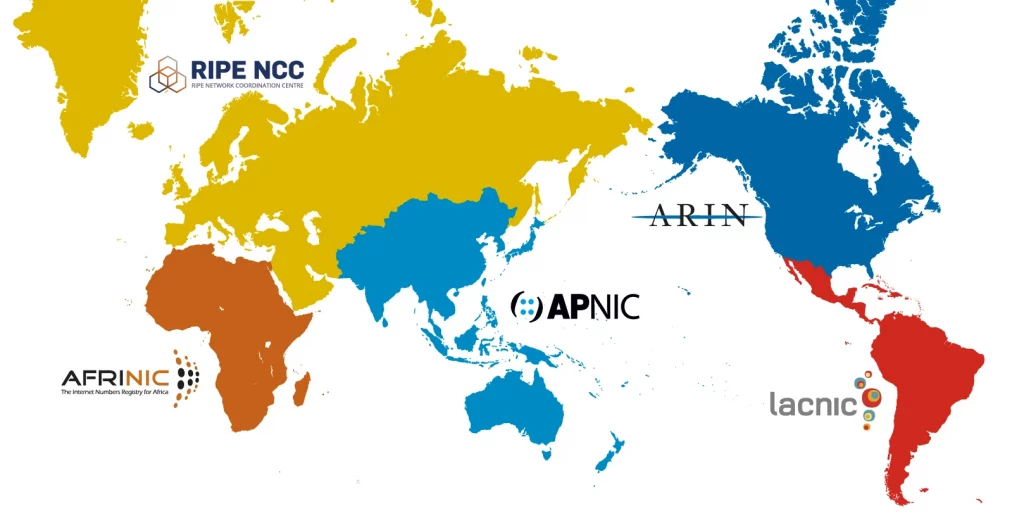
These organizations take care of giving smaller blocks of IP addresses to local internet providers and big companies in their specific parts of the world.
Five regional groups manage IP addresses around the world. Each group covers specific locations:
1. ARIN – North America, parts of the Caribbean and Africa
2. RIPE NCC – Europe, Middle East and Central Asia
3. APNIC – Asia and Pacific countries
4. LACNIC – Latin America and Caribbean nations
5. AFRINIC – The entire African continent
These RIRs play a very important role. They make sure internet companies, businesses, and even governments get enough IP addresses for their users. They also keep records of which organizations own which IP addresses in their region. This helps track where internet traffic comes from.
Alan Ford, a networking expert at NetSure, explains: “RIRs work between IANA and the companies that need IP addresses. They follow rules to give out addresses fairly based on what each region requires.” Without RIRs, it would be difficult to manage IP addresses properly in different parts of the world.
Every RIR sets its own rules for handing out IP addresses. They regularly meet with members to talk about these rules and vote on changes. This approach keeps things fair and organized. It stops arguments about who gets addresses and makes sure all requests follow the same process. The meetings let members have a say in how IP addresses are managed in their region.
How IP addresses are allocated: The process explained
First, IANA gives blocks of IP addresses to RIRs. The RIR checks each request carefully. They look at how big the network is and how many IP addresses are really needed. If the request makes sense, the RIR will give that organization some IP addresses to use.
There are special rules about which IP addresses can be used. Some IP addresses are kept aside for special uses. For example:
- Private addresses (used only inside home or office networks)
- Multicast addresses (used for sending video streams to many people at once)
RIRs also have rules to stop people from taking too many IP addresses they don’t really need. They want to make sure all IP addresses are used properly.
A big problem happened in recent years – we are running out of the old IPv4 addresses. Because of this, RIRs now mostly give out new IPv6 addresses instead. IPv6 is much better because there are way more addresses available – enough for all the new devices connecting to the internet every day. This change to IPv6 is very important for keeping the internet growing.
The whole system works like this: IANA → RIRs → Local internet providers and companies. Each step has rules to make sure IP addresses are given out fairly and used wisely. This helps the internet stay organized as more and more people and devices go online.
IPv4 exhaustion and the transition to IPv6

The biggest issue is that we’re running out of the old IPv4 addresses. IPv4 was created when the internet first started and can make about 4.3 billion different addresses. That sounds like a lot, but with so many new internet devices – like phones, tablets, smart TVs, and home appliances – we’ve used up almost all IPv4 addresses.
In 2011, the last big groups of IPv4 addresses were given out to the regional internet groups (RIRs). This made everyone start switching to IPv6, which is the new system.
Stephen Wu, an internet expert at APNIC, explains:
“We really need IPv6 now because so many everyday devices are connecting to the internet. Without IPv6, we wouldn't have enough addresses for everything.”
— Stephen Wu
This is especially important for smart devices in homes, cars, and cities that all need internet connections.
But there’s another problem – even though IPv6 is better, many places haven’t fully switched to it yet. Most networks still use IPv4 by sharing addresses between devices (called NAT). This works but isn’t perfect. The change to IPv6 is happening slowly because it costs money to upgrade equipment and some older systems don’t work with IPv6 yet.
The main points are:
1. We’ve used up most IPv4 addresses
2. IPv6 has more than enough addresses for all devices
3. The switch to IPv6 is necessary but taking time
4. Many places still use IPv4 with workarounds
This situation shows why we need to keep moving to IPv6, even if the change is happening gradually. It’s the only way to make sure there are enough addresses for all internet devices now and in the future.
The impact of IP address scarcity
Here’s what’s happening with the IP address shortage and who manages them:
The IPv4 address shortage is causing real problems. New internet companies and service providers are struggling to get enough addresses. Some have to buy IPv4 addresses from other companies at high prices because there aren’t enough new ones available.
Diane Wong from GlobalNet Solutions explains:
“Not having enough IP addresses is a big problem, especially in developing countries where more people are getting online. This shortage shows we need to move to IPv6 faster.”
— Diane Wong
staff to make the switch to the new system.
These organizations manage IP addresses worldwide:
1. ICANN – Runs IANA and controls all IP addresses globally
2. IANA – Handles the big picture of IP address distribution worldwide
3. RIRs – Give out IP addresses in different parts of the world (like ARIN for North America or APNIC for Asia)
4. NIRs – Work under RIRs in some countries to help local internet providers get addresses
The situation shows we need to:
-
- Use IPv4 addresses more carefully
-
- Move faster to IPv6
-
- Help smaller companies make the switch
-
- Keep the system fair for everyone needing addresses
The future of IP address allocation
The internet’s future depends on everyone switching to IPv6. Right now, the change is happening slowly. But more and more devices are connecting to the internet every day – things like smart home gadgets, connected cars, and other IoT devices. This means we’ll need many more IP addresses soon.
Tim Rains from Microsoft explains:
“More places are starting to use IPv6, and eventually the whole world will switch. But we can't just stop using IPv4 yet. We need to keep both systems working while helping more people move to IPv6. This way, the internet won't have problems during the change”
— Tim Rains, Microsoft
Here are the key points about the future:
1. IPv6 is the solution for having enough addresses
2. The change is happening, but not quickly
3. More internet-connected devices means we need IPv6 more than ever
4. We must manage both IPv4 and IPv6 during the transition
5. Fair distribution of addresses remains important
As more people upgrade their equipment and services, the internet will gradually move completely to IPv6. Until then, the organizations managing IP addresses will continue working to make this important change happen smoothly.
Trusted IPv4 Leasing for Business Growth
Get enterprise-grade IPv4 space quickly, with seamless deployment and end-to-end management.
Get Started with i.leaseFAQs
What is an IP address?
An IP address is a number for internet devices. Each computer, phone or smart device gets one. Devices use these numbers to communicate online.
What does IANA do?
IANA controls all IP addresses globally. It divides addresses between five regional groups. These groups then give addresses to local providers.
Why is IPv4 running out bad?
IPv4 made 4 billion addresses. Now we need more. Not enough addresses means:
– New devices can’t connect
– Companies buy old addresses at high costs
What's different about IPv6?
IPv6 fixes the address shortage. IPv6 makes enough addresses for all future devices
How do devices get IP addresses?
First, IANA gives address blocks to the five regional groups (RIRs). Then, these groups share smaller blocks with internet providers in their area. Finally, your internet company gives your devices their specific addresses when you go online. Each step follows rules to prevent waste and keep things organized.
Related Blogs
Articles connexes

Qu’est-ce qu’une lettre d’autorisation (LOA) dans le cadre d’un bail de propriété intellectuelle ? LOA vs ROA et points à vérifier
Une Lettre d’Autorisation (LOA) est un document officiel dans lequel le titulaire enregistré d’un bloc d’adresses IP autorise une autre partie à annoncer cet espace d’adressage à partir d’un numéro de système autonome spécifié. Il s’agit de l’autorisation écrite qui relie un droit contractuel d’utiliser un espace d’adressage à l’acte technique consistant à le router — et sans elle, les fournisseurs en amont refuseront généralement d’accepter vos annonces. CeRead more Related Posts IP地址租赁中的授权书 (LOA) 是什么?LOA 与 ROA 的区别以及需要核实的内容 授权书(Letter of Authorization,LOA)是一份正式文件,由 IP 地址块的注册持有者授权另一方通过指定的自治系统编号(ASN)公告该地址空间。 它是一份书面授权,将使用地址空间的合同权利与实际进行路由公告的技术行为连接起来——如果没有 LOA,上游服务提供商通常会拒绝接受你的路由公告。 正是这种拒绝,使 LOA 在运营上具有决定性意义,而不仅仅是一项行政文件。Transit 服务提供商、数据中心和电信运营商都需要证明,公告某个前缀的一方确实获得了授权,因为接受未经授权的公告就意味着参与了一次路由劫持。Cloudflare 的 BYOIP 文档对此说明得非常明确:其 Transit 服务提供商要求在接受 Cloudflare 代表客户公告的路由之前提供 LOA,而且文件必须明确列出获得授权的前缀以及将用于公告这些前缀的 ASN。整个行业普遍都有类似要求。一家企业即使已经签署租赁协议、完成路由器配置,仍然可能因为 Qu’est-ce qu’une lettre d’autorisation (LOA) dans le cadre d’un bail de propriété intellectuelle ? LOA vs ROA et points à vérifier Une Lettre d’Autorisation (LOA) est un document officiel dans lequel le titulaire enregistré d’un bloc d’adresses IP autorise une autre What Is a Letter of Authorization (LOA) in IP Leasing? LOA vs ROA and What to Verify A Letter of Authorization (LOA) is a formal document in which the registered holder of an IP address block authorizes .related-post {} .related-post .post-list { text-align: left; } .related-post .post-list .item { margin: 5px; padding: 10px; } .related-post .headline { font-size: 18px !important; color: #999999 !important; } .related-post .post-list .item .post_thumb { max-height: 220px; margin: 10px 0px; padding: 0px; display: block; } .related-post .post-list .item .post_title { font-size: 16px; color: #3f3f3f; margin: 10px 0px; padding: 0px; display: block; text-decoration: none; } .related-post .post-list .item .post_excerpt { font-size: 13px; color: #3f3f3f; margin: 10px 0px; padding: 0px; display: block; text-decoration: none; } @media only screen and (min-width: 1024px) { .related-post .post-list .item { width: 30%; } } @media only screen and (min-width: 768px) and (max-width: 1023px) { .related-post .post-list .item { width: 90%; } } @media only screen and (min-width: 0px) and (max-width: 767px) { .related-post .post-list .item { width: 90%; } }
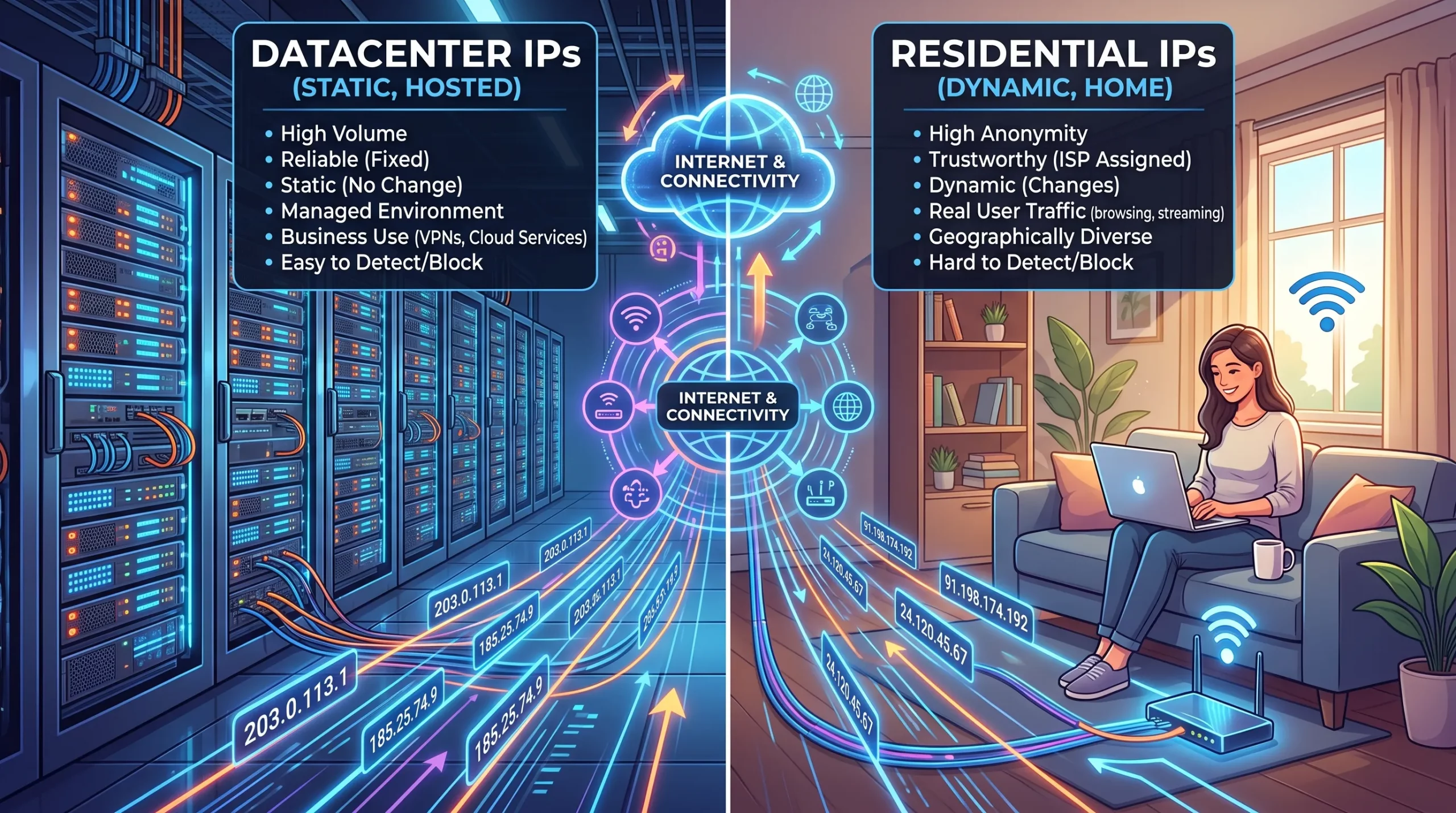
Adresses IP de centres de données vs adresses IP résidentielles : quelle est la différence ? Pourquoi est-ce important ?
Une adresse IP de centre de données provient d’un centre de données commercial, d’un fournisseur cloud ou d’une société d’hébergement, tandis qu’une adresse IP résidentielle est attribuée par un fournisseur d’accès Internet à un particulier ou à une entreprise. La différence tient à l’origine : l’une provient d’une infrastructure conçue pour faire fonctionner des serveurs, l’autre d’une connexion conçue pour servir un utilisateur final. Cette seule distinction influence laRead more Related Posts Qu’est-ce qu’une lettre d’autorisation (LOA) dans le cadre d’un bail de propriété intellectuelle ? LOA vs ROA et points à vérifier Une Lettre d’Autorisation (LOA) est un document officiel dans lequel le titulaire enregistré d’un bloc d’adresses IP autorise une autre 数据中心IP地址与住宅IP地址:区别是什么?为什么这很重要? 常见问题解答 数据中心 IP 地址来源于商业数据中心、云服务提供商或托管公司,而住宅 IP 地址则由互联网服务提供商分配给家庭或企业用户。 两者的区别在于来源:一种来自为运行服务器而建设的基础设施,另一种来自为终端用户提供连接而建设的网络。正是这一根本区别,决定了互联网其他系统如何看待来自这两类地址的流量。 这个话题通常只会在代理和反检测的狭窄语境下被讨论,因此很容易形成片面的认知。实际上,数据中心 IP 与住宅 IP 的区别,对任何运营互联网基础设施的人都很重要,因为它会影响一个地址天然具有多少信任度、网站和安全系统如何响应它,以及这个地址适合什么用途。几乎所有合法的商业互联网基础设施——包括你使用的每个网站、API、邮件服务器和云服务——都运行在数据中心 IP 地址空间上,而这本来就是正确的使用方式。重点并不是哪一种更好、哪一种更差;而是它们服务于不同目的,也会受到不同方式的对待。了解自己正在使用或真正需要哪一种,可以避免许多本来可以避免的问题。 本文将解释这两种 IP 地址分别是什么、系统如何区分它们、为什么它们会受到不同对待,以及这种差异对于在公共 IPv4 地址空间上部署真实服务的企业意味着什么——包括它与地址信誉、地理定位以及不同使用场景究竟需要哪种地址空间之间的关系。 数据中心 Direcciones IP de centros de datos frente a direcciones IP residenciales: ¿Cuál es la diferencia y por qué es importante? A data center IP address originates from a commercial data center, cloud provider, or hosting company, while a residential IP .related-post {} .related-post .post-list { text-align: left; } .related-post .post-list .item { margin: 5px; padding: 10px; } .related-post .headline { font-size: 18px !important; color: #999999 !important; } .related-post .post-list .item .post_thumb { max-height: 220px; margin: 10px 0px; padding: 0px; display: block; } .related-post .post-list .item .post_title { font-size: 16px; color: #3f3f3f; margin: 10px 0px; padding: 0px; display: block; text-decoration: none; } .related-post .post-list .item .post_excerpt { font-size: 13px; color: #3f3f3f; margin: 10px 0px; padding: 0px; display: block; text-decoration: none; } @media only screen and (min-width: 1024px) { .related-post .post-list .item { width: 30%; } } @media only screen and (min-width: 768px) and (max-width: 1023px) { .related-post .post-list .item { width: 90%; } } @media only screen and (min-width: 0px) and (max-width: 767px) { .related-post .post-list .item { width: 90%; } }
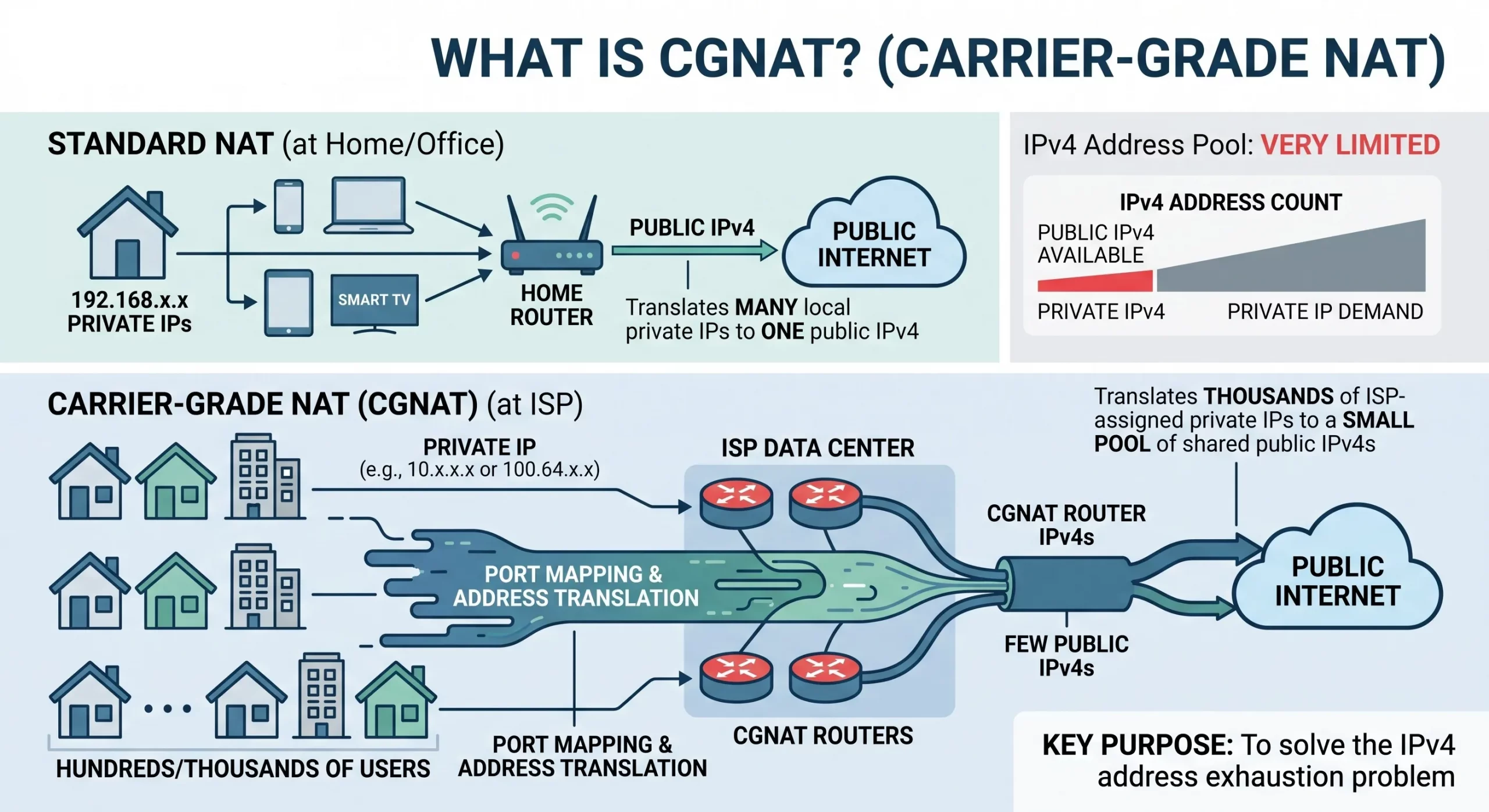
Qu’est-ce que le CGNAT (NAT de niveau opérateur) ? Pourquoi il perturbe l’hébergement, les jeux et les services entrants
Le CGNAT (Carrier-Grade NAT) est une technique qui permet à un fournisseur d’accès Internet de partager simultanément une seule adresse IPv4 publique entre de nombreux clients, au lieu d’attribuer à chacun sa propre adresse. Il ajoute une deuxième couche de traduction d’adresses réseau à l’intérieur du réseau du fournisseur, de sorte que des centaines ou des milliers d’abonnés se trouvent derrière une seule adresse publique visible depuis Internet. PourRead more Related Posts Qu’est-ce qu’une lettre d’autorisation (LOA) dans le cadre d’un bail de propriété intellectuelle ? LOA vs ROA et points à vérifier Une Lettre d’Autorisation (LOA) est un document officiel dans lequel le titulaire enregistré d’un bloc d’adresses IP autorise une autre 数据中心IP地址与住宅IP地址:区别是什么?为什么这很重要? 常见问题解答 数据中心 IP 地址来源于商业数据中心、云服务提供商或托管公司,而住宅 IP 地址则由互联网服务提供商分配给家庭或企业用户。 两者的区别在于来源:一种来自为运行服务器而建设的基础设施,另一种来自为终端用户提供连接而建设的网络。正是这一根本区别,决定了互联网其他系统如何看待来自这两类地址的流量。 这个话题通常只会在代理和反检测的狭窄语境下被讨论,因此很容易形成片面的认知。实际上,数据中心 IP 与住宅 IP 的区别,对任何运营互联网基础设施的人都很重要,因为它会影响一个地址天然具有多少信任度、网站和安全系统如何响应它,以及这个地址适合什么用途。几乎所有合法的商业互联网基础设施——包括你使用的每个网站、API、邮件服务器和云服务——都运行在数据中心 IP 地址空间上,而这本来就是正确的使用方式。重点并不是哪一种更好、哪一种更差;而是它们服务于不同目的,也会受到不同方式的对待。了解自己正在使用或真正需要哪一种,可以避免许多本来可以避免的问题。 本文将解释这两种 IP 地址分别是什么、系统如何区分它们、为什么它们会受到不同对待,以及这种差异对于在公共 IPv4 地址空间上部署真实服务的企业意味着什么——包括它与地址信誉、地理定位以及不同使用场景究竟需要哪种地址空间之间的关系。 数据中心 Direcciones IP de centros de datos frente a direcciones IP residenciales: ¿Cuál es la diferencia y por qué es importante? A data center IP address originates from a commercial data center, cloud provider, or hosting company, while a residential IP .related-post {} .related-post .post-list { text-align: left; } .related-post .post-list .item { margin: 5px; padding: 10px; } .related-post .headline { font-size: 18px !important; color: #999999 !important; } .related-post .post-list .item .post_thumb { max-height: 220px; margin: 10px 0px; padding: 0px; display: block; } .related-post .post-list .item .post_title { font-size: 16px; color: #3f3f3f; margin: 10px 0px; padding: 0px; display: block; text-decoration: none; } .related-post .post-list .item .post_excerpt { font-size: 13px; color: #3f3f3f; margin: 10px 0px; padding: 0px; display: block; text-decoration: none; } @media only screen and (min-width: 1024px) { .related-post .post-list .item { width: 30%; } } @media only screen and (min-width: 768px) and (max-width: 1023px) { .related-post .post-list .item { width: 90%; } } @media only screen and (min-width: 0px) and (max-width: 767px) { .related-post .post-list .item { width: 90%; } }
