What is an IPv4 Address ?
 admin
admin
Before we go into what an IPv4 is, it’s important to understand what an IP address is.
Table of Contents
An IP address, short for Internet Protocol address, serves as a numerical label for a computer. It performs two primary functions:
1.Identifying the point of connection between two computers
2. Uniquely identifying each computer in a network.
IP addresses are represented in notations that look like this: 192.0.2.1 (This is an example of an IPv4 address). An IP address can also be in the IPv6 format, like so: 2001:db8:0:1234:0:567:8:1.
The management of the IP address space is handled globally by the Internet Assigned Numbers Authority (IANA). The assignment of IP assets in specific territories is handled by five regional Internet registries (RIRs).
IPv4 addresses were distributed in blocks to the RIRs, but since 2011, the IANA level has exhausted its supply.Network administrators allocate an IP address to each device connected to a network, either statically (fixed) or dynamically, based on network practices and software features.
What is an IPv4?
IPv4 might be on its way to being a thing of the past. But back when it first rolled out, it revolutionized the way computer networks communicated. Since its initial deployment on SATNET in 1982 and subsequently on the ARPANET in January 1983, IPv4 has remained the primary protocol for routing Internet traffic.
This fact remains true despite the emergence of its successor, Internet Protocol version 6 (IPv6).IPv4 addresses are represented in dot-decimal notation, meaning that the different parts of an IPv4 address are separated by a dot.
Parts of the IPv4 Address
IPv4 addresses consist of four 8-bit fields, written in decimal digits and separated by periods. Each field represents a byte, totaling 32 bits. This format is commonly referred to as the dotted-decimal format.
An IPv4 address comprises two main parts: the network part and the host part. In the example address 129.144.50.56, 129.144 represents the network part, while 50.56 indicates the host part.
The network part of an IPv4 address encompasses the assigned unique number for the network. It also signifies the class of network to which it belongs.
The host part of an IPv4 address is the portion assigned to individual hosts within the network. Your computer or phone is an example of a host.
You can learn more details about how many bits are in an IPv4 address to understand what is going on with IPv4
The host part distinguishes each machine on the network. Notably, the network part remains the same for all hosts within a network, while the host part must be unique (this ensures that your phone’s identity is not confused with your laptop’s identity as they connect to a network).
In scenarios where large networks are divided into subnets, a subnet number is used. Think of a subnet as a smaller network inside a larger network.
To optimize the utilization of the IPv4 address space, some bits from the host number part of the IPv4 address can serve as a network identifier, becoming the subnet number. Here’s an example: if 198.51.100 has a subnet mask of 255.255.255.0, it will be written as 198.51.100.0/24.
Private Networks and IPv4s
Private networks use reserved IPv4 address ranges that are not globally unique. Network address translation (NAT) is commonly used to connect private networks to the Internet.
IP addresses can be assigned dynamically through the Dynamic Host Configuration Protocol (DHCP) or assigned statically with a static IP address.
DHCP is widely used for address assignment, offering flexibility and efficient use of address space.That covers the essence of IP addresses without embellishment.
Advantages of IPv4
IPv4 has several advantages that contribute to its widespread adoption and efficient data transfer:
1. Robust Security Measures:
IPv4 supports encryption techniques that ensure privacy and enhance overall network security.
2. Wide Network Allocation:
The current IPv4 network allocation facilitates seamless connectivity on a large scale.
3. Simplified Device Connection:
Connecting multiple devices across a vast network becomes effortless without the need for Network Address Translation (NAT).
4. Reliable Communication Model:
IPv4’s communication model offers both high-quality service and efficient data transfer, resulting in smooth network operations.
5. Redefined Addressing:
IPv4 addresses are well-defined and allow for flawless encoding, ensuring accurate transmission of data.
6. Scalable Routing:
The collective addressing approach of IPv4 enables more scalable and efficient routing, enhancing overall network performance.
Enhanced Data Communication: IPv4 excels in multicast organizations, facilitating more precise and specific data communication across networks.
Limitations of IPv4
With its 32-bit address space, IPv4 supports approximately 4.3 billion unique addresses. However, due to reserved blocks for special networking purposes, the available pool of usable addresses is constrained. Large blocks are set aside for private networks and multicast addresses, reducing the effective number of addresses for public use.
Reserved IP addresses serve specific purposes and are not intended for general use. These addresses are allocated for multicast traffic and provide addressing space for private networks. The Internet Engineering Task Force (IETF) and IANA maintain these reserved address blocks to ensure efficient network operation.
Below are more of the limitations of IPv4:
1. Depletion of Unique IP Addresses:
The world’s supply of unique IP addresses is rapidly depleting, leading to the possibility of running out of addresses in the future.
2. Need for Classful IP Addressing:
As the number of hosts increases, IPv4 requires the allocation of IP addresses from higher classes, which adds complexity to network management.
3. Complex Configuration:
IPv4 entails intricate host and routing configuration.
5. High System Management Costs:
IPv4’s system management can be labor-intensive, complex, slow, and prone to errors. This can potentially result in increased operational costs.
6. Optional Security Features:
IPv4’s security features are not mandatory, which can leave networks vulnerable to potential threats. On the other hand, security is inherently built in to IPv6’s structure.
7. Limited Future Support:
Adding support for future requirements in IPv4 involves high overhead and hampers the flexibility to connect everything over IP, making it challenging to accommodate evolving needs.
To address these limitations, IPv6 emerged as a successor to IPv4, offering enhanced features and a larger address space to meet the growing demands of the digital landscape.
With the escalating expenses associated with IP addresses, opting to lease an IP address could prove to be the most suitable choice for fulfilling your business requirements.
Articles connexes

Que sont les entreprises de télécommunications ? Comment les fournisseurs de télécommunications assurent la connectivité au Royaume-Uni, aux États-Unis et au Canada
Les entreprises de télécommunications, également appelées opérateurs télécoms, fournissent des services de communication et de connectivité. Ces services peuvent inclure les réseaux mobiles, l’Internet haut débit, les connexions fibre, les services de téléphonie fixe, la connectivité pour les entreprises, l’accès au cloud, les services réseau gérés et la connectivité aux centres de données. Pour les consommateurs, les entreprises de télécommunications sont souvent connues comme des fournisseurs de services mobilesRead more Related Posts Desbloqueando la privacidad digital con una red privada virtual (VPN) ¿Qué es una VPN? Una red privada virtual (VPN) es una tecnología que permite a los usuarios crear una conexión Comprensión de la traducción de direcciones de red (NAT) En las redes informáticas, gestionar las direcciones IP de forma eficiente es fundamental para garantizar una comunicación fluida entre los Arrendamiento de direcciones IP: Cómo arrendar direcciones IP El mundo digital en el que nos movemos hoy depende en gran medida de las direcciones IP, identificadores únicos asignados .related-post {} .related-post .post-list { text-align: left; } .related-post .post-list .item { margin: 5px; padding: 10px; } .related-post .headline { font-size: 18px !important; color: #999999 !important; } .related-post .post-list .item .post_thumb { max-height: 220px; margin: 10px 0px; padding: 0px; display: block; } .related-post .post-list .item .post_title { font-size: 16px; color: #3f3f3f; margin: 10px 0px; padding: 0px; display: block; text-decoration: none; } .related-post .post-list .item .post_excerpt { font-size: 13px; color: #3f3f3f; margin: 10px 0px; padding: 0px; display: block; text-decoration: none; } @media only screen and (min-width: 1024px) { .related-post .post-list .item { width: 30%; } } @media only screen and (min-width: 768px) and (max-width: 1023px) { .related-post .post-list .item { width: 90%; } } @media only screen and (min-width: 0px) and (max-width: 767px) { .related-post .post-list .item { width: 90%; } }
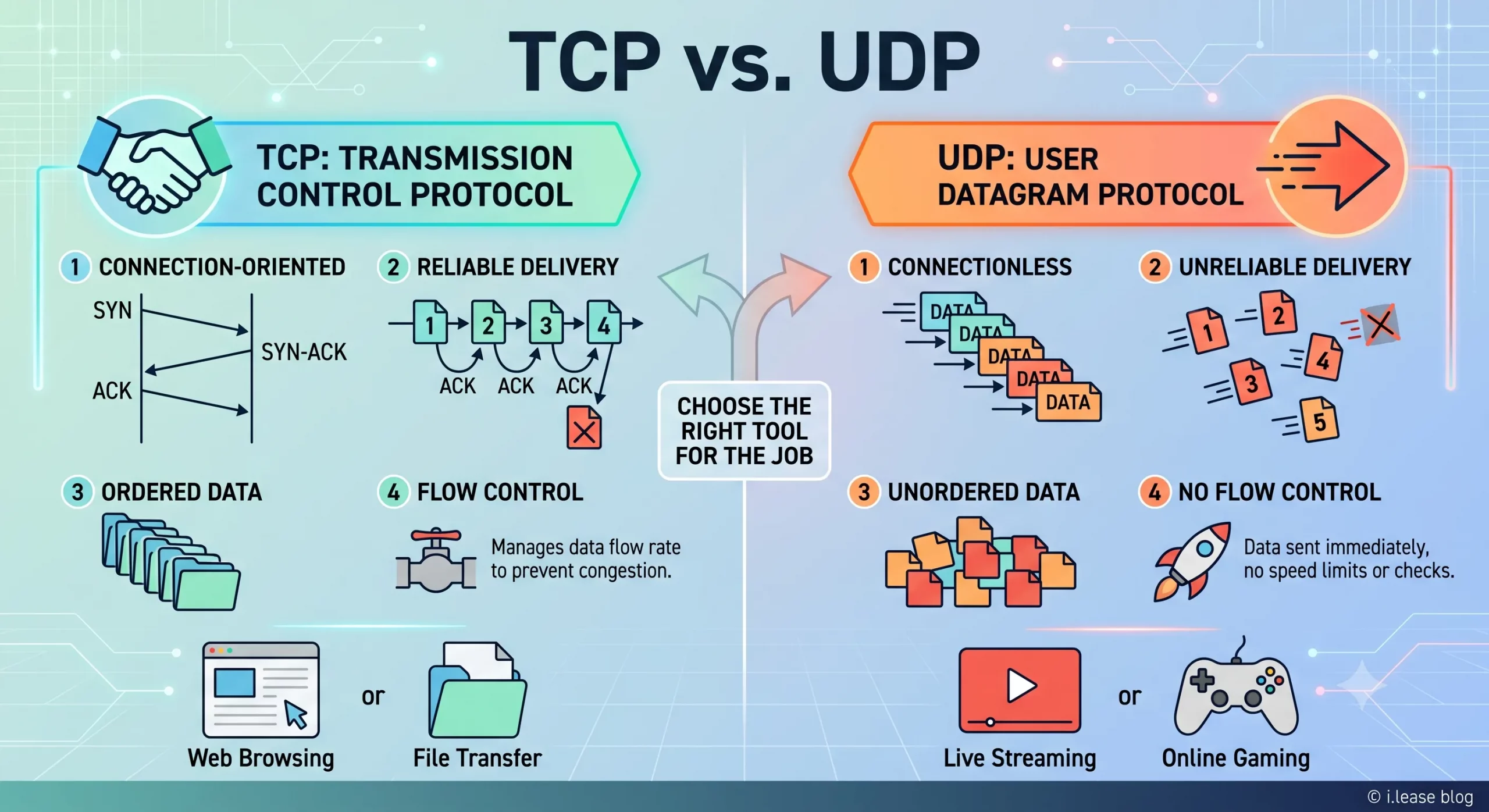
TCP vs UDP : guide de location IPv4 et de réseau d’entreprise
TCP et UDP sont deux des protocoles de transport les plus importants sur Internet. Ils déterminent la circulation des données entre les appareils, les serveurs, les plateformes cloud, les passerelles VPN, les résolveurs DNS, les systèmes de messagerie, les plateformes de streaming et les applications métier. Pour les entreprises, TCP et UDP ne sont pas de simples termes techniques. Ils ont un impact direct sur les performances de l’infrastructure. Related Posts Which RIRs Support Inter-RIR IPv4 Transfers in 2026? IPv4 addresses may be globally routable, but transferring their registration from one organization to another is governed by Regional Internet What Is Reverse DNS (rDNS)? Why PTR Records Matter for Email, Hosting, and Leased IPv4 Reverse DNS (rDNS) is the process of resolving an IP address back to a domain name. It is the mirror How DDoS Mitigation Works: Scrubbing, BGP Diversion, Anycast, and What Network Operators Should Prepare DDoS mitigation is the set of techniques used to keep services online during a distributed denial-of-service attack — by absorbing, .related-post {} .related-post .post-list { text-align: left; } .related-post .post-list .item { margin: 5px; padding: 10px; } .related-post .headline { font-size: 18px !important; color: #999999 !important; } .related-post .post-list .item .post_thumb { max-height: 220px; margin: 10px 0px; padding: 0px; display: block; } .related-post .post-list .item .post_title { font-size: 16px; color: #3f3f3f; margin: 10px 0px; padding: 0px; display: block; text-decoration: none; } .related-post .post-list .item .post_excerpt { font-size: 13px; color: #3f3f3f; margin: 10px 0px; padding: 0px; display: block; text-decoration: none; } @media only screen and (min-width: 1024px) { .related-post .post-list .item { width: 30%; } } @media only screen and (min-width: 768px) and (max-width: 1023px) { .related-post .post-list .item { width: 90%; } } @media only screen and (min-width: 0px) and (max-width: 767px) { .related-post .post-list .item { width: 90%; } }
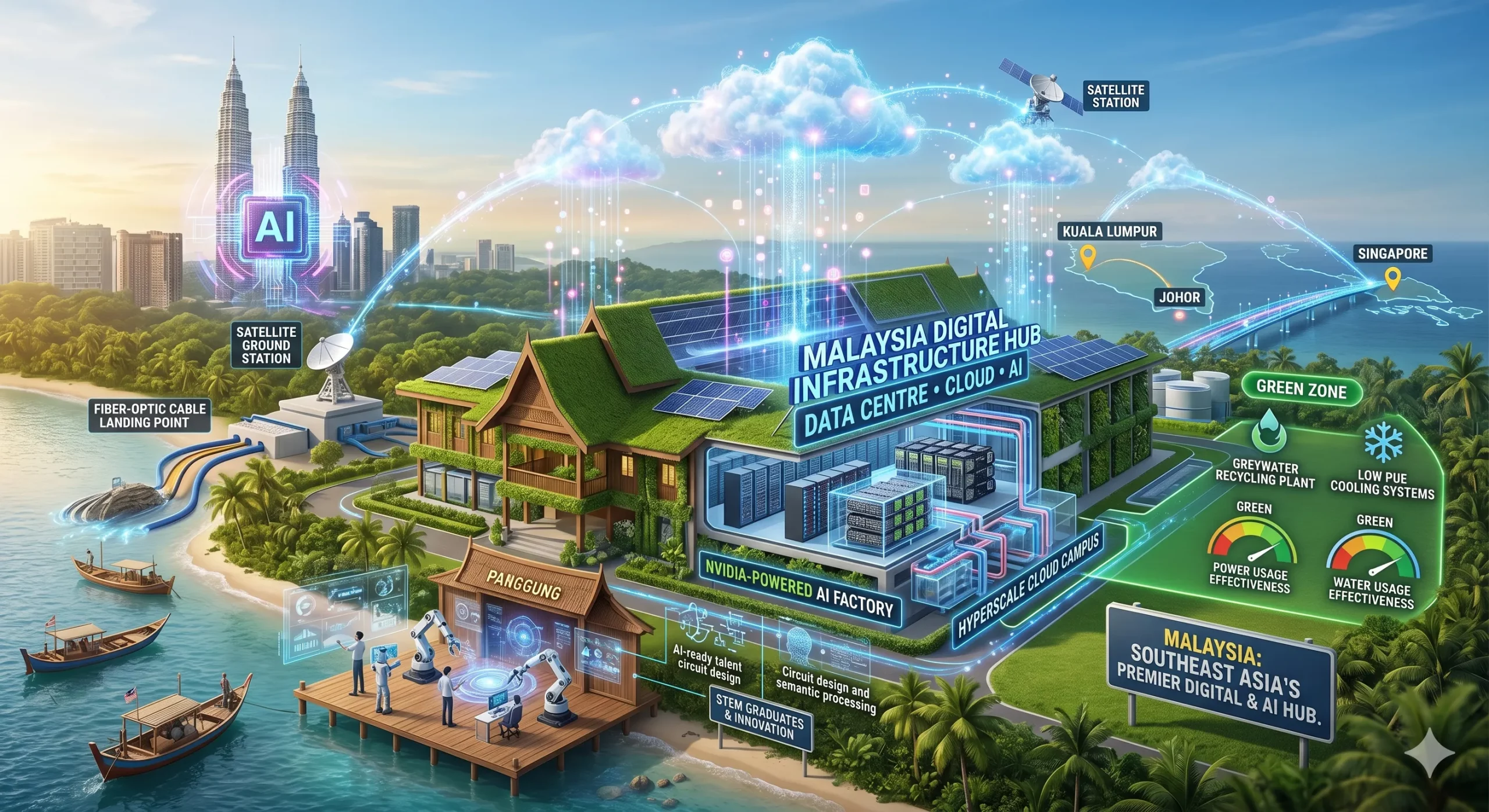
Pourquoi la Malaisie devient-elle un pôle de centres de données pour les infrastructures cloud et d’intelligence artificielle ?
La Malaisie devient l’un des marchés de croissance les plus importants d’Asie du Sud-Est dans le secteur des centres de données. La demande en cloud computing, intelligence artificielle, applications d’entreprise, paiements numériques, commerce électronique, cybersécurité et services régionaux à faible latence pousse les entreprises à construire davantage d’infrastructures au plus près des utilisateurs. Cette croissance ne repose pas uniquement sur un effet de mode. La Malaisie a attiré desRead more Related Posts Desbloqueando la privacidad digital con una red privada virtual (VPN) ¿Qué es una VPN? Una red privada virtual (VPN) es una tecnología que permite a los usuarios crear una conexión Comprensión de la traducción de direcciones de red (NAT) En las redes informáticas, gestionar las direcciones IP de forma eficiente es fundamental para garantizar una comunicación fluida entre los ¿Por qué Malasia se está convirtiendo en un centro neurálgico para la infraestructura de nube e IA? Malasia se está convirtiendo en uno de los mercados de crecimiento de centros de datos más importantes del Sudeste Asiático. .related-post {} .related-post .post-list { text-align: left; } .related-post .post-list .item { margin: 5px; padding: 10px; } .related-post .headline { font-size: 18px !important; color: #999999 !important; } .related-post .post-list .item .post_thumb { max-height: 220px; margin: 10px 0px; padding: 0px; display: block; } .related-post .post-list .item .post_title { font-size: 16px; color: #3f3f3f; margin: 10px 0px; padding: 0px; display: block; text-decoration: none; } .related-post .post-list .item .post_excerpt { font-size: 13px; color: #3f3f3f; margin: 10px 0px; padding: 0px; display: block; text-decoration: none; } @media only screen and (min-width: 1024px) { .related-post .post-list .item { width: 30%; } } @media only screen and (min-width: 768px) and (max-width: 1023px) { .related-post .post-list .item { width: 90%; } } @media only screen and (min-width: 0px) and (max-width: 767px) { .related-post .post-list .item { width: 90%; } }
