Proxy vs VPN: What’s the Difference and Which Do You Need?
 Stephanie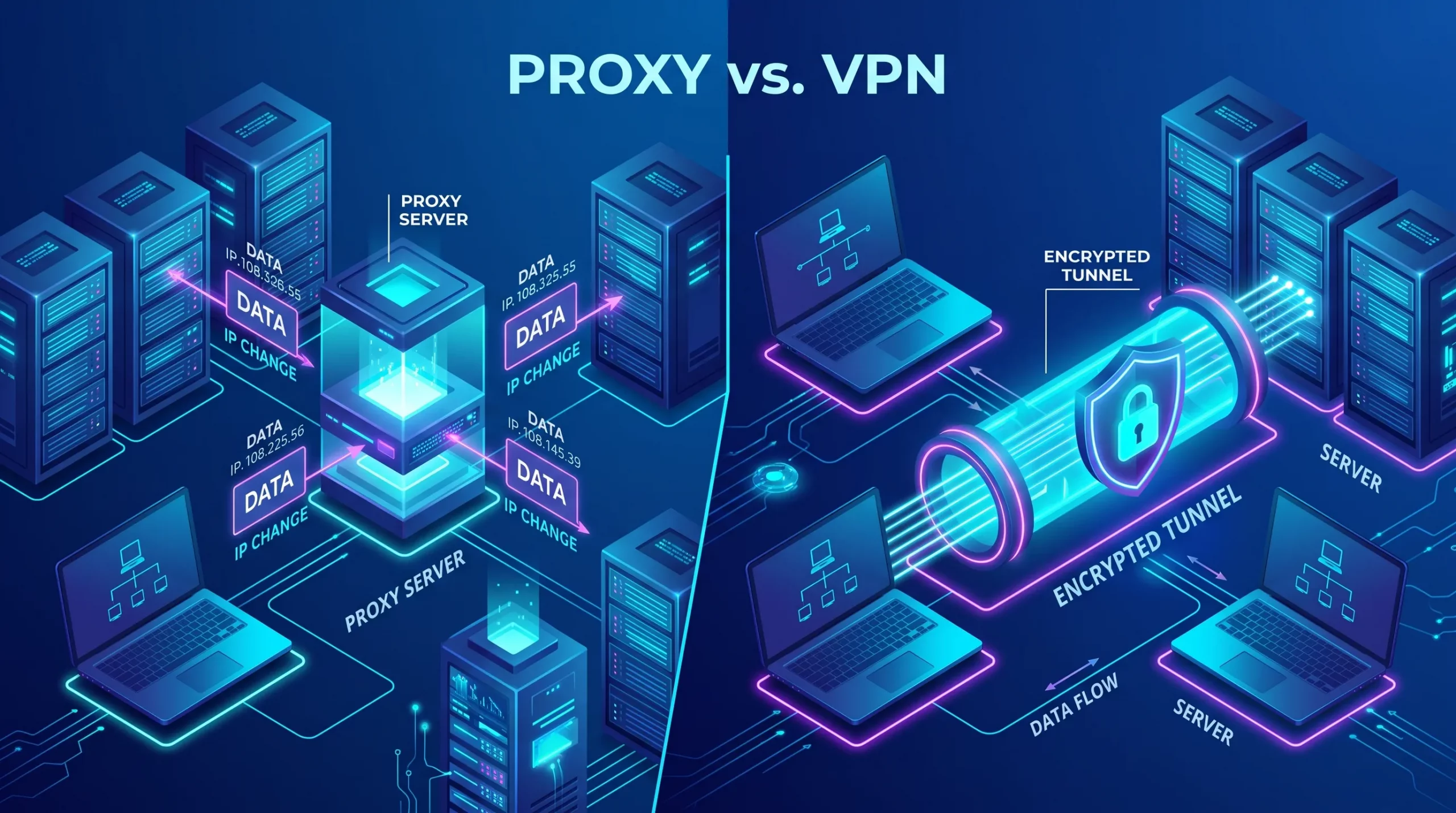
A proxy reroutes traffic for a specific application through an intermediary server, while a VPN routes and encrypts all of a device’s traffic through a secure tunnel. The short version: a proxy changes the apparent source of some of your traffic; a VPN changes and protects the source of all of it. That difference in scope and encryption is the core of the comparison, and it usually points clearly to one or the other for a given job.
Table of Contents
But there is a second difference that most comparisons skip, and it matters more than the software choice for anyone using these tools at scale: both proxies and VPNs are only as good as the IP addresses behind them. Whether the intermediary’s addresses are datacenter, residential, or ISP-type space — and whether that space carries a clean reputation — is what actually determines whether the service works reliably or gets blocked, throttled, and flagged. The tool is the mechanism; the address is the substance.
This article explains what proxies and VPNs are, compares them directly, breaks down the proxy types that determine real-world performance, and shows why IP reputation is the factor that decides whether either one does its job. For the specific case of how a VPN interacts with your public IP address and privacy, we cover that in detail in our guide to public IP addresses and the role of VPNs; here the focus is the comparison and the address layer underneath it.
Proxy vs VPN: The Short Answer
Use a proxy when you need to change the apparent source of specific traffic; use a VPN when you need to secure and reroute all of your traffic. The two differ along two axes:
- Scope. A proxy typically handles traffic for one application or configured connection — a browser, a scraper, a specific tool. A VPN operates at the system level, routing everything the device sends.
- Encryption. A VPN encrypts the traffic between your device and the VPN server, protecting it from anyone in between. A standard proxy does not add encryption — it changes routing and apparent origin, but does not by itself secure the traffic.
From those two differences, most of the practical guidance follows. If the goal is privacy and security across everything you do, a VPN fits. If the goal is controlling how specific traffic appears to a destination — for business data collection, geo-testing, or managing many parallel connections — a proxy fits. Neither is simply “better”; they solve different problems.
What Is a Proxy Server?
A proxy server is an intermediary that sits between a client and a destination, forwarding requests on the client’s behalf so the destination sees the proxy’s IP address instead of the client’s. When you route a browser or an application through a proxy, your requests go to the proxy first, the proxy makes them to the target, and the responses come back through the proxy to you.
The defining characteristics of a standard proxy:
- It changes the apparent source. The destination sees the proxy’s address, not yours — which is the entire point for use cases that depend on how traffic appears to the target.
- It usually operates per-application. You configure a specific tool to use the proxy, rather than routing your whole device through it.
- It does not inherently encrypt. A plain proxy changes routing, not confidentiality. Some proxy protocols and setups add security, but the core function is intermediation, not encryption.
Proxies are the standard tool wherever the important thing is what IP address a destination associates with a request — which is why they dominate business use cases like large-scale data collection, ad verification, price monitoring, and geo-specific testing, where controlling and varying the source address across many requests is the whole requirement.
What Is a VPN?
A VPN (Virtual Private Network) creates an encrypted tunnel between your device and a VPN server, routing all of your device’s traffic through that tunnel so it is both protected in transit and presented to the Internet from the server’s IP address.
The defining characteristics of a VPN:
- It operates system-wide. Once connected, the VPN typically carries everything the device sends, not just one application’s traffic.
- It encrypts the traffic. Between your device and the VPN server, the data is protected from your local network and your ISP — they can see that you are connected to a VPN, but not the content or final destinations of your traffic.
- It changes your public-facing address. The Internet sees the VPN server’s address rather than your own, which is the privacy and access benefit most people associate with VPNs.
Because a VPN combines encryption with system-wide rerouting, it is the standard tool for privacy, security on untrusted networks, and secure remote access — protecting all of a user’s activity rather than reshaping how specific requests appear. The interaction between a VPN and your public IP address, and what your ISP can and cannot see, is covered in our dedicated guide to public IP addresses and the role of VPNs.
Proxy vs VPN: Full Comparison
| Factor | Proxy | VPN |
|---|---|---|
| Scope of traffic | Usually per-application (browser, tool, scraper) | System-wide (all device traffic) |
| Encryption | Not inherent to a standard proxy | Yes — encrypted tunnel |
| Hides source from destination | Yes — destination sees the proxy IP | Yes — destination sees the VPN server IP |
| Protects traffic from local network / ISP | Not by itself | Yes |
| Typical speed overhead | Low (no encryption cost) | Some (encryption adds overhead) |
| Primary business use | Data collection, geo-testing, ad verification, managing many source IPs | Privacy, security, remote access, protecting all activity |
| Granular per-request IP control | Strong — can vary source across requests | Limited — one server endpoint at a time |
The table makes the division clear: a VPN wins on protecting everything with encryption; a proxy wins on flexible, granular control over how specific traffic appears. The choice is a function of the job, not of one being universally superior.
Types of Proxy — and Why the IP Type Matters
Not all proxies are equal — what separates them is the kind of IP address they route through, and that difference determines trust, speed, and how likely the traffic is to be detected or blocked. This is the layer that generic proxy-vs-VPN comparisons rarely reach, and it is the one that actually decides outcomes at scale.
- Datacenter proxies. Route through IP addresses hosted in data centers. They are fast and inexpensive, but destinations can often recognize datacenter address ranges as non-residential, so trust-sensitive targets may treat them with more suspicion. Best suited to targets that do not scrutinize the network origin closely.
- Residential proxies. Route through IP addresses assigned to real consumer connections by ISPs, so the traffic appears to originate from an ordinary household user. This makes them harder to distinguish from normal users on trust-sensitive targets, at the cost of higher price and typically lower speed than datacenter space. Ethical residential proxy services source their addresses from users who have genuinely opted in — sourcing legitimacy is a real differentiator here.
- ISP (static residential) proxies. A hybrid: IP addresses that carry ISP/residential characteristics but are hosted on datacenter-grade infrastructure. The aim is to combine the trust profile of residential addresses with the speed and stability of datacenter hosting — useful where both matter.
- Mobile proxies. Route through mobile carrier connections. Because mobile networks place many devices behind shared carrier-grade NAT addresses (the same CGNAT mechanism ISPs use to conserve IPv4), a mobile proxy address is shared by many real users, which gives it a high trust profile — but also less predictability.
The pattern across all four types is the same insight: the proxy software is largely interchangeable, but the address behind it is not. Whether traffic succeeds or gets blocked is mostly a question of what kind of IP space it comes from and how that space is regarded — which is why serious operators choose proxy type by matching the address profile to the sensitivity of the target, not by picking a tool.
When to Use a Proxy vs a VPN
Choose based on whether the job is about protecting your activity (VPN) or controlling how specific traffic appears to destinations (proxy). Framed by legitimate business and personal use cases:
Reach for a proxy when:
- Running large-scale, consented data collection or web scraping where requests must come from varied, appropriate source addresses.
- Performing geo-specific testing or QA — verifying how a site, ad, or price appears in different regions.
- Doing ad verification, brand protection, or market research that depends on seeing the Internet as an ordinary user in a given location would.
- Managing many parallel connections that each need a distinct, controllable source address.
Reach for a VPN when:
- Protecting your privacy and securing all your traffic, especially on untrusted networks like public Wi-Fi.
- Enabling secure remote access to a network or resources.
- Wanting system-wide encryption rather than per-application source control.
A note on legitimate use: proxies and VPNs are lawful, mainstream tools with extensive business and privacy applications, and this article addresses those uses. Both can be misused — for accessing systems without authorization, evading legitimate restrictions, or concealing wrongdoing — and none of the guidance here is intended for those purposes. Responsible use means respecting destinations’ terms, applicable laws, and, for data collection, the consent and rules that govern it.
Why IP Reputation Decides Everything
Whether a proxy or VPN works reliably comes down less to the software and more to the reputation of the IP addresses behind it — because destinations increasingly judge traffic by the address it comes from.
Modern websites and platforms evaluate incoming connections partly on the standing of the source IP: its history, whether it belongs to ranges associated with abuse, whether it behaves consistently, and whether an entire subnet has been flagged. As we cover in our guide to IP address reputation, an address with a poor or unknown reputation gets challenged, throttled, or blocked regardless of how sophisticated the tool routing through it is. Reputation is a property of the address, not the software.
This is why the most common failure mode for proxy-dependent operations is not a coding or tooling problem — it is an address problem. Shared proxy pools that reuse the same ranges across many customers trigger subnet-level bans; aggressive rotation creates abnormal patterns; frequent IP churn degrades reputation faster than it recovers. Over time, targets stop evaluating individual requests and start blocking whole ranges. The bottleneck becomes IP reputation and address structure, not concurrency or code exactly the problem i.lease’s IPv4 for web scraping and AI pipelines is built to address, with reputation-aware address space and structure that supports controlled use without overexposing a single subnet.
The lesson generalizes beyond scraping: for any operation where a proxy’s or VPN’s effectiveness depends on the destination accepting its traffic, the quality of the underlying address space is the real product. Good software over bad addresses fails; ordinary software over clean, well-structured addresses succeeds.
Can They Be Combined?
Yes — proxies and VPNs can be used together, most commonly by routing proxy traffic through a VPN connection to add encryption to the proxy’s source control. In this arrangement, the VPN encrypts and protects the traffic while the proxy determines the apparent source address seen by the destination, combining the strengths of both.
Combining them adds complexity and some performance overhead, and it is worth doing only when a use case genuinely needs both properties at once — encryption and granular source control. For most needs, one tool or the other, matched to the job, is simpler and sufficient. As always, the effectiveness of the combination still rests on the quality of the addresses involved; layering tools does not compensate for poor-reputation address space.
Limitations and Honest Caveats
Several truths that marketing around these tools tends to soften:
- A standard proxy does not encrypt. If confidentiality matters, a plain proxy alone does not provide it. Do not treat a proxy as a security tool by default.
- Neither provides absolute anonymity. Both change what a destination sees, but neither makes activity untraceable. Your VPN or proxy provider handles your traffic, and provider practices and logging vary — the trust simply shifts from your ISP to the intermediary.
- Free services carry real risk. Free proxies and VPNs have to sustain themselves somehow, sometimes through practices that undermine the privacy or reliability users assume they are getting. For anything that matters, the sourcing and practices of the provider are part of the decision.
- Address quality caps performance. The best tool over flagged or shared addresses still gets blocked. No configuration compensates for poor-reputation IP space — which is the throughline of this entire comparison.
Practical Note from i.lease
The proxy-versus-VPN question is usually easy to answer once the job is clear: protect everything, choose a VPN; control how specific traffic appears, choose a proxy. What trips operations up is not that choice — it is the assumption that the tool is the product. It is not. For any use that depends on a destination accepting the traffic, the product is the IP address, and specifically its reputation and structure.
This is most visible in large-scale data operations, where teams invest in sophisticated scraping tooling and then watch pipelines fail because the addresses underneath are shared, flagged, or churned so aggressively that targets ban entire ranges. The fix is rarely more code; it is better address space — clean, reputation-aware, appropriately structured so that use can be distributed without overexposing a single subnet. That is the layer i.lease works at: not the proxy or VPN software, but the IPv4 address space that determines whether any of it actually works. Whichever tool a use case calls for, the addresses behind it are what decide the outcome, and they are worth treating as the real infrastructure they are.
Final Thoughts
Proxies and VPNs are often compared as competitors, but they are better understood as different tools for different jobs. A proxy reroutes specific traffic and changes how it appears to a destination, without inherent encryption — ideal for data collection, geo-testing, and controlling source addresses at scale. A VPN encrypts and reroutes all of a device’s traffic — ideal for privacy, security, and remote access. Choosing between them is mostly a matter of matching the tool to the task: protect everything, or control how specific traffic appears.
The deeper point, and the one that outlasts any tool comparison, is that both depend entirely on the IP addresses behind them. Datacenter, residential, ISP, or mobile space — and the reputation each carries — is what determines whether the traffic is trusted or blocked. For casual personal use this is invisible; for any operation running at scale, it is the whole game. The software is the mechanism, but the address is the substance, and the quality of that address space is what separates a tool that works from one that quietly fails. Understand the proxy-versus-VPN distinction to pick the right mechanism — then pay attention to the addresses underneath, because that is where the outcome is actually decided.
Frequently Asked Questions
What’s the main difference between a proxy and a VPN?
A proxy reroutes traffic for a specific application and changes its apparent source without inherent encryption; a VPN routes all of a device’s traffic through an encrypted tunnel, protecting and rerouting everything. The key differences are scope (per-app vs system-wide) and encryption (proxy usually none, VPN yes).
Does a proxy hide my IP address?
Yes, from the destination — a proxy makes the target see the proxy server’s IP address instead of yours. However, a standard proxy does not encrypt your traffic, so it does not protect the content from your local network or ISP the way a VPN does.
Do proxies encrypt traffic?
A standard proxy does not encrypt traffic; it changes routing and apparent source only. Some proxy protocols and setups add security, but if confidentiality is the goal, a plain proxy alone is not sufficient — that is what a VPN provides.
Is a VPN a type of proxy?
They are related — both route your traffic through an intermediary that changes your public-facing IP — but a VPN adds system-wide scope and encryption that a standard proxy lacks. A VPN can be thought of as a proxy with encryption and whole-device coverage, though technically they work differently.
Which is faster, a proxy or a VPN?
A proxy is often slightly faster because it does not add encryption overhead, while a VPN’s encryption introduces some cost. In practice, speed depends heavily on the quality and type of the underlying IP addresses and the server infrastructure, which usually matter more than the encryption overhead itself.
What’s the difference between a residential and a datacenter proxy?
A datacenter proxy routes through IP addresses hosted in data centers — fast and cheap, but recognizable as non-residential. A residential proxy routes through addresses assigned to real consumer connections, appearing as ordinary household users — harder to distinguish on trust-sensitive targets, but typically slower and more expensive.
When should a business use a proxy instead of a VPN?
A business should use a proxy when it needs to control how specific traffic appears to destinations — consented data collection, geo-testing, ad verification, or managing many distinct source addresses. A VPN is the right choice for protecting all activity with encryption and enabling secure remote access.
Are proxies and VPNs legal?
Yes, both are legal, mainstream tools with extensive legitimate business and privacy uses. Legality depends on how they are used: employing them for authorized purposes is lawful, while using them to access systems without permission, evade legitimate restrictions, or conceal wrongdoing is not.
Can I use a proxy and VPN together?
Yes. A common setup routes proxy traffic through a VPN, so the VPN encrypts and protects the traffic while the proxy controls the apparent source address. It adds complexity and some overhead, so it is worth doing only when a use case genuinely needs both encryption and granular source control.
Does IP reputation affect proxies and VPNs?
Significantly. Destinations increasingly judge traffic by the reputation of its source IP, so an address with poor or unknown standing gets challenged, throttled, or blocked regardless of the tool. For operations at scale, the quality and reputation of the underlying address space is often the deciding factor in whether a proxy or VPN works reliably.
Also Read
Articles connexes

Que sont les entreprises de télécommunications ? Comment les fournisseurs de télécommunications assurent la connectivité au Royaume-Uni, aux États-Unis et au Canada
Les entreprises de télécommunications, également appelées opérateurs télécoms, fournissent des services de communication et de connectivité. Ces services peuvent inclure les réseaux mobiles, l’Internet haut débit, les connexions fibre, les services de téléphonie fixe, la connectivité pour les entreprises, l’accès au cloud, les services réseau gérés et la connectivité aux centres de données. Pour les consommateurs, les entreprises de télécommunications sont souvent connues comme des fournisseurs de services mobilesRead more Related Posts Desbloqueando la privacidad digital con una red privada virtual (VPN) ¿Qué es una VPN? Una red privada virtual (VPN) es una tecnología que permite a los usuarios crear una conexión Comprensión de la traducción de direcciones de red (NAT) En las redes informáticas, gestionar las direcciones IP de forma eficiente es fundamental para garantizar una comunicación fluida entre los Arrendamiento de direcciones IP: Cómo arrendar direcciones IP El mundo digital en el que nos movemos hoy depende en gran medida de las direcciones IP, identificadores únicos asignados .related-post {} .related-post .post-list { text-align: left; } .related-post .post-list .item { margin: 5px; padding: 10px; } .related-post .headline { font-size: 18px !important; color: #999999 !important; } .related-post .post-list .item .post_thumb { max-height: 220px; margin: 10px 0px; padding: 0px; display: block; } .related-post .post-list .item .post_title { font-size: 16px; color: #3f3f3f; margin: 10px 0px; padding: 0px; display: block; text-decoration: none; } .related-post .post-list .item .post_excerpt { font-size: 13px; color: #3f3f3f; margin: 10px 0px; padding: 0px; display: block; text-decoration: none; } @media only screen and (min-width: 1024px) { .related-post .post-list .item { width: 30%; } } @media only screen and (min-width: 768px) and (max-width: 1023px) { .related-post .post-list .item { width: 90%; } } @media only screen and (min-width: 0px) and (max-width: 767px) { .related-post .post-list .item { width: 90%; } }
TCP vs UDP : guide de location IPv4 et de réseau d’entreprise
TCP et UDP sont deux des protocoles de transport les plus importants sur Internet. Ils déterminent la circulation des données entre les appareils, les serveurs, les plateformes cloud, les passerelles VPN, les résolveurs DNS, les systèmes de messagerie, les plateformes de streaming et les applications métier. Pour les entreprises, TCP et UDP ne sont pas de simples termes techniques. Ils ont un impact direct sur les performances de l’infrastructure. Related Posts How RIR Policy Differences Shape IPv4 Transactions Across Regions Two IPv4 blocks can have the same prefix size, similar market value, and equally willing buyers and sellers—yet require different What Is CGNAT (Carrier-Grade NAT)? Why It Breaks Hosting, Gaming, and Inbound Services CGNAT (Carrier-Grade NAT) is a technique that lets an Internet service provider share a single public IPv4 address among many RPKI and ROA Explained: How Route Origin Authorization Protects Your IPv4 Prefixes RPKI (Resource Public Key Infrastructure) is a security framework that lets IP address holders publish cryptographically signed statements about who .related-post {} .related-post .post-list { text-align: left; } .related-post .post-list .item { margin: 5px; padding: 10px; } .related-post .headline { font-size: 18px !important; color: #999999 !important; } .related-post .post-list .item .post_thumb { max-height: 220px; margin: 10px 0px; padding: 0px; display: block; } .related-post .post-list .item .post_title { font-size: 16px; color: #3f3f3f; margin: 10px 0px; padding: 0px; display: block; text-decoration: none; } .related-post .post-list .item .post_excerpt { font-size: 13px; color: #3f3f3f; margin: 10px 0px; padding: 0px; display: block; text-decoration: none; } @media only screen and (min-width: 1024px) { .related-post .post-list .item { width: 30%; } } @media only screen and (min-width: 768px) and (max-width: 1023px) { .related-post .post-list .item { width: 90%; } } @media only screen and (min-width: 0px) and (max-width: 767px) { .related-post .post-list .item { width: 90%; } }

Pourquoi la Malaisie devient-elle un pôle de centres de données pour les infrastructures cloud et d’intelligence artificielle ?
La Malaisie devient l’un des marchés de croissance les plus importants d’Asie du Sud-Est dans le secteur des centres de données. La demande en cloud computing, intelligence artificielle, applications d’entreprise, paiements numériques, commerce électronique, cybersécurité et services régionaux à faible latence pousse les entreprises à construire davantage d’infrastructures au plus près des utilisateurs. Cette croissance ne repose pas uniquement sur un effet de mode. La Malaisie a attiré desRead more Related Posts Desbloqueando la privacidad digital con una red privada virtual (VPN) ¿Qué es una VPN? Una red privada virtual (VPN) es una tecnología que permite a los usuarios crear una conexión Comprensión de la traducción de direcciones de red (NAT) En las redes informáticas, gestionar las direcciones IP de forma eficiente es fundamental para garantizar una comunicación fluida entre los ¿Por qué Malasia se está convirtiendo en un centro neurálgico para la infraestructura de nube e IA? Malasia se está convirtiendo en uno de los mercados de crecimiento de centros de datos más importantes del Sudeste Asiático. .related-post {} .related-post .post-list { text-align: left; } .related-post .post-list .item { margin: 5px; padding: 10px; } .related-post .headline { font-size: 18px !important; color: #999999 !important; } .related-post .post-list .item .post_thumb { max-height: 220px; margin: 10px 0px; padding: 0px; display: block; } .related-post .post-list .item .post_title { font-size: 16px; color: #3f3f3f; margin: 10px 0px; padding: 0px; display: block; text-decoration: none; } .related-post .post-list .item .post_excerpt { font-size: 13px; color: #3f3f3f; margin: 10px 0px; padding: 0px; display: block; text-decoration: none; } @media only screen and (min-width: 1024px) { .related-post .post-list .item { width: 30%; } } @media only screen and (min-width: 768px) and (max-width: 1023px) { .related-post .post-list .item { width: 90%; } } @media only screen and (min-width: 0px) and (max-width: 767px) { .related-post .post-list .item { width: 90%; } }
