IP Subnetting and CIDR: A Guide for Internet Professionals

In Internet communication, IP addressing is a cornerstone technology that allows devices to connect and exchange information seamlessly. For Internet Service Providers (ISPs) and IT professionals, understanding IP subnetting and CIDR (Classless Inter-Domain Routing) is essential for efficient network management and scalability.
Table of Contents
This article delves into IP subnetting and CIDR concepts, highlighting their significance and practical application.
What Is IP Subnetting?
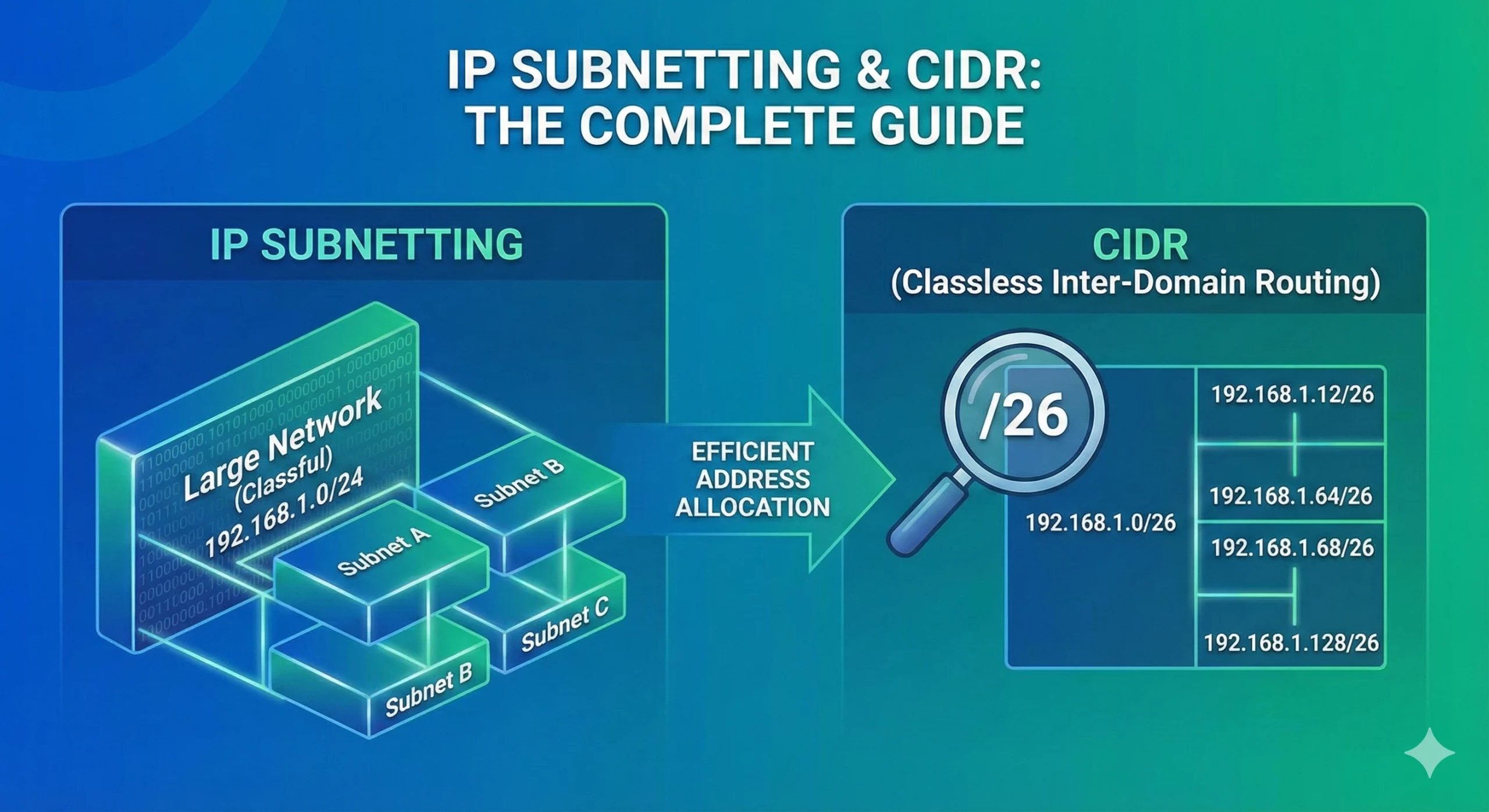
IP subnetting is the process of dividing a large IP network into smaller, more manageable segments called subnets. It’s like splitting a large parcel of land into smaller lots for specific use, allowing better organization and utilization.
Why Subnet?
Efficient Use of IP Addresses: With the finite IPv4 address space, subnetting ensures that addresses are allocated according to the specific needs of different network segments.
Improved Security: By segmenting networks, sensitive data can be isolated, reducing the risk of unauthorized access.
Reduced Network Traffic: Subnetting localizes traffic within each subnet, reducing congestion and improving performance.
CIDR: Classless Inter-Domain Routing
Introduced in the 1990s, CIDR replaced the rigid class-based system of IP addressing. CIDR provides a more flexible and efficient way to allocate IP addresses by allowing subnet masks of variable lengths.
Key Features of CIDR
Variable-Length Subnet Masking (VLSM): CIDR allows network administrators to define subnet masks of varying lengths, optimizing address utilization.
Aggregation (Supernetting): CIDR enables route aggregation, combining multiple IP networks into a single, summarized route. This reduces the size of routing tables and improves router efficiency.
Elimination of Classes: Traditional IP classes (A, B, C) are no longer restrictive; with CIDR, the network portion of an address is defined by the prefix length (e.g., /8, /16, /24).
Practical Applications of Subnetting and CIDR
1. Efficient IP Address Allocation
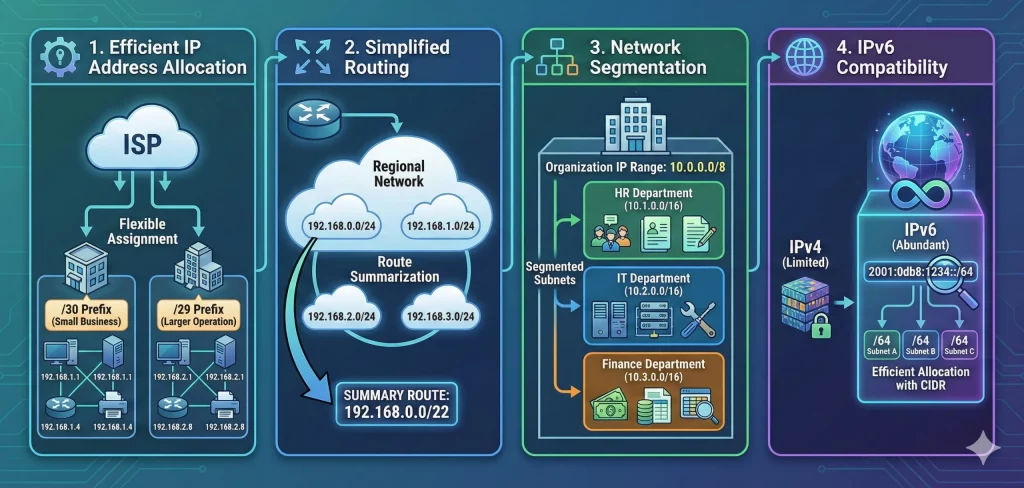
ISPs often face the challenge of allocating IP addresses efficiently to customers. With CIDR, an ISP can allocate prefixes such as /30 for small businesses needing 4 addresses or /29 for slightly larger operations requiring 8 addresses.
2. Simplified Routing
Subnetting combined with CIDR allows for route summarization. For example, an ISP managing several networks in the range 192.168.0.0/24 through 192.168.3.0/24 can summarize these into a single route: 192.168.0.0/22.
3. Network Segmentation
Organizations can segment their networks by departments or functions. For instance, an IP range like 10.0.0.0/8 can be divided into subnets for HR (10.1.0.0/16), IT (10.2.0.0/16), and so on.
4. IPv6 Compatibility
CIDR is critical in IPv6, where addresses are plentiful, but efficient allocation is still necessary. With its 128-bit addressing scheme, IPv6 uses CIDR to break large address spaces into usable subnets (e.g., 2001:0db8:1234::/64).
In a nutshell
IP subnetting and CIDR are indispensable tools for managing modern networks. They enable ISPs and IT professionals to allocate IP addresses efficiently, reduce network congestion, and simplify routing. Mastering these concepts is crucial in the era of increasing internet connectivity and the transition to IPv6. With thoughtful planning and the right tools, subnetting and CIDR can significantly enhance network performance and scalability.
Trusted IPv4 Leasing for Business Growth
Get enterprise-grade IPv4 space quickly, with seamless deployment and end-to-end management.
Get Started with i.leaseArticles connexes
Combien coûte un bloc IPv4 /24 en 2026 ?
La rareté des adresses IPv4 continue de façonner l’infrastructure Internet, les blocs /24 étant toujours activement négociés sur les marchés mondiaux malgré l’adoption croissante de l’IPv6. Points clés Un bloc IPv4 /24 coûte généralement entre 6 000 et 15 000 dollars en 2026. Les fournisseurs de services cloud, les hébergeurs et les fournisseurs SaaS ont besoin d’adresses IPv4, ce qui explique le maintien de prix élevés. Les adresses IPv4 sontRead more Related Posts Combien coûte un bloc IPv4 /24 en 2026 ? La rareté des adresses IPv4 continue de façonner l'infrastructure Internet, les blocs /24 étant toujours activement négociés sur les marchés Read more Short-term vs long-term IPv4 leasing Facing IPv4 shortages, companies must weigh cost, speed, and network growth when choosing a lease plan.Short-term leasing lets you scale Read more Quels sont les facteurs qui déterminent le prix de IPv4 sur le marché actuel ? La rareté, l'évolution de la demande et les plateformes de location comme i.lease redéfinissent la valorisation et le commerce des Read more .related-post {} .related-post .post-list { text-align: left; } .related-post .post-list .item { margin: 5px; padding: 10px; } .related-post .headline { font-size: 18px !important; color: #999999 !important; } .related-post .post-list .item .post_thumb { max-height: 220px; margin: 10px 0px; padding: 0px; display: block; } .related-post .post-list .item .post_title { font-size: 16px; color: #3f3f3f; margin: 10px 0px; padding: 0px; display: block; text-decoration: none; } .related-post .post-list .item .post_excerpt { font-size: 13px; color: #3f3f3f; margin: 10px 0px; padding: 0px; display: block; text-decoration: none; } @media only screen and (min-width: 1024px) { .related-post .post-list .item { width: 30%; } } @media only screen and (min-width: 768px) and (max-width: 1023px) { .related-post .post-list .item { width: 90%; } } @media only screen and (min-width: 0px) and (max-width: 767px) { .related-post .post-list .item { width: 90%; } }

Quels sont les facteurs qui déterminent le prix de IPv4 sur le marché actuel ?
La rareté, l’évolution de la demande et les plateformes de location comme i.lease redéfinissent la valorisation et le commerce des adresses IPv4 à l’échelle mondiale. Le prix des adresses IPv4 est principalement déterminé par leur rareté, la taille des blocs et les fluctuations de la demande selon les régions et les secteurs. Les modèles de location, notamment les plateformes comme i.lease, contribuent à stabiliser les coûts face à laRead more Related Posts Combien coûte un bloc IPv4 /24 en 2026 ? La rareté des adresses IPv4 continue de façonner l'infrastructure Internet, les blocs /24 étant toujours activement négociés sur les marchés Read more Pourquoi la rareté des adresses IPv4 génère de la valeur économique pour les opérateurs La rareté des adresses IPv4, la demande persistante et la lenteur de la transition vers l'IPv6 transforment les adresses IP Read more Qu’est-ce qu’une adresse IP proxy ? Une adresse IP proxy est une adresse IP intermédiaire utilisée pour masquer ou relayer votre adresse IP d'origine lors de Read more .related-post {} .related-post .post-list { text-align: left; } .related-post .post-list .item { margin: 5px; padding: 10px; } .related-post .headline { font-size: 18px !important; color: #999999 !important; } .related-post .post-list .item .post_thumb { max-height: 220px; margin: 10px 0px; padding: 0px; display: block; } .related-post .post-list .item .post_title { font-size: 16px; color: #3f3f3f; margin: 10px 0px; padding: 0px; display: block; text-decoration: none; } .related-post .post-list .item .post_excerpt { font-size: 13px; color: #3f3f3f; margin: 10px 0px; padding: 0px; display: block; text-decoration: none; } @media only screen and (min-width: 1024px) { .related-post .post-list .item { width: 30%; } } @media only screen and (min-width: 768px) and (max-width: 1023px) { .related-post .post-list .item { width: 90%; } } @media only screen and (min-width: 0px) and (max-width: 767px) { .related-post .post-list .item { width: 90%; } }

Pourquoi la rareté des adresses IPv4 génère de la valeur économique pour les opérateurs
La rareté des adresses IPv4, la demande persistante et la lenteur de la transition vers l’IPv6 transforment les adresses IP en actifs négociables, remodelant ainsi l’économie des télécommunications à l’échelle mondiale. L’épuisement des adresses IPv4 a fait de ces dernières des ressources numériques rares, dont les prix sont déterminés par le déséquilibre entre l’offre et la demande. Les opérateurs monétisent de plus en plus l’espace d’adressage inutilisé via desRead more Related Posts Combien coûte un bloc IPv4 /24 en 2026 ? La rareté des adresses IPv4 continue de façonner l'infrastructure Internet, les blocs /24 étant toujours activement négociés sur les marchés Read more Quels sont les facteurs qui déterminent le prix de IPv4 sur le marché actuel ? La rareté, l'évolution de la demande et les plateformes de location comme i.lease redéfinissent la valorisation et le commerce des Read more Pourquoi la rareté des adresses IPv4 génère de la valeur économique pour les opérateurs La rareté des adresses IPv4, la demande persistante et la lenteur de la transition vers l'IPv6 transforment les adresses IP Read more .related-post {} .related-post .post-list { text-align: left; } .related-post .post-list .item { margin: 5px; padding: 10px; } .related-post .headline { font-size: 18px !important; color: #999999 !important; } .related-post .post-list .item .post_thumb { max-height: 220px; margin: 10px 0px; padding: 0px; display: block; } .related-post .post-list .item .post_title { font-size: 16px; color: #3f3f3f; margin: 10px 0px; padding: 0px; display: block; text-decoration: none; } .related-post .post-list .item .post_excerpt { font-size: 13px; color: #3f3f3f; margin: 10px 0px; padding: 0px; display: block; text-decoration: none; } @media only screen and (min-width: 1024px) { .related-post .post-list .item { width: 30%; } } @media only screen and (min-width: 768px) and (max-width: 1023px) { .related-post .post-list .item { width: 90%; } } @media only screen and (min-width: 0px) and (max-width: 767px) { .related-post .post-list .item { width: 90%; } }