
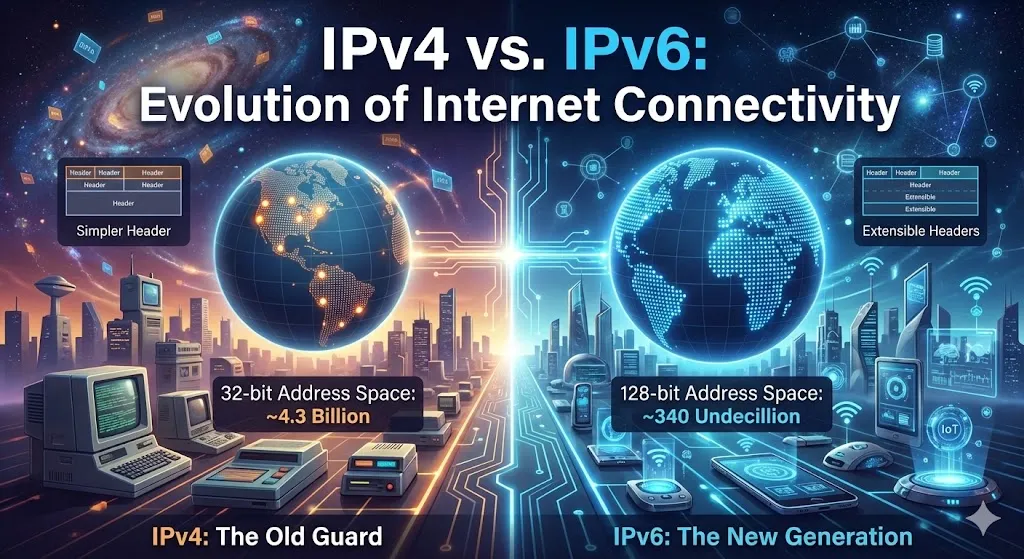
IPv4 e IPv6 son dos versiones del Protocolo de Internet. Se utilizan para identificar dispositivos, enrutar el tráfico y permitir que las redes se comuniquen a través de Internet.
Tabla de contenido
IPv4 es la versión más antigua y todavía ampliamente utilizada. IPv6 es la versión más reciente, creada para ofrecer un espacio de direcciones mucho más amplio y apoyar el crecimiento de Internet a largo plazo. Aunque la adopción de IPv6 está aumentando, IPv4 sigue siendo importante para el alojamiento, la infraestructura cloud, las VPN, los sistemas de correo electrónico, los centros de datos, las redes empresariales y los servicios orientados al cliente.
Para las empresas, la cuestión no es simplemente si IPv6 es mejor que IPv4. La pregunta práctica es cómo apoyar el crecimiento de IPv6 mientras se mantiene la continuidad de IPv4 allí donde los clientes, sistemas y aplicaciones aún dependen de ella.
En i.lease, las empresas pueden comprar IPv4, vender IPv4 o utilizar el alquiler de IPv4 para apoyar el crecimiento de la infraestructura, la compatibilidad y la continuidad operativa.
¿Qué es IPv4?
IPv4 significa Internet Protocol version 4. Es la versión más utilizada del Protocolo de Internet y ha apoyado el crecimiento de Internet durante décadas.
IPv4 utiliza un formato de dirección de 32 bits. Una dirección IPv4 típica se ve así:
192.0.2.1
IPv4 proporciona alrededor de 4.300 millones de direcciones posibles. Ese número fue suficiente en su momento, pero el crecimiento global de Internet, los servicios cloud, las redes móviles, el alojamiento, las plataformas SaaS y los dispositivos conectados aumentaron la demanda más allá de la oferta original.
Como la disponibilidad libre de IPv4 ahora es limitada, las empresas suelen acceder a IPv4 mediante transferencias, marketplaces, compras o alquiler.
¿Qué es IPv6?
IPv6 significa Internet Protocol version 6. Es la versión más reciente del Protocolo de Internet y fue creada para ofrecer un espacio de direcciones mucho más amplio que IPv4.
IPv6 utiliza un formato de dirección de 128 bits. Una dirección IPv6 típica se ve así:
2001:db8::1
El espacio de direcciones más amplio hace que IPv6 sea adecuado para el crecimiento de Internet a largo plazo, especialmente a medida que más dispositivos, redes y servicios se conectan.
Sin embargo, IPv6 no reemplaza automáticamente a IPv4 en todas partes. Muchas redes, aplicaciones y usuarios todavía dependen de IPv4, por lo que las empresas suelen necesitar compatibilidad con ambos protocolos.
Comparación entre IPv4 e IPv6
Comparación entre IPv4 e IPv6
Factor
IPv4
IPv6
Tamaño de la dirección
32 bits
128 bits
Ejemplo de dirección
192.0.2.1
2001:db8::1
Disponibilidad de direcciones
Limitada
Mucho mayor
Uso actual
Todavía ampliamente utilizado
Adopción en crecimiento
Función empresarial
Compatibilidad, alojamiento, cloud, VPN, correo electrónico, sistemas heredados
Escalabilidad futura, planificación de redes modernas, crecimiento masivo de dispositivos
Modelo de transición
Todavía requerido por muchos sistemas
A menudo desplegado junto con IPv4
Enfoque empresarial común
Comprar, vender, transferir o alquilar IPv4
Despliegue gradual mediante preparación para IPv6 y planificación dual-stack
Diferencias clave entre IPv4 e IPv6
1. Espacio de direcciones
La mayor diferencia entre IPv4 e IPv6 es el espacio de direcciones. IPv4 utiliza direcciones de 32 bits, mientras que IPv6 utiliza direcciones de 128 bits. Esto proporciona a IPv6 un conjunto mucho más amplio de direcciones disponibles.
2. Formato de dirección
Las direcciones IPv4 se escriben en números decimales separados por puntos. Las direcciones IPv6 se escriben en formato hexadecimal separado por dos puntos.
3. Diseño de red
IPv6 puede admitir un direccionamiento más directo y una escalabilidad de red a largo plazo. Las redes IPv4 suelen depender de técnicas como NAT porque las direcciones IPv4 públicas son limitadas.
4. Compatibilidad
IPv4 e IPv6 no son directamente intercambiables. Un sistema que utiliza solo IPv6 puede no comunicarse automáticamente con un sistema que utiliza solo IPv4 sin traducción, tunneling o soporte dual-stack.
5. Adopción empresarial
La adopción de IPv6 está aumentando, pero IPv4 sigue profundamente integrado en la infraestructura empresarial. Muchas organizaciones todavía necesitan IPv4 para el acceso de clientes, sistemas heredados, alojamiento, correo electrónico, VPN, API y aplicaciones empresariales.
Por qué se creó IPv6
IPv6 se creó porque el espacio de direcciones IPv4 es limitado. A medida que Internet se expandió a nivel mundial, la oferta original de IPv4 se volvió insuficiente para satisfacer la demanda a largo plazo.
IPv6 ayuda a resolver el problema de capacidad de direcciones al proporcionar un conjunto de direcciones mucho más amplio. Esto respalda el crecimiento futuro de las redes móviles, la infraestructura cloud, el IoT, los sistemas empresariales y los dispositivos conectados.
Para las empresas, estar preparadas para IPv6 es importante porque ayuda a preparar la infraestructura para el futuro. Sin embargo, la adopción de IPv6 debe planificarse cuidadosamente, especialmente cuando los clientes y los sistemas todavía requieren acceso IPv4.
Por qué IPv4 sigue siendo importante
IPv4 sigue siendo importante porque gran parte de Internet continúa dependiendo de él. Los sitios web, las plataformas de alojamiento, las VPN, los sistemas de correo electrónico, las redes empresariales, los servicios cloud y los entornos de clientes todavía suelen requerir conectividad IPv4.
IPv4 también es importante para la compatibilidad. Algunos clientes, regiones, aplicaciones y sistemas heredados pueden no estar completamente preparados para IPv6. Si una empresa elimina IPv4 demasiado pronto, puede afectar la accesibilidad y la continuidad del servicio.
Por eso IPv4 no debe tratarse como una etiqueta técnica obsoleta. Para muchas empresas, IPv4 sigue siendo un recurso operativo que respalda el enrutamiento, el acceso de clientes, los ingresos y la continuidad.
IPv4 e IPv6 juntos: redes dual-stack
Muchas empresas utilizan una configuración dual-stack. Esto significa que la red admite IPv4 e IPv6 al mismo tiempo.
Dual-stack permite a una empresa atender a usuarios preparados para IPv6 mientras sigue dando soporte a usuarios, aplicaciones y sistemas IPv4. A menudo es el enfoque de transición más seguro, porque evita obligar demasiado pronto a los clientes o servicios a utilizar un solo protocolo.
Por ejemplo, un proveedor de alojamiento puede habilitar IPv6 para prepararse para el futuro mientras continúa alquilando direcciones IPv4 para los clientes que todavía necesitan IPv4. Una plataforma SaaS puede preparar el soporte para IPv6 mientras mantiene IPv4 disponible para integraciones empresariales y sistemas heredados.
Qué deben considerar las empresas antes de elegir IPv4, IPv6 o ambos
Las empresas no deben tomar decisiones sobre IPv4 e IPv6 basándose únicamente en la teoría técnica. El enfoque adecuado depende de los clientes, las aplicaciones, la infraestructura, la ubicación, las herramientas de seguridad y los requisitos operativos.
Antes de cambiar su estrategia IP, haga estas preguntas:
- ¿Sus clientes todavía necesitan acceso IPv4?
- ¿Sus aplicaciones han sido completamente probadas en IPv6?
- ¿Su proveedor de alojamiento, ISP o proveedor cloud admite IPv6 correctamente?
- ¿Su firewall, sus herramientas de monitorización y sus herramientas de seguridad pueden gestionar tráfico IPv6?
- ¿Necesita direcciones IPv4 públicas para alojamiento, VPN, correo electrónico o servicios para clientes?
- ¿Comprar o alquilar IPv4 sería más práctico para las necesidades actuales de su empresa?
Nota práctica de i.lease
IPv6 es importante para el crecimiento a largo plazo de Internet, pero IPv4 sigue siendo importante para muchas empresas hoy en día. El enfoque más seguro suele ser no elegir un solo protocolo demasiado pronto, sino planificar una transición que proteja el acceso de los clientes, el enrutamiento, la compatibilidad y la continuidad del servicio.
Comprar, vender o alquilar IPv4 durante la transición
A medida que crece la adopción de IPv6, IPv4 sigue desempeñando un papel importante en la infraestructura empresarial. Las empresas pueden necesitar comprar, vender o alquilar direcciones IPv4 según su situación.
Comprar direcciones IP
Las empresas que necesitan control a largo plazo sobre el espacio de direcciones pueden comprar direcciones IP a través de i.lease. Esto puede ser adecuado para centros de datos, proveedores de alojamiento, plataformas cloud, empresas SaaS, redes de telecomunicaciones y empresas con necesidades IPv4 estables a largo plazo.
Vender direcciones IP
Las organizaciones con espacio de direcciones IPv4 no utilizado o infrautilizado pueden vender direcciones IP a través de i.lease. Esto permite a los titulares de recursos monetizar bloques IPv4 que ya no son necesarios para operaciones activas.
Alquiler de IPv4
Las empresas que necesitan flexibilidad pueden utilizar el alquiler de IPv4 para acceder a direcciones IPv4 sin comprarlas directamente. El alquiler puede ser útil para alojamiento, servicios VPN, proyectos temporales, expansión regional o continuidad IPv4 durante la transición a IPv6.
La mejor opción depende de si su empresa necesita control a largo plazo, flexibilidad a corto plazo o una forma de monetizar recursos IPv4 no utilizados.
Reflexiones finales
IPv4 e IPv6 son importantes. IPv6 proporciona el espacio de direcciones necesario para el crecimiento a largo plazo de Internet, mientras que IPv4 sigue siendo esencial para la compatibilidad, el acceso de clientes, el alojamiento, la infraestructura cloud, las VPN, los sistemas de correo electrónico y muchos servicios empresariales.
La estrategia práctica no consiste en ignorar IPv6 ni en abandonar IPv4 demasiado pronto. Las empresas deben prepararse para IPv6 mientras mantienen IPv4 allí donde todavía respalda operaciones reales.
También se están debatiendo nuevas propuestas técnicas, incluida IPv8. En un Internet-Draft de la IETF, Thain (2026) describe IPv8 como una suite de protocolos de red gestionada con afirmaciones de retrocompatibilidad, incluida la representación de IPv4 dentro de IPv8 y el objetivo de abordar el agotamiento de IPv4. Sin embargo, el mismo documento sigue siendo un Internet-Draft, lo que significa que debe tratarse como un “trabajo en curso” y no como un reemplazo adoptado de IPv4 o IPv6.
Preguntas frecuentes
¿Cuál es la principal diferencia entre IPv4 e IPv6?
La principal diferencia es el tamaño de la dirección. IPv4 utiliza direcciones de 32 bits, mientras que IPv6 utiliza direcciones de 128 bits. Esto proporciona a IPv6 un espacio de direcciones mucho más amplio.
¿Es IPv6 mejor que IPv4?
IPv6 proporciona un espacio de direcciones más amplio y admite la escalabilidad a largo plazo. Sin embargo, IPv4 sigue siendo importante porque muchas redes, usuarios, aplicaciones y sistemas empresariales todavía dependen de él.
¿IPv6 reemplazará a IPv4?
IPv6 está creciendo, pero IPv4 no ha desaparecido. Muchas empresas todavía utilizan IPv4 e IPv6 juntos mediante redes dual-stack.
¿Por qué se sigue utilizando IPv4?
IPv4 todavía se utiliza porque muchos sitios web, servicios de alojamiento, sistemas de correo electrónico, VPN, redes empresariales y entornos de clientes siguen dependiendo de la conectividad IPv4.
¿Mi empresa debería usar IPv4 o IPv6?
Muchas empresas deberían planificar el uso de ambos. IPv6 respalda el crecimiento a largo plazo, mientras que IPv4 todavía puede ser necesario para la compatibilidad, el acceso de clientes, el alojamiento y la continuidad operativa.
¿Puedo comprar direcciones IPv4 a través de i.lease?
Sí. Las empresas pueden comprar IP a través de i.lease cuando necesitan control a largo plazo sobre sus direcciones IPv4.
¿Puedo alquilar direcciones IPv4 en lugar de comprarlas?
Sí. Las empresas pueden utilizar el alquiler de IPv4 para acceder a recursos IPv4 sin comprarlos directamente.