Qu’est-ce qu’une adresse IP proxy ?
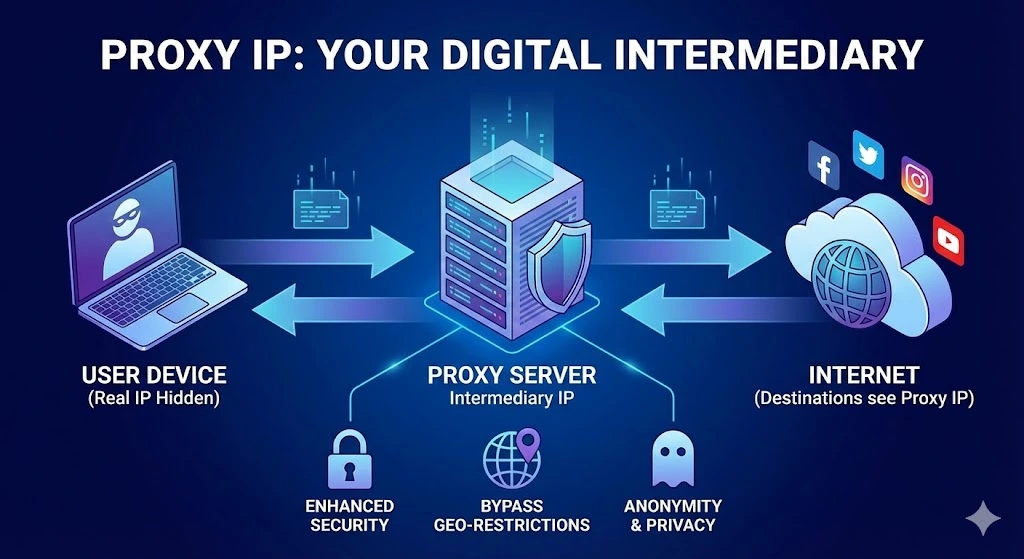
Une adresse IP proxy est une adresse IP intermédiaire utilisée pour masquer ou relayer votre adresse IP d’origine lors de l’accès à Internet. Elle agit comme une passerelle entre l’utilisateur et le web. Lorsqu’une demande d’accès à un site Web est effectuée, le serveur proxy (qui utilise l’adresse IP proxy) transmet cette demande, cachant ainsi la véritable adresse IP de l’utilisateur au site. Cela permet d’augmenter la confidentialité et l’anonymat lors de la navigation en ligne.
Table of Contents
Comment fonctionne une adresse IP proxy
Lorsque vous utilisez un proxy, votre appareil envoie une demande au serveur proxy, qui la transmet au site Web cible. Le site Web voit alors la demande comme provenant du serveur proxy, et non de votre adresse IP. Cela protège votre identité et votre localisation d’origine du site Web. Ensuite, la réponse du site Web est renvoyée au serveur proxy, qui la transmet à vous.
Types d’adresses IP proxy
1. Proxys HTTP : Ceux-ci ne fonctionnent que pour les pages Web et sont idéaux pour la navigation.
2. Proxys SOCKS : Ils gèrent une gamme plus large de trafic, y compris les e-mails, les fichiers torrent et FTP.
3. Proxys transparents : Ceux-ci s’identifient et transmettent l’adresse IP d’origine, souvent utilisés pour le caching.
4. Proxys anonymes : Ceux-ci cachent l’adresse IP de l’utilisateur mais s’identifient comme des proxys.
5. Proxys à haute anonymité : Ceux-ci offrent une confidentialité maximale en ne s’identifiant pas comme des proxys et en cachant complètement l’adresse IP de l’utilisateur.
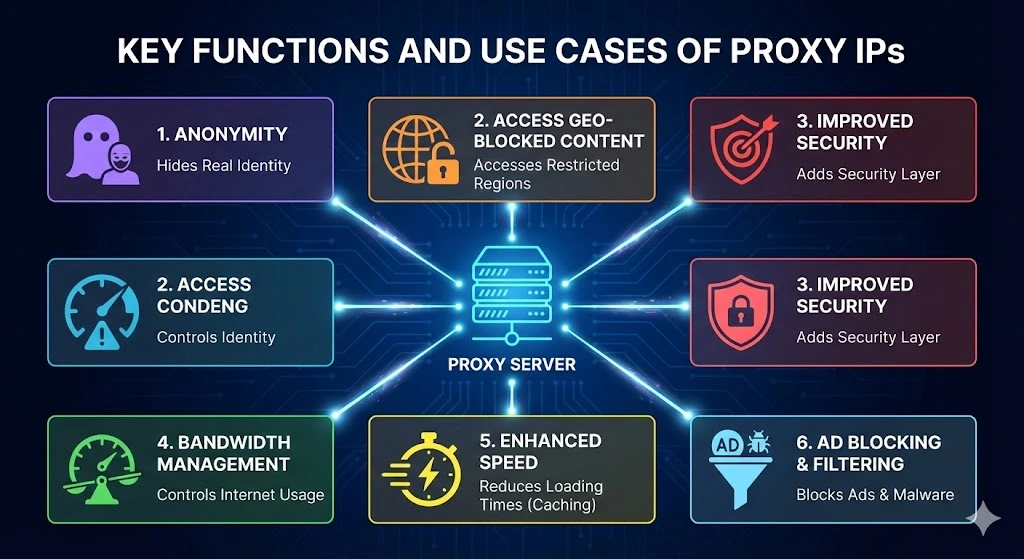
Cas d’utilisation courants pour les adresses IP proxy
1. Entreprises : Les entreprises utilisent des proxys pour la sécurité, l’équilibrage de charge et pour prévenir l’accès non autorisé à leurs systèmes internes.
2. SEO et marketing : Les marketeurs utilisent des proxys pour collecter des données sur les concurrents ou analyser le trafic web depuis différents emplacements.
3. Streaming : Les utilisateurs comptent sur les adresses IP proxy pour contourner les restrictions géographiques et accéder à du contenu non disponible dans leur région.
4. Amateurs de confidentialité : Ceux qui se soucient de la confidentialité en ligne utilisent des adresses IP proxy pour cacher leur véritable adresse IP lors de la navigation.
La différence entre un proxy et un VPN
Bien que les proxys et les VPN cachent votre adresse IP, un VPN chiffre tout votre trafic Internet, offrant une connexion plus sécurisée. Les proxys ne chiffrent généralement pas les données, mais ils peuvent être plus rapides que les VPN pour certains cas d’utilisation puisqu’ils ne traitent pas un chiffrement lourd.
Pensées finales
Les adresses IP proxy sont des outils essentiels pour maintenir la confidentialité, accéder à du contenu restreint et améliorer la sécurité en ligne. Que ce soit pour un usage personnel, des opérations commerciales ou une analyse marketing, les proxys offrent une solution flexible pour interagir plus efficacement avec le web. Parmi les fournisseurs de proxys les plus populaires figurent Luminati, Smartproxy et Bright Data, qui proposent une gamme de services adaptés à différents besoins.
Related Posts

How much does a /24 IPv4 block cost in 2026?
IPv4 scarcity continues to shape internet infrastructure, with /24 blocks still trading actively on global markets despite growing IPv6 adoption. Key points A /24 IPv4 block usually costs between $6,000 and $15,000 in 2026. Cloud providers, hosting companies and SaaS providers need IPv4 addresses so prices stay high. IPv4 addresses are like an asset because they are scarce. What is a /24 IPv4 block A /24 IPv4 blockRead more Related Posts How much does a /24 IPv4 block cost in 2026? IPv4 scarcity continues to shape internet infrastructure, with /24 blocks still trading actively on global markets despite growing IPv6 adoption. Key Read more The future of IPv4 markets Despite IPv6 expansion, scarcity keeps IPv4 valuable, sustaining a global secondary market where addresses increasingly function as tradable digital assets.Finite Read more Common Myths About Selling IP Addresses The IPv4 secondary market is often shrouded in mystery, leading many organizations to sit on valuable digital assets because they Read more .related-post {} .related-post .post-list { text-align: left; } .related-post .post-list .item { margin: 5px; padding: 10px; } .related-post .headline { font-size: 18px !important; color: #999999 !important; } .related-post .post-list .item .post_thumb { max-height: 220px; margin: 10px 0px; padding: 0px; display: block; } .related-post .post-list .item .post_title { font-size: 16px; color: #3f3f3f; margin: 10px 0px; padding: 0px; display: block; text-decoration: none; } .related-post .post-list .item .post_excerpt { font-size: 13px; color: #3f3f3f; margin: 10px 0px; padding: 0px; display: block; text-decoration: none; } @media only screen and (min-width: 1024px) { .related-post .post-list .item { width: 30%; } } @media only screen and (min-width: 768px) and (max-width: 1023px) { .related-post .post-list .item { width: 90%; } } @media only screen and (min-width: 0px) and (max-width: 767px) { .related-post .post-list .item { width: 90%; } }

The future of IPv4 markets
Despite IPv6 expansion, scarcity keeps IPv4 valuable, sustaining a global secondary market where addresses increasingly function as tradable digital assets. Finite IPv4 supply has created a mature secondary market where address blocks are bought, sold and leased worldwide. Prices fluctuate, but persistent demand from cloud, hosting and AI infrastructure suggests IPv4 markets will remain active for years. What happened The rise of a digital commodity The global market forRead more Related Posts How much does a /24 IPv4 block cost in 2026? IPv4 scarcity continues to shape internet infrastructure, with /24 blocks still trading actively on global markets despite growing IPv6 adoption. Key Read more The future of IPv4 markets Despite IPv6 expansion, scarcity keeps IPv4 valuable, sustaining a global secondary market where addresses increasingly function as tradable digital assets.Finite Read more Common Myths About Selling IP Addresses The IPv4 secondary market is often shrouded in mystery, leading many organizations to sit on valuable digital assets because they Read more .related-post {} .related-post .post-list { text-align: left; } .related-post .post-list .item { margin: 5px; padding: 10px; } .related-post .headline { font-size: 18px !important; color: #999999 !important; } .related-post .post-list .item .post_thumb { max-height: 220px; margin: 10px 0px; padding: 0px; display: block; } .related-post .post-list .item .post_title { font-size: 16px; color: #3f3f3f; margin: 10px 0px; padding: 0px; display: block; text-decoration: none; } .related-post .post-list .item .post_excerpt { font-size: 13px; color: #3f3f3f; margin: 10px 0px; padding: 0px; display: block; text-decoration: none; } @media only screen and (min-width: 1024px) { .related-post .post-list .item { width: 30%; } } @media only screen and (min-width: 768px) and (max-width: 1023px) { .related-post .post-list .item { width: 90%; } } @media only screen and (min-width: 0px) and (max-width: 767px) { .related-post .post-list .item { width: 90%; } }

Inbound vs. Outbound IPv4 Leasing: A Complete Guide for Enterprises
Understanding IPv4 leasing helps enterprises manage scarce address space, reducing risk and unlocking strategic growth opportunities in today’s digital economy. Key points Distinguishes between inbound (leasing in) and outbound (leasing out) IPv4 approaches and their strategic implications. Highlights contract structures, registry risk management and continuity considerations affecting global number resources. Inbound vs. outbound IPv4 leasing: complete enterprise guide In the post-exhaustion era of Internet Protocol version 4 (IPv4),Read more Related Posts How much does a /24 IPv4 block cost in 2026? IPv4 scarcity continues to shape internet infrastructure, with /24 blocks still trading actively on global markets despite growing IPv6 adoption. Key Read more The future of IPv4 markets Despite IPv6 expansion, scarcity keeps IPv4 valuable, sustaining a global secondary market where addresses increasingly function as tradable digital assets.Finite Read more Common Myths About Selling IP Addresses The IPv4 secondary market is often shrouded in mystery, leading many organizations to sit on valuable digital assets because they Read more .related-post {} .related-post .post-list { text-align: left; } .related-post .post-list .item { margin: 5px; padding: 10px; } .related-post .headline { font-size: 18px !important; color: #999999 !important; } .related-post .post-list .item .post_thumb { max-height: 220px; margin: 10px 0px; padding: 0px; display: block; } .related-post .post-list .item .post_title { font-size: 16px; color: #3f3f3f; margin: 10px 0px; padding: 0px; display: block; text-decoration: none; } .related-post .post-list .item .post_excerpt { font-size: 13px; color: #3f3f3f; margin: 10px 0px; padding: 0px; display: block; text-decoration: none; } @media only screen and (min-width: 1024px) { .related-post .post-list .item { width: 30%; } } @media only screen and (min-width: 768px) and (max-width: 1023px) { .related-post .post-list .item { width: 90%; } } @media only screen and (min-width: 0px) and (max-width: 767px) { .related-post .post-list .item { width: 90%; } }