
IP Solutions: Enhancing Connectivity and Business Efficiency

ChanChan
Feature image for an article on IP Solutions, illustrating a complex digital network with overlapping layers. Key elements include icons representing IP Address Management (IPAM), IPv4/IPv6 transition, network security (firewalls/shields), and scalability, highlighting enhanced connectivity and business efficiency.

The Internet underpins most business operations, and hence, managing IP (Internet Protocol) resources effectively is crucial. IP solutions involve a range of services and technologies designed to optimize the management and use of IP addresses, which are essential for devices to communicate over the Internet.


This article delves into what IP solutions are, their benefits, and why they are critical for businesses looking to thrive in a connected world.

Understanding IP Solutions

IP solutions refer to the strategies and technologies used to manage and allocate IP addresses within a network. As the number of internet-enabled devices continues to rise, organizations face significant challenges in tracking, organizing, and securing their IP address resources. Effective IP solutions help businesses overcome these challenges by ensuring that IP addresses are managed efficiently, securely, and in compliance with relevant regulations.

Key Components of IP Solutions
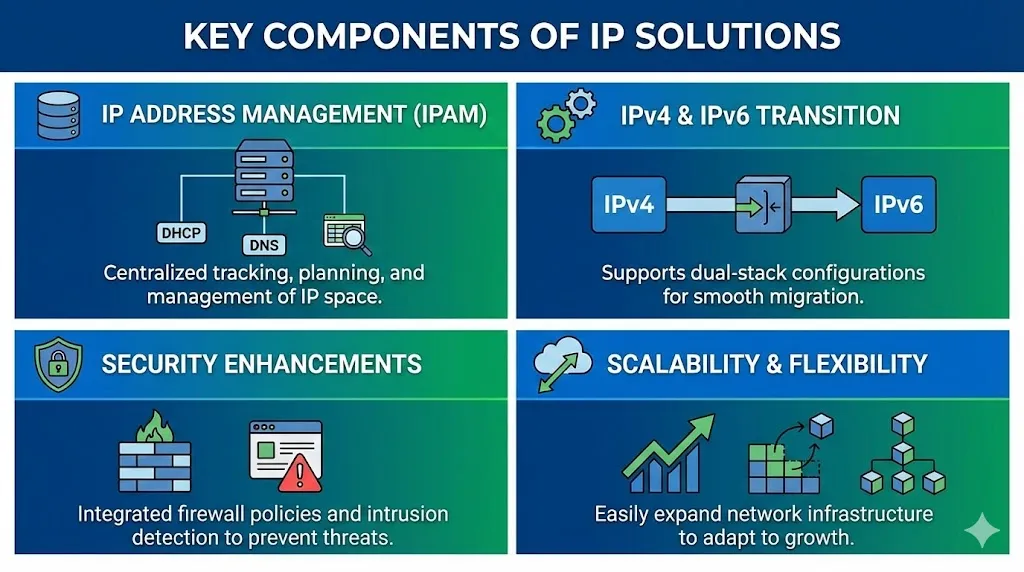
Infographic detailing the four key components of IP Solutions: 1. IP Address Management (IPAM) illustrated with a central database and tracking logs; 2. IPv4/IPv6 Transition showing a dual-stack setup; 3. Security Enhancements featuring a firewall shield; and 4. Scalability and Flexibility represented by expanding network nodes.

IP Address Management (IPAM)

IPAM systems are crucial for managing an organization’s IP address space. They provide a centralized database where network administrators can track, plan, and manage the network’s IP addresses. This management includes handling DHCP (Dynamic Host Configuration Protocol) and DNS (Domain Name System) data, which are critical for network operation.

IPv4 and IPv6 Transition

With the depletion of IPv4 addresses, transitioning to IPv6 has become a necessity for many businesses. IP solutions facilitate this transition by supporting dual-stack configurations, enabling organizations to run IPv4 and IPv6 concurrently and smoothly transition between the two.

Security Enhancements

IP solutions include features that enhance network security, such as integrated firewall policies and intrusion detection systems. By controlling IP allocation and monitoring network traffic, businesses can better prevent unauthorized access and potential cyber threats.

Scalability and Flexibility 

Advanced IP solutions offer scalability, allowing businesses to expand their network as they grow. This flexibility is crucial in today’s dynamic business environment, where companies must quickly adapt to changes in demand and technology.

Benefits of IP Solutions
Improved Network Efficiency

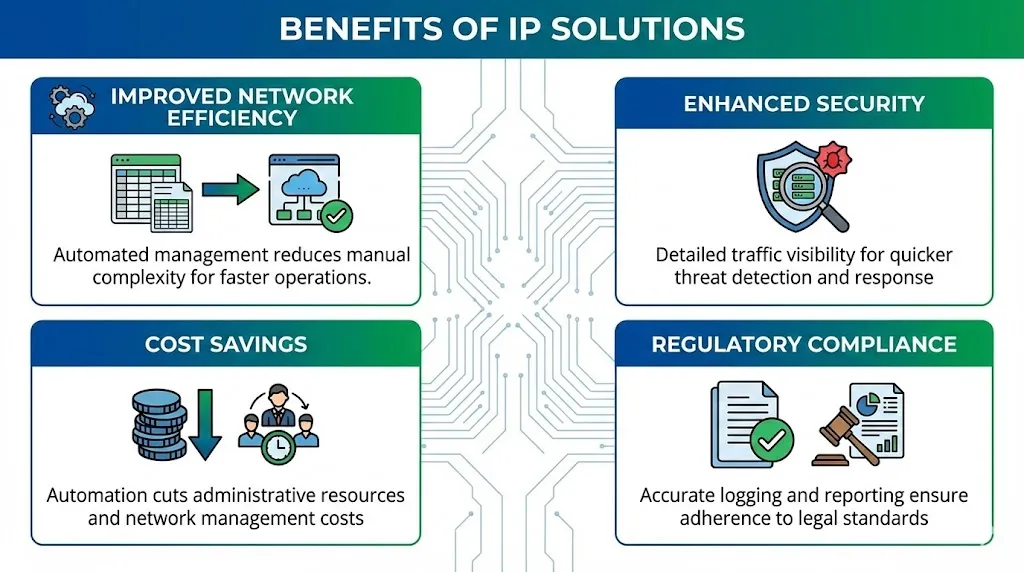
By automating IP address management, businesses can reduce the complexities associated with manual tracking and allocation, leading to more efficient network operations.

Enhanced Security

Effective IP solutions help secure a network by providing detailed visibility into IP traffic, which aids in detecting and responding to security threats.

Cost Savings

Automating IP management reduces the need for extensive administrative resources, thereby cutting costs associated with network management.

Regulatory Compliance

With strict regulations around data transmission and privacy, IP solutions help businesses comply with legal standards by providing accurate logs and reports of IP address usage.

Real-World Applications

IP solutions are used across various industries, from telecommunications and IT services to healthcare and finance. For instance, in the telecommunications sector, IP solutions are essential for managing the vast number of IP addresses required for customer devices and infrastructure. In healthcare, securing IP addresses is critical for protecting sensitive patient information transmitted across networks.


As the backbone of internet connectivity, IP management is more critical than ever. With the right IP solutions, businesses can enhance their network efficiency, bolster security, and ensure continuous compliance with regulatory standards. As technology continues to evolve, investing in robust IP solutions will remain a key strategy for businesses aiming to capitalize on the opportunities of a hyper-connected world.

Trusted IPv4 Leasing for Business Growth

Get enterprise-grade IPv4 space quickly, with seamless deployment and end-to-end management.

Get Started with i.lease

FAQs

What is the difference between IP Solutions and standard hosting?

Standard hosting provides server space for your website, while IP Solutions focus on the management, allocation, and routing of the IP addresses themselves. This includes services like IP leasing, IPAM (IP Address Management) software, and optimizing how your IP blocks are routed globally for better performance and security.

How can IP Solutions help with the IPv4 shortage?

Since buying new IPv4 addresses is expensive and difficult due to exhaustion, IP Solutions providers (like i.lease) offer IPv4 Leasing and IP Brokerage. This allows businesses to rent the exact number of IPs they need instantly without the massive capital expenditure of purchasing them on the open market.

Do I need an IPAM (IP Address Management) tool?

If you manage more than a few hundred IP addresses, yes. Using spreadsheets to track IPs leads to errors like “IP conflicts” (two devices assigned the same IP). An automated IPAM tool tracks usage in real-time, detects conflicts, and helps you reclaim unused addresses to save money.

Related Posts

ipv4-leasing

How i.lease Simplifies IPv4 Leasing Across Multiple RIR Regions

In today’s Internet infrastructure economy, IPv4 address leasing has become a critical operational strategy for enterprises, cloud providers, and network operators facing persistent address scarcity. As IPv4 exhaustion continues across all five Regional Internet Registries (RIRs)—ARIN, RIPE NCC, APNIC, LACNIC, and AFRINIC—the need for structured, compliant, and cross-regional leasing solutions has never been greater. However, beneath the surface of what appears to be a simple “supply-and-demand” market lies aRead more Related Posts How i.lease Simplifies IPv4 Leasing Across Multiple RIR Regions In today’s Internet infrastructure economy, IPv4 address leasing has become a critical operational strategy for enterprises, cloud providers, and network Understanding Operational Risk in IPv4 Address Markets IPv4 has long stopped being a simple technical identifier system. It has become a constrained, priced, and operationally embedded infrastructure Por qué la mayoría de las empresas están expuestas accidentalmente al riesgo de fallo en la asignación de IPv4 La escasez de IPv4 es ampliamente comprendida. Lo que muchas empresas aún subestiman es el riesgo de continuidad relacionado con .related-post {} .related-post .post-list { text-align: left; } .related-post .post-list .item { margin: 5px; padding: 10px; } .related-post .headline { font-size: 18px !important; color: #999999 !important; } .related-post .post-list .item .post_thumb { max-height: 220px; margin: 10px 0px; padding: 0px; display: block; } .related-post .post-list .item .post_title { font-size: 16px; color: #3f3f3f; margin: 10px 0px; padding: 0px; display: block; text-decoration: none; } .related-post .post-list .item .post_excerpt { font-size: 13px; color: #3f3f3f; margin: 10px 0px; padding: 0px; display: block; text-decoration: none; } @media only screen and (min-width: 1024px) { .related-post .post-list .item { width: 30%; } } @media only screen and (min-width: 768px) and (max-width: 1023px) { .related-post .post-list .item { width: 90%; } } @media only screen and (min-width: 0px) and (max-width: 767px) { .related-post .post-list .item { width: 90%; } }

ipv4-transaction

Risk Placement in IPv4 Transactions: What Enterprises Should Know

The IPv4 market has quietly evolved into a structured secondary asset class. As global IPv4 exhaustion continues, enterprises, ISPs, and brokers now routinely engage in buying, leasing, and transferring IPv4 address blocks. Alongside this growth, one topic has become increasingly important—but still under-discussed: risk placement in IPv4 transactions. For organizations participating in this market, especially through platforms such as i.lease, understanding how risk is identified, allocated, and mitigated isRead more Related Posts How i.lease Simplifies IPv4 Leasing Across Multiple RIR Regions In today’s Internet infrastructure economy, IPv4 address leasing has become a critical operational strategy for enterprises, cloud providers, and network Understanding Operational Risk in IPv4 Address Markets IPv4 has long stopped being a simple technical identifier system. It has become a constrained, priced, and operationally embedded infrastructure Por qué la mayoría de las empresas están expuestas accidentalmente al riesgo de fallo en la asignación de IPv4 La escasez de IPv4 es ampliamente comprendida. Lo que muchas empresas aún subestiman es el riesgo de continuidad relacionado con .related-post {} .related-post .post-list { text-align: left; } .related-post .post-list .item { margin: 5px; padding: 10px; } .related-post .headline { font-size: 18px !important; color: #999999 !important; } .related-post .post-list .item .post_thumb { max-height: 220px; margin: 10px 0px; padding: 0px; display: block; } .related-post .post-list .item .post_title { font-size: 16px; color: #3f3f3f; margin: 10px 0px; padding: 0px; display: block; text-decoration: none; } .related-post .post-list .item .post_excerpt { font-size: 13px; color: #3f3f3f; margin: 10px 0px; padding: 0px; display: block; text-decoration: none; } @media only screen and (min-width: 1024px) { .related-post .post-list .item { width: 30%; } } @media only screen and (min-width: 768px) and (max-width: 1023px) { .related-post .post-list .item { width: 90%; } } @media only screen and (min-width: 0px) and (max-width: 767px) { .related-post .post-list .item { width: 90%; } }

ipv4-address-market

Understanding Operational Risk in IPv4 Address Markets

IPv4 has long stopped being a simple technical identifier system. It has become a constrained, priced, and operationally embedded infrastructure asset class. “In the IPv4 market, execution is not paperwork. Execution is continuity under registry-layer uncertainty.”https://heng.lu/on-why-i-lease-exists-and-why-the-broker-question-is-really-a-registry-risk-question/ Yet most of the industry still speaks about it as if it were a straightforward marketplace problem: buyers, sellers, brokers, escrow, transfer, done. That framing is increasingly outdated. The real structure of riskRead more Related Posts How i.lease Simplifies IPv4 Leasing Across Multiple RIR Regions In today’s Internet infrastructure economy, IPv4 address leasing has become a critical operational strategy for enterprises, cloud providers, and network Understanding Operational Risk in IPv4 Address Markets IPv4 has long stopped being a simple technical identifier system. It has become a constrained, priced, and operationally embedded infrastructure Por qué la mayoría de las empresas están expuestas accidentalmente al riesgo de fallo en la asignación de IPv4 La escasez de IPv4 es ampliamente comprendida. Lo que muchas empresas aún subestiman es el riesgo de continuidad relacionado con .related-post {} .related-post .post-list { text-align: left; } .related-post .post-list .item { margin: 5px; padding: 10px; } .related-post .headline { font-size: 18px !important; color: #999999 !important; } .related-post .post-list .item .post_thumb { max-height: 220px; margin: 10px 0px; padding: 0px; display: block; } .related-post .post-list .item .post_title { font-size: 16px; color: #3f3f3f; margin: 10px 0px; padding: 0px; display: block; text-decoration: none; } .related-post .post-list .item .post_excerpt { font-size: 13px; color: #3f3f3f; margin: 10px 0px; padding: 0px; display: block; text-decoration: none; } @media only screen and (min-width: 1024px) { .related-post .post-list .item { width: 30%; } } @media only screen and (min-width: 768px) and (max-width: 1023px) { .related-post .post-list .item { width: 90%; } } @media only screen and (min-width: 0px) and (max-width: 767px) { .related-post .post-list .item { width: 90%; } }

Tags

#IP Solutions