
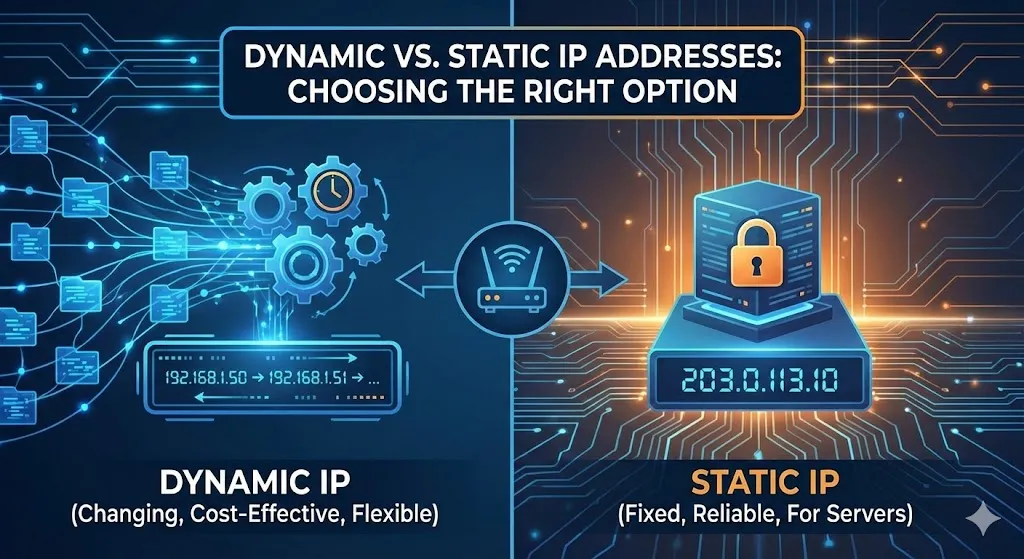
Every device connected to the internet needs an IP address to send and receive data. But not all IP addresses behave the same way. Some change automatically over time, while others remain fixed and consistent.
Table of Contents
This is the key difference between a dynamic IP address and a static IP address.
For ordinary home users, a dynamic IP address is often enough. But for businesses that depend on hosting, VPN access, SaaS platforms, cloud infrastructure, email delivery, telecom systems, security tools, or remote access, a stable IP identity can become essential.
The question is not only whether your network can connect today. The stronger question is whether your business can keep the same reliable digital identity tomorrow.
That is why understanding dynamic vs static IP addresses matters. For companies using IPv4 in production, the choice can affect routing, access control, reputation, uptime, security, and long-term infrastructure planning.
What Is an IP Address?
An IP address is a numerical identifier used by devices and networks to communicate over the internet. It works like a digital address, allowing data to know where it should be sent and where responses should return.
There are two main versions of internet protocol addresses: IPv4 and IPv6. IPv4 is the older and still widely used format, while IPv6 was introduced to provide a much larger address space.
Even though IPv6 adoption continues, IPv4 remains deeply embedded in global internet infrastructure. Many businesses still rely on IPv4 for compatibility, customer access, hosting, routing, security, email, and network operations.
For businesses, an IP address is not merely a technical label. It can become part of the company’s operational identity. It may be tied to firewalls, access rules, DNS records, email reputation, application infrastructure, customer systems, and routing policies.
What Is a Dynamic IP Address?
A dynamic IP address is an IP address that can change automatically over time. It is usually assigned by an internet service provider or network administrator from a pool of available addresses.
Dynamic IP addresses are common for home broadband, mobile networks, guest Wi-Fi, and general consumer internet connections. They are convenient because the user does not need to manually manage address assignment.
For many everyday activities, a dynamic IP address works well. Browsing websites, watching videos, using social media, online shopping, and ordinary app usage usually do not require a fixed IP identity.
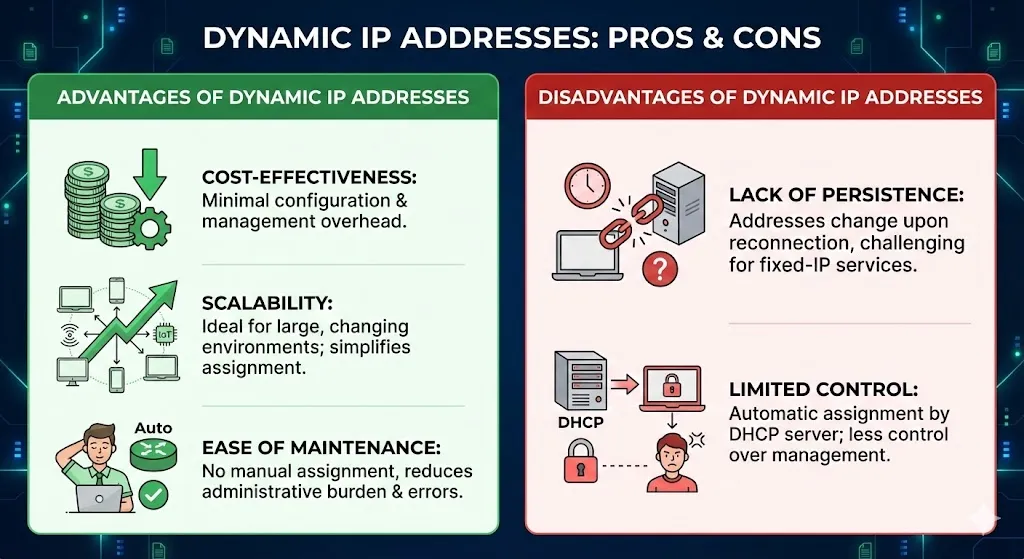
The main limitation is that the address may change. That can be inconvenient for systems that need consistent access, stable whitelisting, reliable remote login, or long-term network identity.
What Is a Static IP Address?
A static IP address is an IP address that remains fixed over time. It does not normally change unless the network administrator, service provider, or address holder changes the configuration.
Static IP addresses are often used by businesses because they provide a stable endpoint for servers, applications, VPN gateways, firewalls, remote access systems, monitoring tools, and email infrastructure.
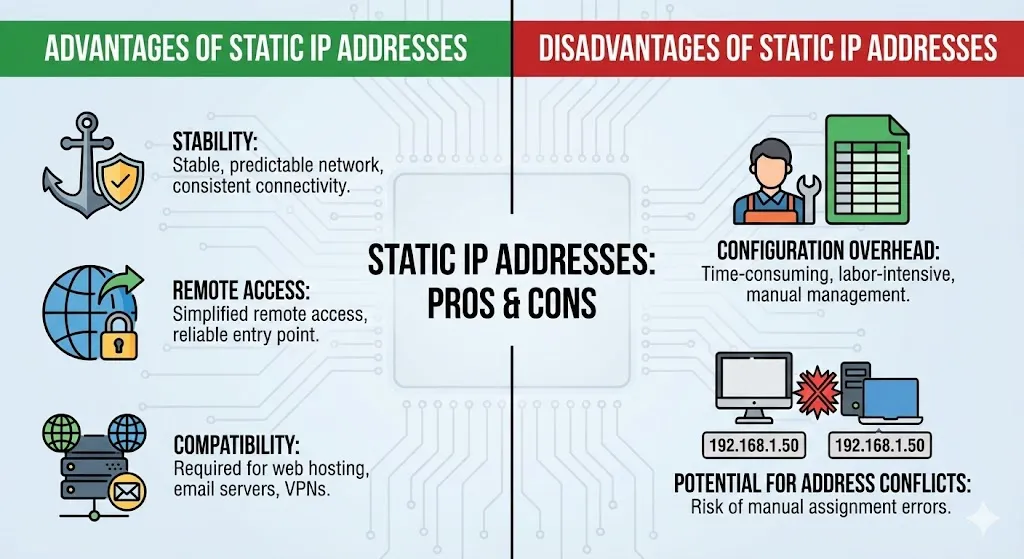
For example, if a company runs a VPN gateway for employees, a static IP address allows the business to define clear access rules. If the IP keeps changing, firewall rules, allowlists, monitoring, and remote access configurations may break or require constant updates.
A static IP address is therefore useful when consistency matters.
Dynamic vs Static IP Address: Key Differences
The difference between dynamic and static IP addresses is not only technical. It also affects business reliability, security planning, and operational control.
Dynamic vs Static IP Address: Key Differences
Feature
Dynamic IP Address
Static IP Address
Address Stability
Can change over time
Usually remains fixed
Common Use
Home internet, mobile networks, general browsing
Business infrastructure, servers, VPN, hosting, email
Setup
Usually automatic
Requires planned configuration
Remote Access
Less reliable for fixed access rules
Better for stable remote access
Security Rules
Harder to maintain allowlists
Easier to manage access control
Email and Reputation
May be less suitable for business email infrastructure
Better for reputation tracking and controlled sending
Business Continuity
Suitable for low-dependency use
Better for production infrastructure
In simple terms, dynamic IP addresses are convenient. Static IP addresses are predictable.
For a business, predictability can be the difference between a network that simply works today and a network that can be trusted tomorrow.
When a Dynamic IP Address Is Enough
A dynamic IP address is usually enough for ordinary internet access. Many users never notice when their IP address changes because their daily activity does not depend on a fixed address.
A dynamic IP address may be suitable for:
- home internet browsing
- general mobile internet use
- streaming and entertainment
- basic online shopping
- social media use
- temporary or low-risk network access
For these situations, a changing IP address usually does not create serious problems.
But business infrastructure is different. Once an IP address becomes part of access control, routing, compliance, email reputation, or customer-facing service delivery, stability becomes more important.
When a Business Needs a Static IP Address
A business may need a static IP address when it requires a consistent network identity.
Common business use cases include:
- hosting websites or applications
- running cloud infrastructure
- operating VPN gateways
- managing remote employee access
- supporting SaaS platforms
- running email servers
- configuring firewall allowlists
- supporting telecom or ISP services
- operating monitoring systems
- maintaining customer-facing platforms
- running cybersecurity or fraud-prevention systems
In these cases, a changing IP address can create operational friction. It may break access rules, disrupt integrations, reduce email reliability, or require repeated configuration updates.
A static IP address gives the business a stable point of reference.
For companies that depend on IPv4, that stable point of reference may also need to be supported by proper sourcing, routing, reputation checks, and continuity planning.
Static IP Address and IPv4 Leasing
Many businesses need static IPv4 addresses but do not want to buy IPv4 address space outright. In that case, IPv4 leasing can provide access to stable address space without the same upfront capital requirement as purchasing.
Through IPv4 leasing, businesses can access IPv4 capacity for hosting, cloud, VPN, SaaS, ISP, telecom, security, and other infrastructure use cases.
However, leasing IPv4 should not be treated as a simple monthly rental. A business should also check whether the provider can support source clarity, routing authorization, renewal accountability, IP reputation, and operational continuity.
A static IPv4 address is valuable because it is stable. But that stability depends on more than the number itself. It also depends on the structure behind it.
If the source, routing support, or renewal path is unclear, the business may still face risk even when the IP address appears stable today.
Risks of Using the Wrong IP Address Type
Choosing the wrong IP address type can create hidden business problems.
If a company uses a dynamic IP address for systems that need stability, it may face:
- broken remote access rules
- failed firewall allowlisting
- unstable VPN access
- email delivery issues
- monitoring problems
- DNS or application configuration errors
- customer access disruption
- unplanned technical support workload
But choosing a static IP address without checking the provider structure can also create risk.
The address may be static, but the business still needs to know:
- who controls the source of the IP block
- who supports routing updates
- who handles abuse reports
- who manages renewal accountability
- who helps if reputation issues appear
- who responds if documentation is questioned
This is where the business question becomes larger than “dynamic or static.”
The better question is:
Does this IP address structure protect business continuity?
What to Check Before Using Static IPv4
Before using static IPv4 addresses for business infrastructure, companies should check several factors.
1. IP Reputation
Check whether the IPv4 addresses have spam, malware, proxy, blacklist, or abuse history. Poor reputation can affect email, hosting, SaaS platforms, security systems, and customer trust.
2. Routing Support
Confirm whether the provider can support routing authorization, BGP announcements, route objects, and related technical setup.
3. Source Clarity
Understand where the IPv4 addresses come from and whether the provider has a clear right to lease or assign them.
4. Renewal Accountability
Ask who is responsible for keeping the IPv4 access active after the first contract period. Renewal risk often appears later, after services are already built around the addresses.
5. Abuse Handling
Check how the provider handles abuse complaints, reputation issues, customer misuse, and escalation.
6. Documentation
Make sure the provider can supply the necessary documentation for routing, compliance, customer onboarding, or internal review.
7. Business Continuity
Consider whether the IPv4 structure can support the company if routing, renewal, documentation, or reputation issues appear.
For companies that need long-term control, it may also be useful to compare leasing with the option to buy IPv4 addresses.
How i.lease Supports Business IP Address Needs
i.lease helps businesses access IPv4 addresses with a continuity-first mindset. Instead of treating IPv4 as a simple technical commodity, i.lease focuses on the practical factors that matter to business users: source clarity, routing support, reputation, renewal accountability, and operational reliability.
For businesses that need static IPv4 addresses, i.lease can support use cases such as hosting, cloud infrastructure, VPN access, SaaS platforms, telecom networks, ISP operations, security platforms, and email infrastructure.
This matters because a static IP address is only useful if the business can continue relying on it.
Through LARUS-backed IPv4 operations, i.lease provides a structured alternative to weak provider-chain sourcing and helps companies plan IPv4 access with stronger continuity awareness.
Businesses that need flexible IPv4 capacity can explore managed IPv4 leasing. Companies that want long-term address control can also review options to buy IPv4 addresses, while address holders looking to monetize unused resources can learn how to sell IPv4 addresses.
Final Thought
The difference between dynamic and static IP addresses is simple on the surface.
A dynamic IP address can change.
A static IP address stays fixed.
But for businesses, the real issue is deeper.
A static IP address can become part of your company’s infrastructure identity. It may support access control, routing, email reputation, customer platforms, VPN systems, cloud workloads, and security operations.
That means the wrong IP strategy can create more than inconvenience. It can create business risk.
Before choosing dynamic or static IP addresses, businesses should ask:
Does our IP address strategy support long-term connectivity, control, and continuity?
If the answer is unclear, the business may not only need an IP address.
It may need a stronger IPv4 continuity structure.
Also Read
- Lease IP Addresses: Why Businesses Lease IPv4 and What to Check First
- Buy IPv4 Address: What Businesses Must Check Before Purchasing IPv4
- Your IPv4 Looks Stable — Until the Provider Chain Breaks
- Is Your Company Absorbing IPv4 Risk?
- Why Self-Holding Can Expose IPv4 Assets to Registry Risk
Frequent Asked Questions (FAQs)
What is the difference between a dynamic and static IP address?
A dynamic IP address can change automatically over time, while a static IP address usually remains fixed. Dynamic IP addresses are common for home users, while static IP addresses are often used by businesses that need stable connectivity, remote access, hosting, VPN, email, or security systems.
Is a static IP address better than a dynamic IP address?
A static IP address is better when a business needs a consistent network identity. A dynamic IP address may be enough for ordinary browsing, but static IP addresses are more suitable for servers, VPNs, firewalls, email systems, SaaS platforms, and business infrastructure.
Why do businesses use static IP addresses?
Businesses use static IP addresses for stable remote access, hosting, VPN gateways, firewall allowlisting, email infrastructure, cloud systems, monitoring tools, and customer-facing services. A static IP address helps keep network identity consistent.
Can I lease a static IPv4 address?
Yes. Businesses can lease IPv4 address space for static use cases such as hosting, cloud infrastructure, VPN access, SaaS platforms, telecom networks, ISP operations, and security systems. The provider should support routing, reputation checks, renewal accountability, and continuity planning.
What should I check before using a static IPv4 address?
Before using a static IPv4 address, check IP reputation, routing support, source clarity, renewal terms, abuse handling, documentation, and whether the provider can support business continuity if technical or operational issues appear.
How does i.lease help with static IPv4 addresses?
i.lease helps businesses access IPv4 addresses through a continuity-first approach focused on source clarity, routing support, reputation checks, renewal accountability, and operational reliability.