SOLD:/24 ARIN @ $32/IP
LEASED:/18 RIPE @ $0.45/IP
SOLD:/24 ARIN @ $32/IP/Mo
SOLD:/24 ARIN @ $32/IP
LEASED:/18 RIPE @ $0.45/IP
SOLD:/24 ARIN @ $32/IP/Mo
SOLD:/24 ARIN @ $32/IP

Best Practices for Managing Elastic IP Addresses

StephanieStephanie
Best Practices for Managing Elastic IP Addresses

Elastic IP addresses (EIPs) are a crucial component of cloud networking, especially in Amazon Web Services (AWS). They provide a static, public IPv4 address that can be associated with an instance, ensuring reliability even if the instance is stopped and restarted. However, improper management of Elastic IPs can lead to security risks, unnecessary costs, and operational inefficiencies. This blog post outlines the best practices for effectively managing Elastic IP addresses to optimize performance, reduce costs, and enhance security.

1. Allocate and Associate EIPs Only When Necessary

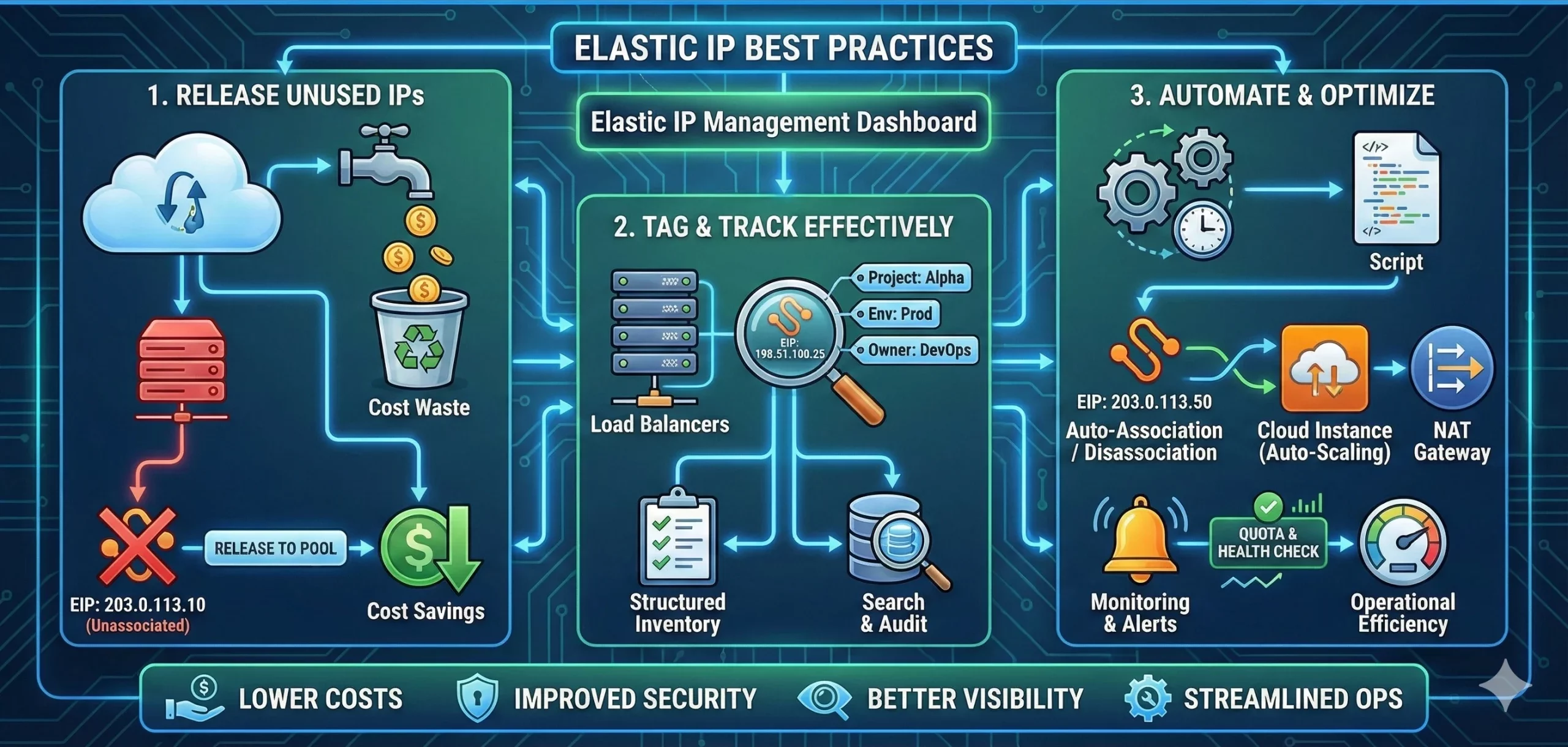
AWS provides a limited number of Elastic IPs per account, and any unused EIPs incur additional costs. To optimize resource utilization:

  • Allocate an EIP only when you need a static public IP.
  • Release unused EIPs to avoid unnecessary charges.
  • Use Elastic Load Balancers (ELB) or AWS PrivateLink instead of EIPs where applicable to reduce reliance on public IPs.

2. Monitor and Audit EIP Usage Regularly

Regularly reviewing EIP allocations helps prevent mismanagement and security vulnerabilities.

  • Use AWS Cost Explorer and CloudWatch to track EIP usage and associated costs.
  • Set up alerts to notify administrators of unassociated or idle EIPs.
  • Audit your account periodically to ensure EIPs are assigned only to necessary resources.

3. Secure Elastic IPs Against Unauthorized Access

Elastic IPs are public and exposed to the internet, making them potential targets for cyber threats. To enhance security:

  • Apply strict firewall rules using AWS Security Groups and Network ACLs.
  • Implement Identity and Access Management (IAM) policies to restrict who can allocate, associate, and release EIPs.
  • Use AWS WAF (Web Application Firewall) to protect applications using EIPs from common web threats.

4. Automate EIP Management with AWS Tools

Automation can reduce the risk of misconfigurations and streamline EIP management.

  • Use AWS Lambda functions to detect and release unused EIPs automatically.
  • Implement Infrastructure as Code (IaC) with AWS CloudFormation or Terraform to manage EIP allocation and association programmatically.
  • Leverage AWS CLI and SDKs to script EIP management tasks, improving operational efficiency.

5. Optimize EIP Usage for High Availability

Elastic IPs can be leveraged to improve uptime and failover strategies.

  • Use multiple EIPs to distribute traffic across redundant instances in different Availability Zones.
  • Automate failover by associating an EIP with a backup instance in case of primary instance failure.
  • Utilize Route 53 for DNS-based failover solutions that work with Elastic IPs.

6. Understand EIP Limits and Request Increases When Needed

AWS imposes limits on the number of Elastic IPs per region to prevent abuse.

  • Check your EIP quota in the AWS Service Quotas dashboard.
  • Request an increase if your architecture requires additional EIPs, providing justification to AWS support.

Conclusion

Effective management of Elastic IP addresses ensures cost efficiency, security, and high availability. By following these best practices, organizations can optimize their cloud resources, prevent unnecessary expenses, and mitigate security risks. Regular monitoring, automation, and security enhancements play a crucial role in managing EIPs effectively in AWS. Implement these strategies today to streamline your cloud networking operations.

Trusted IPv4 Leasing for Business Growth

Get enterprise-grade IPv4 space quickly, with seamless deployment and end-to-end management.

Get Started with i.lease

Related Posts

ipv4-leasing

Inbound vs. Outbound IPv4 Leasing: A Complete Guide for Enterprises

Understanding IPv4 leasing helps enterprises manage scarce address space, reducing risk and unlocking strategic growth opportunities in today’s digital economy.   Key points Distinguishes between inbound (leasing in) and outbound (leasing out) IPv4 approaches and their strategic implications. Highlights contract structures, registry risk management and continuity considerations affecting global number resources. Inbound vs. outbound IPv4 leasing: complete enterprise guide In the post-exhaustion era of Internet Protocol version 4 (IPv4),Read more Related Posts Inbound vs. Outbound IPv4 Leasing: A Complete Guide for Enterprises Understanding IPv4 leasing helps enterprises manage scarce address space, reducing risk and unlocking strategic growth opportunities in today’s digital economy. Key Read more Common Myths About Selling IP Addresses The IPv4 secondary market is often shrouded in mystery, leading many organizations to sit on valuable digital assets because they Read more How to turn idle IPv4 addresses into a recurring revenue stream with iLease Unlock the hidden value of unused IPv4 addresses with iLease, turning dormant digital infrastructure into a recurring revenue stream while Read more .related-post {} .related-post .post-list { text-align: left; } .related-post .post-list .item { margin: 5px; padding: 10px; } .related-post .headline { font-size: 18px !important; color: #999999 !important; } .related-post .post-list .item .post_thumb { max-height: 220px; margin: 10px 0px; padding: 0px; display: block; } .related-post .post-list .item .post_title { font-size: 16px; color: #3f3f3f; margin: 10px 0px; padding: 0px; display: block; text-decoration: none; } .related-post .post-list .item .post_excerpt { font-size: 13px; color: #3f3f3f; margin: 10px 0px; padding: 0px; display: block; text-decoration: none; } @media only screen and (min-width: 1024px) { .related-post .post-list .item { width: 30%; } } @media only screen and (min-width: 768px) and (max-width: 1023px) { .related-post .post-list .item { width: 90%; } } @media only screen and (min-width: 0px) and (max-width: 767px) { .related-post .post-list .item { width: 90%; } }

selling-ip-addresses

Common Myths About Selling IP Addresses

The IPv4 secondary market is often shrouded in mystery, leading many organizations to sit on valuable digital assets because they fear the perceived complexity or legal “gray areas.” As IPv4 exhaustion becomes a permanent reality, the value of these addresses has skyrocketed, yet misconceptions continue to stall potential transactions. At i.lease, powered by the real-world expertise of LARUS, we’ve seen how these myths prevent companies from unlocking significant capital.Read more Related Posts Inbound vs. Outbound IPv4 Leasing: A Complete Guide for Enterprises Understanding IPv4 leasing helps enterprises manage scarce address space, reducing risk and unlocking strategic growth opportunities in today’s digital economy. Key Read more Common Myths About Selling IP Addresses The IPv4 secondary market is often shrouded in mystery, leading many organizations to sit on valuable digital assets because they Read more How to turn idle IPv4 addresses into a recurring revenue stream with iLease Unlock the hidden value of unused IPv4 addresses with iLease, turning dormant digital infrastructure into a recurring revenue stream while Read more .related-post {} .related-post .post-list { text-align: left; } .related-post .post-list .item { margin: 5px; padding: 10px; } .related-post .headline { font-size: 18px !important; color: #999999 !important; } .related-post .post-list .item .post_thumb { max-height: 220px; margin: 10px 0px; padding: 0px; display: block; } .related-post .post-list .item .post_title { font-size: 16px; color: #3f3f3f; margin: 10px 0px; padding: 0px; display: block; text-decoration: none; } .related-post .post-list .item .post_excerpt { font-size: 13px; color: #3f3f3f; margin: 10px 0px; padding: 0px; display: block; text-decoration: none; } @media only screen and (min-width: 1024px) { .related-post .post-list .item { width: 30%; } } @media only screen and (min-width: 768px) and (max-width: 1023px) { .related-post .post-list .item { width: 90%; } } @media only screen and (min-width: 0px) and (max-width: 767px) { .related-post .post-list .item { width: 90%; } }

buy-ip-addresses

How to buy IPv4 addresses through a certified IP broker

Buying IPv4 space requires policy compliance, verified need, and registry approval, making certified IP brokers essential guides through complex global transfers. IPv4 transactions are regulated transfers, not simple purchases — registries must approve documentation, justification and registration changes. Certified brokers reduce risk and delay by aligning buyers with registry policy, routing legitimacy and cross-region requirements. Why companies still need to buy IPv4 addresses The global supply of IPv4 addressesRead more Related Posts Inbound vs. Outbound IPv4 Leasing: A Complete Guide for Enterprises Understanding IPv4 leasing helps enterprises manage scarce address space, reducing risk and unlocking strategic growth opportunities in today’s digital economy. Key Read more Common Myths About Selling IP Addresses The IPv4 secondary market is often shrouded in mystery, leading many organizations to sit on valuable digital assets because they Read more How to turn idle IPv4 addresses into a recurring revenue stream with iLease Unlock the hidden value of unused IPv4 addresses with iLease, turning dormant digital infrastructure into a recurring revenue stream while Read more .related-post {} .related-post .post-list { text-align: left; } .related-post .post-list .item { margin: 5px; padding: 10px; } .related-post .headline { font-size: 18px !important; color: #999999 !important; } .related-post .post-list .item .post_thumb { max-height: 220px; margin: 10px 0px; padding: 0px; display: block; } .related-post .post-list .item .post_title { font-size: 16px; color: #3f3f3f; margin: 10px 0px; padding: 0px; display: block; text-decoration: none; } .related-post .post-list .item .post_excerpt { font-size: 13px; color: #3f3f3f; margin: 10px 0px; padding: 0px; display: block; text-decoration: none; } @media only screen and (min-width: 1024px) { .related-post .post-list .item { width: 30%; } } @media only screen and (min-width: 768px) and (max-width: 1023px) { .related-post .post-list .item { width: 90%; } } @media only screen and (min-width: 0px) and (max-width: 767px) { .related-post .post-list .item { width: 90%; } }