What Is IP Spoofing? How Forged Source Addresses Work and How Networks Defend Against Them
 Stephanie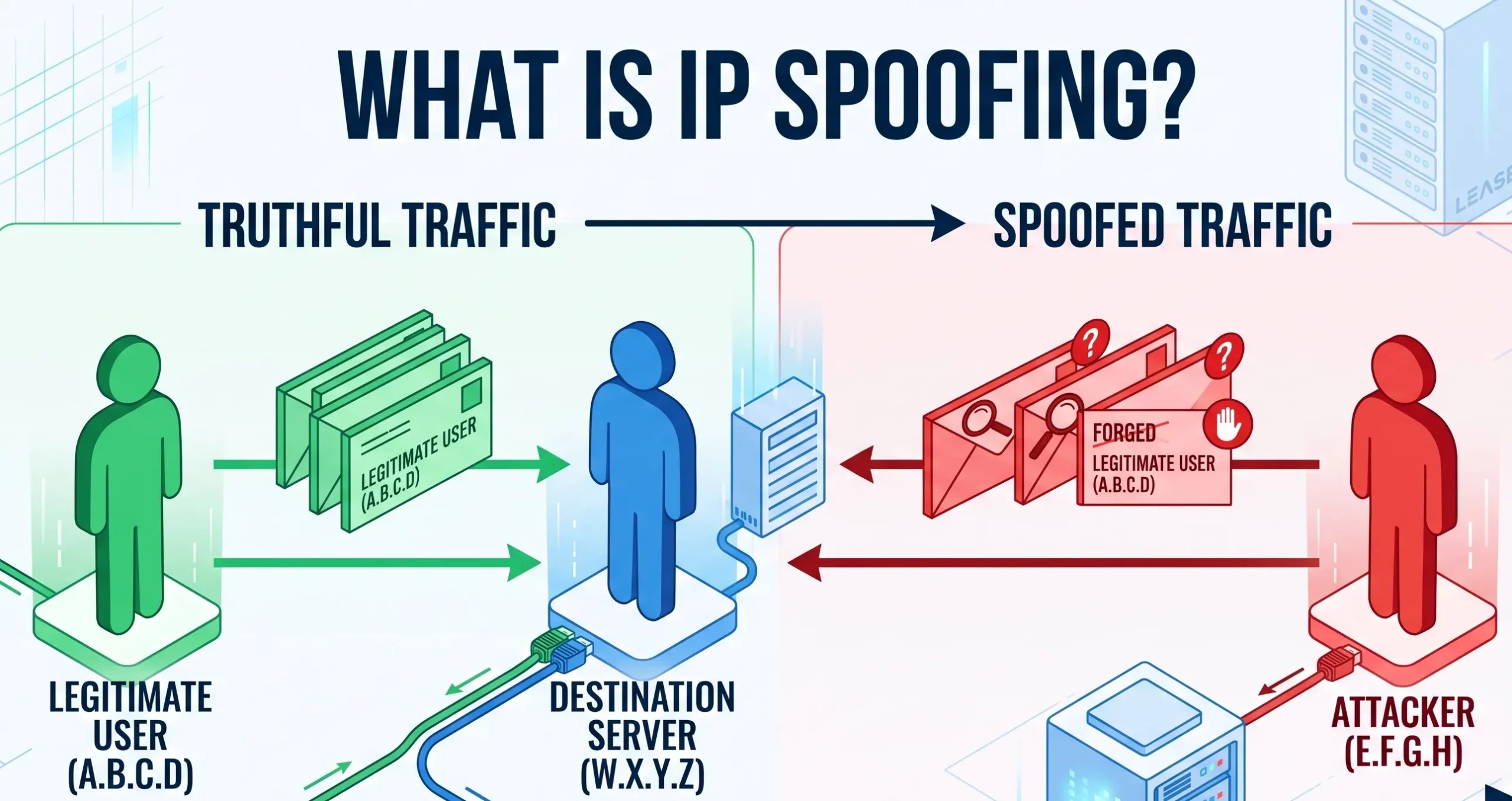
IP spoofing is the practice of sending Internet traffic with a forged source IP address, making packets appear to come from a different machine than the one that actually sent them. It exploits a foundational design fact of the Internet Protocol: routers forward packets based on the destination address and generally do not verify that the source address is genuine.
Table of Contents
Spoofing matters to businesses for two distinct reasons. First, it is the raw material of some of the largest attacks on the Internet — reflection and amplification DDoS attacks depend entirely on forged source addresses, and spoofed floods are harder to filter because they carry no honest return address. Second, and less discussed: your own address space can be the victim of spoofing without your network ever being touched. An attacker anywhere in the world can stamp your IP addresses onto malicious traffic, and the complaints, abuse reports, and reputation damage arrive at the addresses’ registered contacts — yours.
This article explains how spoofing works, the attacks it enables, how the industry defends against it at the network level, and what operators of public IPv4 space — owned or leased — should do about both directions of the problem: preventing spoofed traffic from leaving their networks, and responding when their addresses are impersonated elsewhere.
What Is IP Spoofing?
IP spoofing is the creation of IP packets whose source address field contains an address other than the sender’s real one. Every IP packet carries two addresses in its header: the destination (where it is going) and the source (where replies should be sent). The destination must be accurate for the packet to arrive; the source is simply a claim — and the core routing infrastructure of the Internet does not check it.
A postal analogy captures it exactly: spoofing is writing someone else’s return address on an envelope. The letter still gets delivered to the destination; the postal system never verifies the return address; and if the recipient replies, the reply goes to the innocent party whose address was borrowed.
Two clarifications keep the term precise:
- Spoofing forges packets, not registrations. The attacker’s packets claim your address; nothing changes in any registry, routing table, or DNS record. The forgery exists only inside the traffic itself.
- Spoofing is not the same as using a VPN or proxy. VPNs and proxies route traffic through an intermediary that legitimately holds its own addresses — the source addresses on that traffic are real, they just belong to the intermediary. Spoofing puts a false address directly into the packet header.
How Does IP Spoofing Work?
Spoofing works because packet headers are written by the sending machine, and networks that fail to filter outbound traffic will forward whatever source address that machine chooses. The mechanics, described at the conceptual level:
- The sending system constructs packets with a source address field set to the chosen false address — a capability that requires nothing exotic, only control of a machine on a network that does not validate outgoing sources.
- The packets travel to their destination normally, because forwarding decisions use only the destination address.
- Any replies the destination generates are sent to the forged source address — which means they go to the impersonated party, not the attacker.
That last point defines both the power and the limitation of spoofing. The attacker never sees the replies. Spoofing is therefore a one-way technique: superb for attacks that need no reply (floods) or that weaponize the reply itself (reflection), and largely useless for anything requiring a sustained two-way conversation.
The enabling condition is worth underlining because it locates the responsibility: spoofed packets can only enter the Internet through networks that do not check the source addresses of the traffic they emit. The Internet’s spoofing problem is, concretely, the sum of networks that skip this check — which is why the main defenses (below) target the network edge rather than the victim.
IP Spoofing vs BGP Hijacking: Two Different Forgeries
Spoofing forges the source address inside individual packets; BGP hijacking forges a routing announcement that redirects traffic for a whole prefix. They are frequently confused because both involve “using addresses that aren’t yours,” but they operate at different layers with different consequences:
| Aspect | IP spoofing | BGP hijacking |
|---|---|---|
| What is forged | The source field in packet headers | A route announcement claiming a prefix |
| Layer | Data plane (individual packets) | Control plane (routing system) |
| Effect on traffic | Outbound packets carry a false identity; inbound traffic to the real holder is unaffected | Traffic destined for the prefix is redirected to the hijacker |
| Can the attacker receive replies? | No — replies go to the impersonated address | Yes — that is the point of the hijack |
| Primary defense | Source address validation at network edges (BCP 38, uRPF) | RPKI origin validation, route filtering, monitoring |
Both threats concern anyone responsible for public address space, but they are countered by different mechanisms and detected by different signals. Hijacking risk — including its elevated form during address transfers — is covered in our guide to preventing IPv4 hijacking during a transfer; the rest of this article stays with the packet-level forgery.
What Attacks Does IP Spoofing Enable?
Spoofing’s main uses are hiding the origin of floods, reflecting attacks off innocent servers, and exploiting systems that trust source addresses as identity.
1. Anonymized flood attacks
In direct DDoS floods, spoofed and randomized source addresses serve two purposes: they conceal the true attacking machines, and they defeat simple source-based blocking — the defender cannot filter by sender when every packet claims a different sender. SYN floods, one of the classic protocol attacks covered in our overview of DDoS attack types, traditionally rely on spoofed sources so the half-open connections they create can never be completed or traced.
2. Reflection and amplification attacks
This is spoofing’s most destructive application. The attacker sends requests to legitimate public servers — commonly open DNS resolvers, NTP servers, or other UDP services — with the source address forged to be the victim’s address. Each server dutifully sends its reply to the victim. Because replies for these protocols can be many times larger than requests, the attacker’s bandwidth is multiplied: modest request traffic becomes a massive flood arriving at the victim from hundreds of respectable servers. The victim sees an attack coming from legitimate infrastructure; the reflectors see normal-looking queries; the actual attacker appears nowhere in either party’s traffic. Reflection attacks are impossible without spoofing — which is why source validation is treated as Internet-wide hygiene rather than a private precaution, and why UDP-based amplification features prominently in the mitigation architectures described in our guide to DDoS mitigation.
3. Exploiting address-based trust
Any system that grants access based purely on source IP address — legacy allowlists, some internal service configurations, poorly designed APIs — is structurally vulnerable to a forged source claiming a trusted address. Modern security practice treats a source address as a routing artifact, not an identity: useful as one signal, never sufficient as authentication. This principle is a core motivation behind zero-trust architectures.
4. Evasion and probe obfuscation
Spoofed sources are also used to muddy reconnaissance — burying real scanning activity among decoy sources — and to plant false trails in logs, complicating investigation and attribution.
What Spoofing Cannot Do
A defensively useful section, because overestimating spoofing leads to misdirected worry:
- Spoofing cannot intercept your traffic. Forging your address on outbound packets does not redirect anything destined to your address. Traffic redirection requires a routing-layer attack (hijacking), not spoofing.
- Spoofing cannot sustain modern encrypted sessions. TCP’s handshake requires receiving replies the spoofer never sees, and TLS authentication operates far above the IP layer. An attacker cannot “log in as your server” by spoofing its address.
- Spoofing does not alter registry or DNS records. Your registration, your ROAs, your reverse DNS — none of it is touched. The forgery lives and dies inside the attacker’s packets.
In short: spoofing is an impersonation of your addresses in transit, not a seizure of them. The damage it does to the impersonated party is reputational and administrative — which, as the next sections show, is damage enough.
How Networks Defend Against IP Spoofing
The primary defense is source address validation at the network edge: networks should refuse to emit packets whose source addresses don’t belong to them, and refuse to accept packets that arrive from impossible directions. The main mechanisms:
Ingress filtering — BCP 38
The Internet’s standard anti-spoofing practice, documented as BCP 38 (RFC 2827), asks every network to filter traffic at its edges so that packets leaving the network carry only source addresses the network legitimately holds. If universally deployed, spoofed packets could never enter the Internet at all. Deployment is broad but incomplete — measurement projects that test spoofability continue to find networks that permit it — which is why spoofed attacks persist and why participation is considered a mark of responsible operation. The obligation is notably asymmetric: implementing BCP 38 protects other networks from your customers, not you from attackers. It is Internet citizenship, enforced increasingly by peer expectation and, in some regions, regulatory attention.
Unicast Reverse Path Forwarding (uRPF)
uRPF is the router feature that automates source validation: for each arriving packet, the router checks whether the source address is reachable back through the interface it arrived on (strict mode) or exists in the routing table at all (loose mode). Packets failing the check are dropped. Strict mode suits network edges with symmetric routing — customer connections, server LANs — while loose mode serves multihomed environments where strict checking would discard legitimate asymmetric traffic.
Provider and IX filtering
Transit providers and Internet exchanges increasingly validate that customer and member traffic uses only address space those parties are authorized to announce — tying data-plane filtering to the same authorization records (IRR objects, RPKI) that govern route acceptance. This is the connective tissue between anti-spoofing and routing security: the cleaner a network’s registered authorization data, the more precisely its traffic can be validated.
Protocol- and host-level measures
Above the network layer: modern TCP stacks randomize sequence numbers (closing the classic blind-injection attacks of earlier decades), SYN cookies blunt spoofed SYN floods, and — most importantly — authentication is designed to never rely on source address alone. Cryptographic identity (TLS, mutual authentication, signed tokens) is indifferent to what the IP header claims.
When Your IP Addresses Are the Ones Being Spoofed
If attackers stamp your addresses onto their traffic, the operational consequences arrive at your abuse desk and your reputation profile — even though no packet ever crossed your network. The typical symptoms:
- Abuse complaints for traffic you never sent. Victims and automated systems look up the source address’s registered contacts and complain there. Backscatter — the replies that reflection victims and scanned hosts send to the forged source — can also arrive at your addresses as unexplained inbound traffic.
- Reputation damage. Blocklist operators and reputation systems ingest reports keyed to source addresses. Persistent spoofed abuse citing your space can degrade the standing of addresses that did nothing, with consequences for deliverability and acceptance described in our guide to IP address reputation.
What a responsible operator does about it:
- Prove the traffic did not originate from you. Your own flow records and edge filtering logs demonstrate that the reported traffic never left your network. This is the core evidence for disputing listings and answering complaints — and it exists only if you keep such records.
- Respond to abuse reports rather than ignoring them. A documented “these packets were spoofed; here is our egress filtering posture” response protects reputation; silence reads as guilt to listing operators.
- Demonstrate your own hygiene. A network that visibly implements BCP 38 and keeps clean, verifiable registration data is far more credible when claiming impersonation than one that cannot show its own house is in order.
- Escalate patterns. Sustained spoofed abuse of your space is worth reporting to upstream providers and, where relevant, to the reflector operators involved — the parties actually positioned to trace and filter it.
What This Means for Operators of Public IPv4 Space
For any business running public services on its own or leased IPv4 space, spoofing translates into three standing responsibilities.
First, egress hygiene. Filter outbound traffic so only your legitimate source addresses leave your network — at your edge routers, and contractually downstream if you have customers of your own. This is what keeps your network from becoming a spoofing launchpad if a host is compromised, and it is increasingly expected by upstreams and exchanges as a condition of good standing.
Second, don’t run open reflectors. Publicly answering DNS resolvers, unrestricted NTP, and similar open UDP services on your addresses are the raw material of amplification attacks. Auditing your space for them protects both the Internet and your own reputation, since reflector participation generates exactly the abuse reports described above.
Third, keep your paper trail clean — and this is where address governance meets security. Accurate registration records, working abuse contacts, aligned IRR and RPKI data: these determine whether you can credibly dispute spoofed-abuse reports, whether providers can validate your traffic precisely, and whether your addresses’ reputation can be defended at all. For leased space, this responsibility is shared across the lease relationship, and it belongs on the pre-lease verification list: who receives abuse reports for the block, how are they relayed, and how quickly can records be corrected? A structured arrangement — the kind a IPv4 leasing platform should provide — answers these questions in writing; an informal one leaves the lessee defending reputation with no records and no standing. The same diligence applies to blocks you acquire outright: a block’s spoofing-related abuse history is part of the reputation you inherit, which is one more reason pre-acquisition checks matter whether you lease or Buy IPv4 addresses.
Practical Checklist
- Implement egress source-address filtering (BCP 38) at every network edge you control.
- Enable uRPF on customer-facing and server-facing interfaces — strict mode where routing is symmetric, loose mode where it is not.
- Audit your address space for open reflectors: open resolvers, unrestricted NTP, and other openly answering UDP services.
- Keep flow records or equivalent logs sufficient to prove what traffic did and did not originate from your network.
- Ensure abuse contacts for all your address space are registered, monitored, and answered — including a clear relay path for leased blocks.
- Never use source IP address as sole authentication for anything; treat it as one signal among several.
- Keep IRR objects and RPKI data aligned with reality, so providers can validate your traffic and announcements precisely.
- When leasing or acquiring space, verify abuse-handling responsibilities and the block’s abuse history before committing.
Practical Note from i.lease
Spoofing produces a category of problem that surprises many operators: reputation damage with no incident. Nothing was breached, no traffic crossed your network, no configuration was wrong — yet complaints accumulate against your addresses and a blocklist entry appears, because someone on the far side of the world found it convenient to borrow your numbers. The operators who weather this well all share the same preparation: they can prove a negative. Egress filtering posture documented, flow records retained, abuse contacts responsive, registration data clean. With that file, a spoofed-abuse dispute is a routine exchange; without it, you are asking reputation systems to take your word.
This is, at bottom, the same lesson that runs through routing security, deployment, and DDoS readiness: the value of public IPv4 space depends not only on the addresses but on the governance around them — who answers for them, what records support them, and how fast problems can be corrected. That governance is worth verifying before space enters production, whichever way you source it.
Final Thoughts
IP spoofing exists because the Internet forwards packets on the destination address and takes the source address on faith. That single design fact makes possible anonymized floods, reflection attacks that turn legitimate servers into weapons, and impersonation of address space whose real holders never see the forged traffic. The defenses are correspondingly structural: source validation at network edges (BCP 38 and uRPF) to stop forged packets at their origin, refusal to treat source addresses as identity, and the elimination of open reflectors that give spoofed requests their amplification.
For businesses operating public IPv4 space, the takeaway is double-sided. Outbound, egress filtering is now a baseline expectation of responsible operation — protection you owe the Internet rather than yourself. Inbound, your addresses can be impersonated by anyone, anywhere, at any time, and the defense of their reputation rests on records: proof of what your network did and did not send, working abuse contacts, and clean registration data. Spoofing cannot take your addresses from you — but without that preparation, it can quietly take their good name, which for production infrastructure is much the same loss.
Frequently Asked Questions
What is IP spoofing in simple terms?
IP spoofing is sending Internet traffic with a fake “from” address — like mailing a letter with someone else’s return address. The traffic reaches its destination normally, but it appears to come from a machine that never sent it.
Why is IP spoofing possible?
Because the Internet Protocol forwards packets using only the destination address and does not verify the source address. Spoofed packets enter the Internet through networks that fail to check the source addresses of their outgoing traffic.
Is IP spoofing illegal?
Using spoofing to attack, defraud, or gain unauthorized access is illegal in most jurisdictions under computer misuse and fraud laws. There are narrow legitimate uses in authorized security testing and certain load-testing and load-balancing configurations within networks one controls.
Is using a VPN the same as IP spoofing?
No. A VPN routes your traffic through a server that legitimately holds its own IP addresses — the source addresses are real, they just belong to the VPN provider. Spoofing writes a false address directly into the packet header.
What is the difference between IP spoofing and BGP hijacking?
Spoofing forges the source field inside individual packets; hijacking forges a routing announcement that redirects traffic for an entire prefix. Spoofing cannot intercept traffic destined to the real holder — hijacking can, which is what makes it the more severe routing-layer threat.
How do reflection DDoS attacks use spoofing?
The attacker sends requests to legitimate servers with the source address forged as the victim’s, so every server sends its — often much larger — reply to the victim. The attack is impossible without spoofing, which is why source validation is treated as Internet-wide hygiene.
What is BCP 38?
BCP 38 (RFC 2827) is the Internet best practice of ingress filtering: networks should ensure traffic leaving them carries only source addresses they legitimately hold, preventing spoofed packets from entering the Internet at their edge.
What is uRPF?
Unicast Reverse Path Forwarding is a router feature that validates source addresses automatically: packets are dropped if their claimed source is not reachable back through the arrival interface (strict mode) or absent from the routing table entirely (loose mode).
Can someone spoof my IP address without accessing my network?
Yes. Spoofing requires no access to the impersonated network at all — only a machine on some poorly filtered network elsewhere. Your addresses can appear as the source of traffic you never sent, which is why abuse-report handling and traffic records matter for defending their reputation.
Can IP spoofing be detected?
Individual spoofed packets are hard for the destination to identify with certainty, but networks detect spoofing structurally: uRPF checks catch impossible sources at forwarding time, flow records reveal traffic claiming addresses that never transited the network, and backscatter patterns expose reflection campaigns.
Does spoofing affect leased IP addresses differently?
The mechanics are identical, but responsibility is shared: abuse reports for a leased block may reach the registered holder rather than the lessee, so the lease should define how reports are relayed and who responds. This should be confirmed before leasing, alongside reputation and routing checks.
Also Read
相关文章
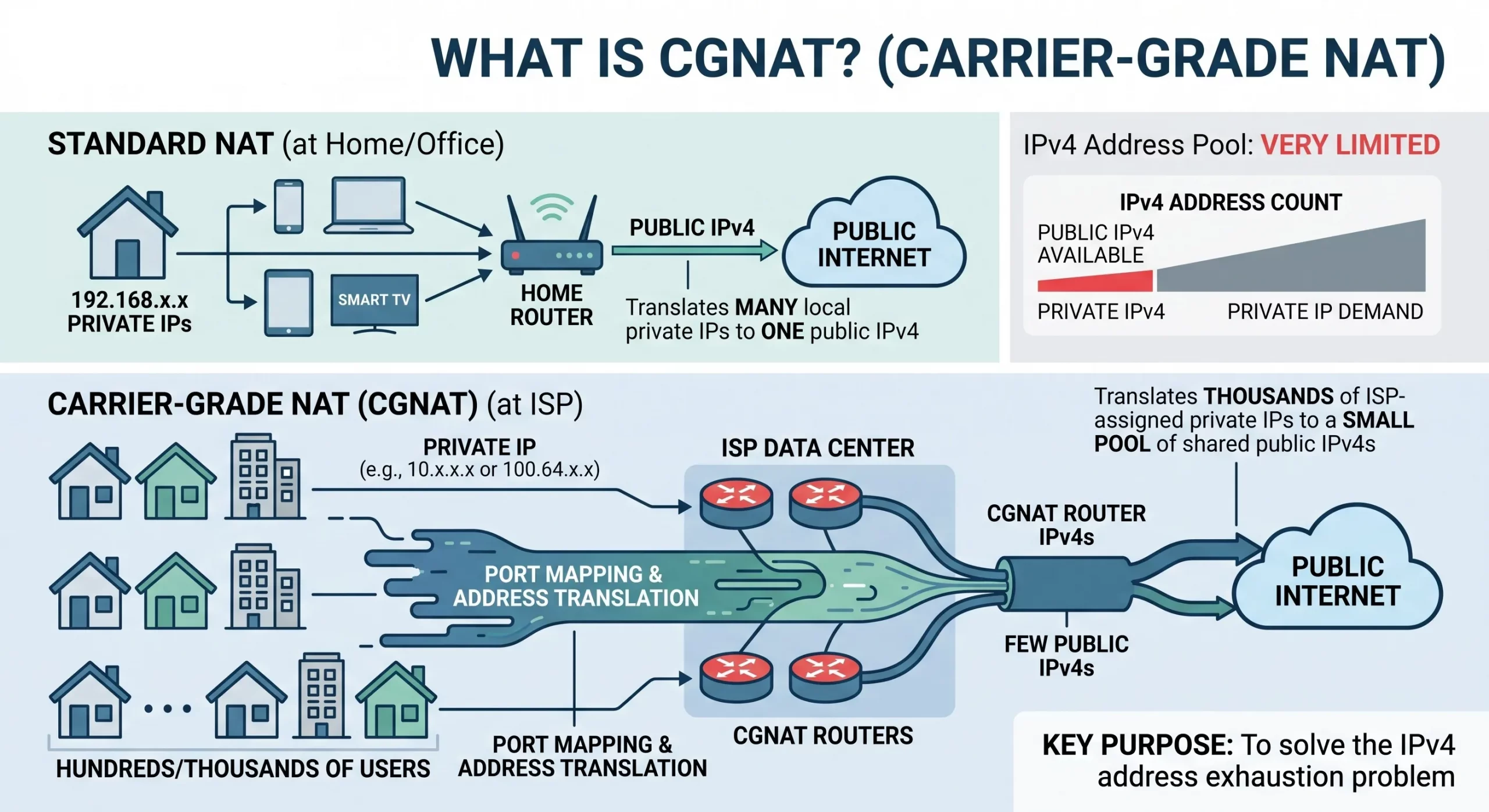
什么是 CGNAT(运营商级 NAT)?它为何会影响主机托管、游戏和入站服务?
CGNAT(Carrier-Grade NAT,运营商级网络地址转换)是一种技术,它允许互联网服务提供商让多个客户同时共享同一个公共 IPv4 地址,而不是为每位客户单独分配一个公共 IPv4 地址。 它会在服务提供商的网络内部增加第二层网络地址转换,因此数百甚至数千名用户都位于同一个公共地址之后,而外部互联网看到的只是这个共享的公共地址。 对于日常网页浏览、流媒体播放和应用程序使用来说,CGNAT 通常不会被用户察觉。问题会在外部网络需要主动连接到你时出现,例如托管服务器、进行端口转发、运行游戏服务器、接收 VoIP 或 VPN 连接,或启用远程访问。由于你不再拥有属于自己的公共地址——而是与其他陌生用户共享同一个地址——传入连接无法明确知道应该被转发到哪一个用户,因此这些服务可能无法正常工作或变得不稳定。 CGNAT 并不是程序错误或配置错误。它是针对一个结构性现实而采取的有意解决方案:全球 IPv4 地址已经不足,而互联网服务提供商仍需要在公共地址数量有限的情况下继续连接新的客户。这使 CGNAT 成为普通用户最容易接触到的一个明显迹象,说明公共 IPv4 地址是一种有限且竞争激烈的资源;同时也清楚说明了为什么运行对外服务的企业需要拥有自己的专用公共地址空间。本文将介绍什么是 CGNAT、它如何运作、具体会影响哪些功能、如何判断自己是否处于 CGNAT 环境中,以及对于无法接受这些限制的企业来说,有哪些可行的解决方案。 什么是 CGNAT CGNAT,也写作 CGN,有时也称为 Large-Scale NAT(LSN,大规模网络地址转换),是一种在运营商层面执行的网络地址转换技术,使 ISP 能够让多个客户共享同一个公共 IPv4 地址。 它延伸了家庭路由器中 NAT 的基本原理——多个私有设备共享一个地址——但会在服务提供商的网络层面再次执行一次,并同时覆盖大量客户。 这样一来,处于 CGNAT 后方的客户并不拥有一个唯一的公共地址。外部互联网所看到、并与其流量关联的地址,是与其他用户共享的,而且该地址由 ISP 控制,而不是由客户控制。对于由用户主动发起的出站连接,这通常不会造成问题。但对于任何依赖外部网络能够单独连接到该用户的服务来说,这个由服务提供商控制的共享地址正是问题的根源。 从一开始就明确区分这一点会很有帮助,因为它几乎解释了 CGNAT 会破坏的所有功能:由你主动发起的出站连接通常可以正常工作;而由其他人从外部主动尝试连接到你的入站连接,才是容易失败的部分。 从根本上来说,CGNAT 对客户端友好,却对服务器并不友好。 CGNAT 的工作原理是什么? CGNAT 的工作方式是在客户网络与公共互联网之间增加第二层地址转换,因此流量会经过两次转换:第一次发生在家庭路由器上,第二次发生在 ISP 的运营商级 NAT 设备上。 在传统网络环境中,家庭路由器会在设备的私有地址与 ISP 分配给你的单个公共地址之间执行 NAT。此时,你仍然拥有一个公共地址,而且可以通过端口转发,将外部传入连接定向到路由器后方的某台设备——这也是自托管以及许多网络服务能够正常运行的重要机制。关于私有地址与公共地址之间的关系,可以参考我们的 公共 IP 与私有 IP 指南。 CGNAT 会加入第二个转换阶段。ISP 不再直接为你的路由器分配公共地址,而是先分配一个来自共享中间地址范围的地址,然后通过运营商 NAT 设备,将大量这类客户的流量转换到一个规模更小的真实公共地址池中。因此,数据路径会变成:你的私有设备地址 Related Posts 什么是 CGNAT(运营商级 NAT)?它为何会影响主机托管、游戏和入站服务? CGNAT(Carrier-Grade NAT,运营商级网络地址转换)是一种技术,它允许互联网服务提供商让多个客户同时共享同一个公共 IPv4 地址,而不是为每位客户单独分配一个公共 IPv4 地址。 它会在服务提供商的网络内部增加第二层网络地址转换,因此数百甚至数千名用户都位于同一个公共地址之后,而外部互联网看到的只是这个共享的公共地址。对于日常网页浏览、流媒体播放和应用程序使用来说,CGNAT 通常不会被用户察觉。问题会在外部网络需要主动连接到你时出现,例如托管服务器、进行端口转发、运行游戏服务器、接收 VoIP 或 VPN 连接,或启用远程访问。由于你不再拥有属于自己的公共地址——而是与其他陌生用户共享同一个地址——传入连接无法明确知道应该被转发到哪一个用户,因此这些服务可能无法正常工作或变得不稳定。CGNAT 并不是程序错误或配置错误。它是针对一个结构性现实而采取的有意解决方案:全球 IPv4 地址已经不足,而互联网服务提供商仍需要在公共地址数量有限的情况下继续连接新的客户。这使 CGNAT 成为普通用户最容易接触到的一个明显迹象,说明公共 IPv4 地址是一种有限且竞争激烈的资源;同时也清楚说明了为什么运行对外服务的企业需要拥有自己的专用公共地址空间。本文将介绍什么是 CGNAT、它如何运作、具体会影响哪些功能、如何判断自己是否处于 什么是电信公司?电信运营商如何为英国、美国和加拿大提供网络连接支持? 电信公司(Telco Companies),也称为电信运营商(Telecommunications Companies),提供通信与网络连接服务。这些服务包括移动通信网络、宽带互联网、光纤连接、固定电话服务、企业网络连接、云连接、托管网络服务以及数据中心连接等。 对于普通消费者而言,电信公司通常被视为移动通信或宽带互联网服务提供商。对于企业来说,电信公司远不只是一个服务品牌,更是关键的基础设施合作伙伴,帮助企业连接办公室、数据中心、云平台、远程员工、客户应用程序以及各类数字化服务。 随着企业越来越依赖云平台、SaaS 应用、AI 工具、VPN、网络安全系统以及在线服务,电信公司已成为数字基础设施规划中不可或缺的重要组成部分。 电信公司是什么? 电信公司(Telco Companies)是提供电信服务的企业。这些服务让个人、设备、企业和各种系统能够跨越距离进行通信与连接。 一家电信公司可能提供以下服务: 移动通信服务 宽带互联网 光纤连接 固定电话服务 企业互联网接入 企业广域网(WAN)服务 云连接服务 数据中心连接 VPN TCP 与 UDP:IPv4 租赁和企业网络指南 TCP 和 UDP 是互联网中最重要的两种传输层协议。它们决定数据如何在设备、服务器、云平台、VPN 网关、DNS 解析器、电子邮件系统、流媒体平台以及企业应用程序之间传输。 对于企业而言,TCP 和 UDP 不仅仅是技术术语,它们会直接影响实际的基础设施性能。公网 IPv4 地址提供可从互联网访问的网络端点,而 TCP 和 UDP 则决定流量如何通过该端点进行传输。 这对于租用或购买 IPv4 地址的企业尤为重要。企业租用 IPv4 .related-post {} .related-post .post-list { text-align: left; } .related-post .post-list .item { margin: 5px; padding: 10px; } .related-post .headline { font-size: 18px !important; color: #999999 !important; } .related-post .post-list .item .post_thumb { max-height: 220px; margin: 10px 0px; padding: 0px; display: block; } .related-post .post-list .item .post_title { font-size: 16px; color: #3f3f3f; margin: 10px 0px; padding: 0px; display: block; text-decoration: none; } .related-post .post-list .item .post_excerpt { font-size: 13px; color: #3f3f3f; margin: 10px 0px; padding: 0px; display: block; text-decoration: none; } @media only screen and (min-width: 1024px) { .related-post .post-list .item { width: 30%; } } @media only screen and (min-width: 768px) and (max-width: 1023px) { .related-post .post-list .item { width: 90%; } } @media only screen and (min-width: 0px) and (max-width: 767px) { .related-post .post-list .item { width: 90%; } }

什么是电信公司?电信运营商如何为英国、美国和加拿大提供网络连接支持?
电信公司(Telco Companies),也称为电信运营商(Telecommunications Companies),提供通信与网络连接服务。这些服务包括移动通信网络、宽带互联网、光纤连接、固定电话服务、企业网络连接、云连接、托管网络服务以及数据中心连接等。 对于普通消费者而言,电信公司通常被视为移动通信或宽带互联网服务提供商。对于企业来说,电信公司远不只是一个服务品牌,更是关键的基础设施合作伙伴,帮助企业连接办公室、数据中心、云平台、远程员工、客户应用程序以及各类数字化服务。 随着企业越来越依赖云平台、SaaS 应用、AI 工具、VPN、网络安全系统以及在线服务,电信公司已成为数字基础设施规划中不可或缺的重要组成部分。 电信公司是什么? 电信公司(Telco Companies)是提供电信服务的企业。这些服务让个人、设备、企业和各种系统能够跨越距离进行通信与连接。 一家电信公司可能提供以下服务: 移动通信服务 宽带互联网 光纤连接 固定电话服务 企业互联网接入 企业广域网(WAN)服务 云连接服务 数据中心连接 VPN 服务 托管网络解决方案 互联网传输(Internet Transit) 电信批发服务 部分电信公司拥有并运营大规模的实体网络基础设施;另一些则通过批发接入、租用基础设施或与网络运营商合作来提供电信服务。 电信公司提供哪些服务? 电信公司同时为个人消费者和企业客户提供服务。 面向消费者的服务通常包括移动通信套餐、家庭宽带、光纤互联网、固定电话以及通信组合套餐。 面向企业的服务则可能包括专线互联网接入、企业光纤、专用网络、云连接、托管安全服务、数据中心连接、物联网(IoT)连接以及企业移动通信方案。 对于大型企业客户,电信公司还可提供: 多地点办公室网络连接 远程员工接入 私有云连接 SD-WAN(软件定义广域网) 灾难恢复连接 低延迟网络路由 互联网传输(Internet Transit) 网络监控 托管防火墙服务 正因如此,电信公司不仅对日常通信至关重要,也是现代企业建设先进数字基础设施的重要支柱。 电信公司 vs 互联网服务提供商 vs 网络运营商 电信公司(Telco)、互联网服务提供商(ISP)和网络运营商(Network Operator)之间可能存在重叠,但它们并不完全相同。 电信公司提供电信服务。 互联网服务提供商(ISP)提供互联网接入服务。 网络运营商负责建设、运营和管理网络基础设施。 一些大型电信公司同时承担这三种角色。它们拥有基础设施、运营网络,并向市场提供互联网、移动通信以及企业网络服务。 规模较小的服务提供商则可能专注于其中某一层。例如,互联网服务提供商(ISP)可以销售宽带服务,而无需拥有所有实体网络基础设施;网络运营商可能负责建设和运营光纤网络,并向电信公司或 ISP 提供批发网络接入;电信公司则可能结合自有网络与合作伙伴网络,为客户提供移动通信和企业服务。 对于企业而言,理解这些区别非常重要,因为服务质量不仅取决于销售该方案的品牌,还受到其底层网络、路由设计、网络覆盖范围以及技术支持体系等因素的影响。 为什么电信公司对企业至关重要 电信公司之所以重要,是因为几乎所有现代企业都依赖稳定的网络连接。 企业可能需要电信服务来支持: 办公室互联网接入 移动网络连接 远程办公 客户支持系统 云应用程序 SaaS 平台 支付系统 VPNRead more Related Posts 什么是 CGNAT(运营商级 NAT)?它为何会影响主机托管、游戏和入站服务? CGNAT(Carrier-Grade NAT,运营商级网络地址转换)是一种技术,它允许互联网服务提供商让多个客户同时共享同一个公共 IPv4 地址,而不是为每位客户单独分配一个公共 IPv4 地址。 它会在服务提供商的网络内部增加第二层网络地址转换,因此数百甚至数千名用户都位于同一个公共地址之后,而外部互联网看到的只是这个共享的公共地址。对于日常网页浏览、流媒体播放和应用程序使用来说,CGNAT 通常不会被用户察觉。问题会在外部网络需要主动连接到你时出现,例如托管服务器、进行端口转发、运行游戏服务器、接收 VoIP 或 VPN 连接,或启用远程访问。由于你不再拥有属于自己的公共地址——而是与其他陌生用户共享同一个地址——传入连接无法明确知道应该被转发到哪一个用户,因此这些服务可能无法正常工作或变得不稳定。CGNAT 并不是程序错误或配置错误。它是针对一个结构性现实而采取的有意解决方案:全球 IPv4 地址已经不足,而互联网服务提供商仍需要在公共地址数量有限的情况下继续连接新的客户。这使 CGNAT 成为普通用户最容易接触到的一个明显迹象,说明公共 IPv4 地址是一种有限且竞争激烈的资源;同时也清楚说明了为什么运行对外服务的企业需要拥有自己的专用公共地址空间。本文将介绍什么是 CGNAT、它如何运作、具体会影响哪些功能、如何判断自己是否处于 什么是电信公司?电信运营商如何为英国、美国和加拿大提供网络连接支持? 电信公司(Telco Companies),也称为电信运营商(Telecommunications Companies),提供通信与网络连接服务。这些服务包括移动通信网络、宽带互联网、光纤连接、固定电话服务、企业网络连接、云连接、托管网络服务以及数据中心连接等。 对于普通消费者而言,电信公司通常被视为移动通信或宽带互联网服务提供商。对于企业来说,电信公司远不只是一个服务品牌,更是关键的基础设施合作伙伴,帮助企业连接办公室、数据中心、云平台、远程员工、客户应用程序以及各类数字化服务。 随着企业越来越依赖云平台、SaaS 应用、AI 工具、VPN、网络安全系统以及在线服务,电信公司已成为数字基础设施规划中不可或缺的重要组成部分。 电信公司是什么? 电信公司(Telco Companies)是提供电信服务的企业。这些服务让个人、设备、企业和各种系统能够跨越距离进行通信与连接。 一家电信公司可能提供以下服务: 移动通信服务 宽带互联网 光纤连接 固定电话服务 企业互联网接入 企业广域网(WAN)服务 云连接服务 数据中心连接 VPN TCP 与 UDP:IPv4 租赁和企业网络指南 TCP 和 UDP 是互联网中最重要的两种传输层协议。它们决定数据如何在设备、服务器、云平台、VPN 网关、DNS 解析器、电子邮件系统、流媒体平台以及企业应用程序之间传输。 对于企业而言,TCP 和 UDP 不仅仅是技术术语,它们会直接影响实际的基础设施性能。公网 IPv4 地址提供可从互联网访问的网络端点,而 TCP 和 UDP 则决定流量如何通过该端点进行传输。 这对于租用或购买 IPv4 地址的企业尤为重要。企业租用 IPv4 .related-post {} .related-post .post-list { text-align: left; } .related-post .post-list .item { margin: 5px; padding: 10px; } .related-post .headline { font-size: 18px !important; color: #999999 !important; } .related-post .post-list .item .post_thumb { max-height: 220px; margin: 10px 0px; padding: 0px; display: block; } .related-post .post-list .item .post_title { font-size: 16px; color: #3f3f3f; margin: 10px 0px; padding: 0px; display: block; text-decoration: none; } .related-post .post-list .item .post_excerpt { font-size: 13px; color: #3f3f3f; margin: 10px 0px; padding: 0px; display: block; text-decoration: none; } @media only screen and (min-width: 1024px) { .related-post .post-list .item { width: 30%; } } @media only screen and (min-width: 768px) and (max-width: 1023px) { .related-post .post-list .item { width: 90%; } } @media only screen and (min-width: 0px) and (max-width: 767px) { .related-post .post-list .item { width: 90%; } }
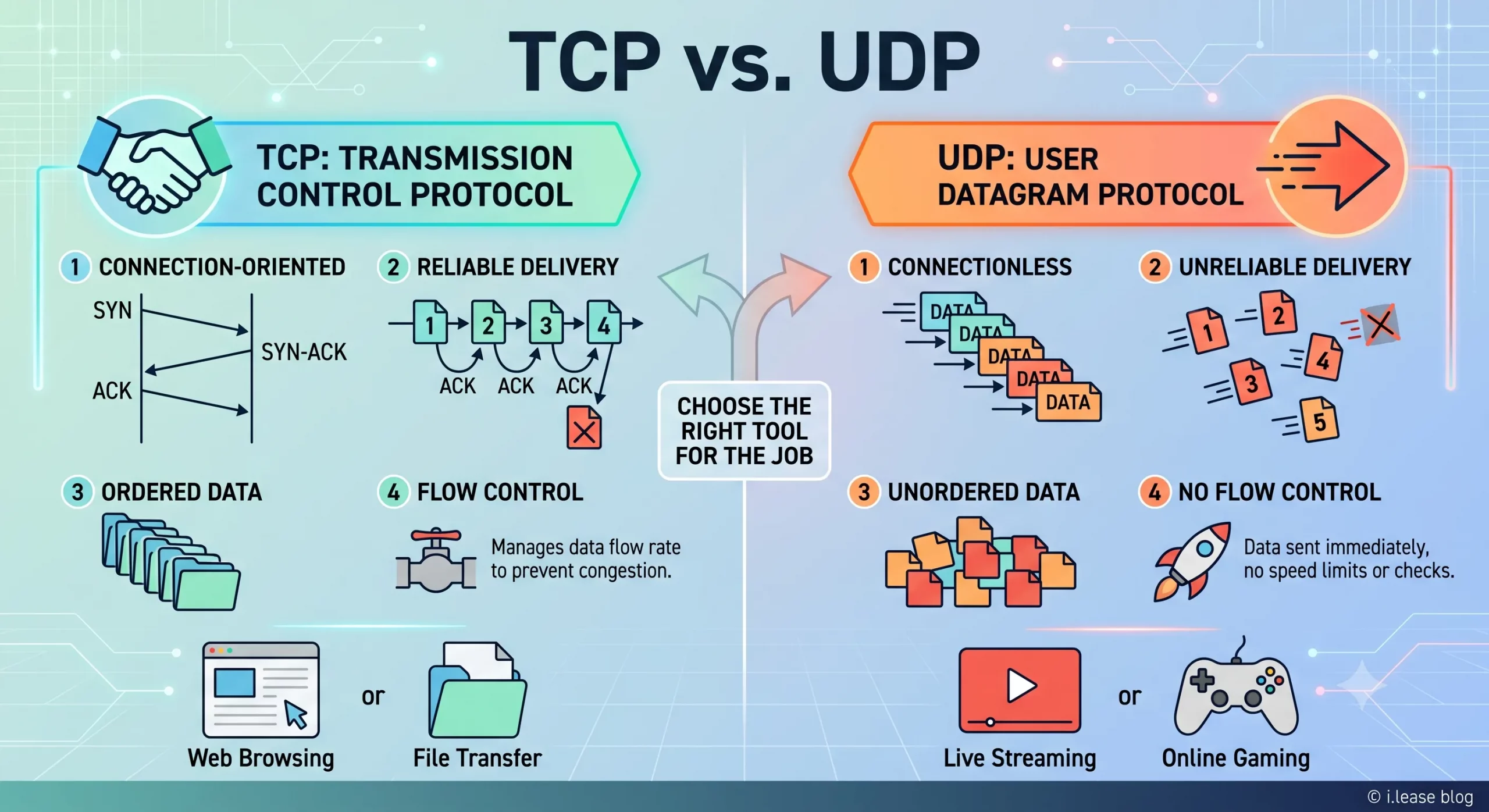
TCP 与 UDP:IPv4 租赁和企业网络指南
TCP 和 UDP 是互联网中最重要的两种传输层协议。它们决定数据如何在设备、服务器、云平台、VPN 网关、DNS 解析器、电子邮件系统、流媒体平台以及企业应用程序之间传输。 对于企业而言,TCP 和 UDP 不仅仅是技术术语,它们会直接影响实际的基础设施性能。公网 IPv4 地址提供可从互联网访问的网络端点,而 TCP 和 UDP 则决定流量如何通过该端点进行传输。 这对于租用或购买 IPv4 地址的企业尤为重要。企业租用 IPv4 地址并不是单纯为了持有这些地址,而是为了运行网站、API、VPN 隧道、DNS 服务、电子邮件平台、SaaS 应用程序、游戏服务器、流媒体系统、安全工具以及云端工作负载。不同类型的服务决定了需要使用 TCP、UDP,还是同时使用两者。 通过 i.lease,企业可以使用 IPv4 租赁服务获取用于实际网络部署的公网 IPv4 资源。需要长期控制 IP 地址资源的企业也可以购买 IP 地址,而拥有闲置 IPv4 资源的组织则可以出售 IP 地址。 TCP和UDP是什么? TCP 和 UDP 都是传输层协议。它们位于 IP 协议之上,帮助应用程序通过网络发送和接收数据。 IP 地址用于确定流量应该发送到哪里,而 TCP 和 UDP 则决定这些流量如何进行传输。 简单来说: TCP 适用于重视可靠性和按顺序传输数据的场景。 UDP 适用于重视速度、低延迟和轻量化数据传输的场景。 企业可能会使用同一个公网 IPv4 地址来运行不同的服务,但每项服务可能依赖不同的传输协议。例如,网站可能使用 TCP,VPN 网关可能使用 UDP,DNS 解析器可能同时使用 UDP 和 TCP,而游戏服务器则可能更倾向于使用 UDP,因为对于实时游戏而言,延迟造成的影响通常比少量数据包丢失更加明显。 因此,TCPRead more Related Posts 什么是 CGNAT(运营商级 NAT)?它为何会影响主机托管、游戏和入站服务? CGNAT(Carrier-Grade NAT,运营商级网络地址转换)是一种技术,它允许互联网服务提供商让多个客户同时共享同一个公共 IPv4 地址,而不是为每位客户单独分配一个公共 IPv4 地址。 它会在服务提供商的网络内部增加第二层网络地址转换,因此数百甚至数千名用户都位于同一个公共地址之后,而外部互联网看到的只是这个共享的公共地址。对于日常网页浏览、流媒体播放和应用程序使用来说,CGNAT 通常不会被用户察觉。问题会在外部网络需要主动连接到你时出现,例如托管服务器、进行端口转发、运行游戏服务器、接收 VoIP 或 VPN 连接,或启用远程访问。由于你不再拥有属于自己的公共地址——而是与其他陌生用户共享同一个地址——传入连接无法明确知道应该被转发到哪一个用户,因此这些服务可能无法正常工作或变得不稳定。CGNAT 并不是程序错误或配置错误。它是针对一个结构性现实而采取的有意解决方案:全球 IPv4 地址已经不足,而互联网服务提供商仍需要在公共地址数量有限的情况下继续连接新的客户。这使 CGNAT 成为普通用户最容易接触到的一个明显迹象,说明公共 IPv4 地址是一种有限且竞争激烈的资源;同时也清楚说明了为什么运行对外服务的企业需要拥有自己的专用公共地址空间。本文将介绍什么是 CGNAT、它如何运作、具体会影响哪些功能、如何判断自己是否处于 什么是电信公司?电信运营商如何为英国、美国和加拿大提供网络连接支持? 电信公司(Telco Companies),也称为电信运营商(Telecommunications Companies),提供通信与网络连接服务。这些服务包括移动通信网络、宽带互联网、光纤连接、固定电话服务、企业网络连接、云连接、托管网络服务以及数据中心连接等。 对于普通消费者而言,电信公司通常被视为移动通信或宽带互联网服务提供商。对于企业来说,电信公司远不只是一个服务品牌,更是关键的基础设施合作伙伴,帮助企业连接办公室、数据中心、云平台、远程员工、客户应用程序以及各类数字化服务。 随着企业越来越依赖云平台、SaaS 应用、AI 工具、VPN、网络安全系统以及在线服务,电信公司已成为数字基础设施规划中不可或缺的重要组成部分。 电信公司是什么? 电信公司(Telco Companies)是提供电信服务的企业。这些服务让个人、设备、企业和各种系统能够跨越距离进行通信与连接。 一家电信公司可能提供以下服务: 移动通信服务 宽带互联网 光纤连接 固定电话服务 企业互联网接入 企业广域网(WAN)服务 云连接服务 数据中心连接 VPN 什么是BYOIP(自备IP地址)? 自带 IP(Bring Your Own IP,简称 BYOIP)是一种网络部署方式,允许企业将自己现有的公网 IP 地址段应用于云服务提供商、数据中心、内容分发网络(CDN)或其他基础设施平台。 企业无需使用服务提供商分配的新公网 IP 地址,而是可以使用自己已拥有或已获授权使用的 IPv4 或 IPv6 地址前缀。服务提供商会验证该组织对该地址段的使用权限,并在支持的情况下,通过其自身网络对该地址段进行路由公告(Advertise)。 BYOIP 有助于企业在迁移至云平台时保留现有的防火墙规则、白名单(Allowlists)、客户系统集成、IP 信誉(IP Reputation)、DNS 配置以及既有的网络身份。这不仅能够减少因更换 .related-post {} .related-post .post-list { text-align: left; } .related-post .post-list .item { margin: 5px; padding: 10px; } .related-post .headline { font-size: 18px !important; color: #999999 !important; } .related-post .post-list .item .post_thumb { max-height: 220px; margin: 10px 0px; padding: 0px; display: block; } .related-post .post-list .item .post_title { font-size: 16px; color: #3f3f3f; margin: 10px 0px; padding: 0px; display: block; text-decoration: none; } .related-post .post-list .item .post_excerpt { font-size: 13px; color: #3f3f3f; margin: 10px 0px; padding: 0px; display: block; text-decoration: none; } @media only screen and (min-width: 1024px) { .related-post .post-list .item { width: 30%; } } @media only screen and (min-width: 768px) and (max-width: 1023px) { .related-post .post-list .item { width: 90%; } } @media only screen and (min-width: 0px) and (max-width: 767px) { .related-post .post-list .item { width: 90%; } }
