How DDoS Mitigation Works: Scrubbing, BGP Diversion, Anycast, and What Network Operators Should Prepare
 Stephanie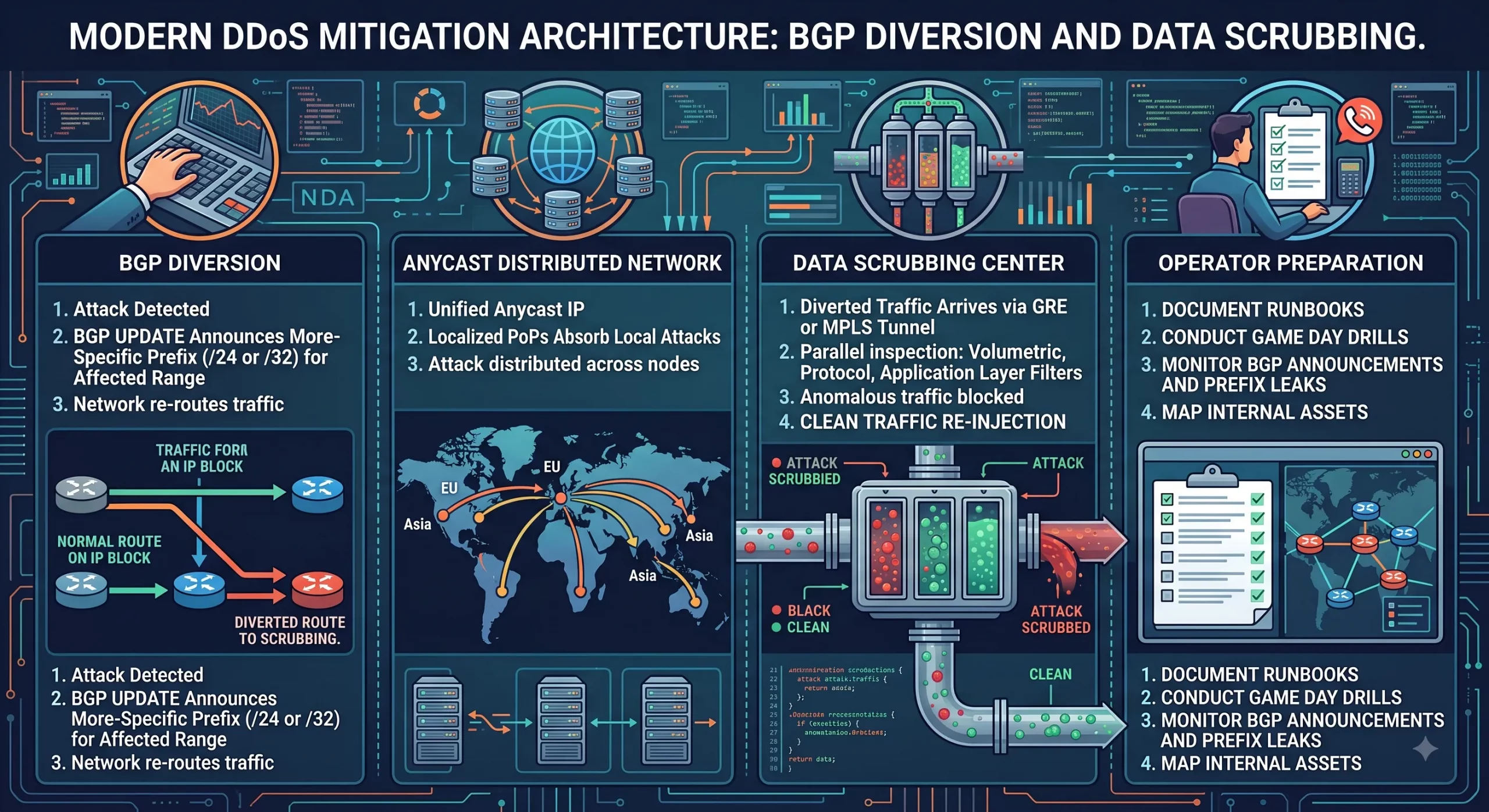
DDoS mitigation is the set of techniques used to keep services online during a distributed denial-of-service attack — by absorbing, diverting, filtering, or discarding attack traffic before it overwhelms the target. Detection tells you an attack is happening; mitigation is what keeps customers connected while it does.
Table of Contents
Most explanations of DDoS focus on the attack side: the types, the botnets, the traffic volumes. We cover that ground in our guide to the different types of DDoS attacks. This article covers the other side — what actually happens when a network defends itself, and what a business needs to have in place before an attack for those defenses to work.
One point shapes everything that follows: serious DDoS mitigation is largely a routing operation. Scrubbing centers receive traffic because a prefix’s BGP announcement is redirected to them. Blackholing works by announcing a route that discards traffic to a targeted address. Anycast absorbs attacks by announcing the same prefix from many locations at once. Because these techniques operate on announcements, a business’s mitigation options depend on how it holds and announces its IP address space — a dependency usually discovered during the first serious attack, which is the most expensive possible time to learn it.
What Is DDoS Mitigation?
DDoS mitigation is the process of protecting a target from distributed denial-of-service attacks by filtering out malicious traffic while allowing legitimate traffic through. The goal is not to make the attack stop — attackers control that — but to make it ineffective: services stay reachable, customers stay connected, and the attack traffic is absorbed or discarded somewhere it cannot cause harm.
Mitigation can happen at several places along the path between attacker and target: inside the target’s own network, at the target’s upstream providers, at a dedicated scrubbing facility, or distributed across a global anycast network. Where the mitigation happens matters enormously, because of a simple physical constraint: traffic must be stopped before it fills a link, not after. A volumetric attack larger than your Internet connection cannot be filtered by any device sitting behind that connection — the link is already saturated by the time the packets reach your equipment. This single constraint explains most of the architecture of modern DDoS defense.
The Four Stages of DDoS Mitigation
Effective mitigation follows four stages: detection, diversion, filtering, and return of clean traffic.
- Detection. Monitoring systems identify that traffic toward a target deviates from its baseline — sudden volume spikes, unusual protocol mixes, abnormal connection patterns. Detection speed matters: the gap between attack start and mitigation activation is the outage window.
- Diversion. Traffic destined for the target is redirected to wherever the filtering will happen. In on-demand scrubbing models, this is typically done by changing BGP announcements so the protected prefix routes through the scrubbing provider. In always-on and anycast models, traffic already flows through the protection layer, so no diversion step is needed.
- Filtering (scrubbing). The mitigation layer separates attack traffic from legitimate traffic using signatures, rate limits, protocol validation, challenge mechanisms, and behavioral analysis. Volumetric floods are dropped in bulk; more subtle application-layer attacks require finer inspection.
- Return of clean traffic. Legitimate traffic is forwarded on to the real infrastructure, commonly through a tunnel or private interconnect back to the origin, so services continue operating behind the shield.
Different techniques implement these stages differently — which is where the real decisions lie.
DDoS Mitigation Techniques Compared
1. Upstream and ISP filtering
The simplest option: your transit provider or ISP filters attack traffic before it reaches your link. Many providers offer basic protection — rate limiting, filtering of obviously malformed traffic — and some sell managed DDoS protection as an add-on. The strength of this approach is position: the provider sits upstream of your connection, so it can stop volumetric traffic before your link saturates. The limitation is depth and control: basic provider filtering is often coarse, activation may require a support ticket, and you are limited to whatever that one provider offers.
2. Scrubbing centers and BGP diversion
A scrubbing center is a high-capacity facility built specifically to absorb and filter attack traffic. In the common on-demand model, the protected business (or its provider) withdraws or adjusts the normal BGP announcement for the targeted prefix and the scrubbing provider announces it instead — usually as a more specific route, which the Internet’s routing system prefers. All traffic for that prefix, attack and legitimate alike, now flows to the scrubbing facility, which filters it and returns clean traffic to the origin through a tunnel (commonly GRE) or a direct interconnect.
This is where the routing dependency becomes concrete: diverting a prefix to a scrubbing center requires the authority to change how that prefix is announced. The scrubbing provider must be authorized to announce your space — which involves the same LOA, ROA, and route-object machinery described in our guide to how BGP works. If the RPKI ROA for your prefix names only your origin ASN, the scrubbing provider’s emergency announcement may be rejected by networks enforcing origin validation — so protection arrangements need to be reflected in routing records before the attack, not during it.
3. Remotely Triggered Blackhole (RTBH)
RTBH is the bluntest instrument in the toolkit: the network announces a special route that tells upstream providers to discard all traffic destined for a specific address. The attack traffic disappears — and so does all legitimate traffic to that address. RTBH deliberately completes the attacker’s goal for one address in order to protect everything else: the targeted address goes dark, but the link is no longer saturated and every other service on the network stays up.
RTBH makes sense when one address is targeted and the collateral saturation threatens the whole network. Its usefulness depends on granularity: blackholing a single /32 out of a /24 you control preserves 255 other addresses; if your provider can only blackhole at coarser granularity, or the targeted address hosts your only public service, RTBH is simply a self-inflicted outage. Operators with address headroom sometimes move a targeted service to a different address within their block and blackhole the old one — an option that exists only when you have spare, controllable address space.
4. Anycast absorption
Anycast announces the same IP prefix from many locations around the world. Traffic — including attack traffic — is routed to the nearest announcement point, so a globally distributed attack is automatically divided among dozens of sites instead of concentrating on one. No single location receives the full attack volume, and each site filters its share. This is the architecture behind the largest commercial DDoS protection networks and much of the global DNS infrastructure. Its precondition is structural: anycast requires a prefix that can be announced from multiple locations — either your own portable space announced from your own distributed presence, or (far more commonly) services fronted by a provider whose anycast network does this for you.
5. CDN and reverse-proxy protection
For websites and HTTP APIs, putting a CDN or reverse-proxy service in front of the origin provides substantial DDoS protection as a side effect: the provider’s anycast edge absorbs volumetric attacks, and its application layer filters HTTP floods. The critical limitation is scope — this protects the traffic that flows through the proxy, which means HTTP(S). Mail servers, VPN gateways, game servers, DNS resolvers, and any non-HTTP service remain exposed on their real addresses. A second common failure: if the origin’s real IP address is discoverable (old DNS records, mail headers, careless configuration), attackers bypass the proxy and hit the origin directly. Proxy-based protection is only as good as the secrecy and filtering around the origin address.
6. On-premises appliances
Dedicated mitigation hardware inside your own network can inspect traffic at line rate, handle application-layer attacks with full knowledge of your services, and react instantly without third-party involvement. What it cannot do is defeat a volumetric attack larger than your upstream link — the physics problem from earlier. On-premises equipment is therefore a complement to upstream capacity, not a substitute for it: it excels against protocol and application-layer attacks that fit within your bandwidth, and pairs naturally with cloud scrubbing for everything larger (a combination often sold as “hybrid” mitigation).
Which Technique Handles Which Attack?
| Technique | Best against | Weak against | What it requires |
|---|---|---|---|
| Upstream/ISP filtering | Volumetric floods (stopped before your link) | Application-layer attacks; anything needing fine-grained policy | Provider offering it; often ticket-based activation |
| Scrubbing center (BGP diversion) | Large volumetric and protocol attacks on any service type | Nothing inherently — but activation takes minutes and needs pre-arranged routing authority | Announceable prefix, authorization for provider announcements (LOA/ROA/route objects), return tunnel |
| RTBH (blackholing) | Saving the network when one address is targeted | Protecting the targeted service itself (it goes offline by design) | Provider support for blackhole announcements; address granularity and headroom |
| Anycast absorption | Distributed volumetric attacks (divided across sites) | Attacks concentrated near one site; requires global footprint | Multi-site announcement of the prefix — usually via a protection provider |
| CDN / reverse proxy | HTTP(S) floods and volumetric attacks on web properties | Non-HTTP services; origin-IP exposure bypasses it entirely | Proxyable service; strict origin-IP hygiene |
| On-premises appliance | Protocol and application-layer attacks within link capacity | Volumetric attacks exceeding upstream bandwidth | Capital investment; skilled operation; pairing with upstream capacity |
In practice, resilient operators layer several of these: proxy or anycast protection for web properties, scrubbing arrangements for the rest of the prefix, RTBH as the emergency valve, and on-premises inspection for application-layer subtlety.
Why Your IP Holding Model Shapes Your Mitigation Options
Because mitigation operates on announcements, the party that controls a prefix’s announcements controls the mitigation options — and that party depends on how the business holds its IP space.
- Provider-assigned addresses. Your addresses belong to your hosting or connectivity provider’s blocks, announced under their ASN. Your mitigation menu is exactly what that provider offers: their filtering, their scrubbing partnerships, their blackhole policy, on their timeline. You cannot divert the prefix to a scrubbing service of your choice, because the announcement is not yours to redirect. If protection is inadequate, the remedy is changing providers — which means renumbering every service.
- Your own or leased prefixes, announced under your control. When the business announces its own space — owned or leased with proper routing authorization — the full menu opens. You can contract with any scrubbing provider and authorize their emergency announcements; request blackholing at /32 granularity through your upstreams; move a targeted service within your block; and change protection providers without touching a single service address. The prefix is the stable identity; the protection behind it becomes swappable.
- Leased space specifically. Everything above applies to leased prefixes with one addition: the routing authorization must genuinely support it. A lease that includes clear LOA arrangements, ROA cooperation, and responsive record updates — the structure a IPv4 leasing arrangement should provide supports scrubbing diversion and blackholing exactly as owned space does. A lease that delivers only addresses, with an unresponsive upstream chain, leaves the lessee unable to authorize emergency announcements when minutes matter. DDoS readiness is therefore another entry on the list of what to verify before leasing, alongside the reputation and deployment factors covered in our IPv4 leasing guide.
To keep the claim precise: no holding model prevents attacks, and none guarantees survival — attackers do not consult your registry records. What announcement control provides is options and speed: the ability to enact any mitigation strategy the market offers, rather than the subset one provider happens to sell.
Always-On vs On-Demand Protection
Always-on protection routes all traffic through the mitigation layer permanently; on-demand protection activates diversion only when an attack is detected. The trade-off is straightforward:
| Factor | Always-on | On-demand |
|---|---|---|
| Time to mitigate | Immediate — traffic is already inside the protection layer | Minutes: detection, BGP change, propagation |
| Latency in peacetime | Small permanent overhead from the extra hop (often negligible on good networks) | None — normal routing until activation |
| Cost | Higher — capacity reserved continuously | Lower base cost; some plans charge per incident |
| Best for | Revenue-critical, frequently attacked, or latency-tolerant services | Services that can tolerate a short exposure window; cost-sensitive deployments |
A reasonable decision rule: calculate what a ten-minute outage costs your business. If that number exceeds the annual price difference between the two models, always-on pays for itself the first time it matters.
Building a DDoS Response Plan
A response plan converts mitigation capability into mitigation speed. The technical arrangements above are necessary but not sufficient — during an attack, the bottleneck is usually human coordination. A workable plan fits on a few pages:
- Baseline and thresholds. Document normal traffic levels per service, and the thresholds at which detection alerts and mitigation activates. Without a baseline, every anomaly is a debate.
- Decision authority. Name who can order diversion to scrubbing, who can request a blackhole, and who informs customers — including at 3 a.m. on a weekend.
- Contact runbook. Emergency contacts and authentication details for every upstream provider and the scrubbing service, verified quarterly. A mitigation contract with an unreachable activation desk is decoration.
- Pre-authorized routing changes. LOAs on file with the scrubbing provider, ROAs that accommodate their announcements, route objects aligned — all confirmed before any attack, per the earlier section.
- Service triage order. Which services are protected first, which addresses may be sacrificed via RTBH, and where services move if renumbering within the block becomes necessary.
- Origin hygiene. For proxied services, a standing check that real origin addresses are not leaking through DNS history, mail headers, or subdomains.
- Testing. An annual (minimum) activation test with the scrubbing provider — diversion, filtering, clean-traffic return — because the first real attack is the wrong moment to discover a misconfigured tunnel.
- Post-incident review. After any attack: what was targeted, what worked, activation time, and what changes.
Limitations and Honest Caveats
Several truths that vendor marketing tends to soften:
- No mitigation is absolute. Record-setting attacks grow yearly, and a sufficiently large or novel attack can degrade any defense. The realistic goal is raising the attacker’s cost above their motivation, and shrinking outage windows from hours to minutes.
- Blackholing is a controlled loss, not a save. RTBH protects the network by abandoning the target. Plans that rely on it should acknowledge what is being given up.
- Scrubbing has false positives. Aggressive filtering during an attack can drop some legitimate users — particularly those behind unusual network configurations. Clean-traffic guarantees are statistical, not perfect.
- Application-layer attacks evade volumetric defenses. A low-and-slow HTTP attack can pass through a scrubbing center that is watching for floods. Layered inspection exists precisely because no single filter sees everything.
- Protection follows preparation. Nearly every capability in this article — diversion authority, blackhole granularity, tested tunnels, verified contacts — must exist before the attack. Mitigation arranged mid-incident happens at ticket-queue speed while services are down.
Practical Checklist
- Know your link capacity and your normal traffic baseline per service.
- Confirm what DDoS protection each upstream provider includes, and its activation process.
- Decide the protection model per service class: proxy/anycast for web, scrubbing coverage for the rest, appliance if application-layer risk warrants it.
- If using scrubbing: authorization documents filed, ROAs accommodating the provider’s announcements, return tunnel configured and tested.
- Confirm blackhole support and granularity with every upstream.
- For proxied services: verify the origin IP is not discoverable.
- Write the response runbook — thresholds, decision authority, contacts — and test it annually.
- When acquiring or leasing IPv4 space, verify the arrangement supports emergency announcement changes at the speed an attack demands.
Practical Note from i.lease
The pattern behind most painful DDoS incidents is not the absence of protection technology — the market offers plenty. It is that the routing preconditions for using that technology were never put in place. A business signs a scrubbing contract, files it away, and discovers during its first attack that the provider’s emergency announcement is being rejected because the ROA names only the business’s own ASN; or that the upstream needs a fresh LOA that takes hours to process; or that the leased block’s upstream chain cannot authorize anything quickly because nobody is sure who is entitled to ask.
Every one of those failures was checkable in advance, and all of them come down to the same question this site returns to often: who actually controls the announcements behind your addresses, and how fast can that control be exercised? Businesses that hold or lease their IPv4 space through arrangements with clear, responsive routing authority get to use the full mitigation market. Businesses that discover the gaps mid-attack pay for the lesson in downtime. If DDoS resilience is part of why you are structuring your address strategy — whether you Buy IPv4 addresses or lease them — make announcement flexibility an explicit requirement, not an assumption.
Final Thoughts
DDoS mitigation works by moving the fight to where the defender has capacity: upstream filters stop floods before links saturate, scrubbing centers absorb attacks that BGP diversion delivers to them, RTBH sacrifices one address to save the network, and anycast divides global attacks across global infrastructure. Each technique handles different attack classes, which is why serious defenses layer several of them — and why the comparison that matters is not “which product” but “which combination, activated how fast.”
The structural insight for infrastructure planning is that nearly all of it runs on announcements. The business that controls how its prefixes are announced — through ownership or through leasing arrangements with genuine routing authorization — can divert, blackhole, redistribute, and switch protection providers without renumbering anything. The business that cannot is limited to one provider’s menu and one provider’s clock. Attack traffic is the attacker’s decision; how many options you have when it arrives is yours, and it is decided long before the first packet of the flood.
Frequently Asked Questions
How does DDoS scrubbing work?
Traffic for the protected prefix is routed to a high-capacity scrubbing facility — typically by changing the prefix’s BGP announcement — where attack traffic is filtered out and legitimate traffic is forwarded to the real infrastructure through a tunnel or interconnect.
What is blackholing (RTBH) in DDoS defense?
Remotely Triggered Blackhole is an emergency measure where upstream providers are asked to discard all traffic to a targeted address. The targeted service goes offline by design, but the attack traffic stops saturating the network, protecting everything else.
Can a firewall stop a DDoS attack?
Only partially. A firewall can filter protocol and application-layer attacks that fit within your Internet link’s capacity, but it cannot stop a volumetric attack larger than the link — the connection is saturated before packets reach the firewall. Volumetric attacks must be stopped upstream.
Does a CDN protect against DDoS attacks?
For websites and HTTP APIs, substantially yes — the CDN’s distributed edge absorbs volumetric attacks and filters HTTP floods. It does not protect non-HTTP services, and it fails entirely if attackers discover the origin server’s real IP address and target it directly.
How fast can DDoS mitigation activate?
Always-on protection mitigates immediately because traffic already flows through it. On-demand scrubbing typically takes minutes: detection, the BGP announcement change, and route propagation. Arrangements requiring manual tickets or fresh authorizations can take much longer — which is why authorizations should exist in advance.
What is BGP diversion?
BGP diversion is redirecting traffic for a prefix by changing how it is announced — typically having a scrubbing provider announce the prefix (often as a more specific route) so the Internet routes all its traffic through the scrubbing facility during an attack.
Do I need my own IP space for DDoS protection?
No — proxy and CDN-based protection works with any addresses, and providers protect their own assigned space. However, announcing your own or properly leased prefixes gives you the full range of options: choosing your scrubbing provider, fine-grained blackholing, and switching protection services without renumbering.
Can leased IP addresses be protected against DDoS?
Yes, with the same techniques as owned space, provided the lease’s routing authorization genuinely supports it — the lessor and upstream chain must be able to authorize scrubbing announcements and blackhole requests quickly. This capability should be verified before leasing, not during an attack.
How long do DDoS attacks last?
Most attacks last minutes to hours, though sustained campaigns can continue for days with intermittent waves. Attack duration is the attacker’s choice; mitigation aims to make the duration irrelevant by keeping services online throughout.
What does DDoS protection cost?
It ranges from bundled basic filtering included with hosting and transit, through CDN plans, to dedicated always-on scrubbing contracts priced on clean-traffic volume and protected capacity. The practical comparison is protection cost against the revenue and reputation cost of your realistic outage window.
Also Read
相关文章

什么是电信公司?电信运营商如何为英国、美国和加拿大提供网络连接支持?
电信公司(Telco Companies),也称为电信运营商(Telecommunications Companies),提供通信与网络连接服务。这些服务包括移动通信网络、宽带互联网、光纤连接、固定电话服务、企业网络连接、云连接、托管网络服务以及数据中心连接等。 对于普通消费者而言,电信公司通常被视为移动通信或宽带互联网服务提供商。对于企业来说,电信公司远不只是一个服务品牌,更是关键的基础设施合作伙伴,帮助企业连接办公室、数据中心、云平台、远程员工、客户应用程序以及各类数字化服务。 随着企业越来越依赖云平台、SaaS 应用、AI 工具、VPN、网络安全系统以及在线服务,电信公司已成为数字基础设施规划中不可或缺的重要组成部分。 电信公司是什么? 电信公司(Telco Companies)是提供电信服务的企业。这些服务让个人、设备、企业和各种系统能够跨越距离进行通信与连接。 一家电信公司可能提供以下服务: 移动通信服务 宽带互联网 光纤连接 固定电话服务 企业互联网接入 企业广域网(WAN)服务 云连接服务 数据中心连接 VPN 服务 托管网络解决方案 互联网传输(Internet Transit) 电信批发服务 部分电信公司拥有并运营大规模的实体网络基础设施;另一些则通过批发接入、租用基础设施或与网络运营商合作来提供电信服务。 电信公司提供哪些服务? 电信公司同时为个人消费者和企业客户提供服务。 面向消费者的服务通常包括移动通信套餐、家庭宽带、光纤互联网、固定电话以及通信组合套餐。 面向企业的服务则可能包括专线互联网接入、企业光纤、专用网络、云连接、托管安全服务、数据中心连接、物联网(IoT)连接以及企业移动通信方案。 对于大型企业客户,电信公司还可提供: 多地点办公室网络连接 远程员工接入 私有云连接 SD-WAN(软件定义广域网) 灾难恢复连接 低延迟网络路由 互联网传输(Internet Transit) 网络监控 托管防火墙服务 正因如此,电信公司不仅对日常通信至关重要,也是现代企业建设先进数字基础设施的重要支柱。 电信公司 vs 互联网服务提供商 vs 网络运营商 电信公司(Telco)、互联网服务提供商(ISP)和网络运营商(Network Operator)之间可能存在重叠,但它们并不完全相同。 电信公司提供电信服务。 互联网服务提供商(ISP)提供互联网接入服务。 网络运营商负责建设、运营和管理网络基础设施。 一些大型电信公司同时承担这三种角色。它们拥有基础设施、运营网络,并向市场提供互联网、移动通信以及企业网络服务。 规模较小的服务提供商则可能专注于其中某一层。例如,互联网服务提供商(ISP)可以销售宽带服务,而无需拥有所有实体网络基础设施;网络运营商可能负责建设和运营光纤网络,并向电信公司或 ISP 提供批发网络接入;电信公司则可能结合自有网络与合作伙伴网络,为客户提供移动通信和企业服务。 对于企业而言,理解这些区别非常重要,因为服务质量不仅取决于销售该方案的品牌,还受到其底层网络、路由设计、网络覆盖范围以及技术支持体系等因素的影响。 为什么电信公司对企业至关重要 电信公司之所以重要,是因为几乎所有现代企业都依赖稳定的网络连接。 企业可能需要电信服务来支持: 办公室互联网接入 移动网络连接 远程办公 客户支持系统 云应用程序 SaaS 平台 支付系统 VPNRead more Related Posts 什么是电信公司?电信运营商如何为英国、美国和加拿大提供网络连接支持? 电信公司(Telco Companies),也称为电信运营商(Telecommunications Companies),提供通信与网络连接服务。这些服务包括移动通信网络、宽带互联网、光纤连接、固定电话服务、企业网络连接、云连接、托管网络服务以及数据中心连接等。 对于普通消费者而言,电信公司通常被视为移动通信或宽带互联网服务提供商。对于企业来说,电信公司远不只是一个服务品牌,更是关键的基础设施合作伙伴,帮助企业连接办公室、数据中心、云平台、远程员工、客户应用程序以及各类数字化服务。 随着企业越来越依赖云平台、SaaS 应用、AI 工具、VPN、网络安全系统以及在线服务,电信公司已成为数字基础设施规划中不可或缺的重要组成部分。 电信公司是什么? 电信公司(Telco Companies)是提供电信服务的企业。这些服务让个人、设备、企业和各种系统能够跨越距离进行通信与连接。 一家电信公司可能提供以下服务: 移动通信服务 宽带互联网 光纤连接 固定电话服务 企业互联网接入 企业广域网(WAN)服务 云连接服务 数据中心连接 VPN TCP 与 UDP:IPv4 租赁和企业网络指南 TCP 和 UDP 是互联网中最重要的两种传输层协议。它们决定数据如何在设备、服务器、云平台、VPN 网关、DNS 解析器、电子邮件系统、流媒体平台以及企业应用程序之间传输。 对于企业而言,TCP 和 UDP 不仅仅是技术术语,它们会直接影响实际的基础设施性能。公网 IPv4 地址提供可从互联网访问的网络端点,而 TCP 和 UDP 则决定流量如何通过该端点进行传输。 这对于租用或购买 IPv4 地址的企业尤为重要。企业租用 IPv4 什么是区域互联网注册管理机构(RIR) 区域互联网注册管理机构(Regional Internet Registry, RIR)是负责在特定地理区域内分配和管理互联网编号资源的组织。这些资源主要包括 IP 地址(IPv4 和 IPv6)以及自治系统号(ASN),它们是支撑设备和网络在互联网上相互通信的关键要素。 如果没有一套组织完善的系统来分配唯一的 IP 地址和路由标识符,互联网便无法正常运转。RIR 确保这一过程在各自管辖的区域内保持公平、高效与一致,从而避免冲突,并提升互联网治理的透明度。 全球五大 RIR 目前全球共有五家获官方认可的 RIR,各自负责世界上特定的区域:AFRINIC – 非洲网络信息中心(非洲)APNIC – 亚太网络信息中心(亚太地区)ARIN .related-post {} .related-post .post-list { text-align: left; } .related-post .post-list .item { margin: 5px; padding: 10px; } .related-post .headline { font-size: 18px !important; color: #999999 !important; } .related-post .post-list .item .post_thumb { max-height: 220px; margin: 10px 0px; padding: 0px; display: block; } .related-post .post-list .item .post_title { font-size: 16px; color: #3f3f3f; margin: 10px 0px; padding: 0px; display: block; text-decoration: none; } .related-post .post-list .item .post_excerpt { font-size: 13px; color: #3f3f3f; margin: 10px 0px; padding: 0px; display: block; text-decoration: none; } @media only screen and (min-width: 1024px) { .related-post .post-list .item { width: 30%; } } @media only screen and (min-width: 768px) and (max-width: 1023px) { .related-post .post-list .item { width: 90%; } } @media only screen and (min-width: 0px) and (max-width: 767px) { .related-post .post-list .item { width: 90%; } }
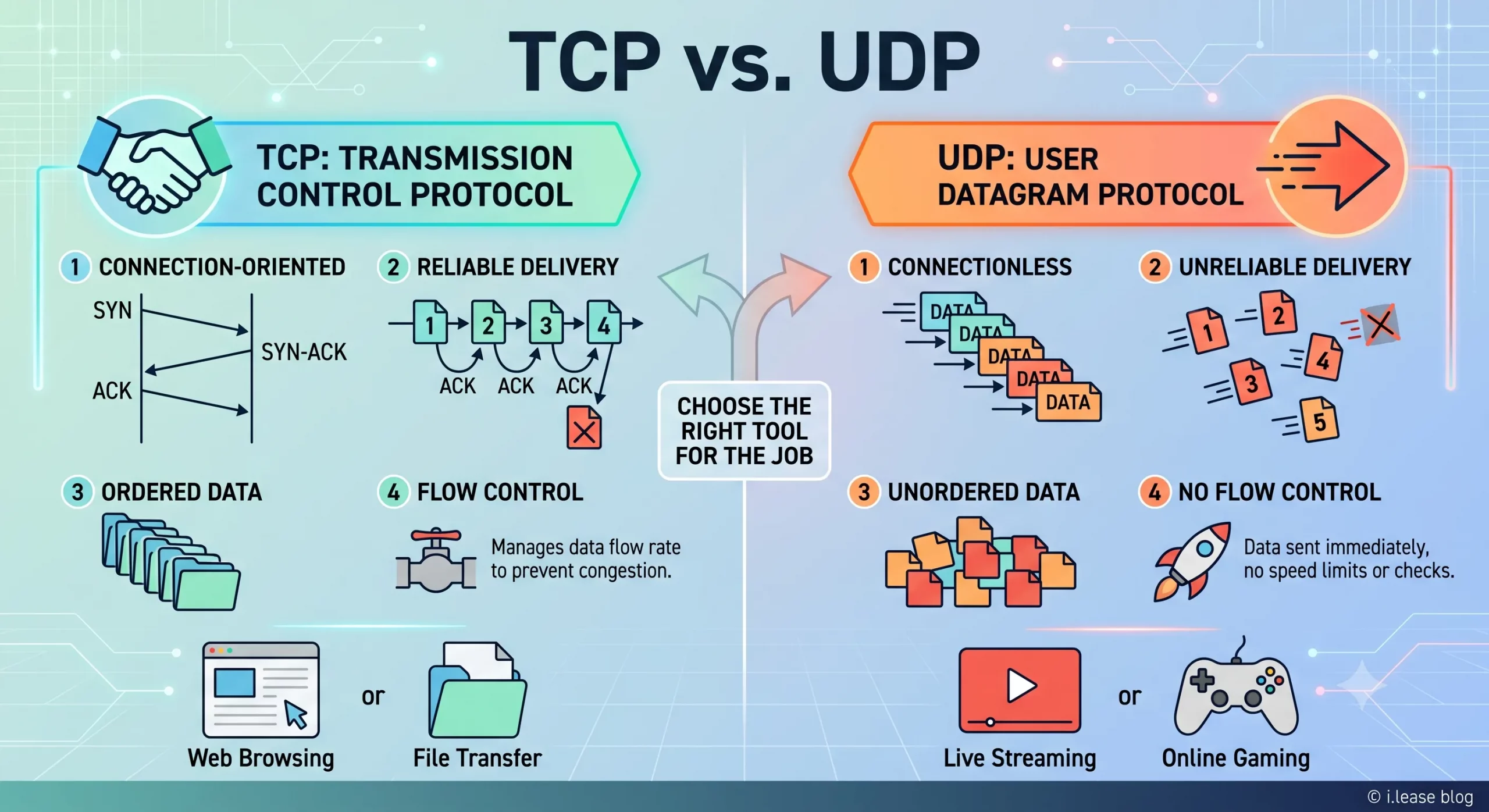
TCP 与 UDP:IPv4 租赁和企业网络指南
TCP 和 UDP 是互联网中最重要的两种传输层协议。它们决定数据如何在设备、服务器、云平台、VPN 网关、DNS 解析器、电子邮件系统、流媒体平台以及企业应用程序之间传输。 对于企业而言,TCP 和 UDP 不仅仅是技术术语,它们会直接影响实际的基础设施性能。公网 IPv4 地址提供可从互联网访问的网络端点,而 TCP 和 UDP 则决定流量如何通过该端点进行传输。 这对于租用或购买 IPv4 地址的企业尤为重要。企业租用 IPv4 地址并不是单纯为了持有这些地址,而是为了运行网站、API、VPN 隧道、DNS 服务、电子邮件平台、SaaS 应用程序、游戏服务器、流媒体系统、安全工具以及云端工作负载。不同类型的服务决定了需要使用 TCP、UDP,还是同时使用两者。 通过 i.lease,企业可以使用 IPv4 租赁服务获取用于实际网络部署的公网 IPv4 资源。需要长期控制 IP 地址资源的企业也可以购买 IP 地址,而拥有闲置 IPv4 资源的组织则可以出售 IP 地址。 TCP和UDP是什么? TCP 和 UDP 都是传输层协议。它们位于 IP 协议之上,帮助应用程序通过网络发送和接收数据。 IP 地址用于确定流量应该发送到哪里,而 TCP 和 UDP 则决定这些流量如何进行传输。 简单来说: TCP 适用于重视可靠性和按顺序传输数据的场景。 UDP 适用于重视速度、低延迟和轻量化数据传输的场景。 企业可能会使用同一个公网 IPv4 地址来运行不同的服务,但每项服务可能依赖不同的传输协议。例如,网站可能使用 TCP,VPN 网关可能使用 UDP,DNS 解析器可能同时使用 UDP 和 TCP,而游戏服务器则可能更倾向于使用 UDP,因为对于实时游戏而言,延迟造成的影响通常比少量数据包丢失更加明显。 因此,TCPRead more Related Posts 什么是电信公司?电信运营商如何为英国、美国和加拿大提供网络连接支持? 电信公司(Telco Companies),也称为电信运营商(Telecommunications Companies),提供通信与网络连接服务。这些服务包括移动通信网络、宽带互联网、光纤连接、固定电话服务、企业网络连接、云连接、托管网络服务以及数据中心连接等。 对于普通消费者而言,电信公司通常被视为移动通信或宽带互联网服务提供商。对于企业来说,电信公司远不只是一个服务品牌,更是关键的基础设施合作伙伴,帮助企业连接办公室、数据中心、云平台、远程员工、客户应用程序以及各类数字化服务。 随着企业越来越依赖云平台、SaaS 应用、AI 工具、VPN、网络安全系统以及在线服务,电信公司已成为数字基础设施规划中不可或缺的重要组成部分。 电信公司是什么? 电信公司(Telco Companies)是提供电信服务的企业。这些服务让个人、设备、企业和各种系统能够跨越距离进行通信与连接。 一家电信公司可能提供以下服务: 移动通信服务 宽带互联网 光纤连接 固定电话服务 企业互联网接入 企业广域网(WAN)服务 云连接服务 数据中心连接 VPN TCP 与 UDP:IPv4 租赁和企业网络指南 TCP 和 UDP 是互联网中最重要的两种传输层协议。它们决定数据如何在设备、服务器、云平台、VPN 网关、DNS 解析器、电子邮件系统、流媒体平台以及企业应用程序之间传输。 对于企业而言,TCP 和 UDP 不仅仅是技术术语,它们会直接影响实际的基础设施性能。公网 IPv4 地址提供可从互联网访问的网络端点,而 TCP 和 UDP 则决定流量如何通过该端点进行传输。 这对于租用或购买 IPv4 地址的企业尤为重要。企业租用 IPv4 什么是区域互联网注册管理机构(RIR) 区域互联网注册管理机构(Regional Internet Registry, RIR)是负责在特定地理区域内分配和管理互联网编号资源的组织。这些资源主要包括 IP 地址(IPv4 和 IPv6)以及自治系统号(ASN),它们是支撑设备和网络在互联网上相互通信的关键要素。 如果没有一套组织完善的系统来分配唯一的 IP 地址和路由标识符,互联网便无法正常运转。RIR 确保这一过程在各自管辖的区域内保持公平、高效与一致,从而避免冲突,并提升互联网治理的透明度。 全球五大 RIR 目前全球共有五家获官方认可的 RIR,各自负责世界上特定的区域:AFRINIC – 非洲网络信息中心(非洲)APNIC – 亚太网络信息中心(亚太地区)ARIN .related-post {} .related-post .post-list { text-align: left; } .related-post .post-list .item { margin: 5px; padding: 10px; } .related-post .headline { font-size: 18px !important; color: #999999 !important; } .related-post .post-list .item .post_thumb { max-height: 220px; margin: 10px 0px; padding: 0px; display: block; } .related-post .post-list .item .post_title { font-size: 16px; color: #3f3f3f; margin: 10px 0px; padding: 0px; display: block; text-decoration: none; } .related-post .post-list .item .post_excerpt { font-size: 13px; color: #3f3f3f; margin: 10px 0px; padding: 0px; display: block; text-decoration: none; } @media only screen and (min-width: 1024px) { .related-post .post-list .item { width: 30%; } } @media only screen and (min-width: 768px) and (max-width: 1023px) { .related-post .post-list .item { width: 90%; } } @media only screen and (min-width: 0px) and (max-width: 767px) { .related-post .post-list .item { width: 90%; } }
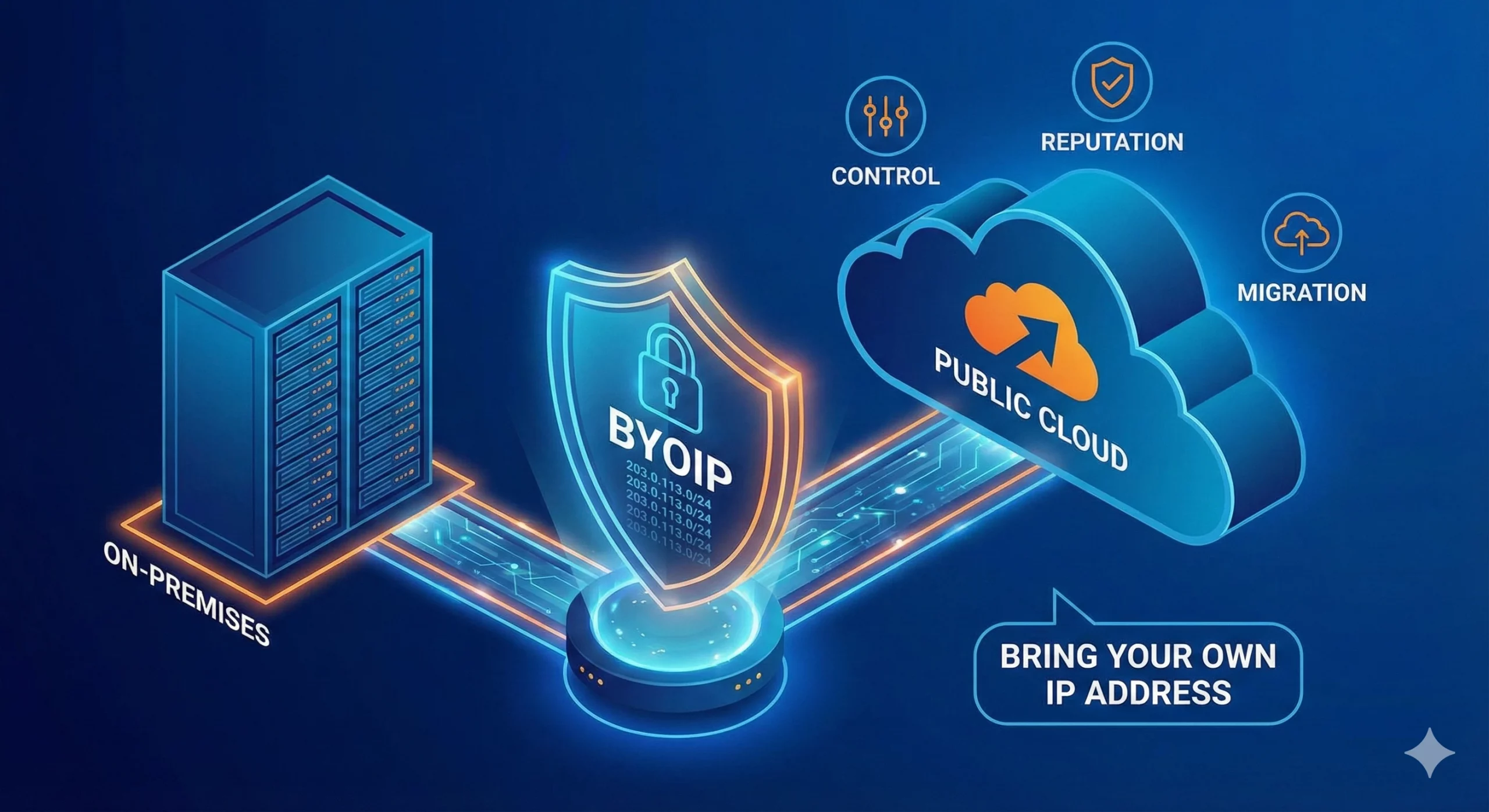
什么是BYOIP(自备IP地址)?
自带 IP(Bring Your Own IP,简称 BYOIP)是一种网络部署方式,允许企业将自己现有的公网 IP 地址段应用于云服务提供商、数据中心、内容分发网络(CDN)或其他基础设施平台。 企业无需使用服务提供商分配的新公网 IP 地址,而是可以使用自己已拥有或已获授权使用的 IPv4 或 IPv6 地址前缀。服务提供商会验证该组织对该地址段的使用权限,并在支持的情况下,通过其自身网络对该地址段进行路由公告(Advertise)。 BYOIP 有助于企业在迁移至云平台时保留现有的防火墙规则、白名单(Allowlists)、客户系统集成、IP 信誉(IP Reputation)、DNS 配置以及既有的网络身份。这不仅能够减少因更换 IP 地址而带来的业务中断,还能降低对服务提供商分配 IP 的依赖,使未来的基础设施迁移与扩展更加灵活且易于管理。 对于需要 BYOIP 地址资源的企业,可选择 购买 IPv4 地址(Buy IP),以获得长期控制权;如果更重视灵活性,也可采用 IPv4 租赁(IPv4 Leasing),按业务需求获取公网 IP 资源。 什么是BYOIP? BYOIP 是 Bring Your Own IP(自带 IP)的缩写。这是一种网络部署模式,允许组织将现有的公网 IP 地址段带入云服务提供商或其他基础设施平台使用。 在 BYOIP 模式下,组织仍然拥有或保留该 IP 地址段的使用权,而平台则获得授权,可在其基础设施中对该地址段进行路由公告(Advertise)和使用。随后,这些 IP 地址可分配给虚拟机(Virtual Machines)、负载均衡器(Load Balancers)、VPN 网关、内容分发服务(CDN)、安全平台以及公网应用程序端点等受支持的服务。 例如,一家企业将应用程序从本地数据中心迁移到云环境时,可能并不希望更换现有的公网 IP 地址。这些 IP 地址可能已经存在于客户白名单(Allowlists)、防火墙策略、DNS 记录、合作伙伴配置以及电子邮件信誉(Email Reputation)数据库中。 BYOIP 使企业能够在迁移工作负载的同时,继续使用原有的公网 IP 地址,从而保持更一致的网络身份,并减少因更换 IP 地址而带来的配置调整和业务影响。 Related Posts 什么是电信公司?电信运营商如何为英国、美国和加拿大提供网络连接支持? 电信公司(Telco Companies),也称为电信运营商(Telecommunications Companies),提供通信与网络连接服务。这些服务包括移动通信网络、宽带互联网、光纤连接、固定电话服务、企业网络连接、云连接、托管网络服务以及数据中心连接等。 对于普通消费者而言,电信公司通常被视为移动通信或宽带互联网服务提供商。对于企业来说,电信公司远不只是一个服务品牌,更是关键的基础设施合作伙伴,帮助企业连接办公室、数据中心、云平台、远程员工、客户应用程序以及各类数字化服务。 随着企业越来越依赖云平台、SaaS 应用、AI 工具、VPN、网络安全系统以及在线服务,电信公司已成为数字基础设施规划中不可或缺的重要组成部分。 电信公司是什么? 电信公司(Telco Companies)是提供电信服务的企业。这些服务让个人、设备、企业和各种系统能够跨越距离进行通信与连接。 一家电信公司可能提供以下服务: 移动通信服务 宽带互联网 光纤连接 固定电话服务 企业互联网接入 企业广域网(WAN)服务 云连接服务 数据中心连接 VPN TCP 与 UDP:IPv4 租赁和企业网络指南 TCP 和 UDP 是互联网中最重要的两种传输层协议。它们决定数据如何在设备、服务器、云平台、VPN 网关、DNS 解析器、电子邮件系统、流媒体平台以及企业应用程序之间传输。 对于企业而言,TCP 和 UDP 不仅仅是技术术语,它们会直接影响实际的基础设施性能。公网 IPv4 地址提供可从互联网访问的网络端点,而 TCP 和 UDP 则决定流量如何通过该端点进行传输。 这对于租用或购买 IPv4 地址的企业尤为重要。企业租用 IPv4 什么是区域互联网注册管理机构(RIR) 区域互联网注册管理机构(Regional Internet Registry, RIR)是负责在特定地理区域内分配和管理互联网编号资源的组织。这些资源主要包括 IP 地址(IPv4 和 IPv6)以及自治系统号(ASN),它们是支撑设备和网络在互联网上相互通信的关键要素。 如果没有一套组织完善的系统来分配唯一的 IP 地址和路由标识符,互联网便无法正常运转。RIR 确保这一过程在各自管辖的区域内保持公平、高效与一致,从而避免冲突,并提升互联网治理的透明度。 全球五大 RIR 目前全球共有五家获官方认可的 RIR,各自负责世界上特定的区域:AFRINIC – 非洲网络信息中心(非洲)APNIC – 亚太网络信息中心(亚太地区)ARIN .related-post {} .related-post .post-list { text-align: left; } .related-post .post-list .item { margin: 5px; padding: 10px; } .related-post .headline { font-size: 18px !important; color: #999999 !important; } .related-post .post-list .item .post_thumb { max-height: 220px; margin: 10px 0px; padding: 0px; display: block; } .related-post .post-list .item .post_title { font-size: 16px; color: #3f3f3f; margin: 10px 0px; padding: 0px; display: block; text-decoration: none; } .related-post .post-list .item .post_excerpt { font-size: 13px; color: #3f3f3f; margin: 10px 0px; padding: 0px; display: block; text-decoration: none; } @media only screen and (min-width: 1024px) { .related-post .post-list .item { width: 30%; } } @media only screen and (min-width: 768px) and (max-width: 1023px) { .related-post .post-list .item { width: 90%; } } @media only screen and (min-width: 0px) and (max-width: 767px) { .related-post .post-list .item { width: 90%; } }
