Key points:
Table of Contents
- IPv4 transfer delays are primarily driven by registry policy complexity and incomplete or inconsistent documentation.
- Early preparation, pre-approval and professional transfer management can dramatically shorten timelines.
IPv4 transfers in an era of scarcity
IPv4 transfers were once considered routine administrative procedures. Today, they represent one of the most time-consuming and underestimated processes in enterprise networking. With the global free pool exhausted, every IPv4 address now moves through formal transfer mechanisms overseen by regional internet registries.
This shift has transformed IPv4 into a regulated asset. Organisations seeking address space must comply with strict policy requirements, undergo verification checks and coordinate with counterparties whose own records and compliance status may be unclear. The result is a process that frequently takes months, even when commercial terms are already agreed.
For enterprises operating on tight deployment schedules, these delays can disrupt cloud expansion, data centre builds and customer onboarding.
Policy fragmentation across regions
A major source of delay lies in the lack of global uniformity. Each regional internet registry applies its own transfer rules, reflecting local policy development rather than a single global standard.
Some regions require recipients to demonstrate immediate operational need. Others impose minimum utilisation thresholds or cooling-off periods before addresses can be transferred again. These differences matter greatly when IPv4 blocks move across regional boundaries.
Inter-regional transfers must satisfy the requirements of both the source and destination regions. Any mismatch can trigger extended review cycles, manual interpretation of policy or additional documentation requests.
As one long-standing policy contributor explains, “IPv4 transfers don’t fail because of bad intent, but because people underestimate how different the rules are from region to region”.
Documentation: where most transfers stall
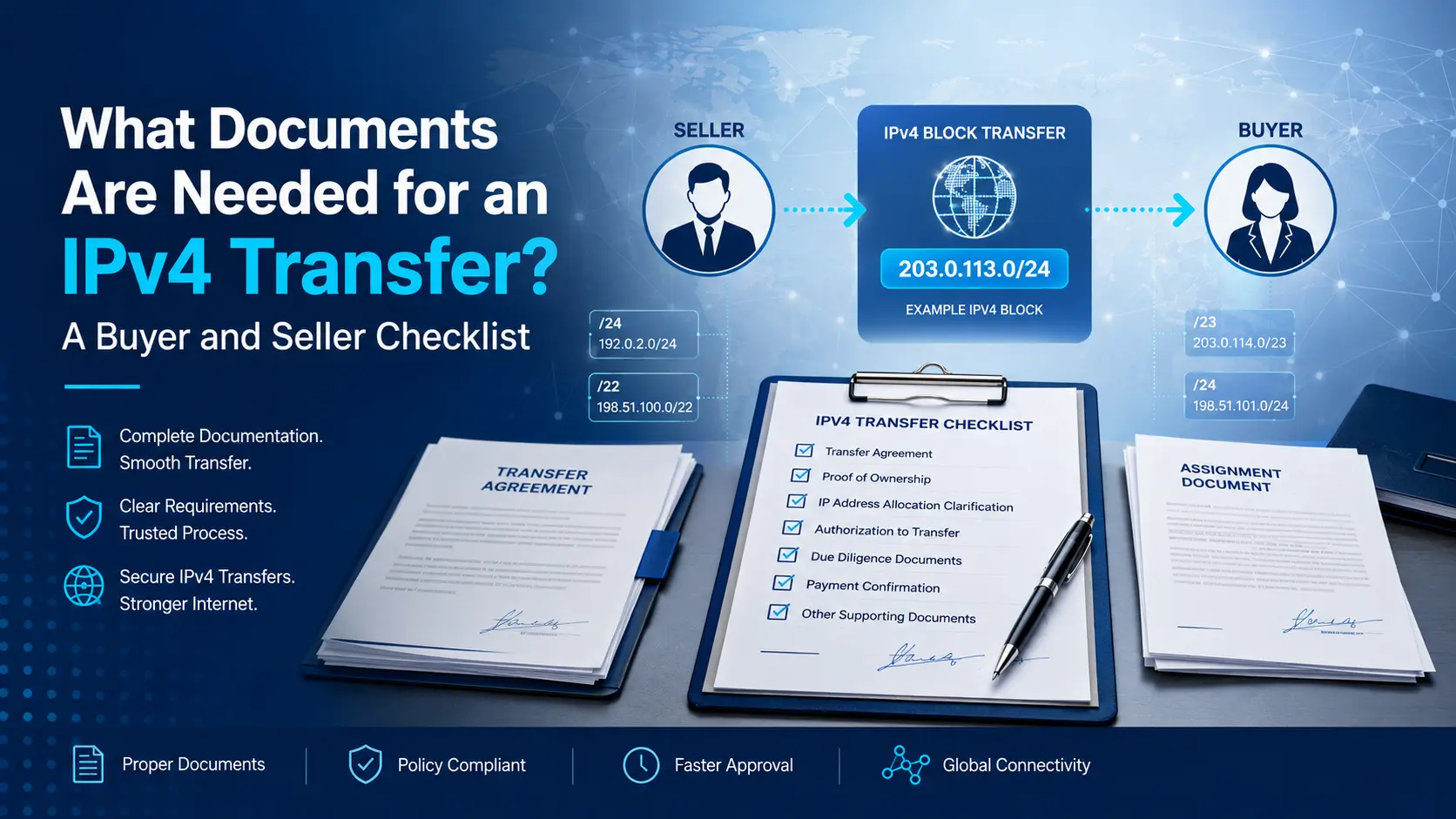
Incomplete or outdated documentation remains the most common reason IPv4 transfers slow down. Registries must verify ownership, authority and eligibility, and they rely heavily on registry records that may not reflect current corporate realities.
Mergers, acquisitions and internal restructures often leave registry data out of sync. When names, contacts or legal entities do not match exactly, registries pause processing until discrepancies are resolved.
These pauses can last weeks, particularly when historical documentation must be retrieved or multiple parties must provide authorisation. In many cases, the technical transfer is straightforward; the administrative cleanup is not.
Inter-regional transfers and compounded delays
Transfers between regions introduce additional layers of complexity. Policies may differ on acceptable block sizes, historical usage or transfer frequency. Registries must also coordinate with one another, extending review timelines beyond those of intra-regional transfers.
For enterprises unfamiliar with these nuances, inter-regional transactions can quickly become unpredictable, with approval dates shifting repeatedly as new requirements emerge.
The importance of pre-approval
Pre-approval is one of the most effective tools for reducing uncertainty. By validating eligibility and need in advance, recipients remove a major source of delay from the transaction phase.
Pre-approved organisations enter negotiations knowing exactly what size block they can receive and under what conditions. This reduces the risk of last-minute rejection and shortens registry review once a transfer is submitted.
Without pre-approval, many enterprises only discover policy obstacles after commercial agreements are in place.
Brokers, escrow and structured execution
Professional brokers and escrow services play a growing role in managing IPv4 transfers efficiently. Their experience allows them to identify potential policy or documentation issues early, before registry submission.
Brokers also coordinate communication between buyers, sellers and registries, reducing misunderstandings that can prolong review. Escrow arrangements ensure that financial settlement aligns with registry approval, preventing disputes that can freeze transfers mid-process.
As one address market specialist notes, “most long delays are preventable with proper structuring”.
Delays in IPv4 transfers are rarely about the technology itself; they’re almost always caused by paperwork, verification steps, and differing policies across Regional Internet Registries. Companies that plan ahead, keep their registry information up to date, and engage experienced brokers usually experience smooth, faster transfers. Treat compliance as part of the transfer process, not an afterthought, and you can cut months off the timeline
-Michael Tan, Senior IPv4 Strategy Consultant
Internal readiness matters too
Even after registry approval, delays can arise from within the organisation. Routing updates, DNS configuration and internal change approvals all take time, especially in large enterprises with layered governance.
Treating IPv4 transfers as cross-functional projects rather than isolated technical tasks helps ensure that operational steps do not become the final bottleneck.
IPv4 transfers often take months not because of technical complexity, but because of policy‑driven administrative steps and compliance requirements. Each block must satisfy precise Regional Internet Registry (RIR) criteria — from validated ownership and accurate WHOIS/RPKI data to documented justification of need — and even minor discrepancies trigger in‑depth reviews that slow approval. The best way to avoid delays is proactive preparation: audit your registry records in advance, secure any needed pre‑approvals, and work with experienced transfer specialists who understand RIR nuances. With thorough documentation and clear compliance from the outset, most bureaucratic holdups can be minimized or eliminated.
– Dr. Emily Chen, IPv4 Asset Management Expert
Trusted IPv4 Leasing for Business Growth
Get enterprise-grade IPv4 space quickly, with seamless deployment and end-to-end management.
Get Started with i.leaseFrequently Asked Questions
1. Why do IPv4 transfers take so long now?
Because address scarcity has introduced strict policy checks and verification processes.
2. Are inter-regional transfers slower than local ones?
Yes, due to differing policies and registry coordination requirements.
3. Can pre-approval really save time?
Yes, it removes eligibility uncertainty before a transaction begins.
4. Do brokers speed things up?
They often prevent common errors that cause weeks of delay.
5.Will IPv6 make IPv4 transfers obsolete?
No, IPv4 remains essential for compatibility and reach.