What a Continuity-Backed IPv4 Marketplace Actually Means
 Stephanie
What is a continuity-backed IPv4 marketplace?
A continuity-backed IPv4 marketplace is an IPv4 trading and leasing model designed to ensure IPv4 addresses remain
operationally usable after transfer, not just successfully traded.
Table of Contents
Execution is not paperwork. Execution is continuity under registry-layer uncertainty. – Heng.lu, Note:66 On Why i.LEASE Exists — and Why the Broker Question Is Really a Registry-Risk Question
Unlike traditional brokers, this model focuses on registry risk management, lifecycle continuity, and execution beyond documentation.
Why traditional IPv4 marketplaces are not enough
Traditional IPv4 marketplaces typically focus on:
- listing IPv4 blocks
- matching buyers and sellers
- preparing transfer documents
- submitting RIR transfer requests
- closing transactions after approval
However, this model assumes the IPv4 registry system is:
- stable
- predictable
- neutral
- purely procedural
In reality, IPv4 operates under Regional Internet Registries (RIRs), where policy interpretation and administrative processes can affect outcomes.
This creates structural risk that traditional brokers do not fully control.
What is IPv4 registry risk?
IPv4 registry risk is the set of uncertainties introduced by RIR-based governance systems that can affect IPv4 usability after transfer.
Common registry risks include:
- RIR transfer approval delays or rejection
- policy interpretation differences between regions
- WHOIS record inconsistencies after transfer
- RPKI validation misalignment
- historical IP reputation issues
- routing propagation instability
Why registry risk matters
These risks can directly impact:
- enterprise network uptime
- cloud infrastructure stability
- SaaS service availability
- CDN performance
- VPN and global routing systems
This means IPv4 is not just an address system—it is a registry-dependent operational infrastructure asset.
How a continuity-backed IPv4 marketplace works
A continuity-backed IPv4 marketplace introduces an execution layer above traditional brokerage.
A continuity-backed IPv4 marketplace introduces an execution layer above traditional brokerage.
It ensures IPv4 usability through three key stages:
1. Pre-transaction IPv4 risk assessment
Before execution, the system evaluates:
- registry transfer feasibility
- historical routing stability
- policy sensitivity of the IPv4 block
- operational risk level
- transfer friction probability
This shifts evaluation from paperwork checking to infrastructure risk prediction.
2. Registry-aware execution layer
Unlike traditional brokers, execution is designed around real registry behavior.
This includes:
- managing RIR-specific policy differences
- structuring documentation for approval success
- handling registry escalation scenarios
- reducing transfer failure probability
The registry is treated as an active risk system, not a passive approval step.
3. Post-transfer IPv4 operational continuity
This is the most important difference from traditional brokerage.
After transfer, continuity systems manage:
- WHOIS record consistency
- RPKI validation stability
- routing propagation monitoring
- IPv4 reputation continuity
- lifecycle operational support
In real infrastructure systems, transfer is not completion. It is the beginning of operational dependency.
Why IPv4 is no longer just a commodity
IPv4 has evolved from a technical allocation system into a form of:
- infrastructure capital
- leasing-based network asset
- compliance-sensitive digital resource
- routing-dependent infrastructure layer
- balance-sheet managed operational asset
Because of this shift, the key question changes:
Old question:
Can I acquire IPv4 addresses?
New question:
Can I operate IPv4 continuously under registry constraints?
This is the core reason continuity matters.
Why liquidity alone is not enough
Many IPv4 platforms focus on:
- faster transactions
- higher liquidity
- more listings
- broker efficiency
However, liquidity does not guarantee stability.
A liquid IPv4 market can still produce:
- failed transfers
- registry delays
- routing inconsistencies
- operational downtime
- compliance disputes
Liquidity without continuity creates fragile infrastructure.
What makes i.LEASE different
i.LEASE is a continuity-backed IPv4 marketplace built as an execution-layer system.
It is designed to ensure:
- IPv4 usability after transfer
- registry-aware transaction execution
- lifecycle-based IPv4 management
- operational continuity across infrastructure systems
Learn more: https://i.lease
Key comparison: traditional vs continuity-backed IPv4 model
| Model | Focus | Success definition |
|---|---|---|
| Traditional IPv4 broker | Matching buyers and sellers | Transaction completed |
| Standard marketplace | Listings and liquidity | Trade executed |
| Continuity-backed IPv4 marketplace (i.LEASE) | Operational stability | IPv4 remains usable after transfer |
Conclusion
A continuity-backed IPv4 marketplace is not an upgrade to traditional brokerage.
It is a structural shift in how IPv4 infrastructure is managed.
It recognizes a simple reality:
The IPv4 market is not defined by transactions—it is defined by operational continuity under registry constraints.
i.LEASE exists to operate at this layer.
Not just to complete IPv4 transactions—but to ensure IPv4 remains usable after them.
Frequent Asked Questions
1. What is a continuity-backed IPv4 marketplace?
A continuity-backed IPv4 marketplace is a system that ensures IPv4 addresses remain operational after transfer by managing registry risk, execution processes, and lifecycle continuity.
2. Why is IPv4 registry risk important?
Because IPv4 transfers depend on RIR systems and policies that can affect whether an IPv4 block remains usable after transfer.
3. How is i.LEASE different from traditional IPv4 brokers?
i.LEASE focuses on execution and operational continuity, not just matching buyers and sellers or completing transactions.
4. Is IPv4 leasing safer than buying?
IPv4 leasing can reduce registry exposure and operational disruption by maintaining continuity under a managed infrastructure model.
Related Posts
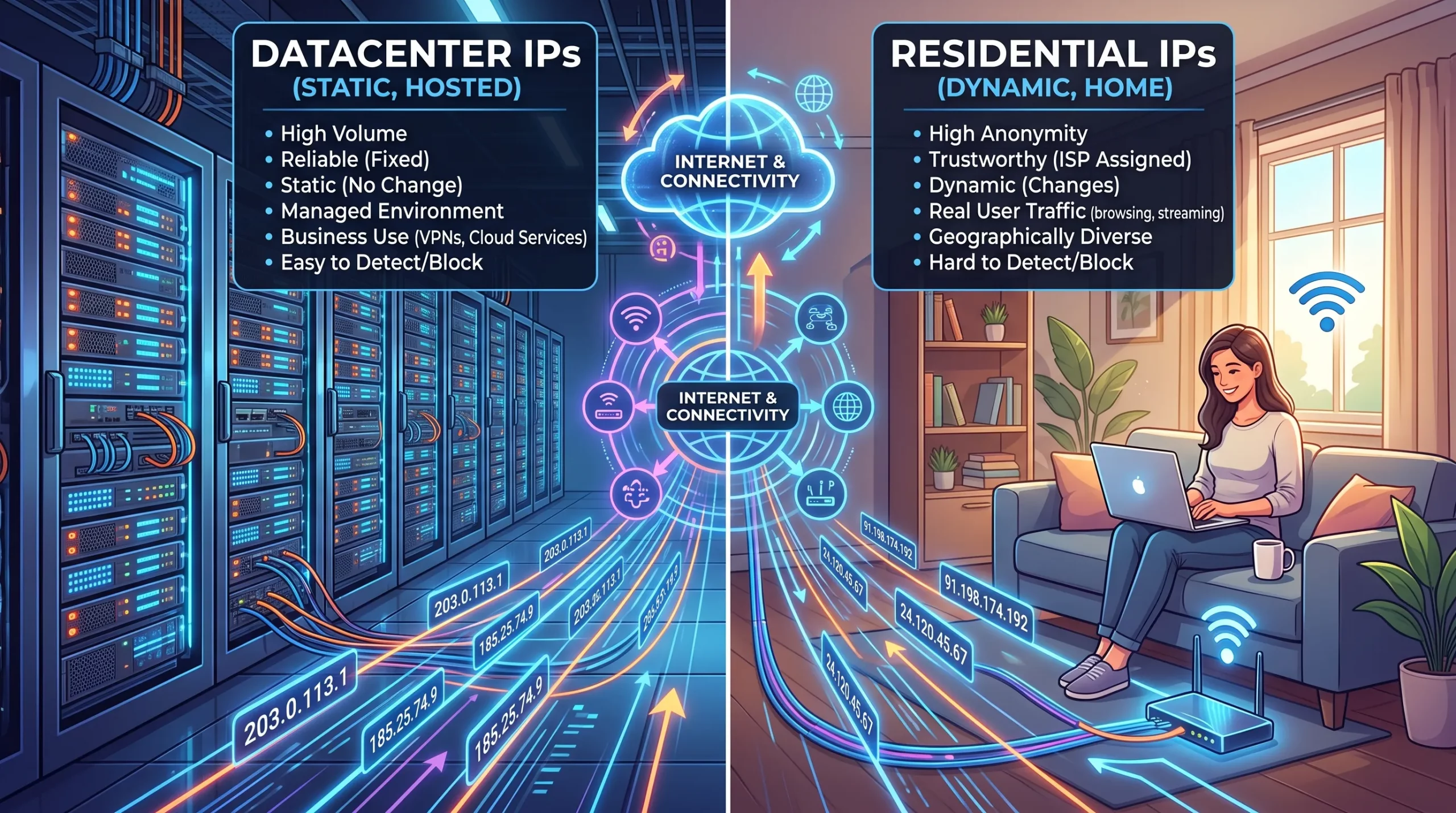
Datacenter vs Residential IP Addresses: What’s the Difference and Why It Matters
A datacenter IP address originates from a commercial data center, cloud provider, or hosting company, while a residential IP address is assigned by an Internet service provider to a home or business subscriber. The difference is origin: one comes from infrastructure built to run servers, the other from a connection built to serve an end user. That single distinction shapes how the rest of the Internet treats traffic fromRead more Related Posts Datacenter vs Residential IP Addresses: What’s the Difference and Why It Matters A datacenter IP address originates from a commercial data center, cloud provider, or hosting company, while a residential IP address Proxy vs VPN: What’s the Difference and Which Do You Need? A proxy reroutes traffic for a specific application through an intermediary server, while a VPN routes and encrypts all of What Is CGNAT (Carrier-Grade NAT)? Why It Breaks Hosting, Gaming, and Inbound Services CGNAT (Carrier-Grade NAT) is a technique that lets an Internet service provider share a single public IPv4 address among many .related-post {} .related-post .post-list { text-align: left; } .related-post .post-list .item { margin: 5px; padding: 10px; } .related-post .headline { font-size: 18px !important; color: #999999 !important; } .related-post .post-list .item .post_thumb { max-height: 220px; margin: 10px 0px; padding: 0px; display: block; } .related-post .post-list .item .post_title { font-size: 16px; color: #3f3f3f; margin: 10px 0px; padding: 0px; display: block; text-decoration: none; } .related-post .post-list .item .post_excerpt { font-size: 13px; color: #3f3f3f; margin: 10px 0px; padding: 0px; display: block; text-decoration: none; } @media only screen and (min-width: 1024px) { .related-post .post-list .item { width: 30%; } } @media only screen and (min-width: 768px) and (max-width: 1023px) { .related-post .post-list .item { width: 90%; } } @media only screen and (min-width: 0px) and (max-width: 767px) { .related-post .post-list .item { width: 90%; } }
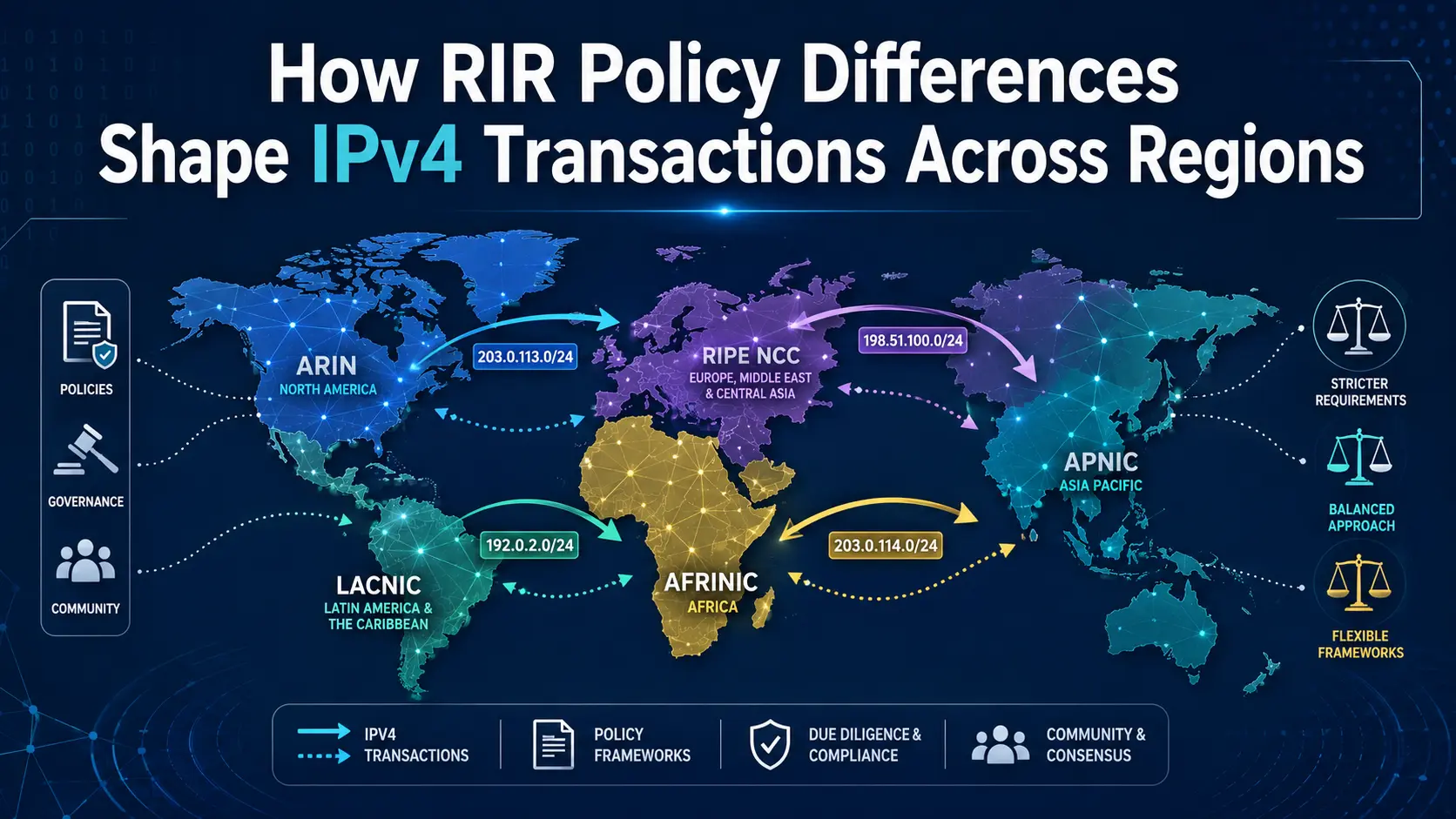
How RIR Policy Differences Shape IPv4 Transactions Across Regions
Two IPv4 blocks can have the same prefix size, similar market value, and equally willing buyers and sellers—yet require different transaction preparation. The reason is that an IPv4 transaction does not exist only at the commercial layer. The address block is also registered within a Regional Internet Registry framework, and the applicable policies can affect whether the resource is currently transferable, what the recipient must prepare, which records needRead more Related Posts Datacenter vs Residential IP Addresses: What’s the Difference and Why It Matters A datacenter IP address originates from a commercial data center, cloud provider, or hosting company, while a residential IP address Proxy vs VPN: What’s the Difference and Which Do You Need? A proxy reroutes traffic for a specific application through an intermediary server, while a VPN routes and encrypts all of What Is CGNAT (Carrier-Grade NAT)? Why It Breaks Hosting, Gaming, and Inbound Services CGNAT (Carrier-Grade NAT) is a technique that lets an Internet service provider share a single public IPv4 address among many .related-post {} .related-post .post-list { text-align: left; } .related-post .post-list .item { margin: 5px; padding: 10px; } .related-post .headline { font-size: 18px !important; color: #999999 !important; } .related-post .post-list .item .post_thumb { max-height: 220px; margin: 10px 0px; padding: 0px; display: block; } .related-post .post-list .item .post_title { font-size: 16px; color: #3f3f3f; margin: 10px 0px; padding: 0px; display: block; text-decoration: none; } .related-post .post-list .item .post_excerpt { font-size: 13px; color: #3f3f3f; margin: 10px 0px; padding: 0px; display: block; text-decoration: none; } @media only screen and (min-width: 1024px) { .related-post .post-list .item { width: 30%; } } @media only screen and (min-width: 768px) and (max-width: 1023px) { .related-post .post-list .item { width: 90%; } } @media only screen and (min-width: 0px) and (max-width: 767px) { .related-post .post-list .item { width: 90%; } }
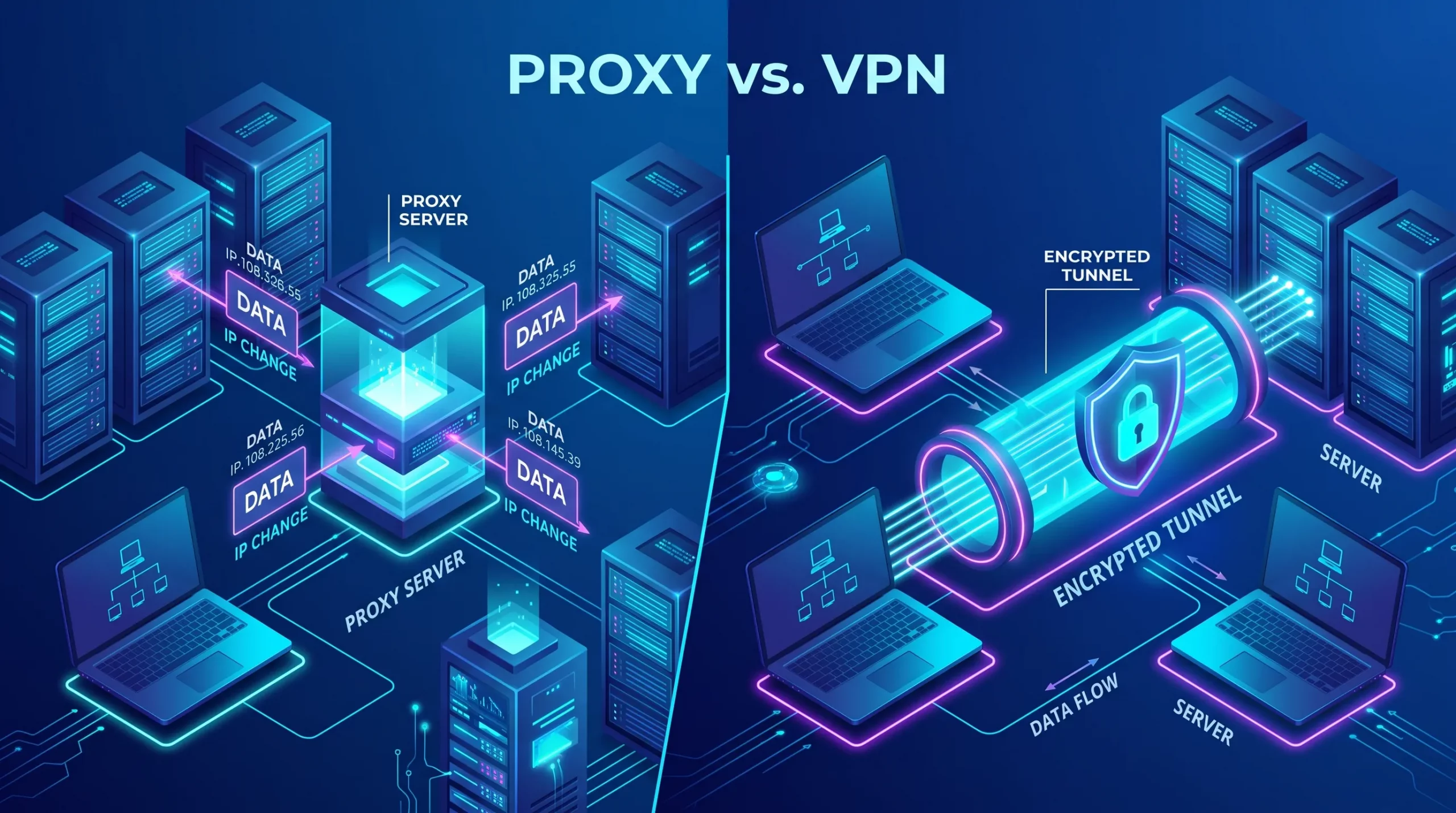
Proxy vs VPN: What’s the Difference and Which Do You Need?
A proxy reroutes traffic for a specific application through an intermediary server, while a VPN routes and encrypts all of a device’s traffic through a secure tunnel. The short version: a proxy changes the apparent source of some of your traffic; a VPN changes and protects the source of all of it. That difference in scope and encryption is the core of the comparison, and it usually points clearlyRead more Related Posts Datacenter vs Residential IP Addresses: What’s the Difference and Why It Matters A datacenter IP address originates from a commercial data center, cloud provider, or hosting company, while a residential IP address Proxy vs VPN: What’s the Difference and Which Do You Need? A proxy reroutes traffic for a specific application through an intermediary server, while a VPN routes and encrypts all of What Is CGNAT (Carrier-Grade NAT)? Why It Breaks Hosting, Gaming, and Inbound Services CGNAT (Carrier-Grade NAT) is a technique that lets an Internet service provider share a single public IPv4 address among many .related-post {} .related-post .post-list { text-align: left; } .related-post .post-list .item { margin: 5px; padding: 10px; } .related-post .headline { font-size: 18px !important; color: #999999 !important; } .related-post .post-list .item .post_thumb { max-height: 220px; margin: 10px 0px; padding: 0px; display: block; } .related-post .post-list .item .post_title { font-size: 16px; color: #3f3f3f; margin: 10px 0px; padding: 0px; display: block; text-decoration: none; } .related-post .post-list .item .post_excerpt { font-size: 13px; color: #3f3f3f; margin: 10px 0px; padding: 0px; display: block; text-decoration: none; } @media only screen and (min-width: 1024px) { .related-post .post-list .item { width: 30%; } } @media only screen and (min-width: 768px) and (max-width: 1023px) { .related-post .post-list .item { width: 90%; } } @media only screen and (min-width: 0px) and (max-width: 767px) { .related-post .post-list .item { width: 90%; } }
