IP Delegation Service
 admin
adminLARUS possesses seasoned expert in IP address policy. To focus on providing unmatched IPv4 address solutions in the world, IP addresses will be delegated to you directly from LARUS’s own IP pool. You will use the IP addresses without limitation on geography and usage. This will be a flexible and speedy service to meet your business needs.
For more information, please contact us at info@i.lease
Related Posts

Why most enterprises are accidentally exposed to IPv4 allocation failure risk
IPv4 scarcity is widely understood. What many enterprises still underestimate is the continuity risk surrounding how address resources are governed and maintained. Enterprises often maintain operational use of IPv4 resources without full visibility into the continuity conditions supporting those allocations. The growing reliance on leasing, transfers, and provider-managed infrastructure is reshaping IPv4 Allocation into a long-term governance issue. IPv4 Allocation has quietly become a continuity issue For many enterpriseRead more Related Posts Why i.lease Exists: IPv4 Continuity Is Not Commodity Access Most businesses enter the IPv4 market with a simple goal. They need addresses. Maybe they need them for hosting.Maybe they Read more Running-Code Primacy: Why IPv4 Leasing Should Be Judged by Operational Proof IPv4 leasing often begins with a simple question:Can this provider give us the addresses?But for businesses that depend on IPv4 Read more IPv4 Poverty Penalty: Why Small Networks Pay More IPv4 access can look equal on paper.The same registry forms.The same transfer rules.The same provider contracts.The same compliance language.The same Read more .related-post {} .related-post .post-list { text-align: left; } .related-post .post-list .item { margin: 5px; padding: 10px; } .related-post .headline { font-size: 18px !important; color: #999999 !important; } .related-post .post-list .item .post_thumb { max-height: 220px; margin: 10px 0px; padding: 0px; display: block; } .related-post .post-list .item .post_title { font-size: 16px; color: #3f3f3f; margin: 10px 0px; padding: 0px; display: block; text-decoration: none; } .related-post .post-list .item .post_excerpt { font-size: 13px; color: #3f3f3f; margin: 10px 0px; padding: 0px; display: block; text-decoration: none; } @media only screen and (min-width: 1024px) { .related-post .post-list .item { width: 30%; } } @media only screen and (min-width: 768px) and (max-width: 1023px) { .related-post .post-list .item { width: 90%; } } @media only screen and (min-width: 0px) and (max-width: 767px) { .related-post .post-list .item { width: 90%; } }
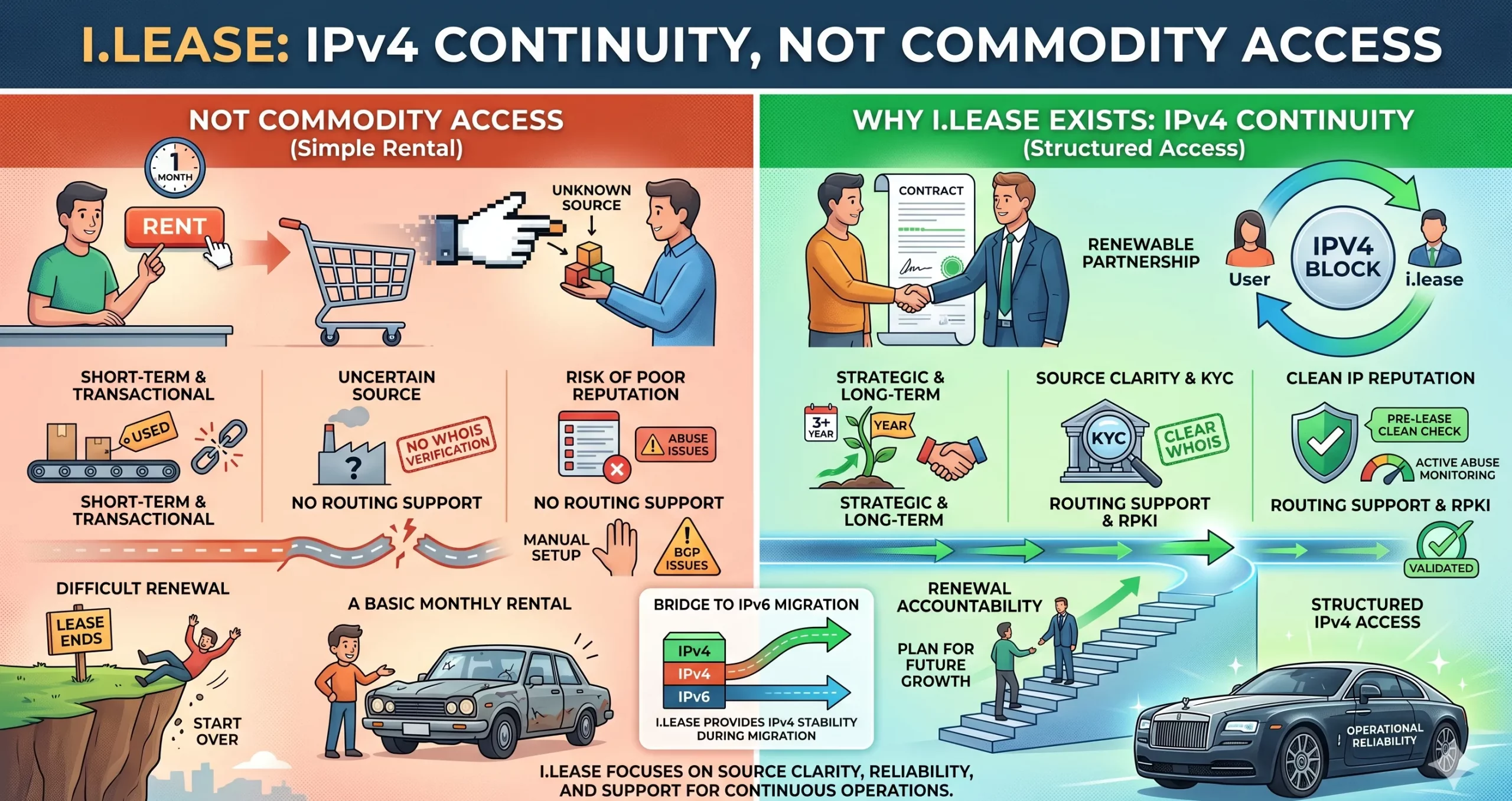
Why i.lease Exists: IPv4 Continuity Is Not Commodity Access
Most businesses enter the IPv4 market with a simple goal. They need addresses. Maybe they need them for hosting.Maybe they need them for VPN infrastructure.Maybe they need them for cloud services, SaaS platforms, telecom expansion, email systems, cybersecurity tools, or customer-facing applications. So they search for an IPv4 provider. They compare prices. They check block sizes. They ask how fast delivery can happen. They look for a seller, broker,Read more Related Posts Why most enterprises are accidentally exposed to IPv4 allocation failure risk IPv4 scarcity is widely understood. What many enterprises still underestimate is the continuity risk surrounding how address resources are governed Read more Why i.lease Exists: IPv4 Continuity Is Not Commodity Access Most businesses enter the IPv4 market with a simple goal. They need addresses. Maybe they need them for hosting.Maybe they Read more Running-Code Primacy: Why IPv4 Leasing Should Be Judged by Operational Proof IPv4 leasing often begins with a simple question:Can this provider give us the addresses?But for businesses that depend on IPv4 Read more .related-post {} .related-post .post-list { text-align: left; } .related-post .post-list .item { margin: 5px; padding: 10px; } .related-post .headline { font-size: 18px !important; color: #999999 !important; } .related-post .post-list .item .post_thumb { max-height: 220px; margin: 10px 0px; padding: 0px; display: block; } .related-post .post-list .item .post_title { font-size: 16px; color: #3f3f3f; margin: 10px 0px; padding: 0px; display: block; text-decoration: none; } .related-post .post-list .item .post_excerpt { font-size: 13px; color: #3f3f3f; margin: 10px 0px; padding: 0px; display: block; text-decoration: none; } @media only screen and (min-width: 1024px) { .related-post .post-list .item { width: 30%; } } @media only screen and (min-width: 768px) and (max-width: 1023px) { .related-post .post-list .item { width: 90%; } } @media only screen and (min-width: 0px) and (max-width: 767px) { .related-post .post-list .item { width: 90%; } }

Running-Code Primacy: Why IPv4 Leasing Should Be Judged by Operational Proof
IPv4 leasing often begins with a simple question: Can this provider give us the addresses? But for businesses that depend on IPv4 for hosting, VPN, SaaS, cloud, telecom, security, email delivery, or customer-facing platforms, that question is not enough. A better question is: Can this IPv4 structure prove that it works operationally? That is where Running-Code Primacy matters. Running-Code Primacy means that live operational reality should come before institutionalRead more Related Posts La Running-Code Primacy: por qué el arrendamiento de IPv4 debe juzgarse mediante pruebas operativas El arrendamiento de IPv4 suele comenzar con una pregunta simple: ¿Puede este proveedor darnos las direcciones? Pero para las empresas Read more Primauté du code en cours d’exécution : pourquoi la location d’adresses IPv4 doit être jugée sur la base de preuves opérationnelles La location IPv4 commence souvent par une question simple :Ce fournisseur peut-il nous fournir les adresses ?Mais pour les entreprises Read more Why most enterprises are accidentally exposed to IPv4 allocation failure risk IPv4 scarcity is widely understood. What many enterprises still underestimate is the continuity risk surrounding how address resources are governed Read more .related-post {} .related-post .post-list { text-align: left; } .related-post .post-list .item { margin: 5px; padding: 10px; } .related-post .headline { font-size: 18px !important; color: #999999 !important; } .related-post .post-list .item .post_thumb { max-height: 220px; margin: 10px 0px; padding: 0px; display: block; } .related-post .post-list .item .post_title { font-size: 16px; color: #3f3f3f; margin: 10px 0px; padding: 0px; display: block; text-decoration: none; } .related-post .post-list .item .post_excerpt { font-size: 13px; color: #3f3f3f; margin: 10px 0px; padding: 0px; display: block; text-decoration: none; } @media only screen and (min-width: 1024px) { .related-post .post-list .item { width: 30%; } } @media only screen and (min-width: 768px) and (max-width: 1023px) { .related-post .post-list .item { width: 90%; } } @media only screen and (min-width: 0px) and (max-width: 767px) { .related-post .post-list .item { width: 90%; } }
