How Law Enforcement Tracks Hackers and Telco Scammers: Tools & Techniques
 Chan
Chan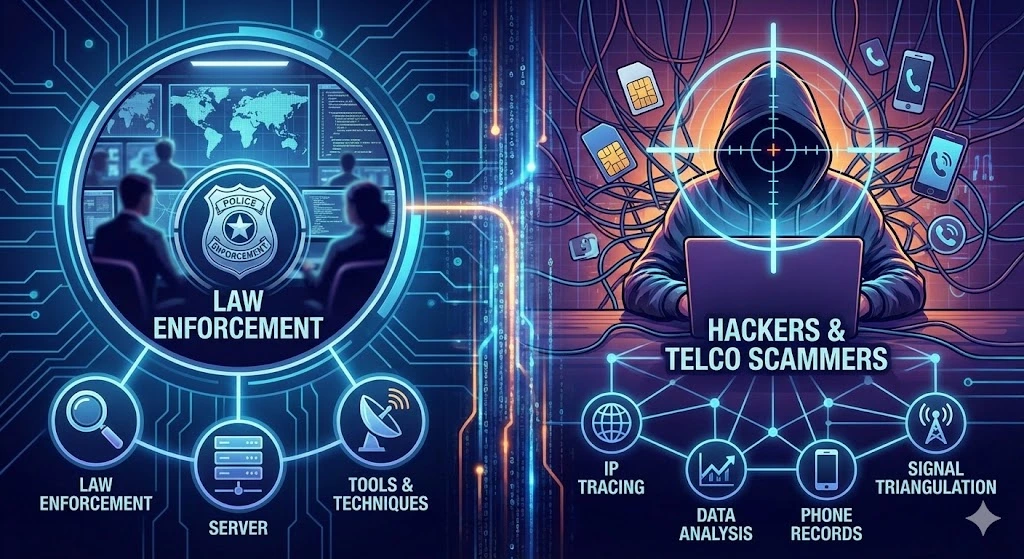
Cybercrime is on the rise, with hackers and telco scammers using sophisticated methods to hide their identities. Law enforcement agencies rely on advanced IP tracking tools, forensic analysis, and cyber intelligence to trace and catch these criminals. In this article, we’ll explore the top tools and techniques used by authorities worldwide to track down cybercriminals.
Table of Contents
IP Tracking & Geolocation Tools
To pinpoint the location of a hacker, authorities use IP tracking and geolocation tools such as MaxMind GeoIP, IPinfo.io, and Whois Lookup. These tools provide insights into an IP address’s physical location, associated ISP, and network details. Shodan and Censys further help by scanning connected devices to reveal potential vulnerabilities that hackers might exploit.
Network Traffic Analysis & Packet Capture
Monitoring real-time network traffic is essential in cybercrime investigations. Tools like Wireshark, Tcpdump, and Zeek (Bro IDS) allow law enforcement to capture and analyze network packets, helping to identify malicious activity. These tools can detect unauthorized connections, suspicious data transfers, and unusual traffic spikes that may indicate cybercrime activities.
Digital Forensics & Log Analysis
Cybercriminals often leave digital footprints that can be uncovered through forensic analysis. Tools like Autopsy, X-Ways Forensics, and Splunk help authorities analyze logs, recover deleted files, and trace an attacker’s movements. ELK Stack (Elasticsearch, Logstash, Kibana) and Graylog provide powerful log monitoring capabilities, assisting in tracking hacker activities over time.
OSINT (Open-Source Intelligence) Tools
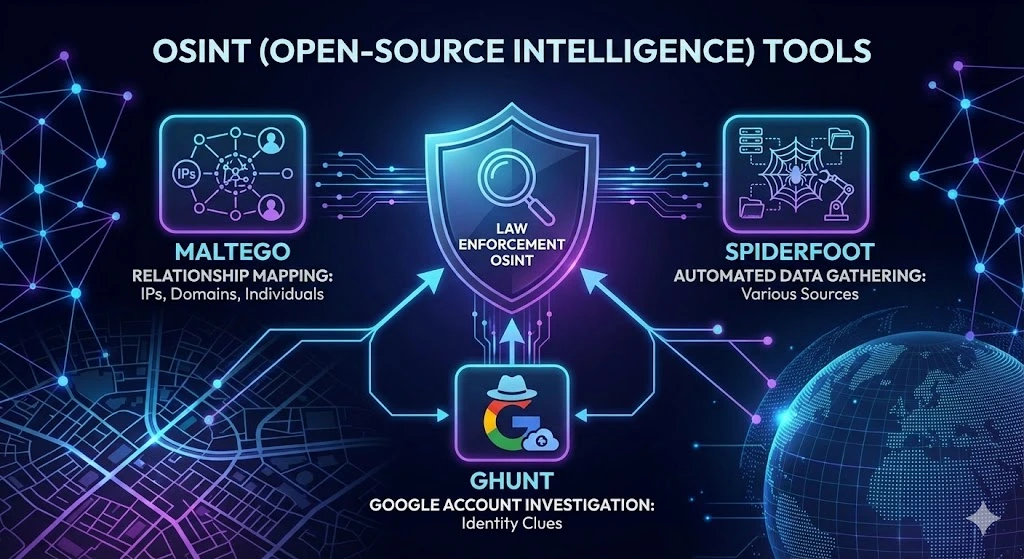
Law enforcement leverages OSINT tools to collect intelligence from publicly available sources. Maltego helps map relationships between IPs, domains, and individuals, while SpiderFoot automates data gathering from various sources. Additionally, GHunt can investigate Google account activity, providing valuable clues about a suspect’s identity.
Tor & Dark Web Monitoring
Hackers and scammers frequently use Tor and dark web platforms to operate anonymously. Tools like Ahmia and OnionScan assist in uncovering hidden services, while CipherTrace and Chainalysis track cryptocurrency transactions linked to cybercrime. Law enforcement also employs ShadowDragon to monitor darknet activities and uncover criminal networks.
ISP Collaboration & Legal Requests
One of the most effective ways to trace hackers is through ISP collaboration. Law enforcement agencies issue subpoenas and MLAT (Mutual Legal Assistance Treaty) requests to obtain user logs from ISPs. Programs like LEAP (Law Enforcement Access Program) and organizations such as Interpol, FBI, and Europol work together to track cybercriminals across borders.
Anti-VPN & Proxy Detection
Many hackers use VPNs, proxies, or the Tor network to mask their real IP addresses. Tools like IPQualityScore, FraudLabs Pro, and Scamalytics help detect these disguises by identifying suspicious IP patterns, VPN usage, and proxy servers. These solutions help law enforcement unmask hidden attackers.
Honeypots & Cyber Threat Intelligence
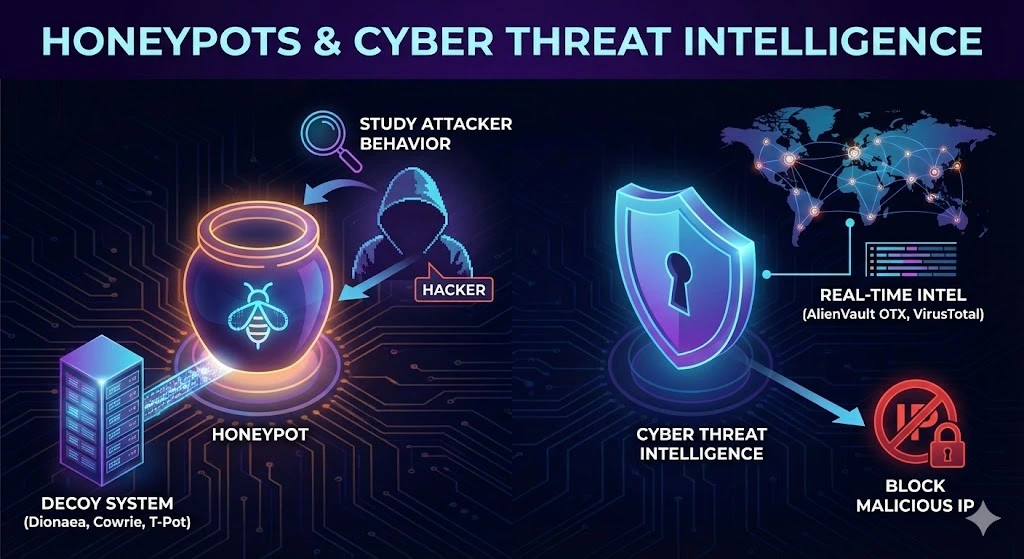
To catch cybercriminals, law enforcement deploys honeypots—decoy systems designed to lure hackers. Tools like Dionaea, Cowrie, and T-Pot simulate vulnerable systems, allowing authorities to study attacker behavior. Additionally, AlienVault OTX and VirusTotal provide real-time threat intelligence, helping to identify and block malicious IP addresses.
Advanced & Government-Level Tracking
Top intelligence agencies employ advanced surveillance programs to track cybercriminals worldwide. XKeyscore (NSA tool) and PRISM (U.S. surveillance program) collect vast amounts of internet data. Echelon, a global surveillance system, monitors communications for national security threats. Meanwhile, Palantir Gotham integrates AI-powered analytics for large-scale investigations.
How Law Enforcement Tracks Hackers & Scammers
To successfully track and apprehend cybercriminals, law enforcement follows a multi-layered approach. This includes IP geolocation tracking, ISP subpoenas, network traffic analysis, OSINT research, and social engineering tactics. Some agencies conduct undercover dark web operations to infiltrate hacking forums and identify criminal masterminds. By combining cutting-edge technology with intelligence collaboration, authorities can track and prosecute hackers effectively.
Final Thoughts
As cyber threats continue to evolve, so do the tools and techniques used by law enforcement to track and locate hackers and scammers. By leveraging IP tracking, digital forensics, OSINT, honeypots, and dark web monitoring, authorities can uncover cybercriminal networks and bring them to justice. If you’re in cybersecurity, law enforcement, or digital forensics, staying ahead of these trends is critical to combating online threats.
Trusted IPv4 Leasing for Business Growth
Get enterprise-grade IPv4 space quickly, with seamless deployment and end-to-end management.
Get Started with i.leaseRelated Posts

What Is a Letter of Authorization (LOA) in IP Leasing? LOA vs ROA and What to Verify
A Letter of Authorization (LOA) is a formal document in which the registered holder of an IP address block authorizes another party to announce that address space from a specified Autonomous System Number. It is the written permission that connects a contractual right to use address space with the technical act of routing it — and without it, upstream providers will generally refuse to accept your announcements. That refusalRead more Related Posts IP地址租赁中的授权书 (LOA) 是什么?LOA 与 ROA 的区别以及需要核实的内容 授权书(Letter of Authorization,LOA)是一份正式文件,由 IP 地址块的注册持有者授权另一方通过指定的自治系统编号(ASN)公告该地址空间。 它是一份书面授权,将使用地址空间的合同权利与实际进行路由公告的技术行为连接起来——如果没有 LOA,上游服务提供商通常会拒绝接受你的路由公告。 正是这种拒绝,使 LOA 在运营上具有决定性意义,而不仅仅是一项行政文件。Transit 服务提供商、数据中心和电信运营商都需要证明,公告某个前缀的一方确实获得了授权,因为接受未经授权的公告就意味着参与了一次路由劫持。Cloudflare 的 BYOIP 文档对此说明得非常明确:其 Transit 服务提供商要求在接受 Cloudflare 代表客户公告的路由之前提供 LOA,而且文件必须明确列出获得授权的前缀以及将用于公告这些前缀的 ASN。整个行业普遍都有类似要求。一家企业即使已经签署租赁协议、完成路由器配置,仍然可能因为 Qu’est-ce qu’une lettre d’autorisation (LOA) dans le cadre d’un bail de propriété intellectuelle ? LOA vs ROA et points à vérifier Une Lettre d’Autorisation (LOA) est un document officiel dans lequel le titulaire enregistré d’un bloc d’adresses IP autorise une autre ¿Qué es una Carta de Autorización (LOA) en el arrendamiento de propiedad intelectual? LOA vs. ROA y qué verificar Una Carta de Autorización (LOA) es un documento formal mediante el cual el titular registrado de un bloque de direcciones .related-post {} .related-post .post-list { text-align: left; } .related-post .post-list .item { margin: 5px; padding: 10px; } .related-post .headline { font-size: 18px !important; color: #999999 !important; } .related-post .post-list .item .post_thumb { max-height: 220px; margin: 10px 0px; padding: 0px; display: block; } .related-post .post-list .item .post_title { font-size: 16px; color: #3f3f3f; margin: 10px 0px; padding: 0px; display: block; text-decoration: none; } .related-post .post-list .item .post_excerpt { font-size: 13px; color: #3f3f3f; margin: 10px 0px; padding: 0px; display: block; text-decoration: none; } @media only screen and (min-width: 1024px) { .related-post .post-list .item { width: 30%; } } @media only screen and (min-width: 768px) and (max-width: 1023px) { .related-post .post-list .item { width: 90%; } } @media only screen and (min-width: 0px) and (max-width: 767px) { .related-post .post-list .item { width: 90%; } }
Datacenter vs Residential IP Addresses: What’s the Difference and Why It Matters
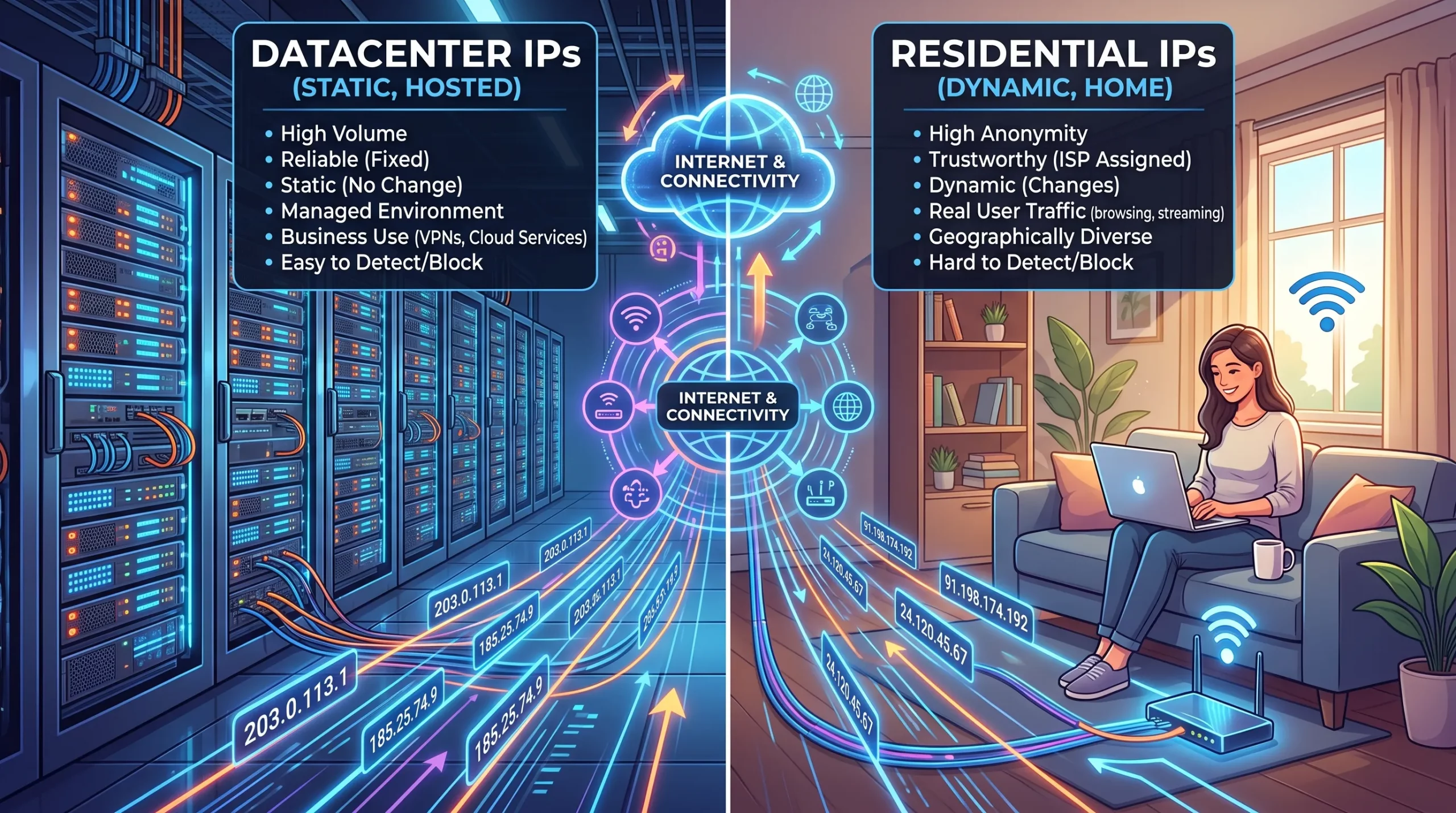
A datacenter IP address originates from a commercial data center, cloud provider, or hosting company, while a residential IP address is assigned by an Internet service provider to a home or business subscriber. The difference is origin: one comes from infrastructure built to run servers, the other from a connection built to serve an end user. That single distinction shapes how the rest of the Internet treats traffic fromRead more Related Posts What Is a Letter of Authorization (LOA) in IP Leasing? LOA vs ROA and What to Verify A Letter of Authorization (LOA) is a formal document in which the registered holder of an IP address block authorizes Datacenter vs Residential IP Addresses: What’s the Difference and Why It Matters A datacenter IP address originates from a commercial data center, cloud provider, or hosting company, while a residential IP address Proxy vs VPN: What’s the Difference and Which Do You Need? A proxy reroutes traffic for a specific application through an intermediary server, while a VPN routes and encrypts all of .related-post {} .related-post .post-list { text-align: left; } .related-post .post-list .item { margin: 5px; padding: 10px; } .related-post .headline { font-size: 18px !important; color: #999999 !important; } .related-post .post-list .item .post_thumb { max-height: 220px; margin: 10px 0px; padding: 0px; display: block; } .related-post .post-list .item .post_title { font-size: 16px; color: #3f3f3f; margin: 10px 0px; padding: 0px; display: block; text-decoration: none; } .related-post .post-list .item .post_excerpt { font-size: 13px; color: #3f3f3f; margin: 10px 0px; padding: 0px; display: block; text-decoration: none; } @media only screen and (min-width: 1024px) { .related-post .post-list .item { width: 30%; } } @media only screen and (min-width: 768px) and (max-width: 1023px) { .related-post .post-list .item { width: 90%; } } @media only screen and (min-width: 0px) and (max-width: 767px) { .related-post .post-list .item { width: 90%; } }
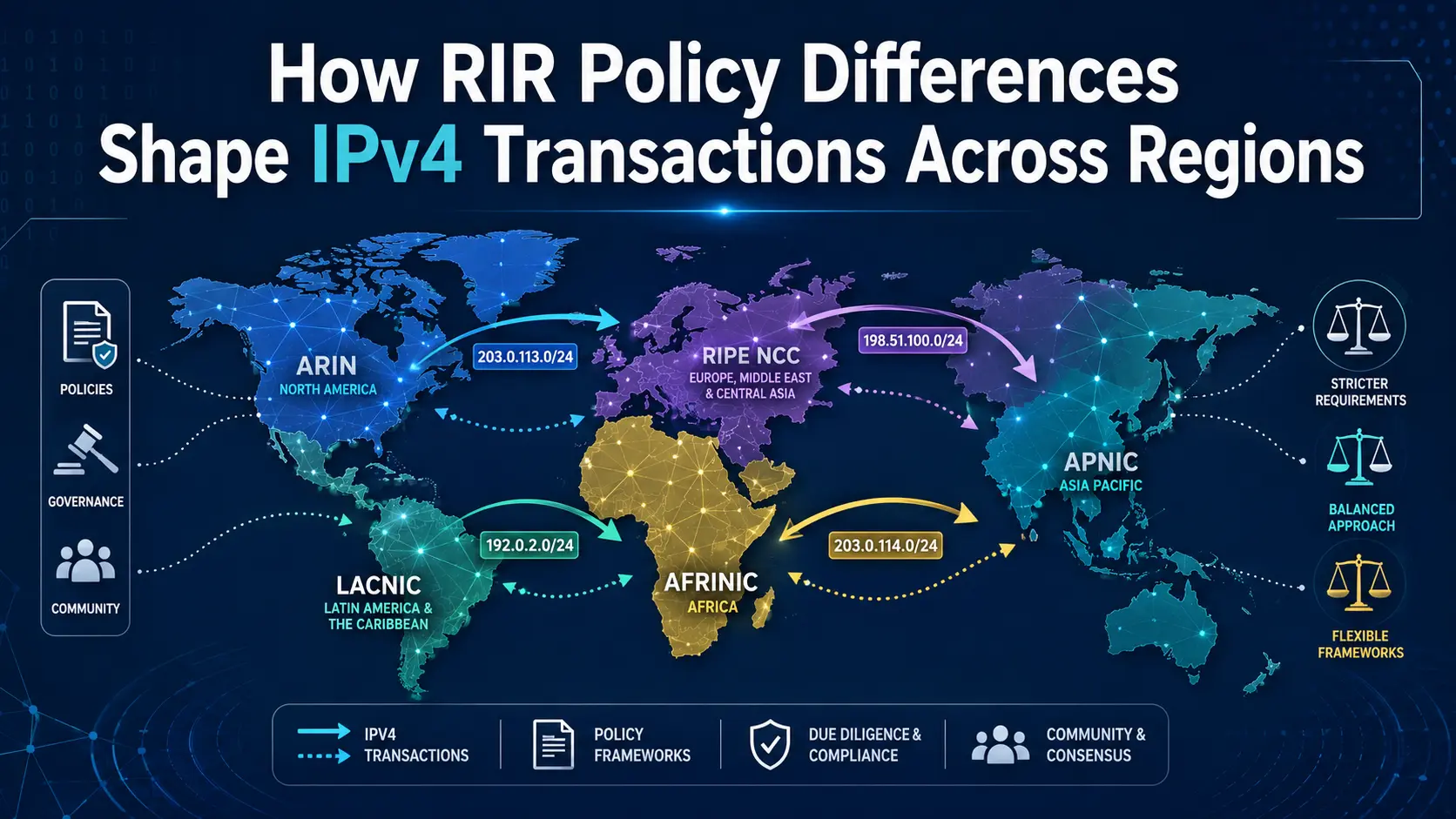
How RIR Policy Differences Shape IPv4 Transactions Across Regions
Two IPv4 blocks can have the same prefix size, similar market value, and equally willing buyers and sellers—yet require different transaction preparation. The reason is that an IPv4 transaction does not exist only at the commercial layer. The address block is also registered within a Regional Internet Registry framework, and the applicable policies can affect whether the resource is currently transferable, what the recipient must prepare, which records needRead more Related Posts What Is a Letter of Authorization (LOA) in IP Leasing? LOA vs ROA and What to Verify A Letter of Authorization (LOA) is a formal document in which the registered holder of an IP address block authorizes Datacenter vs Residential IP Addresses: What’s the Difference and Why It Matters A datacenter IP address originates from a commercial data center, cloud provider, or hosting company, while a residential IP address Proxy vs VPN: What’s the Difference and Which Do You Need? A proxy reroutes traffic for a specific application through an intermediary server, while a VPN routes and encrypts all of .related-post {} .related-post .post-list { text-align: left; } .related-post .post-list .item { margin: 5px; padding: 10px; } .related-post .headline { font-size: 18px !important; color: #999999 !important; } .related-post .post-list .item .post_thumb { max-height: 220px; margin: 10px 0px; padding: 0px; display: block; } .related-post .post-list .item .post_title { font-size: 16px; color: #3f3f3f; margin: 10px 0px; padding: 0px; display: block; text-decoration: none; } .related-post .post-list .item .post_excerpt { font-size: 13px; color: #3f3f3f; margin: 10px 0px; padding: 0px; display: block; text-decoration: none; } @media only screen and (min-width: 1024px) { .related-post .post-list .item { width: 30%; } } @media only screen and (min-width: 768px) and (max-width: 1023px) { .related-post .post-list .item { width: 90%; } } @media only screen and (min-width: 0px) and (max-width: 767px) { .related-post .post-list .item { width: 90%; } }
