How does the government track down people using their IP addresses?
 Chan
Chan
Queries: How does the government track down people using their IP addresses? Why is it difficult for them to catch scammers and hackers?
Table of Contents
IP addresses serve as unique identifiers for internet users, enabling connectivity and interaction. Governments and law enforcement agencies utilize these digital signatures to track down individuals involved in illegal online activities.
However, capturing scammers and hackers isn’t as straightforward as it might seem. Despite the sophisticated technology at their disposal, authorities often find themselves playing a high-stakes game of digital hide-and-seek. This is due to the advanced evasion techniques employed by cybercriminals, the transient nature of IP addresses, and the complex, borderless realm of cyberspace.
In this article, we’ll explore how IP tracking is used by governments and why, despite these efforts, scammers and hackers often remain one step ahead.
Internet Protocol Addresses
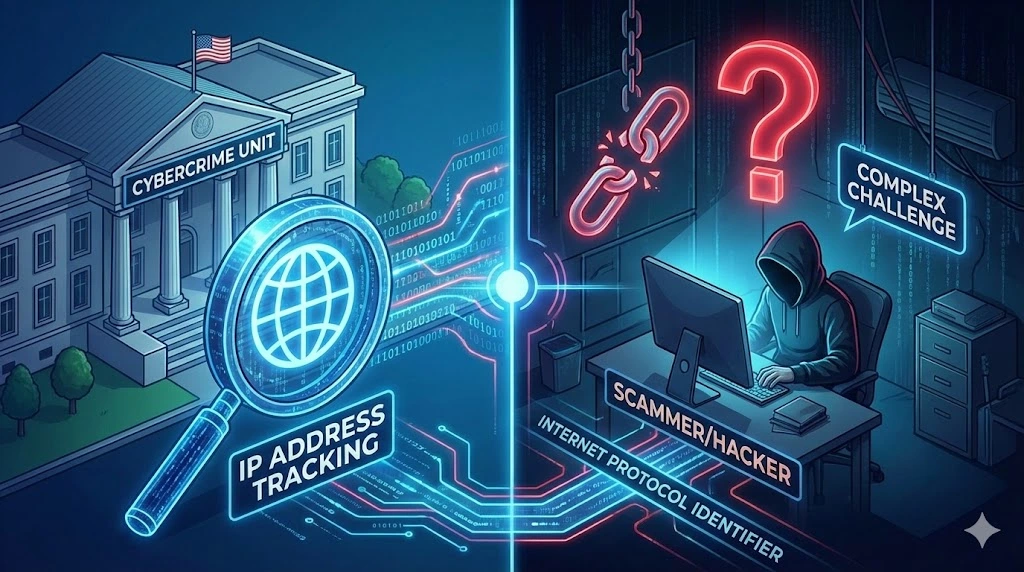
Every device connected to the internet is identified by a unique number known as an IP (Internet Protocol) address. This digital identifier is crucial not only for everyday communications but also for law enforcement agencies that need to track down individuals involved in illegal online activities. However, the task of catching cybercriminals like scammers and hackers is fraught with challenges, despite the sophisticated tools at the disposal of governments. Here’s a closer look at how governments use IP addresses for tracking and why catching cybercriminals remains a complex issue.
How Governments Track Individuals Through IP Addresses
Governments and law enforcement agencies can trace digital activities back to specific IP addresses through various means. One of the primary methods involves cooperation with Internet Service Providers (ISPs). ISPs typically maintain detailed logs that link IP addresses to their customers’ accounts. When suspicious activities are detected, authorities can request these logs under legal mandates, which allow them to identify the individual associated with a particular IP address at a given time.
Additionally, governments often collaborate with online platforms such as social media sites, email providers, and other digital services. These platforms can provide valuable logs that detail the IP addresses used to access particular accounts or conduct specific actions online. This data can be instrumental in piecing together a suspect’s online presence and activities.
Challenges in Catching Scammers and Hackers
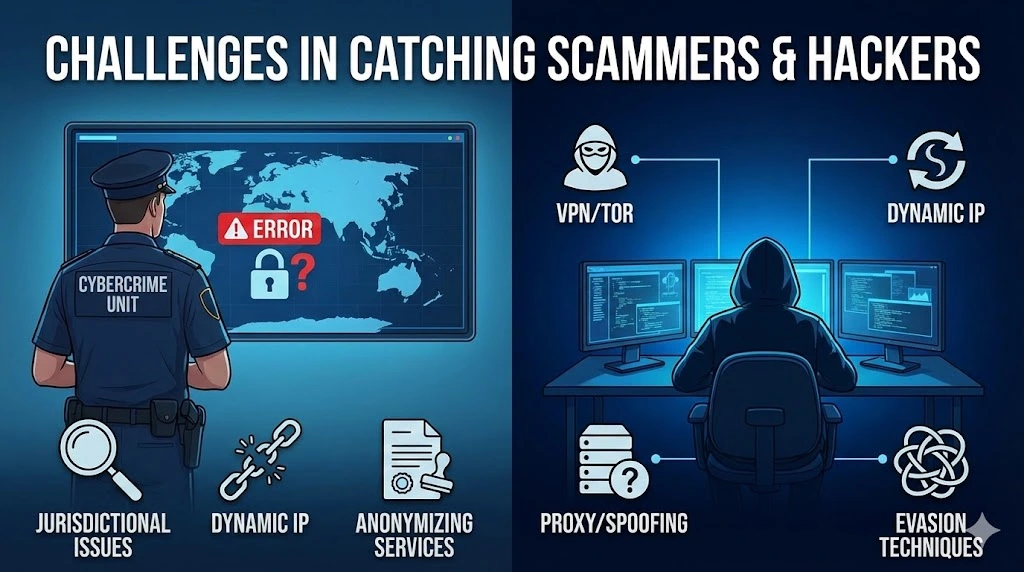
Despite the ability to track IP addresses, several significant obstacles make it difficult for authorities to apprehend cybercriminals:
Use of Anonymizing Services
Many scammers and hackers use VPNs (Virtual Private Networks), proxies, and services like Tor to mask their IP addresses. These tools can hide the user’s real IP address and make it appear as if they are operating from a different location, often in a completely different part of the world.
Dynamic IP Addresses
Many ISPs assign dynamic IP addresses, which change periodically. This variability can make it challenging to pinpoint who had access to a specific IP address at any given time without accurate logs from the ISP.
International Jurisdictional Issues
Cybercrime often transcends borders, with criminals operating from one country while committing crimes in another. This global nature of the internet creates significant legal and practical challenges in cooperation between different countries’ law enforcement agencies.
Advanced Evasion Techniques
Hackers often employ sophisticated methods to avoid detection, including spoofing IP addresses or using compromised systems as proxies for their attacks. This not only obscures their trail but also complicates the legal process of tracking and prosecuting them.
Moving Forward
Addressing the challenges of tracking cybercriminals requires international cooperation and consistent advancements in cybersecurity technology. Law enforcement agencies must also keep pace with the rapidly evolving techniques used by criminals. Additionally, there’s a growing need for legislation that addresses the unique challenges posed by digital crime and ensures that ISPs and other online platforms cooperate fully with investigations.
In conclusion, while the tracking of individuals through IP addresses is a powerful tool for law enforcement, the complexities of the digital age offer unprecedented challenges that require innovative solutions. As cybercrime continues to evolve, so too must the strategies to combat it, ensuring a safer online environment for all users.
Trusted IPv4 Leasing for Business Growth
Get enterprise-grade IPv4 space quickly, with seamless deployment and end-to-end management.
Get Started with i.leaseFAQs
Does "Incognito Mode" hide my activity from the government?
No. Incognito (or Private) mode only prevents your browser from saving your history on your specific device. Your Internet Service Provider (ISP) can still see every website you visit, and they can be legally compelled to share those logs with government agencies.
How long do ISPs keep IP address logs?
Data retention laws vary by country. In the US, ISPs typically retain IP assignment logs for 6 months to 2 years. In the EU, retention periods are strictly regulated but still exist for law enforcement purposes. These logs are the primary link between an IP address and a subscriber’s identity.
Can the government track me through the Tor Browser?
Tor is much harder to track than a standard VPN because it bounces traffic through three different volunteer nodes. However, government agencies (like the NSA or FBI) have developed sophisticated techniques (such as “Traffic Correlation” or compromising exit nodes) to de-anonymize users in high-profile criminal investigations.
Related Posts
Datacenter vs Residential IP Addresses: What’s the Difference and Why It Matters
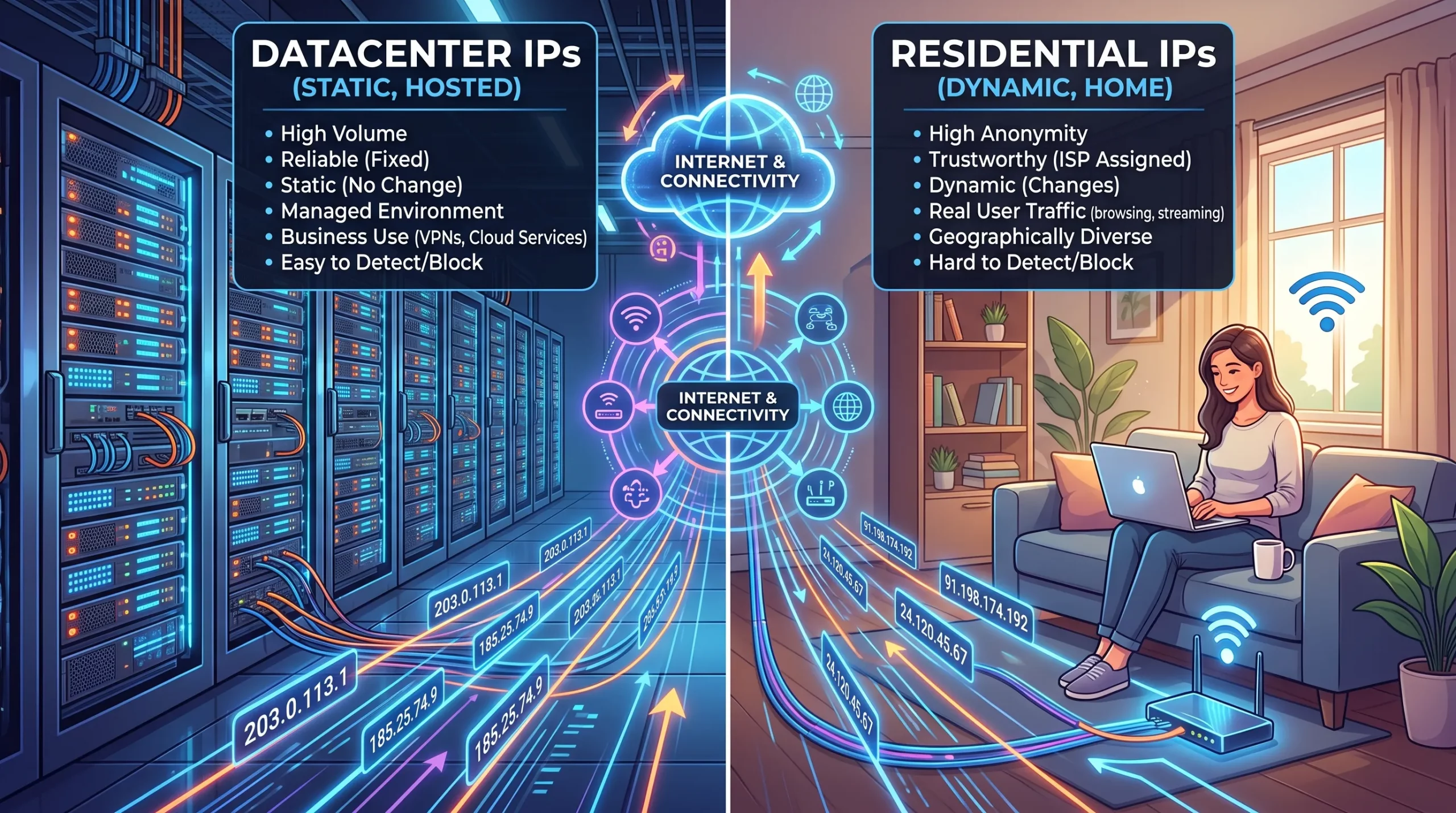
A datacenter IP address originates from a commercial data center, cloud provider, or hosting company, while a residential IP address is assigned by an Internet service provider to a home or business subscriber. The difference is origin: one comes from infrastructure built to run servers, the other from a connection built to serve an end user. That single distinction shapes how the rest of the Internet treats traffic fromRead more Related Posts Datacenter vs Residential IP Addresses: What’s the Difference and Why It Matters A datacenter IP address originates from a commercial data center, cloud provider, or hosting company, while a residential IP address Proxy vs VPN: What’s the Difference and Which Do You Need? A proxy reroutes traffic for a specific application through an intermediary server, while a VPN routes and encrypts all of What Is CGNAT (Carrier-Grade NAT)? Why It Breaks Hosting, Gaming, and Inbound Services CGNAT (Carrier-Grade NAT) is a technique that lets an Internet service provider share a single public IPv4 address among many .related-post {} .related-post .post-list { text-align: left; } .related-post .post-list .item { margin: 5px; padding: 10px; } .related-post .headline { font-size: 18px !important; color: #999999 !important; } .related-post .post-list .item .post_thumb { max-height: 220px; margin: 10px 0px; padding: 0px; display: block; } .related-post .post-list .item .post_title { font-size: 16px; color: #3f3f3f; margin: 10px 0px; padding: 0px; display: block; text-decoration: none; } .related-post .post-list .item .post_excerpt { font-size: 13px; color: #3f3f3f; margin: 10px 0px; padding: 0px; display: block; text-decoration: none; } @media only screen and (min-width: 1024px) { .related-post .post-list .item { width: 30%; } } @media only screen and (min-width: 768px) and (max-width: 1023px) { .related-post .post-list .item { width: 90%; } } @media only screen and (min-width: 0px) and (max-width: 767px) { .related-post .post-list .item { width: 90%; } }
How RIR Policy Differences Shape IPv4 Transactions Across Regions
Two IPv4 blocks can have the same prefix size, similar market value, and equally willing buyers and sellers—yet require different transaction preparation. The reason is that an IPv4 transaction does not exist only at the commercial layer. The address block is also registered within a Regional Internet Registry framework, and the applicable policies can affect whether the resource is currently transferable, what the recipient must prepare, which records needRead more Related Posts Datacenter vs Residential IP Addresses: What’s the Difference and Why It Matters A datacenter IP address originates from a commercial data center, cloud provider, or hosting company, while a residential IP address Proxy vs VPN: What’s the Difference and Which Do You Need? A proxy reroutes traffic for a specific application through an intermediary server, while a VPN routes and encrypts all of What Is CGNAT (Carrier-Grade NAT)? Why It Breaks Hosting, Gaming, and Inbound Services CGNAT (Carrier-Grade NAT) is a technique that lets an Internet service provider share a single public IPv4 address among many .related-post {} .related-post .post-list { text-align: left; } .related-post .post-list .item { margin: 5px; padding: 10px; } .related-post .headline { font-size: 18px !important; color: #999999 !important; } .related-post .post-list .item .post_thumb { max-height: 220px; margin: 10px 0px; padding: 0px; display: block; } .related-post .post-list .item .post_title { font-size: 16px; color: #3f3f3f; margin: 10px 0px; padding: 0px; display: block; text-decoration: none; } .related-post .post-list .item .post_excerpt { font-size: 13px; color: #3f3f3f; margin: 10px 0px; padding: 0px; display: block; text-decoration: none; } @media only screen and (min-width: 1024px) { .related-post .post-list .item { width: 30%; } } @media only screen and (min-width: 768px) and (max-width: 1023px) { .related-post .post-list .item { width: 90%; } } @media only screen and (min-width: 0px) and (max-width: 767px) { .related-post .post-list .item { width: 90%; } }
Proxy vs VPN: What’s the Difference and Which Do You Need?
A proxy reroutes traffic for a specific application through an intermediary server, while a VPN routes and encrypts all of a device’s traffic through a secure tunnel. The short version: a proxy changes the apparent source of some of your traffic; a VPN changes and protects the source of all of it. That difference in scope and encryption is the core of the comparison, and it usually points clearlyRead more Related Posts Datacenter vs Residential IP Addresses: What’s the Difference and Why It Matters A datacenter IP address originates from a commercial data center, cloud provider, or hosting company, while a residential IP address Proxy vs VPN: What’s the Difference and Which Do You Need? A proxy reroutes traffic for a specific application through an intermediary server, while a VPN routes and encrypts all of What Is CGNAT (Carrier-Grade NAT)? Why It Breaks Hosting, Gaming, and Inbound Services CGNAT (Carrier-Grade NAT) is a technique that lets an Internet service provider share a single public IPv4 address among many .related-post {} .related-post .post-list { text-align: left; } .related-post .post-list .item { margin: 5px; padding: 10px; } .related-post .headline { font-size: 18px !important; color: #999999 !important; } .related-post .post-list .item .post_thumb { max-height: 220px; margin: 10px 0px; padding: 0px; display: block; } .related-post .post-list .item .post_title { font-size: 16px; color: #3f3f3f; margin: 10px 0px; padding: 0px; display: block; text-decoration: none; } .related-post .post-list .item .post_excerpt { font-size: 13px; color: #3f3f3f; margin: 10px 0px; padding: 0px; display: block; text-decoration: none; } @media only screen and (min-width: 1024px) { .related-post .post-list .item { width: 30%; } } @media only screen and (min-width: 768px) and (max-width: 1023px) { .related-post .post-list .item { width: 90%; } } @media only screen and (min-width: 0px) and (max-width: 767px) { .related-post .post-list .item { width: 90%; } }
