IoT (Internet of Things) and IP Address Management
 Chan
Chan
When we talk about the Internet of Things, abbreviated IoT, in digital transformation, the Internet of Things (IoT) has emerged as a transformative force, connecting billions of devices and enabling innovative applications across industries. At the heart of this interconnected ecosystem lies IP address management, a critical aspect that ensures the seamless communication and operation of IoT devices.
Table of Contents
Let’s delve into the symbiotic relationship between IoT and IP address management, exploring the challenges, strategies, and best practices for effectively managing IP addresses in the IoT landscape.
Proliferation of IoT Devices: Driving the Need for IP Address Management
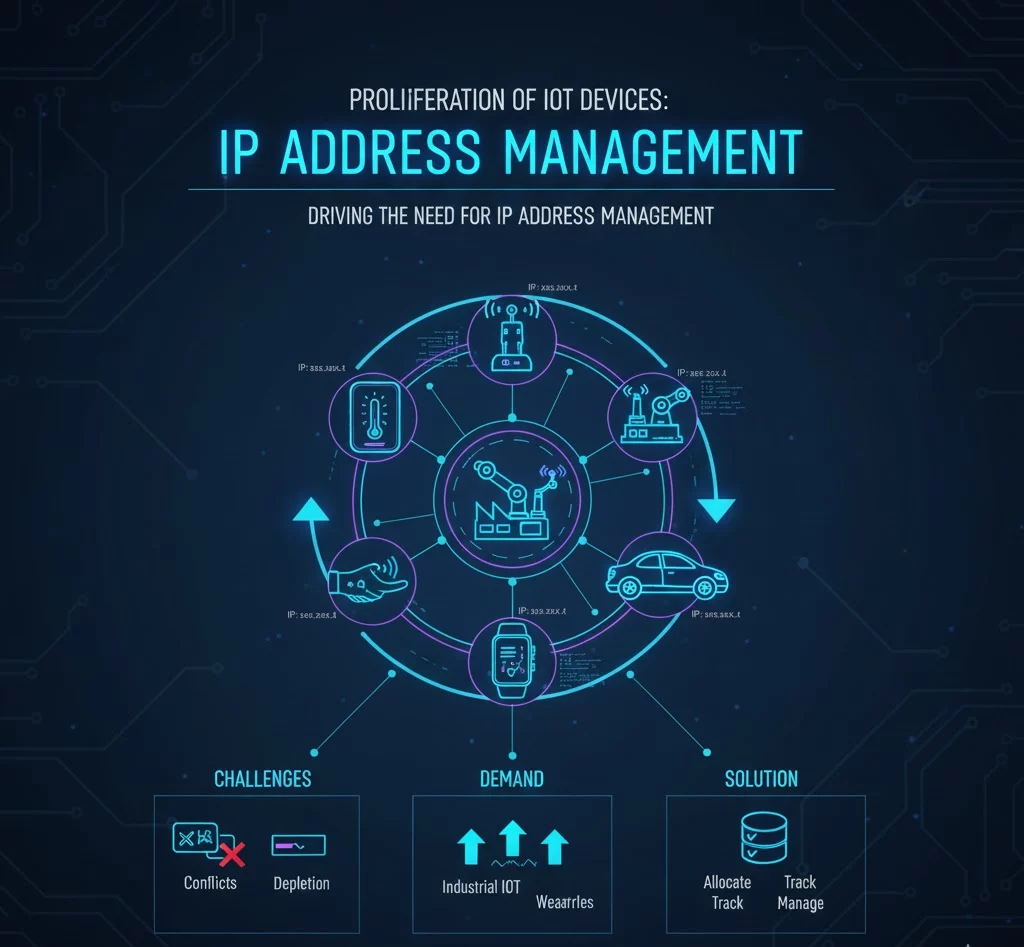
As the number of IoT devices continues to skyrocket, ranging from smart thermostats and wearable devices to industrial sensors and autonomous vehicles, the demand for IP address management has never been greater. Each IoT device requires a unique IP address to communicate and interact with other devices and services over the Internet, necessitating robust IP address management practices to allocate, track, and manage these addresses efficiently. Without effective IP address management, organizations risk facing IP address conflicts, depletion of address space, and network performance issues, hindering the scalability and reliability of their IoT deployments.
Challenges in IoT IP Address Management: Scale, Security, and Scalability
Managing IP addresses in the IoT landscape poses several unique challenges stemming from the sheer scale and heterogeneity of IoT deployments, as well as the security and scalability requirements inherent to IoT applications. With millions, or even billions, of IoT devices interconnected across diverse networks and environments, traditional IP address management approaches may prove inadequate for addressing the dynamic nature of IoT deployments.
Additionally, security concerns, such as unauthorized access, data breaches, and device compromise, underscore the importance of implementing robust authentication, encryption, and access control mechanisms within IoT networks.
Strategies for Effective IoT IP Address Management: Automation and Orchestration
To overcome the challenges of IoT IP address management, organizations are increasingly turning to automation and orchestration solutions that streamline address allocation, provisioning, and lifecycle management processes.
By leveraging automation tools and centralized management platforms, organizations can dynamically assign and reclaim IP addresses based on device provisioning, activation, and decommissioning events, ensuring optimal resource utilization and minimizing manual intervention.
Moreover, orchestration frameworks enable organizations to enforce policy-based IP address assignments, implement role-based access controls, and integrate with existing network infrastructure, thus enhancing security and scalability in IoT deployments.
Best Practices for IoT IP Address Management: Visibility, Monitoring, and Governance
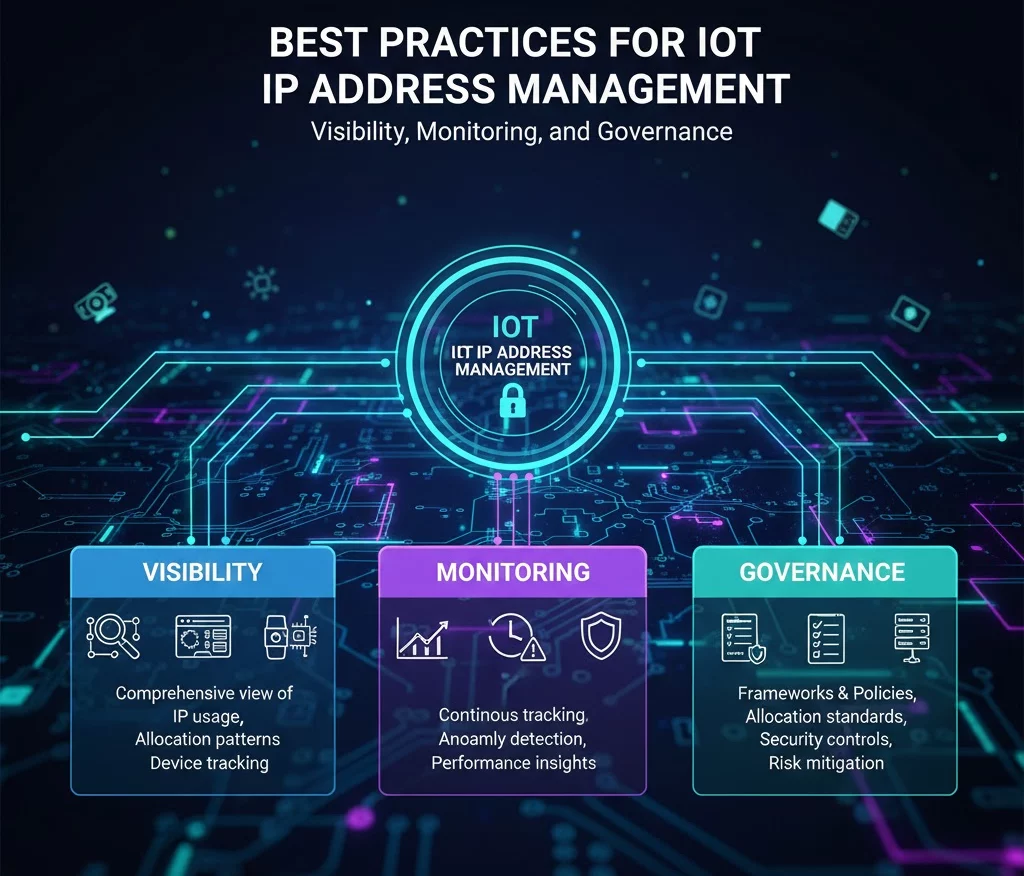
In addition to automation and orchestration, adopting best practices for IoT IP address management is essential to ensuring the long-term success and sustainability of IoT deployments. This includes maintaining comprehensive visibility into IP address usage and allocation patterns across IoT devices, networks, and environments.
Furthermore, implementing governance frameworks and policies that define IP address allocation policies, address space management procedures, and security controls can help organizations maintain compliance, enforce standards, and mitigate the risks associated with IP address management in the IoT landscape.
Embracing the Future of IoT with Effective IP Address Management
In conclusion, the convergence of IoT and IP address management heralds a new era of innovation, connectivity, and efficiency in the digital landscape. By addressing the challenges, leveraging automation and orchestration solutions, and adopting best practices, organizations can unlock the full potential of IoT deployments while ensuring the scalability, security, and reliability of their IP address management infrastructure. As IoT continues to reshape industries and redefine connectivity, effective IP address management remains a cornerstone of success in the interconnected world of tomorrow.
Trusted IPv4 Leasing for Business Growth
Get enterprise-grade IPv4 space quickly, with seamless deployment and end-to-end management.
Get Started with i.leaseFAQs
Do IoT devices need Public or Private IP addresses?
Most IoT devices (like smart bulbs or sensors) use Private IP addresses (e.g., 192.168.x.x) to communicate within a local network, connecting to the internet via a gateway. However, industrial IoT devices that require direct remote access often need Public, Static IP addresses to ensure they can be reached reliably from anywhere.
Why is IPv6 critical for IoT growth?
IPv4 has run out of addresses (only ~4.3 billion exist), which is insufficient for the billions of new IoT devices coming online. IPv6 offers a virtually infinite address space (340 undecillion addresses), allowing every single IoT sensor to have its own unique, globally routable IP address without needing complex NAT workarounds.
What is an IP conflict in an IoT network?
An IP conflict occurs when two devices on the same network try to use the same IP address, causing both to disconnect. In IoT networks with thousands of devices, this is a common issue if IP management is done manually. Using an automated IPAM (IP Address Management) tool prevents this by tracking which IPs are in use in real-time.
Articles connexes
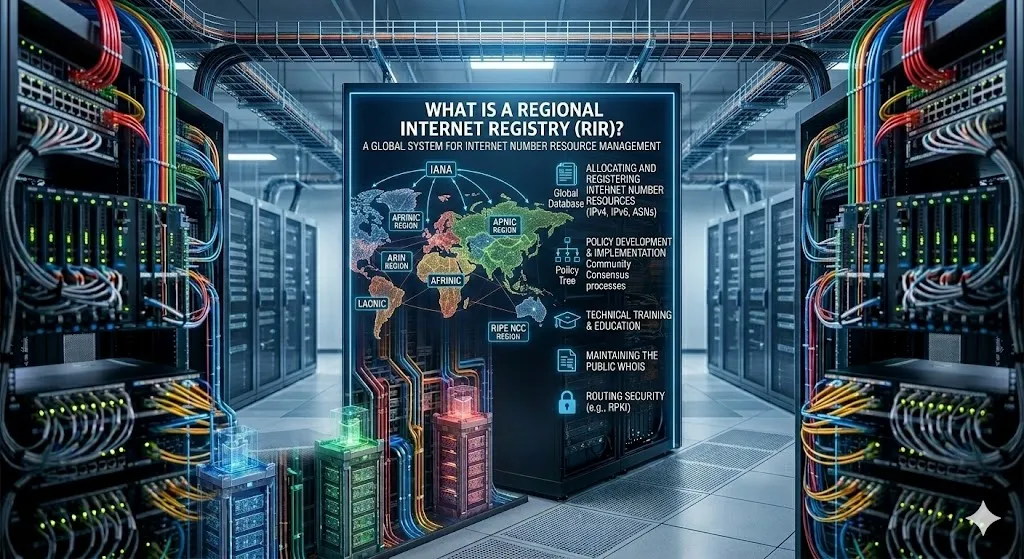
Qu’est-ce qu’un registre Internet régional (RIR) ?
Un registre Internet régional (RIR) est une organisation chargée de l’attribution et de la gestion des ressources de numérotation Internet au sein d’une région géographique spécifique. Ces ressources comprennent principalement les adresses IP (IPv4 et IPv6) et les numéros de système autonome (ASN), éléments essentiels permettant aux appareils et aux réseaux de communiquer sur Internet. Internet ne peut fonctionner sans un système performant d’attribution d’adresses IP uniques etRead more Related Posts Qu’est-ce qu’un registre Internet régional (RIR) ? Un registre Internet régional (RIR) est une organisation chargée de l'attribution et de la gestion des ressources de numérotation Internet Read more Pourquoi n’y a-t-il pas d’IPv5 ? L’histoire du protocole Internet manquant Lorsqu'on parle de protocoles Internet, la plupart des gens connaissent IPv4 et IPv6. Mais vous vous demandez peut-être : qu'est-il arrivé Read more Qu’est-ce que l’APNIC ? Une introduction simple au Centre d'information du réseau Asie-Pacifique Lorsque vous naviguez sur Internet, vous ne pensez probablement pas beaucoup Read more .related-post {} .related-post .post-list { text-align: left; } .related-post .post-list .item { margin: 5px; padding: 10px; } .related-post .headline { font-size: 18px !important; color: #999999 !important; } .related-post .post-list .item .post_thumb { max-height: 220px; margin: 10px 0px; padding: 0px; display: block; } .related-post .post-list .item .post_title { font-size: 16px; color: #3f3f3f; margin: 10px 0px; padding: 0px; display: block; text-decoration: none; } .related-post .post-list .item .post_excerpt { font-size: 13px; color: #3f3f3f; margin: 10px 0px; padding: 0px; display: block; text-decoration: none; } @media only screen and (min-width: 1024px) { .related-post .post-list .item { width: 30%; } } @media only screen and (min-width: 768px) and (max-width: 1023px) { .related-post .post-list .item { width: 90%; } } @media only screen and (min-width: 0px) and (max-width: 767px) { .related-post .post-list .item { width: 90%; } }

Pourquoi n’y a-t-il pas d’IPv5 ? L’histoire du protocole Internet manquant
Lorsqu’on parle de protocoles Internet, la plupart des gens connaissent IPv4 et IPv6. Mais vous vous demandez peut-être : qu’est-il arrivé à IPv5 ? Pourquoi a-t-on l’impression qu’Internet est passé directement d’IPv4 à IPv6 ? Plongeons-nous dans l’histoire fascinante de ce protocole « manquant ». Qu’est-ce que l’IPv5 ? Le protocole IPv5, officiellement appelé Internet Stream Protocol (ST), était un protocole expérimental développé à la fin des années 1970 et dans les années 1980. IlRead more Related Posts Qu’est-ce qu’un registre Internet régional (RIR) ? Un registre Internet régional (RIR) est une organisation chargée de l'attribution et de la gestion des ressources de numérotation Internet Read more Pourquoi n’y a-t-il pas d’IPv5 ? L’histoire du protocole Internet manquant Lorsqu'on parle de protocoles Internet, la plupart des gens connaissent IPv4 et IPv6. Mais vous vous demandez peut-être : qu'est-il arrivé Read more Qu’est-ce que l’APNIC ? Une introduction simple au Centre d'information du réseau Asie-Pacifique Lorsque vous naviguez sur Internet, vous ne pensez probablement pas beaucoup Read more .related-post {} .related-post .post-list { text-align: left; } .related-post .post-list .item { margin: 5px; padding: 10px; } .related-post .headline { font-size: 18px !important; color: #999999 !important; } .related-post .post-list .item .post_thumb { max-height: 220px; margin: 10px 0px; padding: 0px; display: block; } .related-post .post-list .item .post_title { font-size: 16px; color: #3f3f3f; margin: 10px 0px; padding: 0px; display: block; text-decoration: none; } .related-post .post-list .item .post_excerpt { font-size: 13px; color: #3f3f3f; margin: 10px 0px; padding: 0px; display: block; text-decoration: none; } @media only screen and (min-width: 1024px) { .related-post .post-list .item { width: 30%; } } @media only screen and (min-width: 768px) and (max-width: 1023px) { .related-post .post-list .item { width: 90%; } } @media only screen and (min-width: 0px) and (max-width: 767px) { .related-post .post-list .item { width: 90%; } }
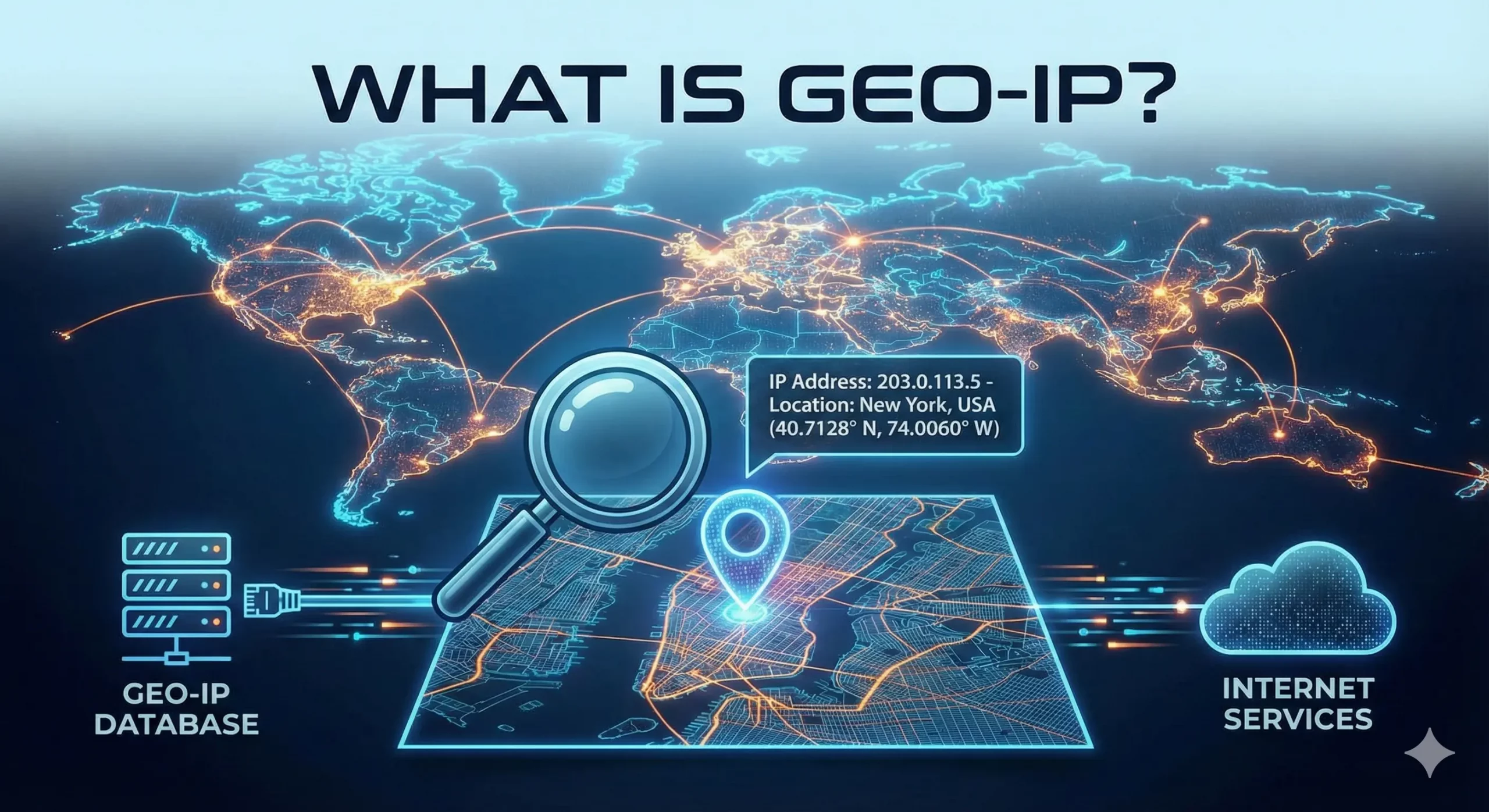
Qu’est-ce que GeoIP et comment ça fonctionne ?
La géolocalisation IP est essentielle pour personnaliser les expériences en ligne, renforcer la cybersécurité et alimenter d’innombrables applications professionnelles. Mais qu’est-ce que la géolocalisation IP exactement, comment fonctionne-t-elle et pourquoi est-elle si importante ? Voyons cela de plus près. Qu’est-ce que GeoIP ? GeoIP signifie « Géographie Internet ». Il s’agit d’une technologie qui détermine la localisation géographique d’un utilisateur à partir de son adresse IP (Internet Protocol). Chaque appareil connecté à InternetRead more Related Posts Qu’est-ce qu’un registre Internet régional (RIR) ? Un registre Internet régional (RIR) est une organisation chargée de l'attribution et de la gestion des ressources de numérotation Internet Read more Pourquoi n’y a-t-il pas d’IPv5 ? L’histoire du protocole Internet manquant Lorsqu'on parle de protocoles Internet, la plupart des gens connaissent IPv4 et IPv6. Mais vous vous demandez peut-être : qu'est-il arrivé Read more Qu’est-ce que l’APNIC ? Une introduction simple au Centre d'information du réseau Asie-Pacifique Lorsque vous naviguez sur Internet, vous ne pensez probablement pas beaucoup Read more .related-post {} .related-post .post-list { text-align: left; } .related-post .post-list .item { margin: 5px; padding: 10px; } .related-post .headline { font-size: 18px !important; color: #999999 !important; } .related-post .post-list .item .post_thumb { max-height: 220px; margin: 10px 0px; padding: 0px; display: block; } .related-post .post-list .item .post_title { font-size: 16px; color: #3f3f3f; margin: 10px 0px; padding: 0px; display: block; text-decoration: none; } .related-post .post-list .item .post_excerpt { font-size: 13px; color: #3f3f3f; margin: 10px 0px; padding: 0px; display: block; text-decoration: none; } @media only screen and (min-width: 1024px) { .related-post .post-list .item { width: 30%; } } @media only screen and (min-width: 768px) and (max-width: 1023px) { .related-post .post-list .item { width: 90%; } } @media only screen and (min-width: 0px) and (max-width: 767px) { .related-post .post-list .item { width: 90%; } }
