Which RIRs Support Inter-RIR IPv4 Transfers in 2026?
 Stephanie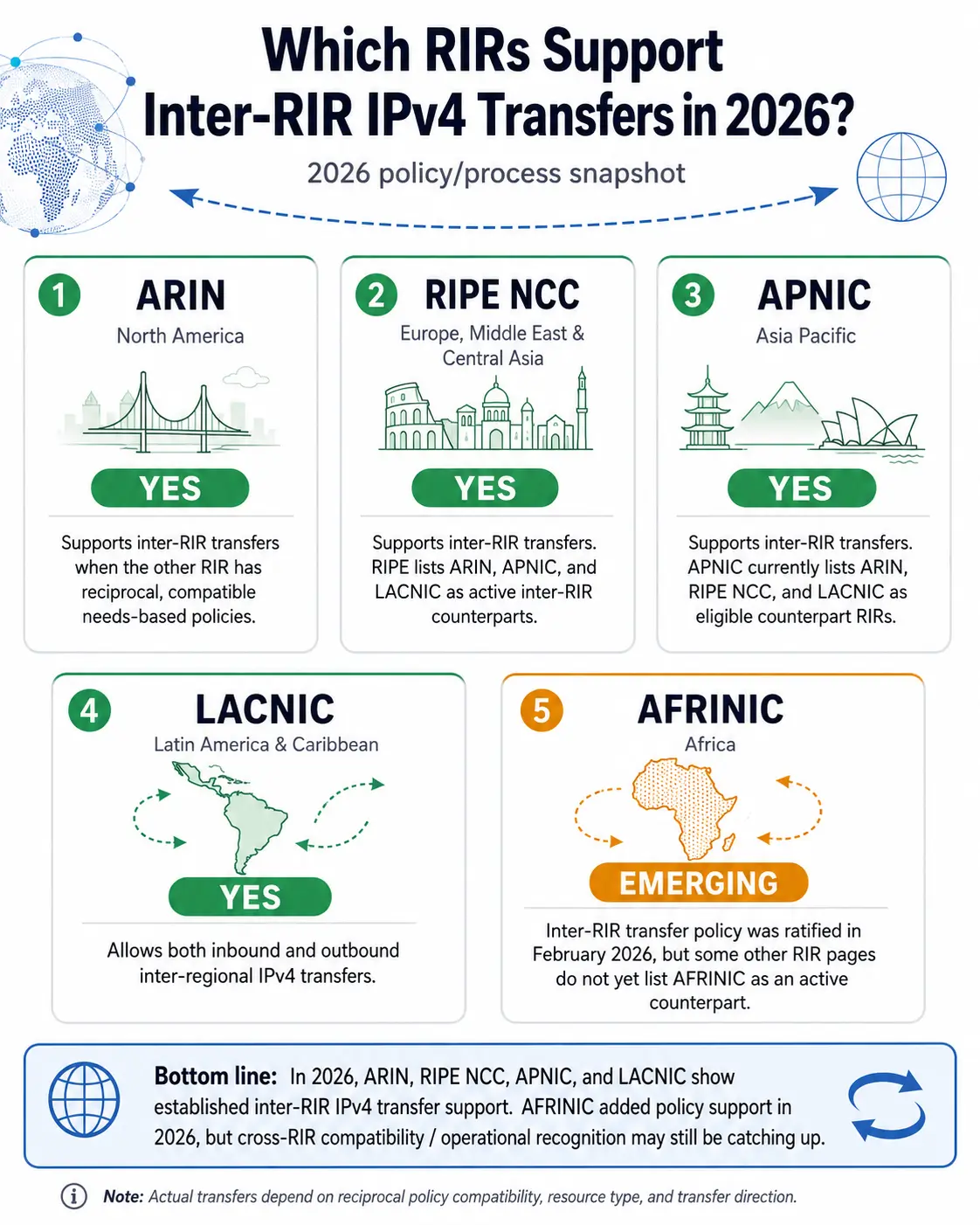
Table of Contents
IPv4 addresses may be globally routable, but transferring their registration from one organization to another is governed by Regional Internet Registry (RIR) policy.
For organizations buying or selling IPv4 address space internationally, this creates an important question:
Which RIRs support inter-RIR IPv4 transfers in 2026?
As of August 2026, ARIN, RIPE NCC, APNIC, and LACNIC have established frameworks for inter-RIR IPv4 transfers, subject to compatibility between the RIRs and the requirements that apply to the source and recipient. AFRINIC has also ratified a broader transfer policy that formally provides for certain inter-RIR transfers, but its implementation status requires additional attention before organizations rely on an AFRINIC cross-regional transaction.
Understanding these differences is essential when planning an international IPv4 transaction.
What Is an Inter-RIR IPv4 Transfer?
An inter-RIR IPv4 transfer occurs when IPv4 address space moves between organizations registered in the service regions of two different Regional Internet Registries.
For example:
- An IPv4 block registered with RIPE NCC is transferred to an organization in the ARIN region.
- An APNIC-registered block moves to a qualified recipient in another compatible RIR.
- A LACNIC-region organization receives IPv4 space from another supported registry.
This differs from an intra-RIR transfer, where the source and recipient remain within the same RIR.
For a broader explanation of how the registries work, read i.lease’s guide to What Is a Regional Internet Registry (RIR)?.
Inter-RIR transactions can be more complex because both registries may need to approve and coordinate the transfer. RIPE NCC, for example, explicitly states that an inter-RIR transfer involving its region must be approved by both RIPE NCC and the other RIR before completion.
Which RIRs Support Inter-RIR IPv4 Transfers in 2026?
Here is the practical picture as of August 2026:
| RIR | Region | Inter-RIR IPv4 Transfer Status | Important Consideration |
|---|---|---|---|
| ARIN | United States, Canada and parts of the Caribbean | Supported | Requires a compatible counterpart RIR and applicable needs-based requirements |
| RIPE NCC | Europe, Middle East and parts of Central Asia | Supported | Supports IPv4 transfers with compatible RIR regions |
| APNIC | Asia Pacific | Supported | Counterpart RIR must permit the transfer |
| LACNIC | Latin America and the Caribbean | Supported | Policy covers both intra- and inter-RIR IPv4 transfers |
| AFRINIC | Africa | Policy ratified; implementation requires verification | New inter-RIR framework was ratified in 2026, while current operational documentation still reflects the transition |
The result is that international IPv4 transactions are possible across much of the global RIR system, but “inter-RIR supported” does not mean every block can automatically move between every registry.
Eligibility still depends on the policies of the specific registries involved.
1. ARIN Inter-RIR IPv4 Transfers
The American Registry for Internet Numbers (ARIN) supports inter-RIR transfers under Section 8.4 of its Number Resource Policy Manual.
ARIN’s policy states that inter-regional IPv4 and ASN transfers may occur only through RIRs that agree to the transfer and maintain reciprocal, compatible needs-based policies.
This means an organization cannot simply purchase an IPv4 block anywhere in the world and request that ARIN register it.
Several conditions need to align.
The source must be recognized as the legitimate registered rights holder, the resource must qualify for transfer, the counterpart RIR must support the transaction, and recipients within the ARIN region must satisfy the applicable ARIN transfer requirements.
For organizations acquiring IPv4 space, careful preparation before the transaction can significantly reduce unnecessary transfer delays.
Businesses looking for available address space can explore IPv4 addresses for sale through the i.lease marketplace.
2. RIPE NCC Inter-RIR IPv4 Transfers
RIPE NCC has one of the most clearly documented inter-RIR transfer processes.
Its current documentation identifies inter-RIR transfer arrangements involving ARIN, APNIC, and LACNIC, including IPv4 transfers.
A transfer involving RIPE NCC generally requires approval by both registries.
When addresses enter the RIPE NCC service region, RIPE NCC may also perform due diligence on the receiving organization and determine the appropriate registration status of the resources.
Another important operational consideration is that registry transfer is only one part of the process.
RIPE NCC notes that services such as reverse DNS and RPKI may be affected during an inter-RIR transfer. Existing ROAs associated with resources leaving the RIPE region may be removed, requiring new routing authorization to be established through the receiving RIR.
This is why a successful IPv4 acquisition should be measured by more than a completed registry record.
The address space also needs to remain operationally usable.
3. APNIC Inter-RIR IPv4 Transfers
The APNIC Internet Number Resource Policies explicitly provide for inter-RIR IPv4 transfers.
APNIC states that it will process and record an inter-RIR IPv4 transfer when the counterpart RIR has a policy permitting transfers between APNIC and that region. The minimum transfer size under APNIC’s policy is generally a /24.
APNIC also requires the IPv4 resources to be properly registered and free from disputes over the status of the resource holder.
For organizations operating across Asia-Pacific markets, this makes registry due diligence particularly important before signing a transaction.
The existence of an IPv4 block alone does not prove that the proposed transfer is eligible.
Organizations should verify:
- Registered holder information
- Transfer restrictions
- Block history
- Applicable holding periods
- Recipient eligibility
- RPKI and routing readiness
- Reputation and abuse history
i.lease discusses these wider considerations in Understanding RIR Transfer Rules Across Regions.
4. LACNIC Inter-RIR IPv4 Transfers
LACNIC permits both inbound and outbound inter-regional IPv4 transfers without requiring a merger or acquisition between the organizations involved.
LACNIC’s IPv4 transfer policy applies to transactions where one of the participating organizations belongs to another RIR region as well as transfers occurring entirely inside the LACNIC region. The policy sets a minimum transferable block size of /24.
The introduction of inter-regional transfers has made it easier for organizations in Latin America and the Caribbean to participate in the broader IPv4 transfer market.
However, the same principle still applies:
The policies of both sides of an inter-RIR transaction matter.
A transfer permitted by one RIR will not necessarily succeed if the counterpart registry’s requirements are not satisfied.
5. What About AFRINIC Inter-RIR Transfers in 2026?
AFRINIC requires special attention because its position is evolving.
On February 4, 2026, AFRINIC published details of a ratified Number Resources Transfer Policy that formally allows inter-RIR transfers under specified conditions where appropriate reciprocal arrangements exist. The policy also introduces important restrictions: AFRINIC-issued IPv4 space generally cannot simply be transferred out of the African region, while certain categories such as eligible legacy resources and resources previously transferred into AFRINIC may be treated differently.
However, this does not mean organizations should assume that every AFRINIC inter-RIR transfer path is already operational.
AFRINIC’s current resource-transfer guidance still describes policy-based transfers primarily in terms of IPv4 transfers within the AFRINIC service region, and its current Consolidated Policy Manual continues to list Section 5.7 as “IPv4 Resource Transfers within the AFRINIC region.”
The ratified policy documentation itself also identifies an implementation timeline and the need for coordination with other RIRs.
Therefore, organizations considering an AFRINIC-related inter-RIR transaction in 2026 should verify current implementation and counterpart compatibility directly with the relevant registries before committing to the transaction.
This distinction between a ratified policy and an operational transfer process is important.
Why Inter-RIR IPv4 Transfers Are More Complex
An intra-RIR transfer typically involves one registry framework.
An inter-RIR transfer introduces two.
That means the transaction can involve different rules for the source organization, recipient organization, resource eligibility, documentation, holding periods, needs justification and registry contracts.
There are also operational elements beyond approval.
A registry transfer may affect:
RPKI and ROAs: Routing authorizations may need to be recreated after a registry change.
Reverse DNS: Existing delegations may need to be removed and established again with the new registry.
WHOIS and RDAP: Registration data must correctly identify the post-transfer resource holder.
Routing objects: Network operators may need to update associated Internet Routing Registry information.
Geolocation: Third-party geolocation databases do not necessarily update immediately after a registry transfer.
IP reputation: A registry-compliant IPv4 block can still have historical reputation problems that affect email delivery, hosting, VPN services or other applications.
This is why buying IPv4 address space is not merely about agreeing on a price.
It is about ensuring the resource can move legally, administratively and operationally from one environment to another.
Inter-RIR Transfer vs IPv4 Leasing
Buying address space through an inter-RIR transfer provides long-term control of the resource registration, but a transfer may involve significant due diligence and registry coordination.
For organizations that primarily need IPv4 capacity rather than a permanent acquisition, leasing can offer another path.
With IPv4 leasing, the registered resource does not necessarily need to undergo a permanent ownership or holdership transfer between the parties. This can make leasing useful for organizations that need additional capacity, geographic flexibility or shorter deployment horizons without committing capital to an outright IPv4 purchase.
The i.lease IPv4 marketplace supports organizations looking to source IPv4 capacity through buying, selling and leasing options.
The appropriate model depends on the organization’s requirements.
A network expecting to use the addresses permanently may prefer acquisition.
A company with changing capacity needs may find leasing more flexible.
How to Prepare for an Inter-RIR IPv4 Transfer
Before purchasing IPv4 space from another registry region, both buyers and sellers should determine the transfer path before completing commercial negotiations.
Confirm:
Which RIR currently registers the IPv4 block.
Which RIR will register the recipient after the transfer.
Whether those RIRs currently support the proposed transfer path.
Whether the specific IPv4 block is eligible for transfer.
Whether the source satisfies applicable holding and registration requirements.
Whether the recipient meets applicable qualification requirements.
Whether registry documentation is complete and consistent.
Whether the block has routing, reputation, blacklist or geolocation concerns.
How RPKI, rDNS and routing objects will be handled after completion.
What happens if either RIR rejects or delays the transfer.
Organizations selling unused resources should perform the same checks before marketing them internationally. IPv4 holders can learn more about the process through Sell IPv4 Addresses on i.lease.
Why Registry Compatibility Should Be Checked Before Buying IPv4
One of the biggest mistakes in an international IPv4 transaction is treating the resource as if it were a conventional asset that can simply be delivered after payment.
IPv4 transfers depend on registry recognition.
A commercial agreement between a buyer and seller does not by itself change authoritative RIR registration.
The transaction must satisfy the relevant registry policies.
That makes due diligence important before funds move.
A structured IPv4 marketplace can help buyers evaluate resource availability, reputation and registry requirements before entering the formal transfer process. i.lease provides RIR-aligned IPv4 purchasing with pre-vetted marketplace listings, escrow protection and transfer coordination.
Which RIR Is Best for an IPv4 Transfer?
There is no single “best” RIR for IPv4 transfers.
The correct registry is determined by factors such as the existing registration of the resource, the recipient’s operational presence, applicable registry policy and the intended transfer structure.
Instead of choosing an RIR based only on perceived simplicity, organizations should ask:
Can the specific source, recipient and IPv4 block complete the intended transfer under both registries’ current rules?
That question is much more useful than asking which registry has the easiest transfer policy.
Frequently Asked Questions
Which RIRs allow inter-RIR IPv4 transfers in 2026?
ARIN, RIPE NCC, APNIC and LACNIC have established operational frameworks for inter-RIR IPv4 transfers, subject to counterpart compatibility and applicable registry requirements. AFRINIC ratified a broader inter-RIR-capable transfer policy in February 2026, but organizations should verify its current implementation status and the specific transfer path before proceeding.
Can IPv4 addresses be transferred from RIPE NCC to ARIN?
Yes. RIPE NCC documents IPv4 transfer arrangements with ARIN, while ARIN permits inter-RIR transfers with registries that meet its compatibility requirements. Both registries must approve the applicable transaction.
Can IPv4 addresses be transferred between APNIC and another RIR?
Yes, provided the counterpart RIR maintains an inter-RIR transfer policy that permits the transaction. APNIC’s current policy explicitly provides for inter-RIR IPv4 address transfers under this condition.
Does LACNIC support international IPv4 transfers?
Yes. LACNIC permits inter-regional IPv4 transfers, subject to its policy requirements and coordination with the counterpart RIR.
Does AFRINIC support inter-RIR IPv4 transfers?
AFRINIC ratified a new Number Resources Transfer Policy in February 2026 that formally provides for certain inter-RIR transfers. However, its currently published operational transfer guidance and implemented policy manual still reflect an implementation transition. Organizations should confirm the specific transfer path with AFRINIC and the counterpart RIR before relying on it.
How long does an inter-RIR IPv4 transfer take?
There is no universal timeline. Processing depends on both registries, the accuracy of the documentation, recipient qualification, resource eligibility and how quickly each party responds. RIPE NCC specifically notes that inter-RIR transfers generally involve more coordination and can take longer than transfers occurring only within its service region.
Is buying IPv4 from another RIR safe?
It can be, provided the transaction includes proper registry verification, due diligence and operational checks. Buyers should verify the registered resource holder, transfer eligibility, IP reputation, routing history and relevant RIR requirements before payment and transfer.
Final Thoughts
Inter-RIR IPv4 transfers have made the IPv4 market significantly more global.
In 2026, ARIN, RIPE NCC, APNIC and LACNIC provide established pathways for cross-regional IPv4 transfers, while AFRINIC’s newly ratified transfer framework represents an important policy development that should be monitored as implementation progresses.
But registry support is only the starting point.
A successful transaction requires the right IPv4 block, an eligible source, a qualified recipient, compatible registry policies, accurate documentation and a plan for maintaining routing and operational continuity after the transfer.
For organizations looking to acquire address space, the i.lease IPv4 marketplace provides access to IPv4 buying, selling and leasing options with a focus on structured, RIR-aligned transactions.
Looking for IPv4 address space?
Explore IPv4 addresses available for purchase, or list unused IPv4 resources for sale through i.lease.
Frequent Asked Questions
1. Which RIRs support inter-RIR IPv4 transfers in 2026?
ARIN, RIPE NCC, APNIC, and LACNIC have established processes for inter-RIR IPv4 transfers with compatible Regional Internet Registries. AFRINIC ratified its Number Resources Transfer Policy on February 4, 2026, introducing a framework for eligible inter-RIR transfers subject to resource category and counterpart RIR requirements.
2. What are the five Regional Internet Registries?
The five RIRs are ARIN for North America and parts of the Caribbean, RIPE NCC for Europe, the Middle East and parts of Central Asia, APNIC for Asia Pacific, LACNIC for Latin America and the Caribbean, and AFRINIC for Africa. Each RIR maintains its own policies for managing and transferring Internet number resources.
3. Can IPv4 addresses be transferred between two different RIRs?
Yes, but only when the RIRs involved permit the proposed transfer and the transaction satisfies their applicable requirements. For example, RIPE NCC requires an inter-RIR transfer to be approved by both RIPE NCC and the counterpart RIR before it can be processed.
4. What is the minimum IPv4 block size for an inter-RIR transfer?
A /24 IPv4 block is a common minimum transfer size under several RIR policies. ARIN specifies a /24 minimum for transfer recipients, while AFRINIC’s ratified transfer framework and APNIC transfer policies also include requirements affecting eligible resources and recipients. Buyers should always confirm the rules of both RIRs before proceeding.
5. How can I buy IPv4 addresses through an inter-RIR transfer?
Start by confirming the source RIR, destination RIR, ownership and transfer eligibility of the IPv4 block. The buyer should also review IP reputation, routing history, RPKI requirements, registry documentation and any recipient qualification rules before completing the purchase. Businesses looking for IPv4 resources can explore IPv4 addresses for sale on i.lease.
Articles connexes

Que sont les entreprises de télécommunications ? Comment les fournisseurs de télécommunications assurent la connectivité au Royaume-Uni, aux États-Unis et au Canada
Les entreprises de télécommunications, également appelées opérateurs télécoms, fournissent des services de communication et de connectivité. Ces services peuvent inclure les réseaux mobiles, l’Internet haut débit, les connexions fibre, les services de téléphonie fixe, la connectivité pour les entreprises, l’accès au cloud, les services réseau gérés et la connectivité aux centres de données. Pour les consommateurs, les entreprises de télécommunications sont souvent connues comme des fournisseurs de services mobilesRead more Related Posts Desbloqueando la privacidad digital con una red privada virtual (VPN) ¿Qué es una VPN? Una red privada virtual (VPN) es una tecnología que permite a los usuarios crear una conexión Comprensión de la traducción de direcciones de red (NAT) En las redes informáticas, gestionar las direcciones IP de forma eficiente es fundamental para garantizar una comunicación fluida entre los Arrendamiento de direcciones IP: Cómo arrendar direcciones IP El mundo digital en el que nos movemos hoy depende en gran medida de las direcciones IP, identificadores únicos asignados .related-post {} .related-post .post-list { text-align: left; } .related-post .post-list .item { margin: 5px; padding: 10px; } .related-post .headline { font-size: 18px !important; color: #999999 !important; } .related-post .post-list .item .post_thumb { max-height: 220px; margin: 10px 0px; padding: 0px; display: block; } .related-post .post-list .item .post_title { font-size: 16px; color: #3f3f3f; margin: 10px 0px; padding: 0px; display: block; text-decoration: none; } .related-post .post-list .item .post_excerpt { font-size: 13px; color: #3f3f3f; margin: 10px 0px; padding: 0px; display: block; text-decoration: none; } @media only screen and (min-width: 1024px) { .related-post .post-list .item { width: 30%; } } @media only screen and (min-width: 768px) and (max-width: 1023px) { .related-post .post-list .item { width: 90%; } } @media only screen and (min-width: 0px) and (max-width: 767px) { .related-post .post-list .item { width: 90%; } }
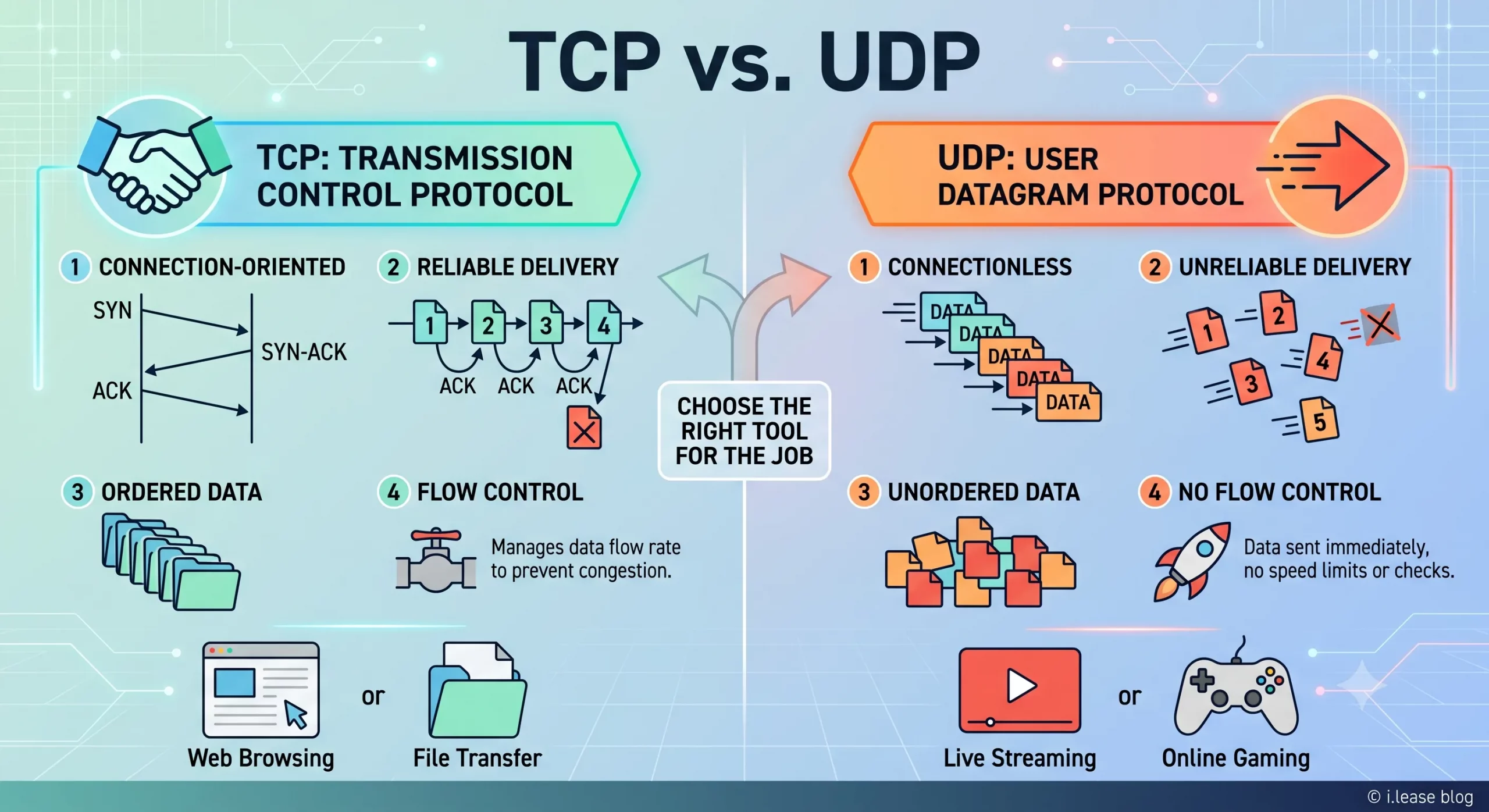
TCP vs UDP : guide de location IPv4 et de réseau d’entreprise
TCP et UDP sont deux des protocoles de transport les plus importants sur Internet. Ils déterminent la circulation des données entre les appareils, les serveurs, les plateformes cloud, les passerelles VPN, les résolveurs DNS, les systèmes de messagerie, les plateformes de streaming et les applications métier. Pour les entreprises, TCP et UDP ne sont pas de simples termes techniques. Ils ont un impact direct sur les performances de l’infrastructure. Related Posts Which RIRs Support Inter-RIR IPv4 Transfers in 2026? IPv4 addresses may be globally routable, but transferring their registration from one organization to another is governed by Regional Internet What Is Reverse DNS (rDNS)? Why PTR Records Matter for Email, Hosting, and Leased IPv4 Reverse DNS (rDNS) is the process of resolving an IP address back to a domain name. It is the mirror How DDoS Mitigation Works: Scrubbing, BGP Diversion, Anycast, and What Network Operators Should Prepare DDoS mitigation is the set of techniques used to keep services online during a distributed denial-of-service attack — by absorbing, .related-post {} .related-post .post-list { text-align: left; } .related-post .post-list .item { margin: 5px; padding: 10px; } .related-post .headline { font-size: 18px !important; color: #999999 !important; } .related-post .post-list .item .post_thumb { max-height: 220px; margin: 10px 0px; padding: 0px; display: block; } .related-post .post-list .item .post_title { font-size: 16px; color: #3f3f3f; margin: 10px 0px; padding: 0px; display: block; text-decoration: none; } .related-post .post-list .item .post_excerpt { font-size: 13px; color: #3f3f3f; margin: 10px 0px; padding: 0px; display: block; text-decoration: none; } @media only screen and (min-width: 1024px) { .related-post .post-list .item { width: 30%; } } @media only screen and (min-width: 768px) and (max-width: 1023px) { .related-post .post-list .item { width: 90%; } } @media only screen and (min-width: 0px) and (max-width: 767px) { .related-post .post-list .item { width: 90%; } }

Pourquoi la Malaisie devient-elle un pôle de centres de données pour les infrastructures cloud et d’intelligence artificielle ?
La Malaisie devient l’un des marchés de croissance les plus importants d’Asie du Sud-Est dans le secteur des centres de données. La demande en cloud computing, intelligence artificielle, applications d’entreprise, paiements numériques, commerce électronique, cybersécurité et services régionaux à faible latence pousse les entreprises à construire davantage d’infrastructures au plus près des utilisateurs. Cette croissance ne repose pas uniquement sur un effet de mode. La Malaisie a attiré desRead more Related Posts Desbloqueando la privacidad digital con una red privada virtual (VPN) ¿Qué es una VPN? Una red privada virtual (VPN) es una tecnología que permite a los usuarios crear una conexión Comprensión de la traducción de direcciones de red (NAT) En las redes informáticas, gestionar las direcciones IP de forma eficiente es fundamental para garantizar una comunicación fluida entre los ¿Por qué Malasia se está convirtiendo en un centro neurálgico para la infraestructura de nube e IA? Malasia se está convirtiendo en uno de los mercados de crecimiento de centros de datos más importantes del Sudeste Asiático. .related-post {} .related-post .post-list { text-align: left; } .related-post .post-list .item { margin: 5px; padding: 10px; } .related-post .headline { font-size: 18px !important; color: #999999 !important; } .related-post .post-list .item .post_thumb { max-height: 220px; margin: 10px 0px; padding: 0px; display: block; } .related-post .post-list .item .post_title { font-size: 16px; color: #3f3f3f; margin: 10px 0px; padding: 0px; display: block; text-decoration: none; } .related-post .post-list .item .post_excerpt { font-size: 13px; color: #3f3f3f; margin: 10px 0px; padding: 0px; display: block; text-decoration: none; } @media only screen and (min-width: 1024px) { .related-post .post-list .item { width: 30%; } } @media only screen and (min-width: 768px) and (max-width: 1023px) { .related-post .post-list .item { width: 90%; } } @media only screen and (min-width: 0px) and (max-width: 767px) { .related-post .post-list .item { width: 90%; } }
