Understanding RIR Transfer Rules Across Regions
 Stephanie
Understanding RIR Transfer Rules Across Regions
IPv4 addresses have become valuable operational assets. For ISPs, hosting providers, cloud platforms, enterprises, and network operators, obtaining IPv4 space is no longer just a technical task. It often involves policy review, registry approval, documentation, and regional compliance.
Table of Contents
At the center of this process are the five Regional Internet Registries, commonly known as RIRs:
- ARIN
- RIPE NCC
- APNIC
- LACNIC
- AFRINIC
Each RIR manages internet number resources for a specific part of the world. These resources include IPv4 addresses, IPv6 addresses, and Autonomous System Numbers, or ASNs.
Although the internet is global, IP address registration is still managed regionally. This means that IPv4 transfer rules can differ significantly depending on where the resource is registered and where the receiving organization is located.
For businesses involved in IPv4 acquisition, IP address leasing, network expansion, or cross-border infrastructure planning, understanding RIR transfer rules is essential. The rules can affect whether a transfer is possible, how long it takes, what documents are required, and whether leasing may be a more practical option.
What Are RIR Transfer Rules?
RIR transfer rules are the policies that govern how internet number resources move from one organization to another.
A formal transfer changes the registered holder of an IP address block or ASN in the relevant RIR database. This is different from simply announcing a prefix through BGP or using an IP address block under a commercial lease.
A transfer may affect:
- WHOIS and RDAP registration records
- Abuse contact information
- Reverse DNS delegation
- RPKI management
- IRR route objects
- Billing and membership obligations
- Legal responsibility for the resource
Most RIR transfer policies are designed to answer several key questions:
Is the source organization authorized to transfer the resource?
Is the recipient eligible to receive it?
Is the resource free from restrictions or lock-up periods?
Does the recipient need to justify future use?
If the transfer is cross-regional, do both RIRs have compatible policies?
These requirements vary by region, which is why a transfer that is simple in one market may be more complex in another.
Why Regional Differences Matter
The IPv4 market is increasingly global. A company in Europe may acquire address space from North America. A hosting provider in Asia may receive resources from Latin America. An enterprise expanding into multiple regions may need to compare registry rules before deciding whether to transfer or lease IP addresses.
However, the commercial agreement is only one part of the process. The transfer must still be accepted by the relevant RIR or RIRs.
This is especially important for inter-RIR transfers, where the source and recipient are in different registry regions. In these cases, both RIRs usually need to approve the transfer, and both policies must be compatible.
Common reasons for delay include:
- Missing corporate documentation
- Unclear authority from the source holder
- Recipient eligibility issues
- Needs-based review requirements
- Transfer restriction periods
- Incompatible inter-RIR policies
- Incomplete registry account setup
For companies that need IPv4 capacity quickly, these requirements can affect project timelines. This is one reason many operators also consider IP leasing as an alternative to a full registry transfer.
RIR Transfer Rules by Region
The table below gives a high-level comparison of how transfer rules differ across the five RIR regions.
| RIR | Region | Transfer Scope | Key Considerations |
|---|---|---|---|
| ARIN | North America and parts of the Caribbean | IPv4 and ASNs, with inter-RIR support for compatible regions | Strong needs-based review. Inter-RIR IPv6 transfers are generally not supported. |
| RIPE NCC | Europe, Middle East, and parts of Central Asia | IPv4, IPv6, and ASNs | Flexible transfer framework, with restrictions on scarce resources such as IPv4 and 16-bit ASNs. |
| APNIC | Asia Pacific | IPv4 and ASNs | Minimum IPv4 transfer size is usually /24. Recipients may need to provide a use plan. |
| LACNIC | Latin America and the Caribbean | IPv4 transfers | Requires recipient justification. Certain one-year and three-year restrictions may apply. |
| AFRINIC | Africa | IPv4 and ASNs under updated transfer policy framework | Inter-RIR transfer availability should be verified carefully before planning a transaction. |
ARIN Transfer Rules
ARIN serves the United States, Canada, and parts of the Caribbean and North Atlantic region.
ARIN has one of the more structured transfer frameworks. A key feature of ARIN policy is needs-based review. This means the receiving organization may need to show that it has a legitimate operational requirement for the requested IPv4 resources.
For transfers within the ARIN region, the recipient must meet ARIN’s policy requirements. For inter-RIR transfers, ARIN also requires the other RIR to have a compatible transfer policy.
Important ARIN considerations include:
- Inter-RIR transfers may include IPv4 addresses and ASNs.
- IPv6 inter-RIR transfers are generally not supported.
- Recipients may need to demonstrate operational need.
- The source organization must be the authorized holder.
- The resource must not be subject to a policy restriction or dispute.
- Transfer pre-approval can help reduce uncertainty.
For businesses entering the ARIN market, preparation is important. A buyer may have a signed commercial agreement, but the transfer still depends on registry approval.
RIPE NCC Transfer Rules
RIPE NCC serves Europe, the Middle East, and parts of Central Asia.
Compared with some other regions, RIPE NCC has a relatively flexible transfer environment. RIPE NCC allows transfers of IPv4, IPv6, and ASNs, but certain scarce resources remain subject to restrictions.
One of the most important restrictions is the 24-month transfer limitation for IPv4 addresses and 16-bit ASNs after they are received. This prevents resources from being immediately transferred again after a recent transaction.
Important RIPE NCC considerations include:
- IPv4, IPv6, and ASN transfers are supported.
- Inter-RIR transfers require approval from both RIRs.
- IPv4 and 16-bit ASNs are subject to a 24-month re-transfer restriction.
- Allocated PA resources generally require RIPE NCC membership.
- PI resources may require a sponsoring LIR relationship.
- Registry records are updated after the transfer is completed.
RIPE NCC’s framework is often viewed as practical for IPv4 market activity, but buyers still need to review transfer history, contractual status, and registry requirements before proceeding.
APNIC Transfer Rules
APNIC serves the Asia Pacific region.
APNIC supports IPv4 transfers within its region and inter-RIR transfers with compatible regions. The minimum IPv4 transfer size is generally /24, and recipients may be asked to provide a plan showing how the transferred resources will be used.
APNIC also applies special restrictions to certain resources, including IPv4 addresses delegated from the 103/8 free pool.
Important APNIC considerations include:
- IPv4 transfers usually require a minimum /24 block size.
- Inter-RIR transfers require compatible policies between registries.
- Recipients may need to provide a detailed use plan.
- Some 103/8 free pool resources are subject to a five-year transfer restriction.
- Transfer fees and account status should be checked in advance.
- National Internet Registries in the APNIC region may have additional process requirements.
For Asia Pacific network operators, APNIC transfers are manageable when documentation is prepared early. Businesses should confirm the resource status, recipient eligibility, and routing plan before starting the process.
LACNIC Transfer Rules
LACNIC serves Latin America and the Caribbean.
LACNIC permits IPv4 transfers within the region and between compatible RIR regions, subject to policy requirements. The minimum transferable block size is generally /24.
A recipient in the LACNIC region must justify the IPv4 space it wants to receive. There are also timing restrictions that can affect whether a specific block is eligible for transfer.
Important LACNIC considerations include:
- The minimum IPv4 transfer size is usually /24.
- Recipients must justify their need for the IPv4 resources.
- A source organization may become ineligible to receive new IPv4 resources from LACNIC for one year after a transfer.
- Transferred addresses may not be transferable again for one year.
- IPv4 resources originally allocated or assigned by LACNIC may be restricted from transfer for three years.
- Legacy resources transferred into the LACNIC region may lose legacy status.
These rules make timing and resource history especially important. Before entering a transaction, both parties should confirm whether the address block is currently transferable.
AFRINIC Transfer Rules
AFRINIC serves the African region.
AFRINIC’s transfer framework has evolved over time. Recent policy developments have introduced clearer rules around IPv4 and ASN transfers, including references to inter-RIR transfers where reciprocal policies exist.
However, organizations should be careful when planning AFRINIC-related inter-RIR transfers. A regional policy update does not always mean that every other RIR immediately treats the process as operationally compatible. Before relying on an inter-RIR transfer path involving AFRINIC, both registries’ current positions should be checked.
Important AFRINIC considerations include:
- IPv4 transfers are part of the updated AFRINIC policy framework.
- ASN transfers may also be covered under updated policy conditions.
- Inter-RIR transfers may depend on reciprocal policy recognition.
- Counterpart RIR compatibility should be verified before any transaction.
- Documentation, account status, and resource eligibility should be reviewed carefully.
For African network operators, transfer policy is closely connected to regional internet development. Clear, predictable transfer processes can help networks access IPv4 resources while maintaining accurate registry records.
How Inter-RIR Transfers Usually Work
An inter-RIR transfer involves resources moving between organizations in different RIR regions.
These transfers are more complex than intra-region transfers because two registries are involved. Each registry may have its own eligibility checks, documentation requirements, review timeline, and policy restrictions.
A typical inter-RIR transfer includes the following steps.
1. Confirm Resource Eligibility
The source organization must confirm that the IP address block or ASN is eligible for transfer. The resource should not be under dispute, subject to a lock-up period, reserved by policy, or tied to an unresolved contractual issue.
2. Confirm Recipient Eligibility
The receiving organization must meet the requirements of its RIR. In some regions, this may include demonstrating need for the requested IPv4 address space.
3. Check Policy Compatibility
Both RIRs must support compatible transfer policies. This is one of the most important checks in any inter-RIR transfer.
If the policies are not compatible, the transfer may not proceed even if both organizations have agreed commercially.
4. Prepare Documentation
The parties may need to provide corporate documents, transfer agreements, proof of authority, asset sale records, or merger and acquisition documentation.
Incomplete documentation is one of the most common causes of delay.
5. Coordinate Routing and Registry Updates
Once the transfer is approved, the parties should coordinate operational changes, including:
- RPKI ROAs
- IRR route objects
- Reverse DNS
- Abuse contacts
- Geolocation records
- BGP announcements
- Customer or downstream routing updates
A transfer changes registry control, but the operational transition still needs to be managed carefully.
6. Monitor Transfer Completion
Most RIRs publish transfer logs or provide confirmation once the transfer is complete. Operators should verify that the registry record has been updated before relying on the transferred resource in production.
Transfer vs Lease: Which Option Makes More Sense?
A full IPv4 transfer changes the registered holder of the IP address block. This may be the right option when an organization wants long-term control and direct registry responsibility.
IP leasing is different. In a lease arrangement, the registered holder usually remains the same, while another organization receives the contractual right to use the addresses for a defined period.
Both models have advantages.
A transfer may be better when:
- You need permanent control of the IPv4 block.
- You want direct registration under your organization.
- You need full control over RPKI, reverse DNS, and registry records.
- You are prepared for RIR documentation and policy review.
- You have a long-term IPv4 requirement.
Leasing may be better when:
- You need IPv4 capacity quickly.
- You want to avoid a large upfront purchase.
- You need addresses for a temporary or project-based deployment.
- You want flexibility as your network changes.
- You do not want to navigate a complex inter-RIR transfer.
- You want access to usable IPv4 without immediately acquiring the asset.
For many businesses, leasing can be a practical way to access IPv4 resources while maintaining flexibility. However, leased IP addresses still require proper due diligence. Reputation, routing authorization, abuse handling, contract terms, and technical control should all be reviewed.
Governance, Cost, and Accountability
RIRs play an important role in maintaining accurate internet number resource registration. Their databases support routing coordination, abuse handling, resource accountability, and global network stability.
At the same time, the role of RIRs has changed as IPv4 scarcity has increased. IP address resources now carry significant commercial value, and registry policies can directly affect who can access IPv4, how quickly resources can move, and what costs operators must absorb.
This has led to broader industry discussion around registry governance, cost efficiency, and accountability.
For example, some commentators have examined the cost structure of Regional Internet Registries and questioned how membership fees are allocated across core registry operations, community activities, administration, and policy development.
Others have argued that the current Regional Internet Registry model may face structural challenges as IPv4 scarcity, global demand, and regional policy differences create pressure on the system.
There are also concerns that broader interpretations of the RIR mandate may introduce governance and accountability risks, especially when registry decisions have significant commercial and operational consequences for network operators.
These discussions do not reduce the importance of RIRs. Instead, they highlight the need for transparent, efficient, and predictable registry operations. For members, especially smaller operators and networks in underserved areas, clarity around fees, policies, and transfer procedures is essential.
Why This Matters for Network Operators
RIR policy may seem administrative, but it has real operational impact.
A delayed IPv4 transfer can affect:
- Data center expansion
- Customer onboarding
- Cloud deployment
- ISP growth
- Hosting capacity
- Network migration
- Regional expansion
- BGP and routing planning
For businesses operating across multiple regions, policy differences can become a major planning factor.
Before deciding whether to transfer or lease IPv4 addresses, operators should understand:
- Which RIR currently holds the resource
- Which RIR region the recipient belongs to
- Whether the transfer is intra-RIR or inter-RIR
- Whether the recipient must justify need
- Whether the block is subject to a transfer restriction
- Whether both RIRs support compatible policies
- How long the process may take
- Whether leasing would be faster or more flexible
The better the preparation, the lower the risk of delays.
Practical Checklist Before Starting an RIR Transfer
Before entering an IPv4 transfer agreement, review this checklist:
- Confirm the current RIR of the resource.
- Confirm the recipient’s RIR region.
- Check whether the transfer is intra-RIR or inter-RIR.
- Verify that inter-RIR policy compatibility exists.
- Confirm the minimum transfer size.
- Check whether the resource is subject to a lock-up period.
- Confirm that the source organization is the authorized holder.
- Review whether the recipient must justify operational need.
- Check RIR membership and service agreement requirements.
- Prepare legal and corporate documentation.
- Review the IP block’s reputation history.
- Check existing RPKI ROAs and IRR route objects.
- Review reverse DNS and abuse contact records.
- Plan the BGP transition before the transfer is completed.
- Compare whether leasing may be more suitable than a full transfer.
Conclusion
RIR transfer rules are an important part of IPv4 resource management. While IPv4 addresses are used globally, their registration is governed regionally by ARIN, RIPE NCC, APNIC, LACNIC, and AFRINIC.
Each RIR has different requirements. Some focus heavily on needs-based review. Others provide more flexible transfer options but apply restrictions to scarce resources. Inter-RIR transfers add another layer of complexity because both registries must support compatible policies.
For businesses, the key lesson is simple: do not treat an IPv4 transfer as only a commercial transaction. It is also a policy, documentation, and operational process.
In some cases, a full transfer is the right long-term solution. In other cases, IP leasing may offer a faster and more flexible path to usable IPv4 resources.
As IPv4 scarcity continues, network operators should evaluate both options carefully. Understanding regional transfer rules helps reduce delays, avoid compliance issues, and choose the most practical way to access the address space needed for growth.
Need flexible IPv4 access without unnecessary transfer complexity? Explore IP leasing options with i.lease and find address space that fits your network, budget, and deployment timeline.
Frequent Asked Questions
1.Can IPv4 addresses be transferred between regions?
Yes, but only where both RIRs support compatible inter-RIR transfer policies. Both the source and receiving registry may need to approve the transaction.
2. Are RIR transfer rules the same everywhere?
No. Each RIR has its own policies, documentation requirements, restrictions, and review processes. ARIN, RIPE NCC, APNIC, LACNIC, and AFRINIC all manage transfers differently.
3.What is the minimum IPv4 transfer size?
In many regions, the practical minimum IPv4 transfer size is /24. However, requirements vary, so both parties should confirm the current policy of the relevant RIR.
4.Do all RIRs require proof of need?
No. Some RIRs apply stronger needs-based review than others. ARIN and LACNIC have notable needs-based elements. APNIC may require a use plan. RIPE NCC generally has a more flexible transfer framework, although some restrictions still apply.
5.Is IP leasing the same as an IP transfer?
No. A transfer changes the registered holder in the RIR database. Leasing allows another party to use IP addresses under a commercial agreement while the registered holder may remain unchanged.
Articles connexes

Que sont les entreprises de télécommunications ? Comment les fournisseurs de télécommunications assurent la connectivité au Royaume-Uni, aux États-Unis et au Canada
Les entreprises de télécommunications, également appelées opérateurs télécoms, fournissent des services de communication et de connectivité. Ces services peuvent inclure les réseaux mobiles, l’Internet haut débit, les connexions fibre, les services de téléphonie fixe, la connectivité pour les entreprises, l’accès au cloud, les services réseau gérés et la connectivité aux centres de données. Pour les consommateurs, les entreprises de télécommunications sont souvent connues comme des fournisseurs de services mobilesRead more Related Posts Desbloqueando la privacidad digital con una red privada virtual (VPN) ¿Qué es una VPN? Una red privada virtual (VPN) es una tecnología que permite a los usuarios crear una conexión Comprensión de la traducción de direcciones de red (NAT) En las redes informáticas, gestionar las direcciones IP de forma eficiente es fundamental para garantizar una comunicación fluida entre los Arrendamiento de direcciones IP: Cómo arrendar direcciones IP El mundo digital en el que nos movemos hoy depende en gran medida de las direcciones IP, identificadores únicos asignados .related-post {} .related-post .post-list { text-align: left; } .related-post .post-list .item { margin: 5px; padding: 10px; } .related-post .headline { font-size: 18px !important; color: #999999 !important; } .related-post .post-list .item .post_thumb { max-height: 220px; margin: 10px 0px; padding: 0px; display: block; } .related-post .post-list .item .post_title { font-size: 16px; color: #3f3f3f; margin: 10px 0px; padding: 0px; display: block; text-decoration: none; } .related-post .post-list .item .post_excerpt { font-size: 13px; color: #3f3f3f; margin: 10px 0px; padding: 0px; display: block; text-decoration: none; } @media only screen and (min-width: 1024px) { .related-post .post-list .item { width: 30%; } } @media only screen and (min-width: 768px) and (max-width: 1023px) { .related-post .post-list .item { width: 90%; } } @media only screen and (min-width: 0px) and (max-width: 767px) { .related-post .post-list .item { width: 90%; } }
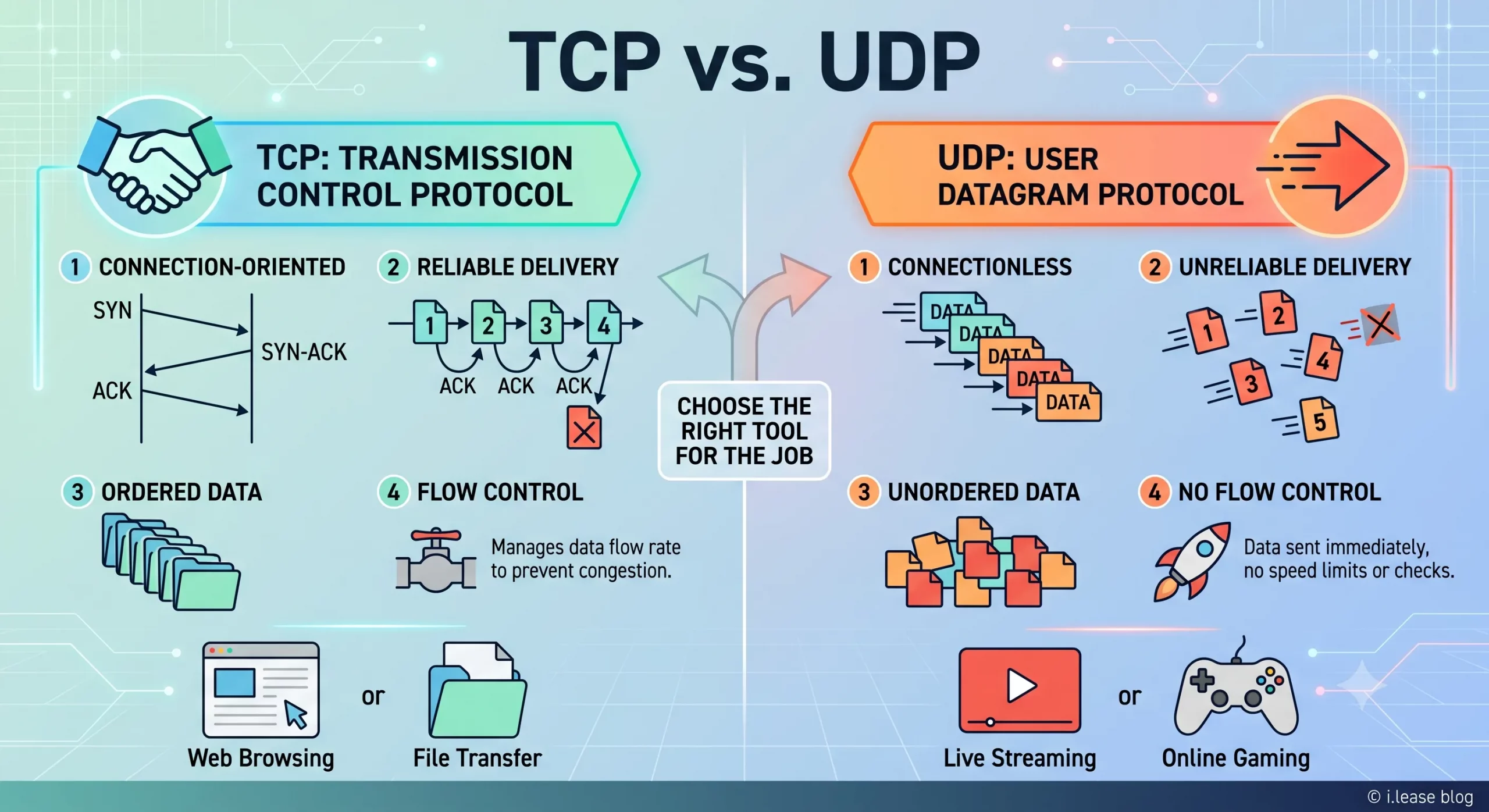
TCP vs UDP : guide de location IPv4 et de réseau d’entreprise
TCP et UDP sont deux des protocoles de transport les plus importants sur Internet. Ils déterminent la circulation des données entre les appareils, les serveurs, les plateformes cloud, les passerelles VPN, les résolveurs DNS, les systèmes de messagerie, les plateformes de streaming et les applications métier. Pour les entreprises, TCP et UDP ne sont pas de simples termes techniques. Ils ont un impact direct sur les performances de l’infrastructure. Related Posts What Is BGP Hijacking? How Route Hijacks Work, Famous Incidents, and How Networks Prevent Them BGP hijacking is the illegitimate takeover of traffic destined for IP address space, carried out by announcing routes for prefixes Which RIRs Support Inter-RIR IPv4 Transfers in 2026? IPv4 addresses may be globally routable, but transferring their registration from one organization to another is governed by Regional Internet What Is BGP? How Border Gateway Protocol Turns IP Addresses into Reachable Services BGP (Border Gateway Protocol) is the routing protocol that connects independent networks across the Internet. It allows networks to announce .related-post {} .related-post .post-list { text-align: left; } .related-post .post-list .item { margin: 5px; padding: 10px; } .related-post .headline { font-size: 18px !important; color: #999999 !important; } .related-post .post-list .item .post_thumb { max-height: 220px; margin: 10px 0px; padding: 0px; display: block; } .related-post .post-list .item .post_title { font-size: 16px; color: #3f3f3f; margin: 10px 0px; padding: 0px; display: block; text-decoration: none; } .related-post .post-list .item .post_excerpt { font-size: 13px; color: #3f3f3f; margin: 10px 0px; padding: 0px; display: block; text-decoration: none; } @media only screen and (min-width: 1024px) { .related-post .post-list .item { width: 30%; } } @media only screen and (min-width: 768px) and (max-width: 1023px) { .related-post .post-list .item { width: 90%; } } @media only screen and (min-width: 0px) and (max-width: 767px) { .related-post .post-list .item { width: 90%; } }

Pourquoi la Malaisie devient-elle un pôle de centres de données pour les infrastructures cloud et d’intelligence artificielle ?
La Malaisie devient l’un des marchés de croissance les plus importants d’Asie du Sud-Est dans le secteur des centres de données. La demande en cloud computing, intelligence artificielle, applications d’entreprise, paiements numériques, commerce électronique, cybersécurité et services régionaux à faible latence pousse les entreprises à construire davantage d’infrastructures au plus près des utilisateurs. Cette croissance ne repose pas uniquement sur un effet de mode. La Malaisie a attiré desRead more Related Posts Desbloqueando la privacidad digital con una red privada virtual (VPN) ¿Qué es una VPN? Una red privada virtual (VPN) es una tecnología que permite a los usuarios crear una conexión Comprensión de la traducción de direcciones de red (NAT) En las redes informáticas, gestionar las direcciones IP de forma eficiente es fundamental para garantizar una comunicación fluida entre los ¿Por qué Malasia se está convirtiendo en un centro neurálgico para la infraestructura de nube e IA? Malasia se está convirtiendo en uno de los mercados de crecimiento de centros de datos más importantes del Sudeste Asiático. .related-post {} .related-post .post-list { text-align: left; } .related-post .post-list .item { margin: 5px; padding: 10px; } .related-post .headline { font-size: 18px !important; color: #999999 !important; } .related-post .post-list .item .post_thumb { max-height: 220px; margin: 10px 0px; padding: 0px; display: block; } .related-post .post-list .item .post_title { font-size: 16px; color: #3f3f3f; margin: 10px 0px; padding: 0px; display: block; text-decoration: none; } .related-post .post-list .item .post_excerpt { font-size: 13px; color: #3f3f3f; margin: 10px 0px; padding: 0px; display: block; text-decoration: none; } @media only screen and (min-width: 1024px) { .related-post .post-list .item { width: 30%; } } @media only screen and (min-width: 768px) and (max-width: 1023px) { .related-post .post-list .item { width: 90%; } } @media only screen and (min-width: 0px) and (max-width: 767px) { .related-post .post-list .item { width: 90%; } }
