Risk Placement in IPv4 Transactions: What Enterprises Should Know
 Stephanie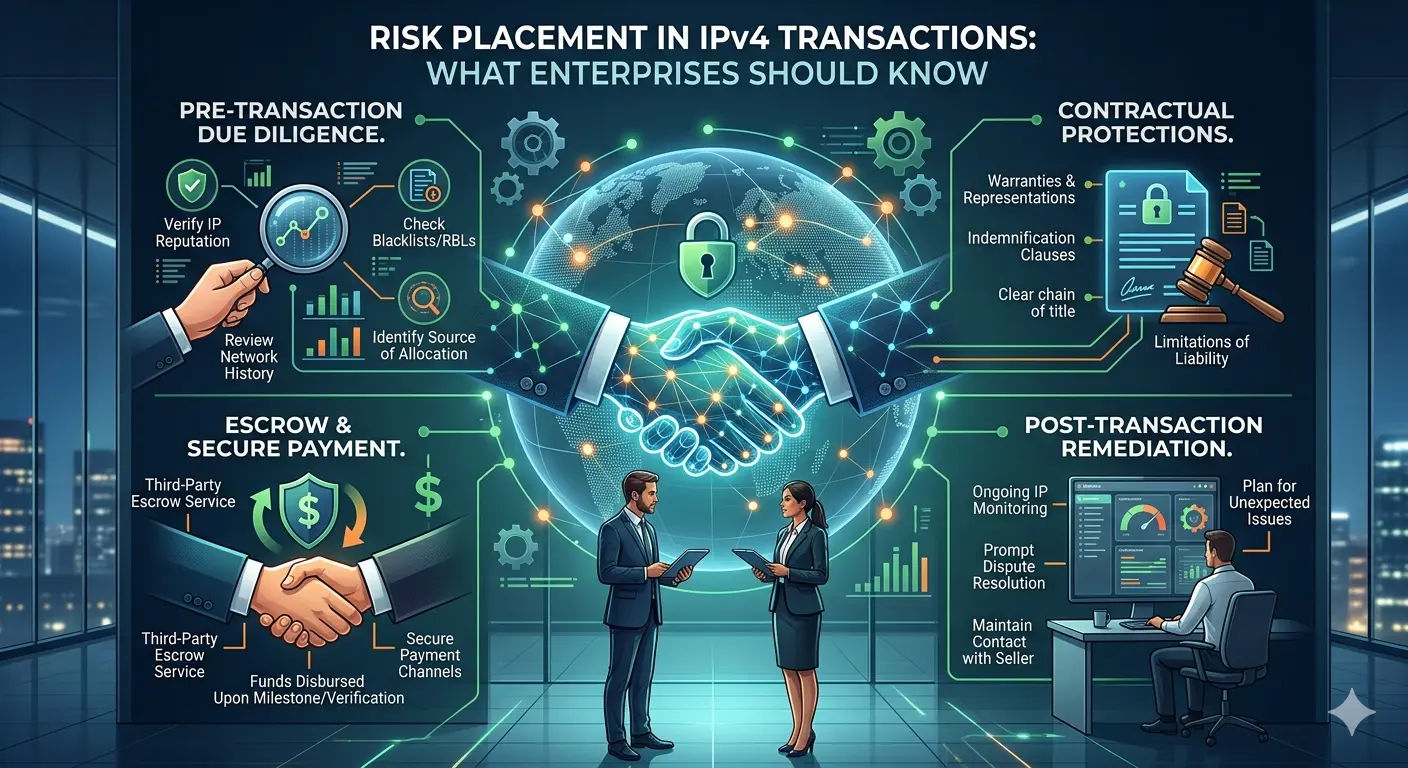
The IPv4 market has quietly evolved into a structured secondary asset class. As global IPv4 exhaustion continues, enterprises, ISPs, and brokers now routinely engage in buying, leasing, and transferring IPv4 address blocks. Alongside this growth, one topic has become increasingly important—but still under-discussed: risk placement in IPv4 transactions.
Table of Contents
For organizations participating in this market, especially through platforms such as i.lease, understanding how risk is identified, allocated, and mitigated is essential to avoiding operational, financial, and compliance issues.
Why IPv4 Has Become a High-Value Asset
IPv4 addresses—formally part of Internet Protocol version 4—were not designed as tradable assets. However, due to global scarcity, they now function similarly to leased infrastructure resources.
Key drivers of value include:
- Continued reliance on IPv4 by legacy systems
- Slow global transition to IPv6
- Regional scarcity and regulatory fragmentation
- Demand from cloud, telecom, and data-heavy industries
As a result, IPv4 blocks are now actively traded, leased, and financed—bringing financial-market-style risk considerations into what was once a purely technical domain.
What “Risk Placement” Means in IPv4 Transactions
Risk placement refers to how various risks are identified and assigned across parties in an IPv4 deal. In practice, this determines who bears responsibility if something goes wrong.
In IPv4 transactions, risk typically falls into four main categories:
1. Ownership and Title Risk
IPv4 address ownership is governed by Regional Internet Registries (RIRs), not traditional property law. This creates ambiguity around:
- Whether the seller/lessor has clear rights to transfer
- Whether historical allocations are valid or contested
- Whether the block has been involved in prior disputes
2. Reputation and Blacklist Risk
IPv4 addresses may carry “reputation baggage” from prior use:
- Spam or abuse listings
- Email deliverability degradation
- Blocklisting by security providers
If not properly checked, enterprises may inherit operational issues immediately after transfer.
3. Compliance and Regulatory Risk
Different RIR regions (ARIN, RIPE NCC, APNIC, etc.) have distinct policies:
- Transfer eligibility rules
- Justification requirements
- Leasing vs. ownership distinctions
Non-compliance can lead to revocation or forced return of resources.
4. Counterparty and Settlement Risk
Like any asset transaction:
- One party may default during settlement
- Escrow mechanisms may be weak or absent
- Documentation may be incomplete or forged
How Risk Is Typically Allocated
In mature IPv4 markets, risk placement is structured through contractual frameworks and intermediaries.
Escrow-Backed Transfers
Funds and address blocks are held in escrow until registry approval is confirmed, reducing settlement risk.
Broker-Assisted Transactions
Specialized brokers often perform:
- Due diligence on block history
- Registry compliance validation
- Reputation screening
Lease Structures vs. Transfers
Leasing models (common in platforms like i.lease) shift risk ownership differently:
- The lessor retains title risk
- The lessee assumes operational risk
- Both share reputation monitoring responsibilities
Due Diligence Checklist for Enterprises
Before entering an IPv4 transaction, enterprises should evaluate:
1. Block History
- Prior use cases (hosting, email, VPN, etc.)
- Blacklist status across major providers
2. Registry Validation
- Confirm allocation status with the relevant RIR
- Ensure transfer eligibility
3. Contract Clarity
- Define responsibility for abuse complaints
- Specify remediation procedures
- Establish SLA for reputation issues
4. Technical Testing
- Route validation and BGP integrity checks
- Connectivity and latency benchmarks
Common Mistakes Enterprises Make
Despite increasing market maturity, several recurring errors persist:
- Treating IPv4 like a simple commodity purchase
- Skipping reputation screening due to urgency
- Relying on informal agreements instead of structured contracts
- Underestimating cross-region regulatory differences
These mistakes often lead to downstream operational disruption that far outweighs initial cost savings.
The Future of Risk in IPv4 Markets
As IPv6 adoption slowly increases, IPv4 will likely become:
- More expensive
- More tightly regulated
- More structured as a financial asset class
This means risk placement will increasingly resemble traditional infrastructure financing, with:
- Standardized legal frameworks
- Insurance-backed allocations
- Automated compliance verification tools
Enterprises that build strong governance around IPv4 acquisition today will be better positioned for this transition.
Conclusion
IPv4 transactions are no longer just technical exchanges—they are structured asset deals with embedded financial, legal, and operational risks. Understanding how risk is placed across counterparties is critical for avoiding hidden liabilities and ensuring long-term network stability.
Organizations engaging in this space—especially through leasing platforms like i.lease—should treat risk management as a core part of their acquisition strategy, not an afterthought.
As the market matures, the winners will be those who combine technical due diligence with disciplined risk allocation.
Frequent Asked Questions
What is operational risk in IPv4 address markets?
Operational risk in IPv4 markets refers to potential losses caused by failures in processes, systems, or governance when buying, leasing, or managing IP address blocks. This includes issues like poor documentation, misconfigured routing, or abuse history attached to address ranges.
Why are IPv4 addresses considered risky assets to manage?
IPv4 addresses are scarce and traded like digital commodities. Because they can be transferred or leased between parties, they carry risks such as unclear ownership rights, outdated registry data, and historical abuse (“reputation residue”) that can impact network performance and trust.
What is “abuse residue” in IPv4 address blocks?
Abuse residue refers to the reputation problems that remain tied to an IP range even after it changes users. If an address was previously used for spam, malware, or bot traffic, it may still be flagged by blocklists, causing delivery issues or higher verification rates for new users.
How does poor IP management increase operational risk?
Unmanaged or poorly tracked IPv4 inventories can lead to security gaps, such as unpatched devices, incorrect routing, or unused addresses being hijacked. Attackers often target unmonitored IP ranges because they are less likely to be defended or quickly noticed.
What reduces operational risk in IPv4 transactions?
Risk is reduced through strong governance practices like:
- Proper due diligence before purchase or lease
- Accurate WHOIS/RIR registration updates
- RPKI/ROA validation for routing security
- Continuous monitoring and abuse handling processes
- Clear contracts and transparent ownership records
Articles connexes

Que sont les entreprises de télécommunications ? Comment les fournisseurs de télécommunications assurent la connectivité au Royaume-Uni, aux États-Unis et au Canada
Les entreprises de télécommunications, également appelées opérateurs télécoms, fournissent des services de communication et de connectivité. Ces services peuvent inclure les réseaux mobiles, l’Internet haut débit, les connexions fibre, les services de téléphonie fixe, la connectivité pour les entreprises, l’accès au cloud, les services réseau gérés et la connectivité aux centres de données. Pour les consommateurs, les entreprises de télécommunications sont souvent connues comme des fournisseurs de services mobilesRead more Related Posts Desbloqueando la privacidad digital con una red privada virtual (VPN) ¿Qué es una VPN? Una red privada virtual (VPN) es una tecnología que permite a los usuarios crear una conexión Comprensión de la traducción de direcciones de red (NAT) En las redes informáticas, gestionar las direcciones IP de forma eficiente es fundamental para garantizar una comunicación fluida entre los Arrendamiento de direcciones IP: Cómo arrendar direcciones IP El mundo digital en el que nos movemos hoy depende en gran medida de las direcciones IP, identificadores únicos asignados .related-post {} .related-post .post-list { text-align: left; } .related-post .post-list .item { margin: 5px; padding: 10px; } .related-post .headline { font-size: 18px !important; color: #999999 !important; } .related-post .post-list .item .post_thumb { max-height: 220px; margin: 10px 0px; padding: 0px; display: block; } .related-post .post-list .item .post_title { font-size: 16px; color: #3f3f3f; margin: 10px 0px; padding: 0px; display: block; text-decoration: none; } .related-post .post-list .item .post_excerpt { font-size: 13px; color: #3f3f3f; margin: 10px 0px; padding: 0px; display: block; text-decoration: none; } @media only screen and (min-width: 1024px) { .related-post .post-list .item { width: 30%; } } @media only screen and (min-width: 768px) and (max-width: 1023px) { .related-post .post-list .item { width: 90%; } } @media only screen and (min-width: 0px) and (max-width: 767px) { .related-post .post-list .item { width: 90%; } }
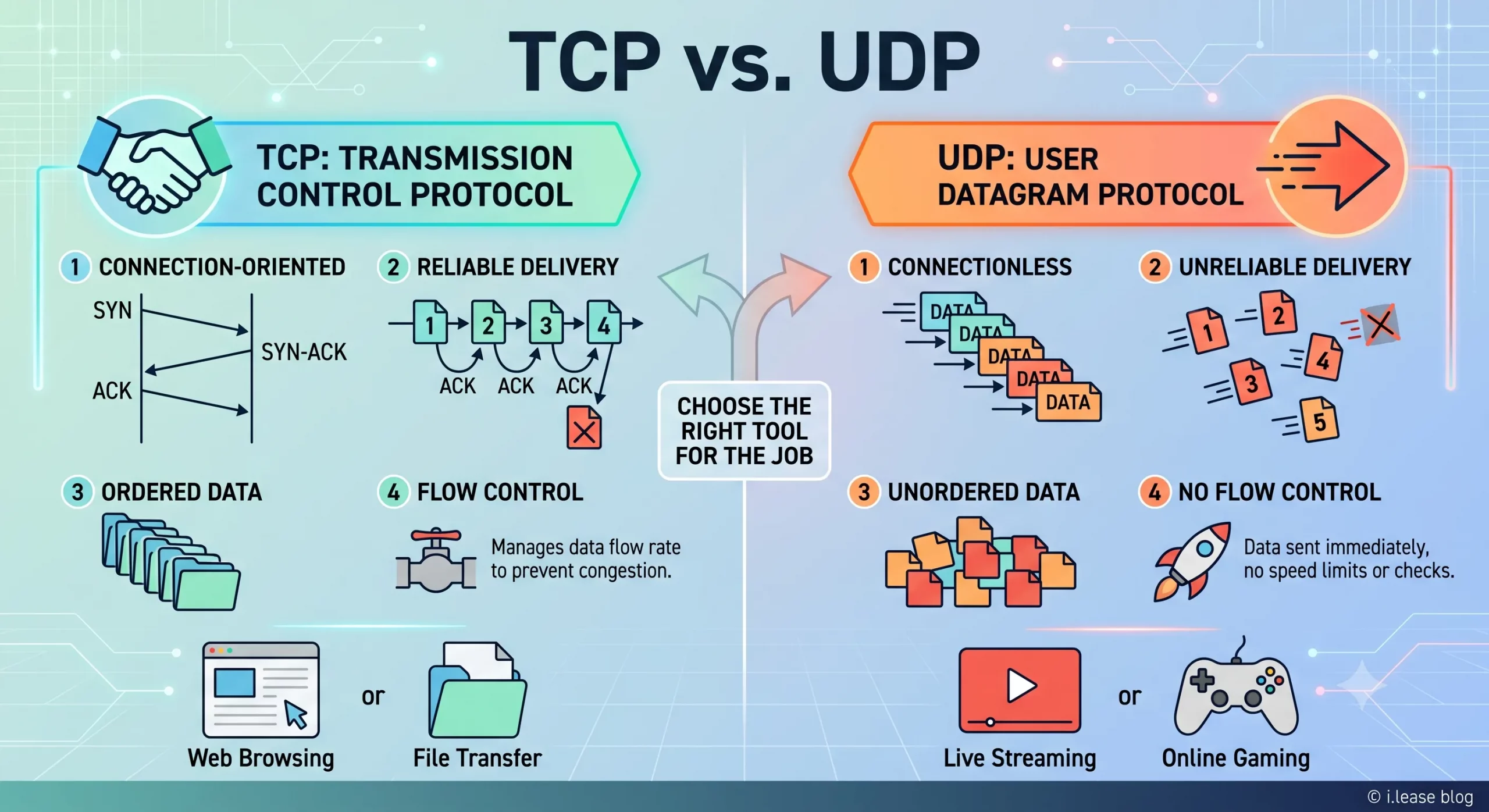
TCP vs UDP : guide de location IPv4 et de réseau d’entreprise
TCP et UDP sont deux des protocoles de transport les plus importants sur Internet. Ils déterminent la circulation des données entre les appareils, les serveurs, les plateformes cloud, les passerelles VPN, les résolveurs DNS, les systèmes de messagerie, les plateformes de streaming et les applications métier. Pour les entreprises, TCP et UDP ne sont pas de simples termes techniques. Ils ont un impact direct sur les performances de l’infrastructure. Related Posts Que sont les entreprises de télécommunications ? Comment les fournisseurs de télécommunications assurent la connectivité au Royaume-Uni, aux États-Unis et au Canada Les entreprises de télécommunications, également appelées opérateurs télécoms, fournissent des services de communication et de connectivité. Ces services peuvent inclure Pourquoi la Malaisie devient-elle un pôle de centres de données pour les infrastructures cloud et d’intelligence artificielle ? La Malaisie devient l’un des marchés de croissance les plus importants d’Asie du Sud-Est dans le secteur des centres de TCP vs UDP: IPv4 Leasing & Business Network Guide TCP and UDP are two of the most important transport protocols used on the internet. They determine how data moves .related-post {} .related-post .post-list { text-align: left; } .related-post .post-list .item { margin: 5px; padding: 10px; } .related-post .headline { font-size: 18px !important; color: #999999 !important; } .related-post .post-list .item .post_thumb { max-height: 220px; margin: 10px 0px; padding: 0px; display: block; } .related-post .post-list .item .post_title { font-size: 16px; color: #3f3f3f; margin: 10px 0px; padding: 0px; display: block; text-decoration: none; } .related-post .post-list .item .post_excerpt { font-size: 13px; color: #3f3f3f; margin: 10px 0px; padding: 0px; display: block; text-decoration: none; } @media only screen and (min-width: 1024px) { .related-post .post-list .item { width: 30%; } } @media only screen and (min-width: 768px) and (max-width: 1023px) { .related-post .post-list .item { width: 90%; } } @media only screen and (min-width: 0px) and (max-width: 767px) { .related-post .post-list .item { width: 90%; } }

Pourquoi la Malaisie devient-elle un pôle de centres de données pour les infrastructures cloud et d’intelligence artificielle ?
La Malaisie devient l’un des marchés de croissance les plus importants d’Asie du Sud-Est dans le secteur des centres de données. La demande en cloud computing, intelligence artificielle, applications d’entreprise, paiements numériques, commerce électronique, cybersécurité et services régionaux à faible latence pousse les entreprises à construire davantage d’infrastructures au plus près des utilisateurs. Cette croissance ne repose pas uniquement sur un effet de mode. La Malaisie a attiré desRead more Related Posts Desbloqueando la privacidad digital con una red privada virtual (VPN) ¿Qué es una VPN? Una red privada virtual (VPN) es una tecnología que permite a los usuarios crear una conexión Comprensión de la traducción de direcciones de red (NAT) En las redes informáticas, gestionar las direcciones IP de forma eficiente es fundamental para garantizar una comunicación fluida entre los ¿Por qué Malasia se está convirtiendo en un centro neurálgico para la infraestructura de nube e IA? Malasia se está convirtiendo en uno de los mercados de crecimiento de centros de datos más importantes del Sudeste Asiático. .related-post {} .related-post .post-list { text-align: left; } .related-post .post-list .item { margin: 5px; padding: 10px; } .related-post .headline { font-size: 18px !important; color: #999999 !important; } .related-post .post-list .item .post_thumb { max-height: 220px; margin: 10px 0px; padding: 0px; display: block; } .related-post .post-list .item .post_title { font-size: 16px; color: #3f3f3f; margin: 10px 0px; padding: 0px; display: block; text-decoration: none; } .related-post .post-list .item .post_excerpt { font-size: 13px; color: #3f3f3f; margin: 10px 0px; padding: 0px; display: block; text-decoration: none; } @media only screen and (min-width: 1024px) { .related-post .post-list .item { width: 30%; } } @media only screen and (min-width: 768px) and (max-width: 1023px) { .related-post .post-list .item { width: 90%; } } @media only screen and (min-width: 0px) and (max-width: 767px) { .related-post .post-list .item { width: 90%; } }
