IPv4 Planning for AI Infrastructure and GPU Cloud Providers
 Stephanie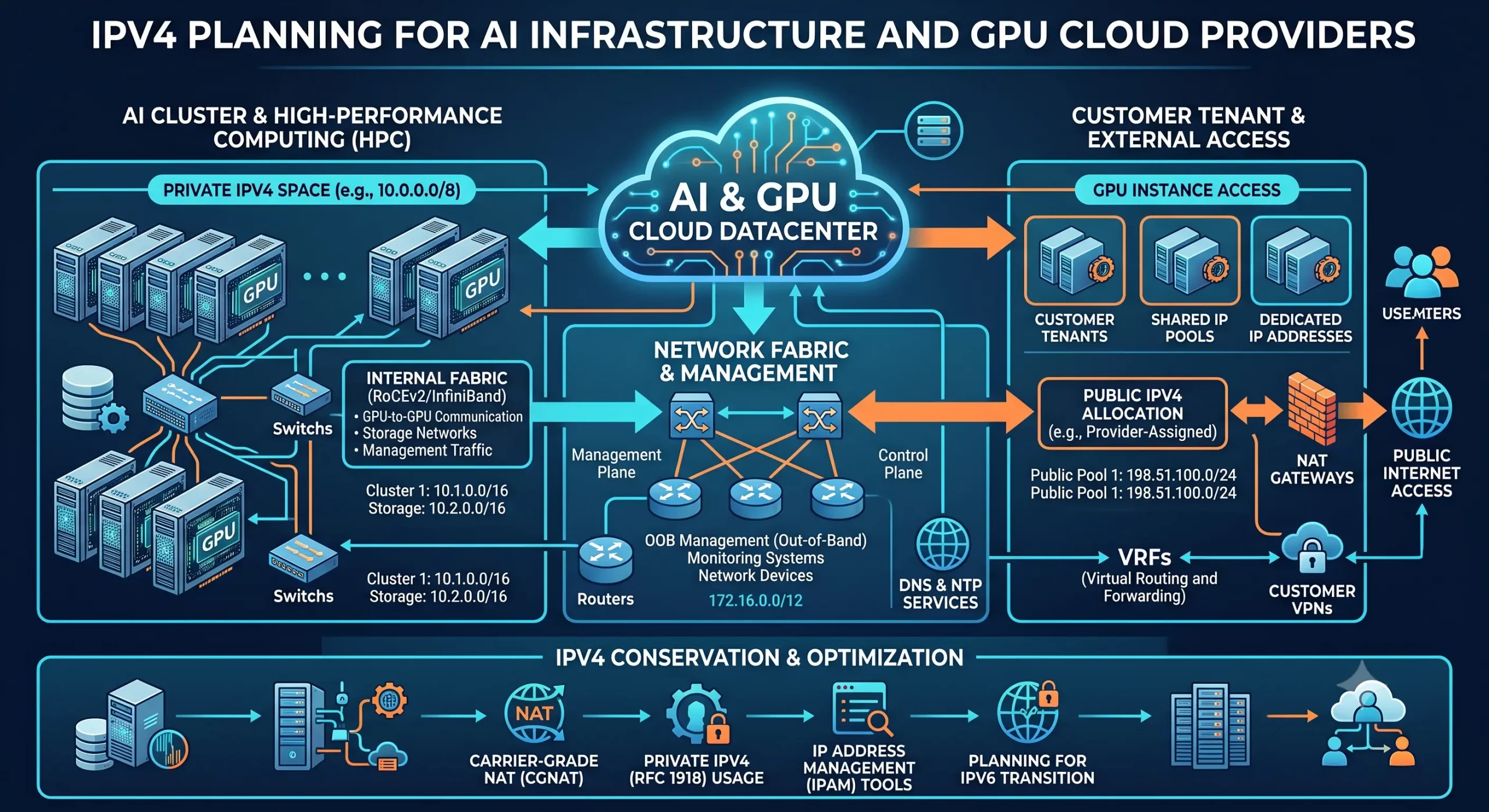
IPv4 Planning for AI Infrastructure and GPU Cloud Providers
AI infrastructure planning often begins with GPUs.
Table of Contents
Operators compare accelerator models, cluster size, power density, cooling, storage throughput, interconnect performance, and data-center capacity. These decisions are essential, but they do not complete the infrastructure plan.
A GPU cloud also needs a reliable addressing strategy.
Customers must reach inference APIs, training environments, management portals, gateways, storage services, observability platforms, VPN endpoints, and other public-facing infrastructure. The platform itself may need predictable outbound identities for software repositories, customer allowlists, security services, and data-transfer workflows.
IPv4 planning should therefore begin before GPU capacity enters production.
The correct question is not:
How many public IP addresses does each GPU require?
Most GPU workers should not be directly exposed to the public Internet.
The better question is:
Which platform boundaries, customer services, and operational functions require stable public IPv4 identity?
That distinction helps AI infrastructure providers conserve addresses without placing critical services behind an improvised or fragile network design.
AI Infrastructure Is More Than Compute
A GPU cloud platform is not simply a collection of accelerator servers.
A production environment may include:
GPU worker nodes
CPU control and orchestration nodes
Kubernetes or another workload scheduler
- High-performance storage
- Container registries
- Training-data ingestion systems
- Inference gateways
- Customer dashboards
- Authentication services
- VPN or private-connectivity gateways
- Monitoring and logging systems
- Billing platforms
- Support and administration tools
- Internet-facing load balancers
Many GPU environments use Kubernetes-based orchestration. Kubernetes assigns addresses to pods and creates stable service addresses while the underlying workloads may change. External access is normally delivered through Services, load balancers, Ingress, or Gateway implementations rather than by exposing every pod directly.
NVIDIA’s cloud-native tooling similarly treats networking as an integrated part of scale-out GPU infrastructure. Its Network Operator works alongside the GPU Operator to provision components needed for high-throughput, low-latency GPU clusters.
This produces two different addressing environments:
East-west networking
East-west traffic moves inside the AI cluster or between internal services.
Examples include:
- GPU-to-GPU communication
- Worker-to-storage traffic
- Distributed training traffic
- Scheduler-to-node communication
- Internal monitoring
- Service-to-service API calls
This layer normally uses private address space, internal routing, virtual networking, or specialized cluster fabrics.
North-south networking
North-south traffic enters or leaves the platform.
Examples include:
- Public inference APIs
- Customer SSH or remote desktop access
- Web dashboards
- VPN gateways
- Internet-facing load balancers
- Software and model downloads
- Customer data uploads
- Outbound access to third-party platforms
This is where public IPv4 planning becomes commercially and operationally important.
Why GPU Cloud Providers Still Need IPv4
IPv6 can and should be considered in new infrastructure, but it does not remove the need to plan for IPv4 compatibility.
Customers, enterprise firewalls, external APIs, software repositories, access-control systems, security products, and partner networks may still depend on IPv4. Major cloud providers continue to support static public IPv4 services and maintain specific quotas and controls around them.
For example, AWS describes Elastic IP addresses as static public IPv4 addresses for dynamic cloud workloads. Its default quota is five Elastic IP addresses per account per region, although customers can request increases or bring their own IPv4 address space.
Google Cloud also applies quotas to external addresses and notes that infrastructure projects must have sufficient networking quota for subnets, external IP addresses, firewall rules, and cluster access.
For an AI provider building its own cloud rather than consuming a hyperscaler, the planning responsibility sits directly with the operator.
IPv4 becomes an input to the service—not an address request to consider after deployment.
Which AI Services Need Public IPv4?
Not every workload requires a dedicated public address. IPv4 should be assigned according to function, isolation requirements, customer expectations, and operational risk.
Inference API endpoints
Public inference services need reachable and stable endpoints.
A provider may use shared load balancers for standard API customers while reserving dedicated addresses for enterprises that require:
- Source allowlisting
- Dedicated environments
- Regulatory separation
- Private routing arrangements
- Stable endpoint identity
- Custom security policies
The address plan should distinguish between shared API infrastructure and dedicated enterprise endpoints.
Customer access gateways
Customers may access GPU instances through SSH gateways, bastion services, VPNs, remote desktop systems, or private-access platforms.
A shared gateway model reduces address consumption, but some customers may require dedicated ingress addresses for security or compliance reasons.
Outbound egress identity
Enterprise customers frequently need predictable source addresses.
They may need to allowlist the GPU environment when it connects to:
- Private datasets
- Object-storage services
- Financial systems
- Enterprise APIs
- Software repositories
- Internal development platforms
- Customer-controlled databases
Shared NAT can conserve IPv4, but a single shared egress pool may not provide enough isolation or accountability for all tenants.
An AI cloud may therefore need several egress tiers:
Shared platform egress
Dedicated tenant egress
Regulated-workload egress
Administration egress
Security-scanning egress
Control and management services
Administrative systems should generally be protected behind VPNs, Zero Trust access, restricted gateways, or private connectivity.
Where public addresses are required, they should be separated from customer workloads and controlled through strict access policies.
Load balancers and regional gateways
Each region may require multiple public addresses for:
- Production ingress
- Failover ingress
- API gateways
- Web portals
- VPN termination
- Dedicated customer environments
- Outbound NAT
- Disaster-recovery services
The requirement grows as the provider expands across facilities, regions, and upstream networks.
Customer-assigned resources
Some GPU cloud providers allow customers to receive dedicated public IPv4 addresses or routed blocks.
This may be relevant for:
- Long-running GPU virtual machines
- AI development environments
- Dedicated inference clusters
- Model-serving platforms
- Security research
- Customer-managed Kubernetes clusters
- Hosted private-cloud environments
The provider must decide whether addresses are assigned per instance, per customer, per cluster, or per service boundary.
Per-instance allocation is simple to understand but can consume IPv4 quickly. Gateway and load-balancer models are more efficient but may not satisfy every customer requirement.
Build an IPv4 Demand Model Before Procurement
IPv4 demand should be forecast using a service-based model.
A practical formula is:
Total IPv4 requirement = platform addresses + customer addresses + regional addresses + failover capacity + growth reserve
Platform addresses
Count addresses required for shared infrastructure, including:
- Public web services
- Authentication endpoints
- API gateways
- Shared load balancers
- VPN gateways
- NAT gateways
- Monitoring endpoints
- Administration gateways
- DNS services
Customer addresses
Estimate how many customers will require:
- A dedicated public endpoint
- Dedicated outbound identity
- One or more public GPU-instance addresses
- A routed subnet
- Separate production and development addresses
The model should use expected customer adoption rather than assuming every tenant requires dedicated IPv4.
Regional addresses
Calculate requirements separately for each data center or cloud region.
Do not assume that the same address can always move instantly between regions. Routing design, upstream providers, network border policies, registry records, and platform limitations may affect portability.
Failover capacity
A provider that allocates every available address has no room to respond to:
- A regional outage
- An upstream-provider change
- A block-reputation problem
- Customer migration
- Emergency replacement
- Routing maintenance
- Acquisition of a new facility
Failover inventory should be treated as production capacity, not wasted inventory.
Growth reserve
GPU deployments can grow unevenly.
A customer may begin with a small inference workload and later require a dedicated cluster. A region may add hundreds of GPUs faster than the procurement team expected. A platform may introduce public notebooks, hosted agents, vector databases, or additional inference endpoints.
The address plan should include a defined reserve and a trigger for procuring the next block.
Example IPv4 Planning Model
Consider a GPU cloud launching in three regions.
The provider expects to operate:
- Shared inference gateways
- Customer and administration VPNs
- Regional outbound NAT
- Dedicated enterprise egress
- Public GPU instances for selected customers
- Disaster-recovery capacity
- Additional addresses for growth
Rather than assigning a public address to every GPU server, the provider could create address pools for:
-
Shared platform services
-
Dedicated customer ingress
-
Dedicated customer egress
-
Public virtual machines
-
Management and security
-
Failover and migration
-
Future regional growth
This structure gives the network team better visibility into how address space is being consumed.
It also makes commercial decisions clearer. The provider can price dedicated IPv4 as a premium feature instead of silently absorbing the cost across every GPU instance.
Avoid Assigning Public IPv4 to Every GPU Node
Direct public addressing may be appropriate for some bare-metal or customer-controlled environments, but it should not be the default for every accelerator.
Exposing every GPU node can increase:
- Address consumption
- Attack surface
- Firewall complexity
- Abuse risk
- Customer-isolation requirements
- Reputation exposure
- Renumbering work
Private worker networks combined with controlled ingress and egress usually provide a more scalable architecture.
Public IPv4 should be placed at deliberate boundaries:
- Load balancers
- Gateways
- Dedicated tenant edges
- Public virtual machines
- Managed egress pools
- Customer-controlled routed environments
The objective is not to minimize address use at any cost.
It is to assign scarce addresses where they create operational or commercial value.
Plan for Address Reputation
For an AI cloud provider, an address is not useful merely because it can be routed.
The previous use of an IPv4 block may affect:
- Email and notification delivery
- Customer security controls
- Fraud-detection systems
- API access
- Content platforms
- Search engines
- Threat-intelligence feeds
- Geolocation databases
A block associated with spam, proxies, malware, scanning, or abusive hosting may create problems during customer onboarding.
Before leasing or buying IPv4, providers should review:
- Blocklist history
- Current reputation
- Historical routing
- Geolocation records
- Existing route objects
- Reverse DNS
- Prior abuse patterns
- Unexpected announcements
A low headline price can become expensive if engineers spend weeks repairing reputation and customer-access problems.
Treat Tenant Abuse as an Infrastructure Risk
GPU clouds can attract demanding and sometimes high-risk workloads.
Potential misuse may include:
- Automated scanning
- Credential attacks
- Fraudulent automation
- Spam
- Malicious model-hosting activity
- Unauthorized proxy services
- Copyright-infringing workloads
- Resource theft
The address plan should support accountability.
Providers should be able to identify which tenant, service, cluster, or gateway was using an address at a specific time. Shared NAT logs, allocation records, customer identity, and abuse-response procedures must be designed before scale makes attribution difficult.
The contract should also define:
- Acceptable use
- Complaint handling
- Suspension procedures
- Customer notification
- Evidence retention
- Address replacement
- Responsibility for reputation damage
IPv4 supply without abuse controls is not scalable infrastructure.
Routing and Security Requirements
Obtaining a block is only one part of deployment.
The provider should also plan for:
BGP authorization
Confirm which Autonomous System will announce the block and which facilities or upstreams will accept the route.
Where leased address space is announced by the lessee, a Letter of Authorization may be required.
RPKI and ROA management
The Route Origin Authorization should reflect the intended origin ASN and prefix length.
ROA changes must be coordinated during:
- Initial deployment
- ASN migration
- Multi-origin routing
- Provider changes
- Customer handover
- Lease termination
Internet Routing Registry objects
Route objects may be required by upstream providers or routing filters.
The IRR record should align with the intended announcement and operational responsibility.
Reverse DNS
Decide whether reverse DNS will be managed by:
- The IPv4 provider
- The GPU cloud
- The customer
- An automated delegation platform
Responsibility should be documented before customers begin using the addresses.
Geolocation
The physical deployment region, registry region, and geolocation-database result may not match automatically.
Providers should maintain geofeed or correction processes so customer services are not incorrectly localized or blocked.
WHOIS and RDAP accuracy
Registration contacts should remain current and should reflect the relevant operational relationships.
A registry record should describe reality, not be treated as permission to run the network.
Lease or Buy IPv4 for GPU Infrastructure?
The correct model depends on the project’s timeline, capital structure, and expected lifespan.
When IPv4 Leasing Makes Sense
Managed IPv4 leasing may be suitable when the provider:
- Is launching a new GPU region
- Needs addresses quickly
- Has uncertain customer demand
- Wants to preserve capital for GPUs and data-center construction
- Is testing a new service
- Needs temporary migration capacity
- Expects address requirements to change
- Wants operational support for routing and registry workflows
i.LEASE offers managed leasing with reputation screening, LOA support, RPKI and reverse DNS coordination, geolocation processes, and operational assistance.
Leasing can align IPv4 cost with revenue growth. The provider can secure capacity for the current deployment and expand when tenant demand justifies it.
However, lease terms must be evaluated carefully.
A GPU provider should check:
- Renewal rights
- Price-adjustment terms
- Termination notice
- Routing authorization
- Address-replacement procedures
- Abuse responsibilities
- Reputation support
- Provider accountability
- What happens if the upstream holder changes
A cheap lease with weak continuity terms can become a production risk.
When Buying IPv4 Makes Sense
Buying IPv4 addresses may be appropriate when the provider:
- Has stable long-term demand
- Operates permanent data-center regions
- Needs predictable address control
- Has capital available
- Can manage registry and operational responsibilities
- Wants to treat IPv4 as a long-term infrastructure asset
Buying can reduce repeated lease-renewal exposure, but it creates other responsibilities.
The buyer must manage:
- Transfer documentation
- Registry records
- Account security
- RPKI
- Reverse DNS
- Abuse contacts
- Address reputation
- Corporate changes
- Future transfers
- Registry-layer risk
i.LEASE provides structured buying workflows that include block screening, escrow coordination, registry transfer support, and operational handover.
Ownership language should not create false comfort. Completing a purchase does not automatically guarantee routing, reputation, registry continuity, or operational usability.
The transaction is one stage of the infrastructure lifecycle.
A Hybrid Strategy
Many GPU cloud providers will benefit from a hybrid model.
They may buy IPv4 for:
- Core regions
- Permanent platform services
- Long-term enterprise customers
- Stable public network identity
They may lease IPv4 for:
- New-market launches
- Seasonal capacity
- Temporary customer projects
- Migration pools
- Disaster recovery
- Rapid expansion
- Experimental services
This avoids making a single irreversible procurement decision before the platform’s real demand is known.
Multi-Region IPv4 Planning
AI providers often expand one facility at a time.
The first region may have excess address capacity, while the second region runs out quickly because its customer mix is different.
Each region should therefore have its own forecast covering:
- Customer count
- Public-service design
- Dedicated egress adoption
- Public-instance demand
- Failover requirements
- Upstream-provider structure
- Expected growth
- Regulatory constraints
The global plan should also define whether blocks can be moved between regions and how long such a move would take.
A prefix that exists in inventory but cannot be routed where the next GPU cluster is located is not immediately usable capacity.
Common IPv4 Planning Mistakes
Planning after GPU deployment
Waiting until servers are installed can delay customer onboarding and create pressure to accept unsuitable or poorly documented address space.
Counting servers instead of services
The number of GPUs does not directly determine the IPv4 requirement. Public service boundaries, tenants, gateways, and egress models are more useful planning units.
Ignoring failover inventory
Running at full address utilization leaves no room for migrations, reputation incidents, or new customer requirements.
Choosing only by price
Address reputation, routing readiness, renewal terms, and provider accountability may matter more than a small monthly price difference.
Treating a transaction as the end
A signed lease, completed transfer, or escrow release does not guarantee usability.
IPv4 must remain manageable when it is announced, recorded, renewed, reviewed, challenged, maintained, and used.
Depending on one undocumented provider chain
When addresses pass through several brokers or intermediaries, responsibility may become unclear during a routing, renewal, registry, or abuse incident.
Infrastructure should be evaluated under stress, not only under normal conditions.
How i.LEASE Supports AI and GPU Cloud Providers
i.LEASE is designed as an execution layer for the IPv4 secondary market.
The platform supports organizations that need to:
- Lease IPv4 addresses
- Buy address space
- Expand into new regions
- Prepare registry documentation
- Coordinate routing authorization
- Manage RPKI and reverse DNS
- Review address reputation
- Support operational handover
- Plan address lifecycle and renewal
Its role does not end when buyer and seller are matched.
The objective is to connect market access with operational execution so that address space can support real infrastructure after the commercial transaction is complete. i.LEASE describes this model as combining secondary-market access with registry and lifecycle workflows rather than leaving execution to disconnected follow-ups.
A marketplace shows supply.
An execution layer makes supply usable.
For GPU cloud providers, that difference matters because failed IPv4 planning can delay high-value infrastructure that is already consuming power, rack space, and capital.
IPv4 Planning Checklist for GPU Clouds
Before launching or expanding an AI region, confirm:
Architecture
- Which services require public access?
- Which workloads can remain private?
- Will ingress and egress be shared or dedicated?
- Do customers receive individual addresses or routed pools?
Demand
- How many shared platform addresses are required?
- How many customers need dedicated ingress?
- How many customers need dedicated egress?
- What growth reserve is required?
- What failover capacity is required?
Procurement
- Will the addresses be leased, purchased, or both?
- Are the blocks clean and routable?
- Is the source of the address space clear?
- Are renewal or transfer terms documented?
Routing
- Which ASN will originate the prefix?
- Will upstreams accept the planned prefix?
- Is an LOA required?
- Is the ROA correct?
- Are IRR route objects ready?
Operations
- Who controls reverse DNS?
- Who manages geolocation?
- Who receives abuse reports?
- How is tenant use attributed?
- What happens if a block develops a reputation problem?
Continuity
- What happens when a lease expires?
- Is replacement capacity available?
- Can the service migrate without customer disruption?
- Who is responsible during a registry dispute?
- Is there a clear escalation path?
Final Thoughts
GPU supply may determine how much AI compute a provider can sell.
IPv4 planning helps determine whether customers can reliably reach, use, secure, and integrate that compute.
The most effective strategy is not to assign a public address to every accelerator. It is to identify the service boundaries where stable public IPv4 creates operational value:
- Inference endpoints
- Customer gateways
- Dedicated tenant environments
- Predictable outbound identity
- Regional load balancers
- Public virtual machines
- Failover infrastructure
IPv4 should then be procured as part of the platform architecture—not as an emergency purchase after capacity is live.
For short-term growth, uncertain demand, and new-region launches, leasing may preserve capital and improve flexibility.
For mature regions and permanent service identity, buying may provide longer-term control.
In both cases, the provider must evaluate more than inventory.
It must evaluate routing, reputation, authorization, registry records, renewability, abuse handling, and continuity.
AI infrastructure is judged by what happens under load.
IPv4 infrastructure should be judged the same way.
Frequent Asked Questions
1. Do GPU servers need individual public IPv4 addresses?
Not usually. Most GPU workers can use private networking. Public IPv4 is generally more valuable at controlled boundaries such as load balancers, inference gateways, VPNs, dedicated customer environments, and egress services.
2. How many IPv4 addresses does a GPU cloud need?
The requirement depends more on platform design and customer services than on the raw GPU count. Providers should calculate shared platform addresses, dedicated customer addresses, regional capacity, failover inventory, and growth reserve.
3. Why do AI customers need dedicated egress IPv4?
Enterprise customers may need predictable source addresses so they can allowlist connections from the GPU environment to private datasets, APIs, databases, and internal systems.
4. Should a GPU cloud lease or buy IPv4?
Leasing is often suitable for rapid expansion, temporary projects, uncertain demand, and lower upfront cost. Buying may be better for permanent regions with stable long-term requirements. A hybrid strategy can support both core and growth capacity.
5. What should be checked before leasing IPv4?
Check address reputation, routing history, source clarity, LOA and ROA support, reverse DNS, geolocation, renewal terms, abuse responsibilities, termination notice, and the provider’s ability to respond to operational problems.
Articles connexes
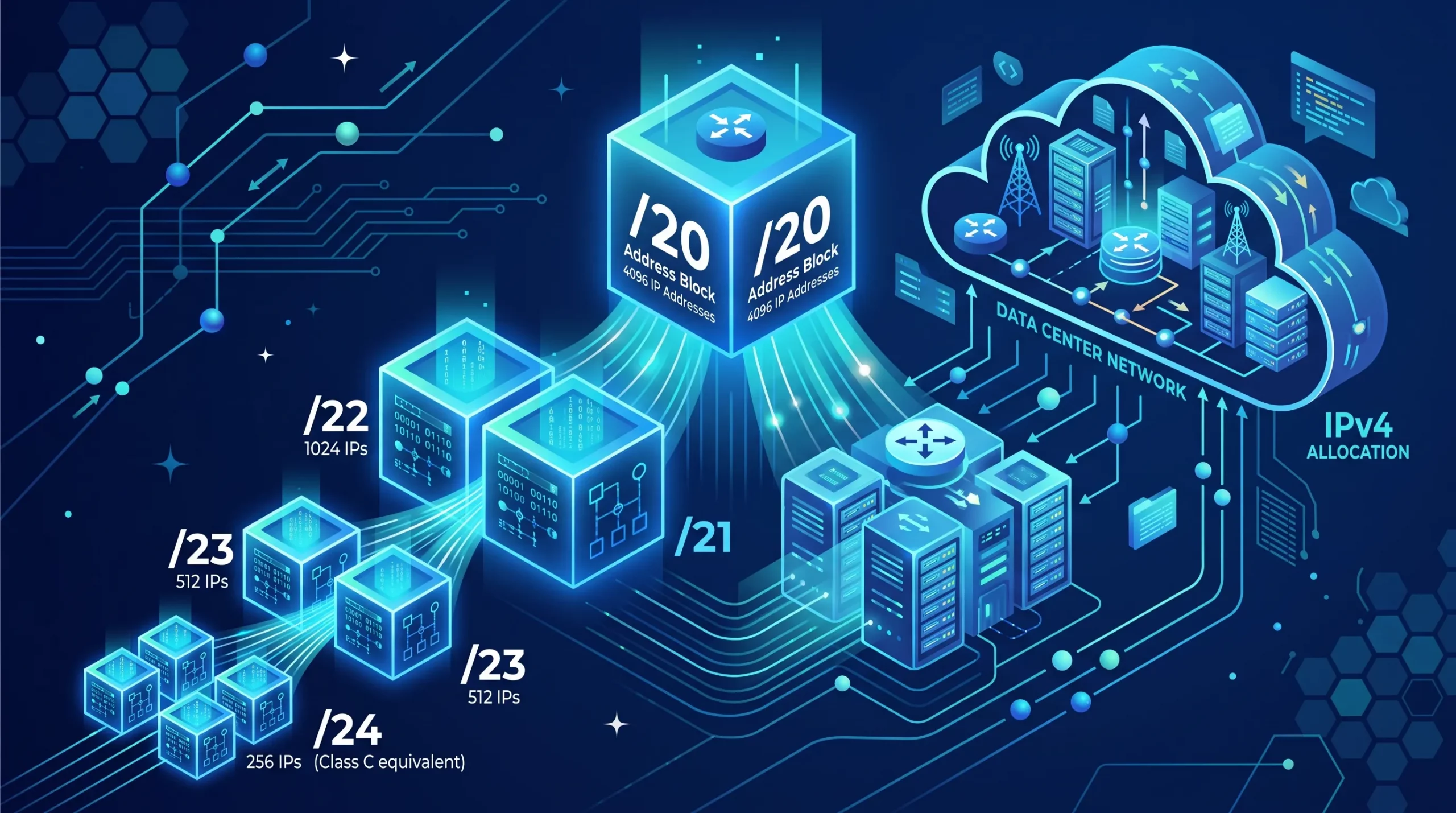
De combien d’espace IPv4 avez-vous besoin ? Tailles de blocs (/24, /23, /22, /21, /20) et guide de dimensionnement
La plupart des entreprises devraient dimensionner leur espace IPv4 en commençant par un /24 — le plus petit bloc que l’Internet mondial peut router de manière fiable — puis augmenter la taille en fonction du nombre d’adresses réellement consommées par leurs services, tout en prévoyant une marge pour la croissance. Un /24 fournit 256 adresses ; chaque niveau supérieur double approximativement ce nombre. La bonne taille est celle quiRead more Related Posts De combien d’espace IPv4 avez-vous besoin ? Tailles de blocs (/24, /23, /22, /21, /20) et guide de dimensionnement La plupart des entreprises devraient dimensionner leur espace IPv4 en commençant par un /24 — le plus petit bloc que What Happens to IPv4 Records After an IP Address Transfer? Completing an IPv4 transfer does more than move address space from one organization to another. It changes the administrative relationship IP地址租赁中的授权书 (LOA) 是什么?LOA 与 ROA 的区别以及需要核实的内容 授权书(Letter of Authorization,LOA)是一份正式文件,由 IP 地址块的注册持有者授权另一方通过指定的自治系统编号(ASN)公告该地址空间。 它是一份书面授权,将使用地址空间的合同权利与实际进行路由公告的技术行为连接起来——如果没有 LOA,上游服务提供商通常会拒绝接受你的路由公告。 正是这种拒绝,使 LOA 在运营上具有决定性意义,而不仅仅是一项行政文件。Transit 服务提供商、数据中心和电信运营商都需要证明,公告某个前缀的一方确实获得了授权,因为接受未经授权的公告就意味着参与了一次路由劫持。Cloudflare 的 BYOIP 文档对此说明得非常明确:其 Transit 服务提供商要求在接受 Cloudflare 代表客户公告的路由之前提供 LOA,而且文件必须明确列出获得授权的前缀以及将用于公告这些前缀的 ASN。整个行业普遍都有类似要求。一家企业即使已经签署租赁协议、完成路由器配置,仍然可能因为 .related-post {} .related-post .post-list { text-align: left; } .related-post .post-list .item { margin: 5px; padding: 10px; } .related-post .headline { font-size: 18px !important; color: #999999 !important; } .related-post .post-list .item .post_thumb { max-height: 220px; margin: 10px 0px; padding: 0px; display: block; } .related-post .post-list .item .post_title { font-size: 16px; color: #3f3f3f; margin: 10px 0px; padding: 0px; display: block; text-decoration: none; } .related-post .post-list .item .post_excerpt { font-size: 13px; color: #3f3f3f; margin: 10px 0px; padding: 0px; display: block; text-decoration: none; } @media only screen and (min-width: 1024px) { .related-post .post-list .item { width: 30%; } } @media only screen and (min-width: 768px) and (max-width: 1023px) { .related-post .post-list .item { width: 90%; } } @media only screen and (min-width: 0px) and (max-width: 767px) { .related-post .post-list .item { width: 90%; } }

Qu’est-ce qu’une lettre d’autorisation (LOA) dans le cadre d’un bail de propriété intellectuelle ? LOA vs ROA et points à vérifier
Une Lettre d’Autorisation (LOA) est un document officiel dans lequel le titulaire enregistré d’un bloc d’adresses IP autorise une autre partie à annoncer cet espace d’adressage à partir d’un numéro de système autonome spécifié. Il s’agit de l’autorisation écrite qui relie un droit contractuel d’utiliser un espace d’adressage à l’acte technique consistant à le router — et sans elle, les fournisseurs en amont refuseront généralement d’accepter vos annonces.Ce refusRead more Related Posts De combien d’espace IPv4 avez-vous besoin ? Tailles de blocs (/24, /23, /22, /21, /20) et guide de dimensionnement La plupart des entreprises devraient dimensionner leur espace IPv4 en commençant par un /24 — le plus petit bloc que What Happens to IPv4 Records After an IP Address Transfer? Completing an IPv4 transfer does more than move address space from one organization to another. It changes the administrative relationship IP地址租赁中的授权书 (LOA) 是什么?LOA 与 ROA 的区别以及需要核实的内容 授权书(Letter of Authorization,LOA)是一份正式文件,由 IP 地址块的注册持有者授权另一方通过指定的自治系统编号(ASN)公告该地址空间。 它是一份书面授权,将使用地址空间的合同权利与实际进行路由公告的技术行为连接起来——如果没有 LOA,上游服务提供商通常会拒绝接受你的路由公告。 正是这种拒绝,使 LOA 在运营上具有决定性意义,而不仅仅是一项行政文件。Transit 服务提供商、数据中心和电信运营商都需要证明,公告某个前缀的一方确实获得了授权,因为接受未经授权的公告就意味着参与了一次路由劫持。Cloudflare 的 BYOIP 文档对此说明得非常明确:其 Transit 服务提供商要求在接受 Cloudflare 代表客户公告的路由之前提供 LOA,而且文件必须明确列出获得授权的前缀以及将用于公告这些前缀的 ASN。整个行业普遍都有类似要求。一家企业即使已经签署租赁协议、完成路由器配置,仍然可能因为 .related-post {} .related-post .post-list { text-align: left; } .related-post .post-list .item { margin: 5px; padding: 10px; } .related-post .headline { font-size: 18px !important; color: #999999 !important; } .related-post .post-list .item .post_thumb { max-height: 220px; margin: 10px 0px; padding: 0px; display: block; } .related-post .post-list .item .post_title { font-size: 16px; color: #3f3f3f; margin: 10px 0px; padding: 0px; display: block; text-decoration: none; } .related-post .post-list .item .post_excerpt { font-size: 13px; color: #3f3f3f; margin: 10px 0px; padding: 0px; display: block; text-decoration: none; } @media only screen and (min-width: 1024px) { .related-post .post-list .item { width: 30%; } } @media only screen and (min-width: 768px) and (max-width: 1023px) { .related-post .post-list .item { width: 90%; } } @media only screen and (min-width: 0px) and (max-width: 767px) { .related-post .post-list .item { width: 90%; } }
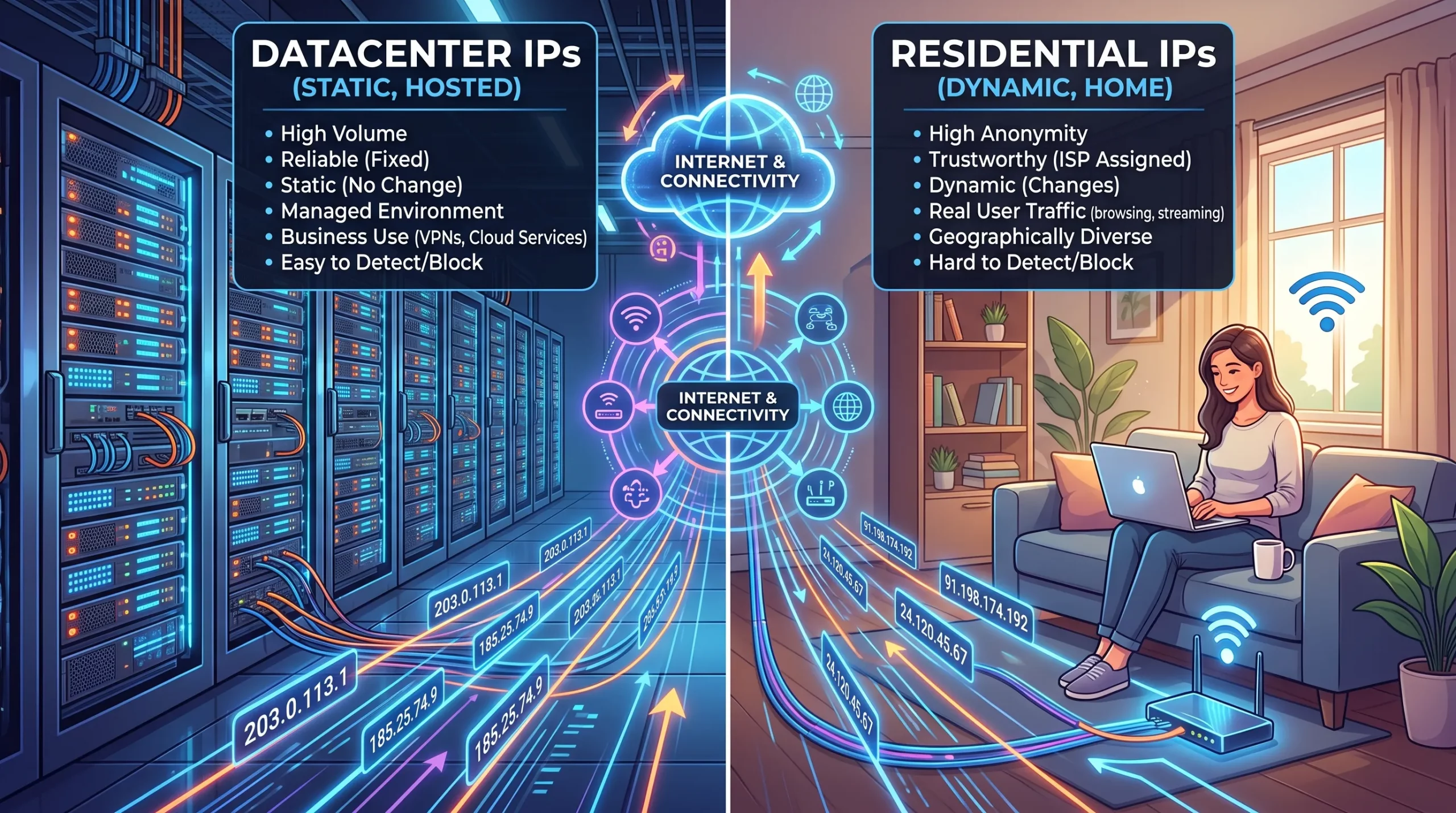
Adresses IP de centres de données vs adresses IP résidentielles : quelle est la différence ? Pourquoi est-ce important ?
Une adresse IP de centre de données provient d’un centre de données commercial, d’un fournisseur cloud ou d’une société d’hébergement, tandis qu’une adresse IP résidentielle est attribuée par un fournisseur d’accès Internet à un particulier ou à une entreprise. La différence tient à l’origine : l’une provient d’une infrastructure conçue pour faire fonctionner des serveurs, l’autre d’une connexion conçue pour servir un utilisateur final. Cette seule distinction influence laRead more Related Posts 您需要多少 IPv4 地址空间?IP 地址块大小(/24、/23、/22、/21、/20)与容量规划指南 大多数企业在规划 IPv4 地址空间时,应从 /24 开始——这是全球互联网能够可靠路由的最小地址块——然后根据实际服务所消耗的地址数量以及未来增长空间逐步扩大。 一个 /24 提供 256 个地址;每增加一个级别,地址数量大约翻倍。合适的地址块大小,应能够覆盖您真实的地址使用量和近期增长,同时避免让您为大量无法合理说明或实际使用的地址空间付费。 在租赁或购买 IPv4 时,这个问题经常出现,而且通常还伴随着另一个问题:像 /24、/22 或 /20 这样的标记到底是什么意思?本指南会同时回答这两个问题。它会说明每种常见地址块大小包含多少个地址、适合哪些使用场景,并提供一个实用框架,帮助您将实际服务需求转换为合适的地址块大小。目标是让您做出一个能够向注册管理机构、财务团队以及内部容量规划团队合理解释的决定,而不是凭猜测选择一个过小或过度配置的地址块。 这是一篇关于容量规划和地址块大小选择的指南,而不是子网划分教程。如果您想了解地址块如何划分,以及 CIDR 标记在位级别上如何工作,请参考我们专门的 IP地址租赁中的授权书 (LOA) 是什么?LOA 与 ROA 的区别以及需要核实的内容 授权书(Letter of Authorization,LOA)是一份正式文件,由 IP 地址块的注册持有者授权另一方通过指定的自治系统编号(ASN)公告该地址空间。 它是一份书面授权,将使用地址空间的合同权利与实际进行路由公告的技术行为连接起来——如果没有 LOA,上游服务提供商通常会拒绝接受你的路由公告。 正是这种拒绝,使 LOA 在运营上具有决定性意义,而不仅仅是一项行政文件。Transit 服务提供商、数据中心和电信运营商都需要证明,公告某个前缀的一方确实获得了授权,因为接受未经授权的公告就意味着参与了一次路由劫持。Cloudflare 的 BYOIP 文档对此说明得非常明确:其 Transit 服务提供商要求在接受 Cloudflare 代表客户公告的路由之前提供 LOA,而且文件必须明确列出获得授权的前缀以及将用于公告这些前缀的 ASN。整个行业普遍都有类似要求。一家企业即使已经签署租赁协议、完成路由器配置,仍然可能因为 数据中心IP地址与住宅IP地址:区别是什么?为什么这很重要? 常见问题解答 数据中心 IP 地址来源于商业数据中心、云服务提供商或托管公司,而住宅 IP 地址则由互联网服务提供商分配给家庭或企业用户。 两者的区别在于来源:一种来自为运行服务器而建设的基础设施,另一种来自为终端用户提供连接而建设的网络。正是这一根本区别,决定了互联网其他系统如何看待来自这两类地址的流量。 这个话题通常只会在代理和反检测的狭窄语境下被讨论,因此很容易形成片面的认知。实际上,数据中心 IP 与住宅 IP 的区别,对任何运营互联网基础设施的人都很重要,因为它会影响一个地址天然具有多少信任度、网站和安全系统如何响应它,以及这个地址适合什么用途。几乎所有合法的商业互联网基础设施——包括你使用的每个网站、API、邮件服务器和云服务——都运行在数据中心 IP 地址空间上,而这本来就是正确的使用方式。重点并不是哪一种更好、哪一种更差;而是它们服务于不同目的,也会受到不同方式的对待。了解自己正在使用或真正需要哪一种,可以避免许多本来可以避免的问题。 本文将解释这两种 IP 地址分别是什么、系统如何区分它们、为什么它们会受到不同对待,以及这种差异对于在公共 IPv4 地址空间上部署真实服务的企业意味着什么——包括它与地址信誉、地理定位以及不同使用场景究竟需要哪种地址空间之间的关系。 数据中心 .related-post {} .related-post .post-list { text-align: left; } .related-post .post-list .item { margin: 5px; padding: 10px; } .related-post .headline { font-size: 18px !important; color: #999999 !important; } .related-post .post-list .item .post_thumb { max-height: 220px; margin: 10px 0px; padding: 0px; display: block; } .related-post .post-list .item .post_title { font-size: 16px; color: #3f3f3f; margin: 10px 0px; padding: 0px; display: block; text-decoration: none; } .related-post .post-list .item .post_excerpt { font-size: 13px; color: #3f3f3f; margin: 10px 0px; padding: 0px; display: block; text-decoration: none; } @media only screen and (min-width: 1024px) { .related-post .post-list .item { width: 30%; } } @media only screen and (min-width: 768px) and (max-width: 1023px) { .related-post .post-list .item { width: 90%; } } @media only screen and (min-width: 0px) and (max-width: 767px) { .related-post .post-list .item { width: 90%; } }
