What is IP Subnetting? A Comprehensive Introduction
 Chan
Chan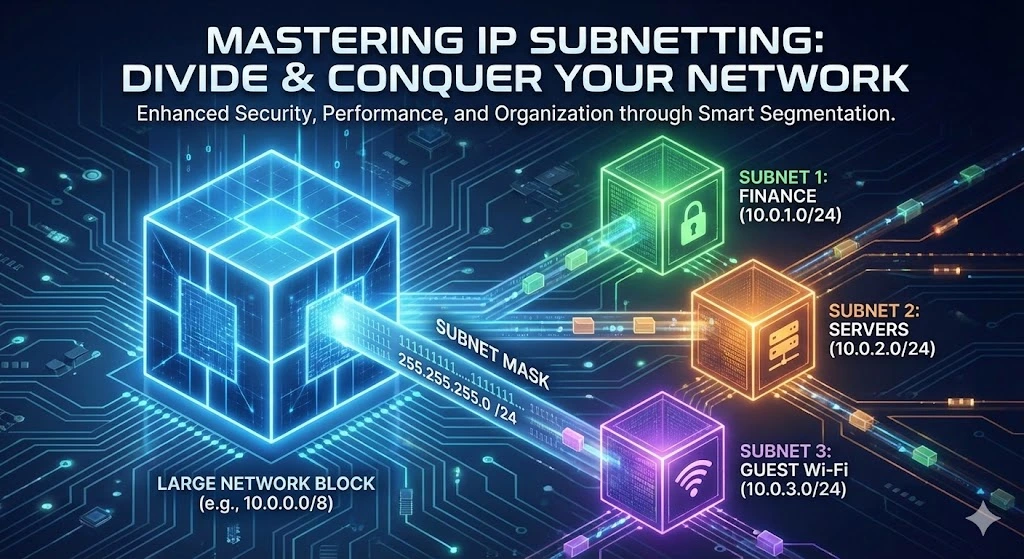
Understanding IP subnetting is essential for designing efficient and scalable networks. Subnetting allows network administrators to divide a single IP address range into smaller, more manageable subnetworks, enabling better organization of network resources and efficient allocation of IP addresses. In this article, we’ll provide a comprehensive introduction to IP subnetting, covering its fundamental concepts, benefits, and practical applications.
Table of Contents
Before we delve into subnetting, let’s review the basics of IP addresses.
Understanding IP Addresses
An IP address is a unique numerical identifier assigned to each device connected to a network. IPv4 addresses, the most commonly used type of IP address, consist of four sets of numbers separated by dots (e.g., 192.168.1.1). Each set of numbers ranges from 0 to 255, representing different portions of the address.
Now, let’s proceed to our main topic: subnetting.
What is subnetting?
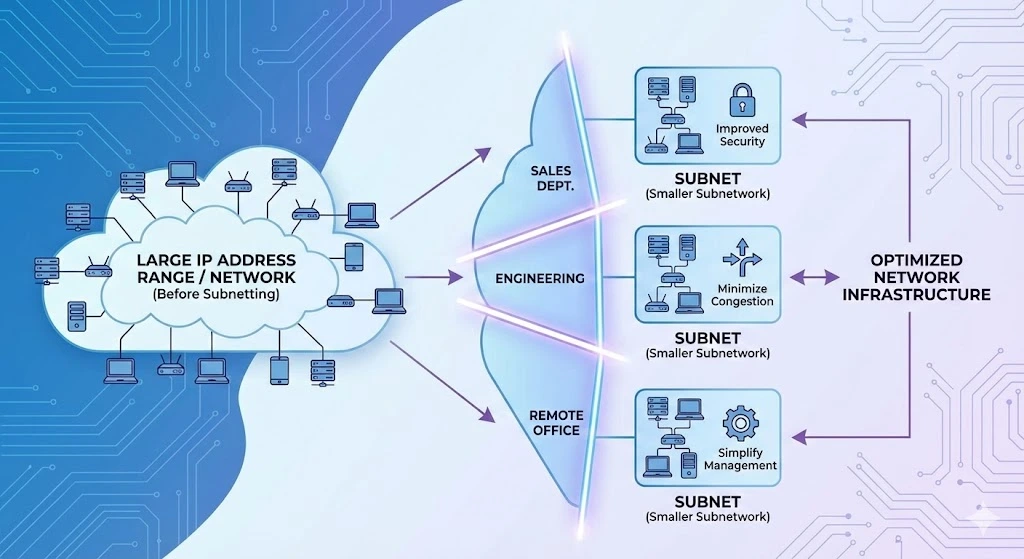
Subnetting is the process of dividing a large IP address range, or network, into smaller, more manageable subnetworks, or subnets. This allows organizations to optimize their network infrastructure by segmenting devices into logical groups based on factors such as location, function, or department. Subnetting helps minimize network congestion, improve security, and simplify network management tasks.
Each RIR has its own nuances. Such as whilst AFRINIC prevents transfers to intra-RIR only, APNIC, ARIN, RIPE, and LACNIC all facilitate inter-RIR transfers under reciprocal, needs-based policies. The registry affirms the fact the seller is the legitimate owner of the IP addresses and makes sure that all applicable regulations are met before RIR-led transfers can take position. Each transfer involves documentation, justification of need, and processing fees, making the process thorough but sometimes slow.
Benefits of Subnetting
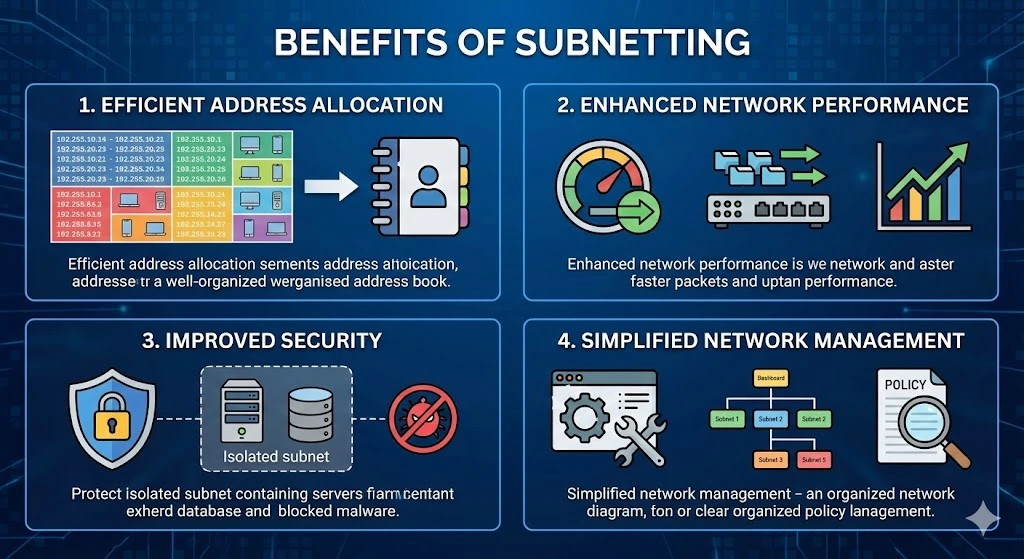
1. Efficient Address Allocation
Subnetting enables organizations to allocate IP addresses more efficiently by dividing a large address space into smaller, more targeted subnets. This reduces IP address waste and ensures that each device receives an appropriate address within its subnet.
2. Enhanced Network Performance
By reducing the size of broadcast domains and segmenting traffic into smaller subnets, subnetting helps minimize network congestion and improve overall network performance. This allows for faster data transmission and better bandwidth utilization.
3. Improved Security
Subnetting enhances network security by isolating sensitive or critical network resources within their own subnets. This limits the scope of potential security breaches and helps contain network threats, such as malware or unauthorized access attempts.
4. Simplified Network Management
Subnetting simplifies network management tasks by organizing devices into logical groups based on their subnet assignments. This makes it easier to configure and troubleshoot network devices, track IP address usage, and implement network policies and rules.
Key Concepts in Subnetting
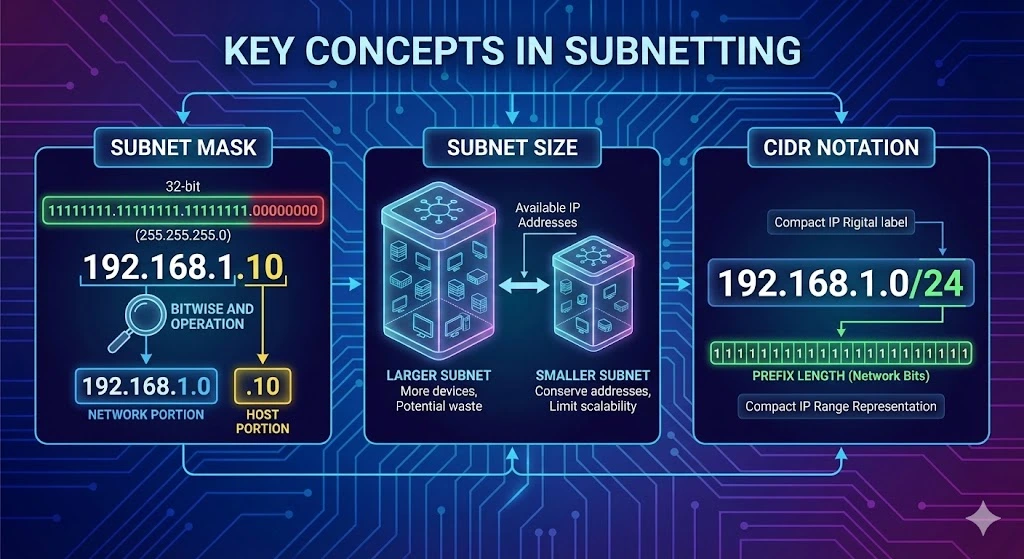
Subnet Mask: A subnet mask is a 32-bit binary number that defines the boundaries of a subnet within an IP address range. It consists of a series of consecutive binary 1s, followed by a series of consecutive binary 0s. The subnet mask is applied to an IP address using a bitwise AND operation to determine the network and host portions of the address.
Subnet Size: The size of a subnet is determined by the number of available IP addresses within the subnet range. Larger subnets accommodate more devices but may lead to greater address waste, while smaller subnets conserve addresses but may limit scalability.
CIDR Notation: The Classless Inter-Domain Routing (CIDR) notation is a compact representation of IP address ranges that includes the network address and subnet mask. CIDR notation uses a forward slash followed by a number to indicate the number of bits in the subnet mask (e.g., 192.168.1.0/24).
Practical Applications of Subnetting
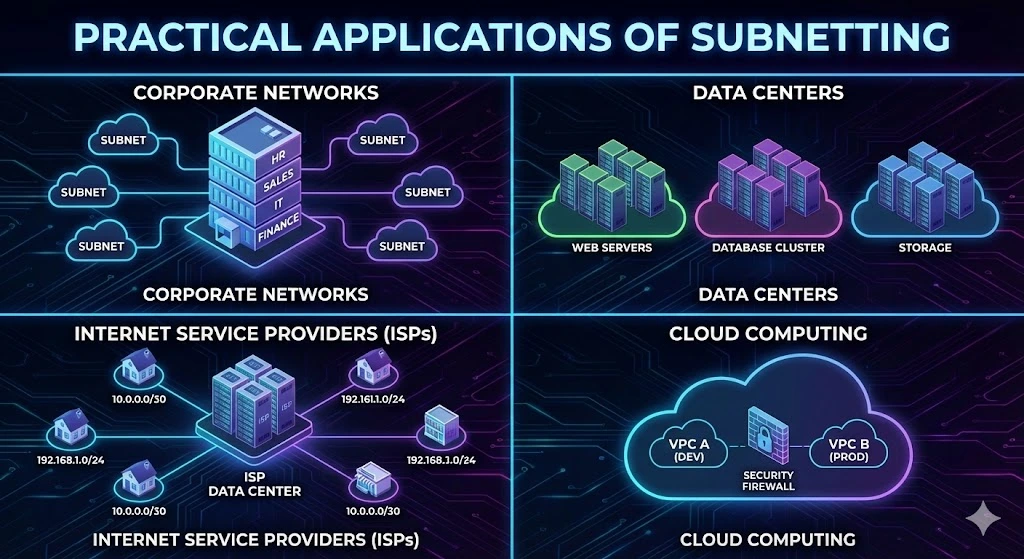
Corporate Networks: Subnetting is commonly used in corporate networks to divide large address ranges into smaller subnets for different departments, floors, or locations. This improves network performance, enhances security, and simplifies network management.
Internet Service Providers (ISPs): ISPs use subnetting to allocate IP address ranges to their customers more efficiently. By subnetting their address space, ISPs can accommodate more customers and reduce IP address waste.
Data Centers: In data center environments, subnetting helps organize servers and network devices into logical groups based on their roles or functions. This facilitates efficient resource allocation, load balancing, and fault tolerance.
Cloud Computing: Subnetting is essential in cloud computing environments for creating virtual private networks (VPNs), isolating workloads, and enforcing network security policies. Subnetting allows cloud providers to partition their infrastructure and offer customized networking solutions to customers.
IP Subnetting in a brief
In a nutshell, IP subnetting is a fundamental concept in networking that plays a crucial role in optimizing network infrastructure, enhancing security, and simplifying network management. By understanding the principles of subnetting and its practical applications, network administrators can design scalable, efficient, and resilient networks that meet the evolving needs of their organizations. Whether you’re configuring a small office network or managing a large-scale data center, mastering IP subnetting is essential for building robust and reliable network environments.
Are you interested in learning more about IP addresses? or do you want to lease an IP address? Contact us now!
Trusted IPv4 Leasing for Business Growth
Get enterprise-grade IPv4 space quickly, with seamless deployment and end-to-end management.
Get Started with i.leaseFAQs
How many usable IP addresses are in a /24 subnet?
A /24 subnet has 254 usable IP addresses. While there are 256 total addresses in the range (2^8), two are always reserved: the Network Address (the first IP) and the Broadcast Address (the last IP).
What is CIDR notation and how does it work?
CIDR (Classless Inter-Domain Routing) notation is a shorthand way to show an IP address and its associated subnet mask. The number after the slash (e.g., /24) represents the number of “bits” dedicated to the network portion of the address. The higher the number after the slash, the smaller the number of available host IPs in that subnet.
Why is 192.168.1.1 the most common IP address?
This address belongs to a “Private” IP range designated for local networks. Most router manufacturers set 192.168.1.1 as the default gateway (the “front door” to the internet) for home and small business routers because it is easy to remember and complies with standard IPv4 subnetting rules.
Articles connexes

Que sont les entreprises de télécommunications ? Comment les fournisseurs de télécommunications assurent la connectivité au Royaume-Uni, aux États-Unis et au Canada
Les entreprises de télécommunications, également appelées opérateurs télécoms, fournissent des services de communication et de connectivité. Ces services peuvent inclure les réseaux mobiles, l’Internet haut débit, les connexions fibre, les services de téléphonie fixe, la connectivité pour les entreprises, l’accès au cloud, les services réseau gérés et la connectivité aux centres de données. Pour les consommateurs, les entreprises de télécommunications sont souvent connues comme des fournisseurs de services mobilesRead more Related Posts Desbloqueando la privacidad digital con una red privada virtual (VPN) ¿Qué es una VPN? Una red privada virtual (VPN) es una tecnología que permite a los usuarios crear una conexión Comprensión de la traducción de direcciones de red (NAT) En las redes informáticas, gestionar las direcciones IP de forma eficiente es fundamental para garantizar una comunicación fluida entre los Arrendamiento de direcciones IP: Cómo arrendar direcciones IP El mundo digital en el que nos movemos hoy depende en gran medida de las direcciones IP, identificadores únicos asignados .related-post {} .related-post .post-list { text-align: left; } .related-post .post-list .item { margin: 5px; padding: 10px; } .related-post .headline { font-size: 18px !important; color: #999999 !important; } .related-post .post-list .item .post_thumb { max-height: 220px; margin: 10px 0px; padding: 0px; display: block; } .related-post .post-list .item .post_title { font-size: 16px; color: #3f3f3f; margin: 10px 0px; padding: 0px; display: block; text-decoration: none; } .related-post .post-list .item .post_excerpt { font-size: 13px; color: #3f3f3f; margin: 10px 0px; padding: 0px; display: block; text-decoration: none; } @media only screen and (min-width: 1024px) { .related-post .post-list .item { width: 30%; } } @media only screen and (min-width: 768px) and (max-width: 1023px) { .related-post .post-list .item { width: 90%; } } @media only screen and (min-width: 0px) and (max-width: 767px) { .related-post .post-list .item { width: 90%; } }
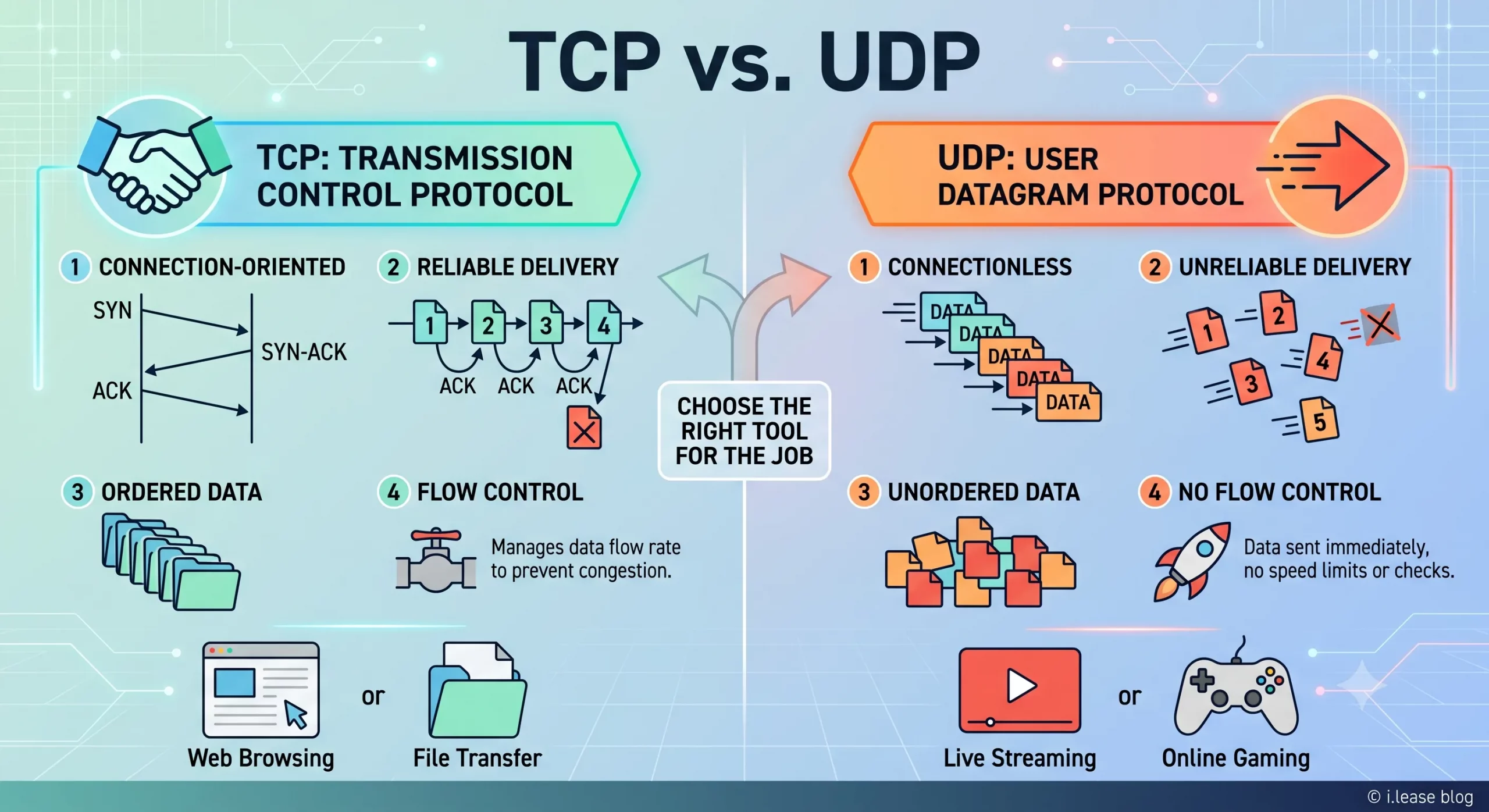
TCP vs UDP : guide de location IPv4 et de réseau d’entreprise
TCP et UDP sont deux des protocoles de transport les plus importants sur Internet. Ils déterminent la circulation des données entre les appareils, les serveurs, les plateformes cloud, les passerelles VPN, les résolveurs DNS, les systèmes de messagerie, les plateformes de streaming et les applications métier. Pour les entreprises, TCP et UDP ne sont pas de simples termes techniques. Ils ont un impact direct sur les performances de l’infrastructure. Related Posts What Is BGP Hijacking? How Route Hijacks Work, Famous Incidents, and How Networks Prevent Them BGP hijacking is the illegitimate takeover of traffic destined for IP address space, carried out by announcing routes for prefixes Which RIRs Support Inter-RIR IPv4 Transfers in 2026? IPv4 addresses may be globally routable, but transferring their registration from one organization to another is governed by Regional Internet What Is BGP? How Border Gateway Protocol Turns IP Addresses into Reachable Services BGP (Border Gateway Protocol) is the routing protocol that connects independent networks across the Internet. It allows networks to announce .related-post {} .related-post .post-list { text-align: left; } .related-post .post-list .item { margin: 5px; padding: 10px; } .related-post .headline { font-size: 18px !important; color: #999999 !important; } .related-post .post-list .item .post_thumb { max-height: 220px; margin: 10px 0px; padding: 0px; display: block; } .related-post .post-list .item .post_title { font-size: 16px; color: #3f3f3f; margin: 10px 0px; padding: 0px; display: block; text-decoration: none; } .related-post .post-list .item .post_excerpt { font-size: 13px; color: #3f3f3f; margin: 10px 0px; padding: 0px; display: block; text-decoration: none; } @media only screen and (min-width: 1024px) { .related-post .post-list .item { width: 30%; } } @media only screen and (min-width: 768px) and (max-width: 1023px) { .related-post .post-list .item { width: 90%; } } @media only screen and (min-width: 0px) and (max-width: 767px) { .related-post .post-list .item { width: 90%; } }

Pourquoi la Malaisie devient-elle un pôle de centres de données pour les infrastructures cloud et d’intelligence artificielle ?
La Malaisie devient l’un des marchés de croissance les plus importants d’Asie du Sud-Est dans le secteur des centres de données. La demande en cloud computing, intelligence artificielle, applications d’entreprise, paiements numériques, commerce électronique, cybersécurité et services régionaux à faible latence pousse les entreprises à construire davantage d’infrastructures au plus près des utilisateurs. Cette croissance ne repose pas uniquement sur un effet de mode. La Malaisie a attiré desRead more Related Posts Desbloqueando la privacidad digital con una red privada virtual (VPN) ¿Qué es una VPN? Una red privada virtual (VPN) es una tecnología que permite a los usuarios crear una conexión Comprensión de la traducción de direcciones de red (NAT) En las redes informáticas, gestionar las direcciones IP de forma eficiente es fundamental para garantizar una comunicación fluida entre los ¿Por qué Malasia se está convirtiendo en un centro neurálgico para la infraestructura de nube e IA? Malasia se está convirtiendo en uno de los mercados de crecimiento de centros de datos más importantes del Sudeste Asiático. .related-post {} .related-post .post-list { text-align: left; } .related-post .post-list .item { margin: 5px; padding: 10px; } .related-post .headline { font-size: 18px !important; color: #999999 !important; } .related-post .post-list .item .post_thumb { max-height: 220px; margin: 10px 0px; padding: 0px; display: block; } .related-post .post-list .item .post_title { font-size: 16px; color: #3f3f3f; margin: 10px 0px; padding: 0px; display: block; text-decoration: none; } .related-post .post-list .item .post_excerpt { font-size: 13px; color: #3f3f3f; margin: 10px 0px; padding: 0px; display: block; text-decoration: none; } @media only screen and (min-width: 1024px) { .related-post .post-list .item { width: 30%; } } @media only screen and (min-width: 768px) and (max-width: 1023px) { .related-post .post-list .item { width: 90%; } } @media only screen and (min-width: 0px) and (max-width: 767px) { .related-post .post-list .item { width: 90%; } }
