How i.lease Simplifies IPv4 Leasing Across Multiple RIR Regions
 Stephanie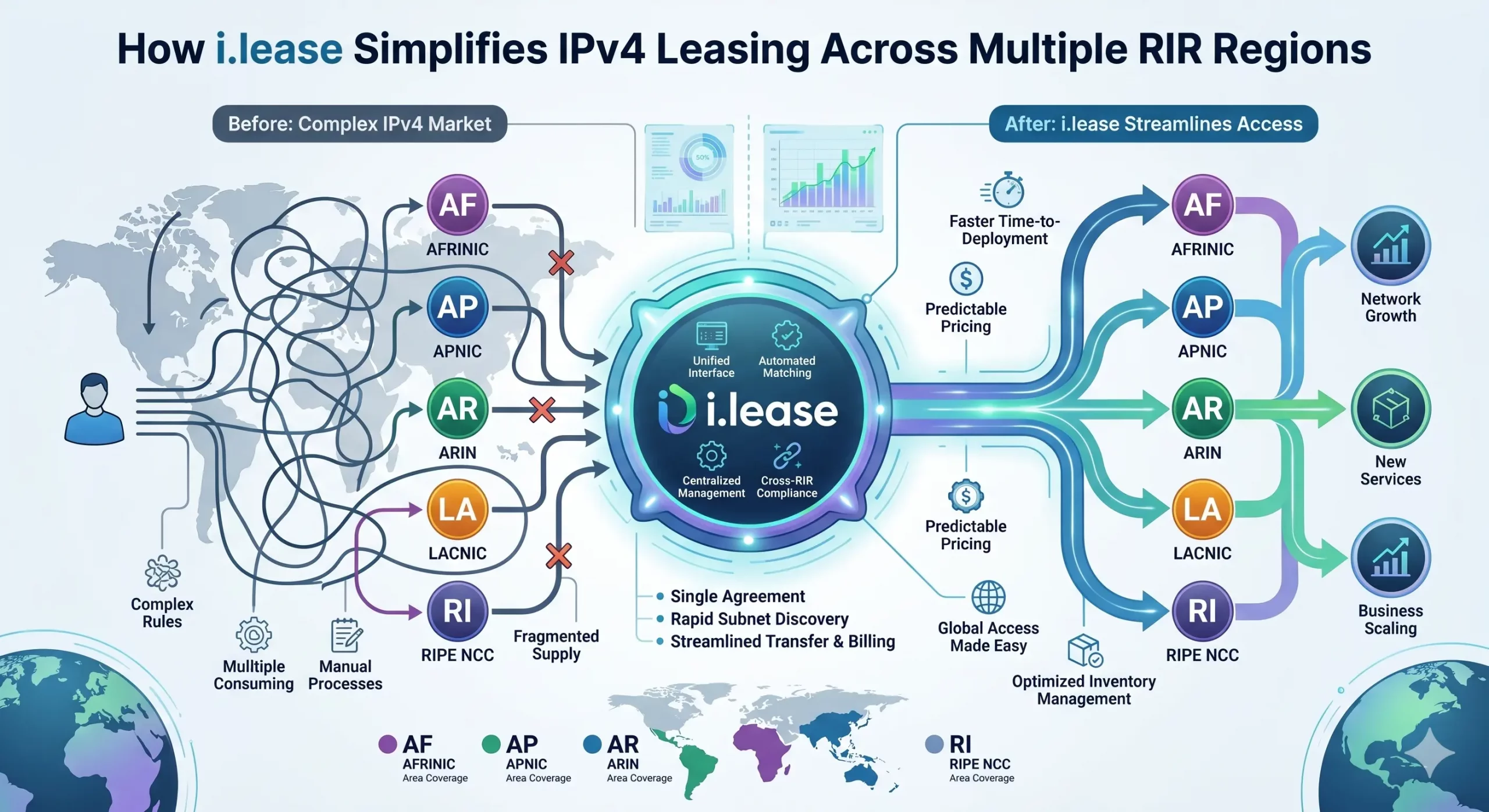
In today’s Internet infrastructure economy, IPv4 address leasing has become a critical operational strategy for enterprises, cloud providers, and network operators facing persistent address scarcity. As IPv4 exhaustion continues across all five Regional Internet Registries (RIRs)—ARIN, RIPE NCC, APNIC, LACNIC, and AFRINIC—the need for structured, compliant, and cross-regional leasing solutions has never been greater.
Table of Contents
However, beneath the surface of what appears to be a simple “supply-and-demand” market lies a more complex reality: registry governance, policy fragmentation, and operational risk exposure across multiple jurisdictions.
This is where i.lease emerges—not as a traditional broker, but as an execution layer designed to simplify IPv4 leasing across multiple RIR regions while addressing structural registry risks.
Understanding the Real Problem in IPv4 Leasing
At first glance, IPv4 leasing seems straightforward: a holder provides address space, a tenant leases it, and the registry updates reflect the change. But in practice, the ecosystem is shaped by fragmented governance.
Each RIR operates under its own policy framework, documentation requirements, and transfer or leasing interpretations. This creates several challenges:
- Differing transfer policies between regions
- Varying compliance expectations and audits
- Inconsistent treatment of leasing vs. ownership
- Complex inter-RIR transfer pathways
- Risk of registry rejection or post-transfer disputes
As highlighted in Lu Heng’s analysis of IPv4 market structure, the core issue is not simply brokerage efficiency, but registry-layer risk—the structural uncertainty created when operational assets depend on policy-driven approval systems rather than pure transactional ownership logic .
This means IPv4 leasing is not just a commercial activity—it is an infrastructure governance process.
Why Multi-RIR IPv4 Leasing Is So Complex
When leasing occurs within a single RIR, operators already face procedural overhead. When leasing spans multiple RIR regions, complexity increases exponentially.
1. Policy Fragmentation Across RIRs
Each RIR has distinct policies regarding:
- Address justification requirements
- Leasing recognition (formal vs. informal frameworks)
- Transfer eligibility rules
- Historical usage validation
- Regional restrictions or soft preferences
A block acceptable under RIPE NCC rules may face additional scrutiny under ARIN or APNIC policies.
2. Registry Interpretation Risk
Even when policies are documented, interpretation varies. Registry staff may assess:
- The legitimacy of leasing arrangements
- Whether the usage aligns with “in-region” expectations
- Whether the transfer reflects operational need or speculation
This introduces what industry experts describe as registry discretion risk—the possibility that administrative interpretation affects transaction outcome.
3. Operational Continuity Risk
IPv4 leasing is not just about acquiring addresses—it is about ensuring:
- BGP routing stability
- WHOIS consistency
- RPKI alignment
- Abuse handling continuity
- Network reputation preservation
A failed or delayed registry process can directly impact production networks, making leasing a business continuity issue rather than a procurement task.
Why Traditional Brokers Are Not Enough
In conventional commodity markets, brokers act as intermediaries between buyers and sellers. But IPv4 is not a standard commodity.
As outlined in Lu Heng’s note, a broker that only matches supply and demand does not eliminate underlying registry risk—it merely passes it through .
This is a critical distinction:
- A traditional broker facilitates paperwork
- A registry-aware execution layer ensures operational continuity
The difference becomes visible only when something goes wrong—such as transfer rejection, policy reinterpretation, or registry delay.
In IPv4 leasing, failure is not financial—it is infrastructural.
What i.lease Actually Solves
i.lease is designed around a different principle: IPv4 leasing must be treated as an execution problem, not a brokerage problem.
Instead of simply connecting parties, i.lease operates as a structured system that manages:
1. Multi-RIR Compliance Coordination
i.lease harmonizes leasing processes across:
- ARIN
- RIPE NCC
- APNIC
- LACNIC
- AFRINIC
This includes aligning documentation, validating eligibility, and ensuring leasing structures are compatible with regional expectations before submission.
2. Registry Process Orchestration
Rather than treating RIR interaction as a final step, i.lease integrates it into the lifecycle:
- Pre-validation of transfer readiness
- Policy compatibility checks
- Documentation normalization
- Registry submission management
- Post-transfer monitoring
This reduces rejection rates and prevents avoidable delays.
3. Risk Absorption at the Execution Layer
A key theme in i.LEASE philosophy is that registry risk should not be pushed to the end customer.
Instead, it is handled at the execution layer through:
- Structured leasing contracts
- Operational continuity frameworks
- Experienced registry interaction processes
- Historical policy interpretation knowledge
This transforms leasing from a “hope-based transaction” into a managed infrastructure workflow.
IPv4 Leasing as Infrastructure, Not Trade
One of the most important conceptual shifts in modern IPv4 markets is the recognition that address space is no longer a passive registry entry—it is active infrastructure capital.
IPv4 blocks now directly support:
- Cloud workloads
- CDN infrastructure
- VPN networks
- SaaS platforms
- Mobile backbones
- Enterprise routing systems
A disruption in leasing continuity can therefore cascade into real service outages.
This aligns with broader research showing that IP registration accuracy and allocation consistency directly impact Internet stability and operational security .
How i.lease Simplifies Cross-Region Leasing
By combining compliance orchestration and execution design, i.lease simplifies what is otherwise a fragmented global process.
A Unified Workflow
Instead of navigating each RIR separately, operators experience:
- Centralized leasing request
- Policy-aligned structuring
- Pre-cleared registry pathway
- Coordinated inter-RIR handling
- Continuous operational support
Reduced Failure Points
Traditional multi-RIR leasing involves multiple failure points:
- Documentation mismatch
- Policy misinterpretation
- Transfer rejection
- Timing inconsistencies
- Registry escalation delays
i.lease reduces these by ensuring that structural compatibility is validated before registry submission.
Predictable Operational Outcomes
The goal is not just successful leasing—it is predictable leasing:
- Stable timelines
- Lower rejection probability
- Reduced registry uncertainty
- Continuous post-leasing usability
The Strategic Value of Registry-Aware Leasing
The IPv4 market is often framed as a commercial ecosystem, but in reality it sits on top of a governance architecture where registry rules define operational reality.
This creates a structural gap:
- Market logic: supply, demand, pricing
- Registry logic: policy, compliance, discretion
i.lease bridges this gap by embedding registry logic into the execution layer.
As Lu Heng emphasizes, the real question is not who can broker IPv4, but who can manage registry-layer risk that determines whether IPv4 assets remain usable after transaction closure .
Conclusion: From Brokerage to Execution Infrastructure
IPv4 leasing across multiple RIR regions is no longer a simple commercial exchange. It is a multi-layered infrastructure process shaped by registry governance, policy interpretation, and operational continuity requirements.
Traditional brokerage models are insufficient because they operate only at the surface layer of transactions.
i.lease simplifies this ecosystem by transforming IPv4 leasing into a structured execution process that:
- Aligns multi-RIR policies
- Reduces registry risk exposure
- Ensures operational continuity
- Provides predictable leasing outcomes
- Treats IPv4 as infrastructure capital, not just inventory
In a fragmented global registry environment, this shift is not just beneficial—it is necessary.
Because in the IPv4 economy, the real value is not in completing a transaction.
It is in ensuring that what you acquire remains usable, stable, and operational across every RIR boundary it touches.
Frequent Asked Questions
1. What is IPv4 leasing and why is it necessary today?
IPv4 leasing is the process of temporarily renting IPv4 address blocks from a resource holder instead of purchasing them outright. It has become essential because the global IPv4 pool is fully exhausted across all RIRs, making leasing one of the only scalable ways for organizations to obtain additional addresses for network growth, cloud infrastructure, and connectivity expansion.
2. How does IPv4 leasing differ across RIR regions like ARIN, RIPE, and APNIC?
Each Regional Internet Registry (RIR) operates under its own policy framework. This means requirements for leasing documentation, transfer approvals, justification, and compliance checks can vary significantly between regions such as ARIN, RIPE NCC, and APNIC. As a result, cross-region leasing often requires careful policy alignment to avoid delays or rejection.
3. What challenges arise when leasing IPv4 across multiple RIRs?
Multi-RIR IPv4 leasing introduces several challenges, including policy fragmentation, inconsistent transfer interpretation, documentation mismatches, and registry approval delays. Additionally, organizations must ensure operational continuity (such as routing, WHOIS accuracy, and RPKI alignment), which increases the complexity beyond simple commercial leasing agreements.
4. How does i.lease simplify multi-RIR IPv4 leasing?
i.lease simplifies the process by acting as an execution layer that coordinates compliance, documentation, and registry interactions across multiple RIRs. Instead of treating leasing as a simple brokered transaction, i.lease aligns each deal with RIR-specific requirements in advance, reducing rejection risk and improving predictability in cross-region IPv4 transfers and leasing workflows.
5. Why is “registry risk” more important than brokerage in IPv4 leasing?
In IPv4 markets, the biggest risk is not finding a counterparty but ensuring that the transaction is accepted and remains valid under RIR policies. As highlighted in the i.lease framework discussion, brokerage alone does not eliminate the possibility of registry rejection or reinterpretation. “Registry risk” refers to this deeper structural uncertainty, which i.lease addresses by embedding compliance and registry alignment into the leasing process itself.
Articles connexes

Que sont les entreprises de télécommunications ? Comment les fournisseurs de télécommunications assurent la connectivité au Royaume-Uni, aux États-Unis et au Canada
Les entreprises de télécommunications, également appelées opérateurs télécoms, fournissent des services de communication et de connectivité. Ces services peuvent inclure les réseaux mobiles, l’Internet haut débit, les connexions fibre, les services de téléphonie fixe, la connectivité pour les entreprises, l’accès au cloud, les services réseau gérés et la connectivité aux centres de données. Pour les consommateurs, les entreprises de télécommunications sont souvent connues comme des fournisseurs de services mobilesRead more Related Posts Desbloqueando la privacidad digital con una red privada virtual (VPN) ¿Qué es una VPN? Una red privada virtual (VPN) es una tecnología que permite a los usuarios crear una conexión Comprensión de la traducción de direcciones de red (NAT) En las redes informáticas, gestionar las direcciones IP de forma eficiente es fundamental para garantizar una comunicación fluida entre los Arrendamiento de direcciones IP: Cómo arrendar direcciones IP El mundo digital en el que nos movemos hoy depende en gran medida de las direcciones IP, identificadores únicos asignados .related-post {} .related-post .post-list { text-align: left; } .related-post .post-list .item { margin: 5px; padding: 10px; } .related-post .headline { font-size: 18px !important; color: #999999 !important; } .related-post .post-list .item .post_thumb { max-height: 220px; margin: 10px 0px; padding: 0px; display: block; } .related-post .post-list .item .post_title { font-size: 16px; color: #3f3f3f; margin: 10px 0px; padding: 0px; display: block; text-decoration: none; } .related-post .post-list .item .post_excerpt { font-size: 13px; color: #3f3f3f; margin: 10px 0px; padding: 0px; display: block; text-decoration: none; } @media only screen and (min-width: 1024px) { .related-post .post-list .item { width: 30%; } } @media only screen and (min-width: 768px) and (max-width: 1023px) { .related-post .post-list .item { width: 90%; } } @media only screen and (min-width: 0px) and (max-width: 767px) { .related-post .post-list .item { width: 90%; } }
TCP vs UDP : guide de location IPv4 et de réseau d’entreprise
TCP et UDP sont deux des protocoles de transport les plus importants sur Internet. Ils déterminent la circulation des données entre les appareils, les serveurs, les plateformes cloud, les passerelles VPN, les résolveurs DNS, les systèmes de messagerie, les plateformes de streaming et les applications métier. Pour les entreprises, TCP et UDP ne sont pas de simples termes techniques. Ils ont un impact direct sur les performances de l’infrastructure. Related Posts IPv4 Planning for AI Infrastructure and GPU Cloud Providers IPv4 Planning for AI Infrastructure and GPU Cloud Providers AI infrastructure planning often begins with GPUs. Operators compare accelerator models, How to Prevent IPv4 Hijacking During a Transfer: 10 Security Steps Transferring IPv4 address space is not only a commercial and registry process. It is also a sensitive routing operation. During What causes IPv4 deals to stall after the first agreement IPv4 deals usually stall after the first agreement because agreeing on price is only the commercial beginning—not operational completion.A buyer .related-post {} .related-post .post-list { text-align: left; } .related-post .post-list .item { margin: 5px; padding: 10px; } .related-post .headline { font-size: 18px !important; color: #999999 !important; } .related-post .post-list .item .post_thumb { max-height: 220px; margin: 10px 0px; padding: 0px; display: block; } .related-post .post-list .item .post_title { font-size: 16px; color: #3f3f3f; margin: 10px 0px; padding: 0px; display: block; text-decoration: none; } .related-post .post-list .item .post_excerpt { font-size: 13px; color: #3f3f3f; margin: 10px 0px; padding: 0px; display: block; text-decoration: none; } @media only screen and (min-width: 1024px) { .related-post .post-list .item { width: 30%; } } @media only screen and (min-width: 768px) and (max-width: 1023px) { .related-post .post-list .item { width: 90%; } } @media only screen and (min-width: 0px) and (max-width: 767px) { .related-post .post-list .item { width: 90%; } }

Pourquoi la Malaisie devient-elle un pôle de centres de données pour les infrastructures cloud et d’intelligence artificielle ?
La Malaisie devient l’un des marchés de croissance les plus importants d’Asie du Sud-Est dans le secteur des centres de données. La demande en cloud computing, intelligence artificielle, applications d’entreprise, paiements numériques, commerce électronique, cybersécurité et services régionaux à faible latence pousse les entreprises à construire davantage d’infrastructures au plus près des utilisateurs. Cette croissance ne repose pas uniquement sur un effet de mode. La Malaisie a attiré desRead more Related Posts Desbloqueando la privacidad digital con una red privada virtual (VPN) ¿Qué es una VPN? Una red privada virtual (VPN) es una tecnología que permite a los usuarios crear una conexión Comprensión de la traducción de direcciones de red (NAT) En las redes informáticas, gestionar las direcciones IP de forma eficiente es fundamental para garantizar una comunicación fluida entre los ¿Por qué Malasia se está convirtiendo en un centro neurálgico para la infraestructura de nube e IA? Malasia se está convirtiendo en uno de los mercados de crecimiento de centros de datos más importantes del Sudeste Asiático. .related-post {} .related-post .post-list { text-align: left; } .related-post .post-list .item { margin: 5px; padding: 10px; } .related-post .headline { font-size: 18px !important; color: #999999 !important; } .related-post .post-list .item .post_thumb { max-height: 220px; margin: 10px 0px; padding: 0px; display: block; } .related-post .post-list .item .post_title { font-size: 16px; color: #3f3f3f; margin: 10px 0px; padding: 0px; display: block; text-decoration: none; } .related-post .post-list .item .post_excerpt { font-size: 13px; color: #3f3f3f; margin: 10px 0px; padding: 0px; display: block; text-decoration: none; } @media only screen and (min-width: 1024px) { .related-post .post-list .item { width: 30%; } } @media only screen and (min-width: 768px) and (max-width: 1023px) { .related-post .post-list .item { width: 90%; } } @media only screen and (min-width: 0px) and (max-width: 767px) { .related-post .post-list .item { width: 90%; } }
