BYOIP vs IP Leasing: Which is better for your Business?
 Stephanie
- BYOIP offers greater control and potential cost savings for businesses with existing IP assets.
- IP leasing provides flexibility and lower upfront costs, ideal for businesses with fluctuating needs.
Table of Contents
In today’s digital landscape, businesses face critical decisions regarding their IP address management, especially when migrating to cloud services. Two prevalent options are Bring Your Own IP (BYOIP) and IP leasing. Each approach has its advantages and considerations, depending on your organization’s specific needs and resources.
Understanding BYOIP and IP Leasing
Also read: How BYOIP Helps Prevent IP Spoofing and Fraud
What is BYOIP?
BYOIP allows businesses to migrate their existing IP addresses to cloud providers. This approach ensures continuity, maintains established IP reputations, and offers greater control over IP management. Leading cloud providers like AWS, Google Cloud, and Microsoft Azure support BYOIP, enabling seamless integration of your IP addresses into their infrastructure.
The benefits of BYOIP include the ability to retain ownership of your trusted IP addresses, helping you avoid the time and complexity involved in building a new online reputation. It also enhances security by allowing the seamless transfer of existing security policies tied to specific IP addresses into cloud environments. From a compliance standpoint, BYOIP supports adherence to industry-specific regulations and data sovereignty laws, which is crucial for businesses operating in regulated sectors. Additionally, it ensures a smooth and uninterrupted transition to cloud services without the need to change IP addresses. Overall, BYOIP offers greater control over online security and reputation management, giving businesses the ability to operate with consistency and trust across their digital infrastructure. However, implementing BYOIP can involve technical complexities, such as configuring Route Origin Authorizations (ROAs) and updating Registry Data Access Protocol (RDAP) records.
Exploring IP Leasing
IP Leasing involves renting IP addresses from a provider for a specified period. This approach is particularly beneficial for businesses that require flexibility or have short-term projects.
The advantages of IP leasing include cost-effectiveness, as it requires lower upfront investment compared to purchasing IP addresses outright. This makes it an attractive option for businesses with limited capital or short-term operational needs. Leasing also provides flexibility, allowing organisations to scale IP resources up or down in response to changing demands without the long-term commitment of ownership. Additionally, many leasing platforms offer simplified IP management services, handling the technical and administrative complexities on behalf of the client, which helps reduce the workload on internal IT teams and streamlines overall network operations. However, leasing IP addresses means you do not own them, which can limit control and long-term planning. Additionally, recurring costs can accumulate over time.
Also read: IPv4 Investment – The New Investment Opportunity
Also read: About IPv6 Security Considerations
Cost considerations
BYOIP: While there may be initial costs associated with configuring and integrating your IP addresses into the cloud, BYOIP can lead to long-term savings, especially if you already own IP addresses. For instance, AWS charges $0.005 per hour for each public IPv4 address. By bringing your own IPs, you can avoid these charges.
IP leasing: Leasing IP addresses can be more affordable upfront. For example, leasing a /24 IPv4 block (256 addresses) might cost around $1,636 annually, compared to purchasing the same block for approximately $10,000. However, over several years, leasing costs can surpass the one-time purchase price.
Operational control and flexibility
BYOIP offers greater control over your IP addresses, allowing you to manage configurations, security policies, and compliance requirements directly. This control is crucial for businesses with specific regulatory obligations or those that require consistent IP reputations.
IP leasing, on the other hand, provides flexibility, making it easier to adapt to changing business needs. It’s ideal for startups or projects with uncertain durations, where long-term IP ownership isn’t necessary.
Security and compliance
BYOIP: Retaining your IP addresses ensures continuity in security policies and compliance measures. It simplifies audits and helps maintain trust with clients and partners.
IP leasing: While leasing can meet security and compliance needs, it may require additional steps to align leased IPs with your existing policies. Ensuring the leased IPs have a clean history is also essential to avoid reputational risks.
Making the right choice for your business
When deciding between BYOIP and IP leasing, several factors should be considered. If your organisation already owns IP addresses, BYOIP can be a more cost-effective solution while also offering greater control over IP management. For businesses facing budget constraints or working on short-term projects, leasing may be the more practical choice due to its lower upfront costs. In sectors with strict regulatory requirements, BYOIP is often preferred as it allows for better control and compliance with data governance standards. Meanwhile, companies that require the ability to quickly scale their IP resources may find leasing advantageous, as it provides the flexibility needed to adapt to changing operational demands.
FAQs
What is the minimum IP block size for BYOIP on AWS?
AWS requires a minimum of a /24 IPv4 block (256 addresses) for BYOIP.
Can I lease IP addresses and use them with BYOIP?
Yes, some providers allow you to lease IP addresses and integrate them into your cloud infrastructure using BYOIP.
Are there any additional fees associated with BYOIP?
While BYOIP can help avoid certain charges, there may be costs related to configuring and maintaining your IP addresses within the cloud environment.
How does IP leasing impact my IP reputation?
Leased IP addresses may have a history that could affect their reputation. It’s essential to verify the cleanliness of leased IPs to avoid deliverability or trust issues.
Is BYOIP supported by all cloud providers?
Most major cloud providers, including AWS, Google Cloud, and Microsoft Azure, support BYOIP. However, specific requirements and processes may vary.
Articles connexes

Que sont les entreprises de télécommunications ? Comment les fournisseurs de télécommunications assurent la connectivité au Royaume-Uni, aux États-Unis et au Canada
Les entreprises de télécommunications, également appelées opérateurs télécoms, fournissent des services de communication et de connectivité. Ces services peuvent inclure les réseaux mobiles, l’Internet haut débit, les connexions fibre, les services de téléphonie fixe, la connectivité pour les entreprises, l’accès au cloud, les services réseau gérés et la connectivité aux centres de données. Pour les consommateurs, les entreprises de télécommunications sont souvent connues comme des fournisseurs de services mobilesRead more Related Posts Desbloqueando la privacidad digital con una red privada virtual (VPN) ¿Qué es una VPN? Una red privada virtual (VPN) es una tecnología que permite a los usuarios crear una conexión Comprensión de la traducción de direcciones de red (NAT) En las redes informáticas, gestionar las direcciones IP de forma eficiente es fundamental para garantizar una comunicación fluida entre los Arrendamiento de direcciones IP: Cómo arrendar direcciones IP El mundo digital en el que nos movemos hoy depende en gran medida de las direcciones IP, identificadores únicos asignados .related-post {} .related-post .post-list { text-align: left; } .related-post .post-list .item { margin: 5px; padding: 10px; } .related-post .headline { font-size: 18px !important; color: #999999 !important; } .related-post .post-list .item .post_thumb { max-height: 220px; margin: 10px 0px; padding: 0px; display: block; } .related-post .post-list .item .post_title { font-size: 16px; color: #3f3f3f; margin: 10px 0px; padding: 0px; display: block; text-decoration: none; } .related-post .post-list .item .post_excerpt { font-size: 13px; color: #3f3f3f; margin: 10px 0px; padding: 0px; display: block; text-decoration: none; } @media only screen and (min-width: 1024px) { .related-post .post-list .item { width: 30%; } } @media only screen and (min-width: 768px) and (max-width: 1023px) { .related-post .post-list .item { width: 90%; } } @media only screen and (min-width: 0px) and (max-width: 767px) { .related-post .post-list .item { width: 90%; } }
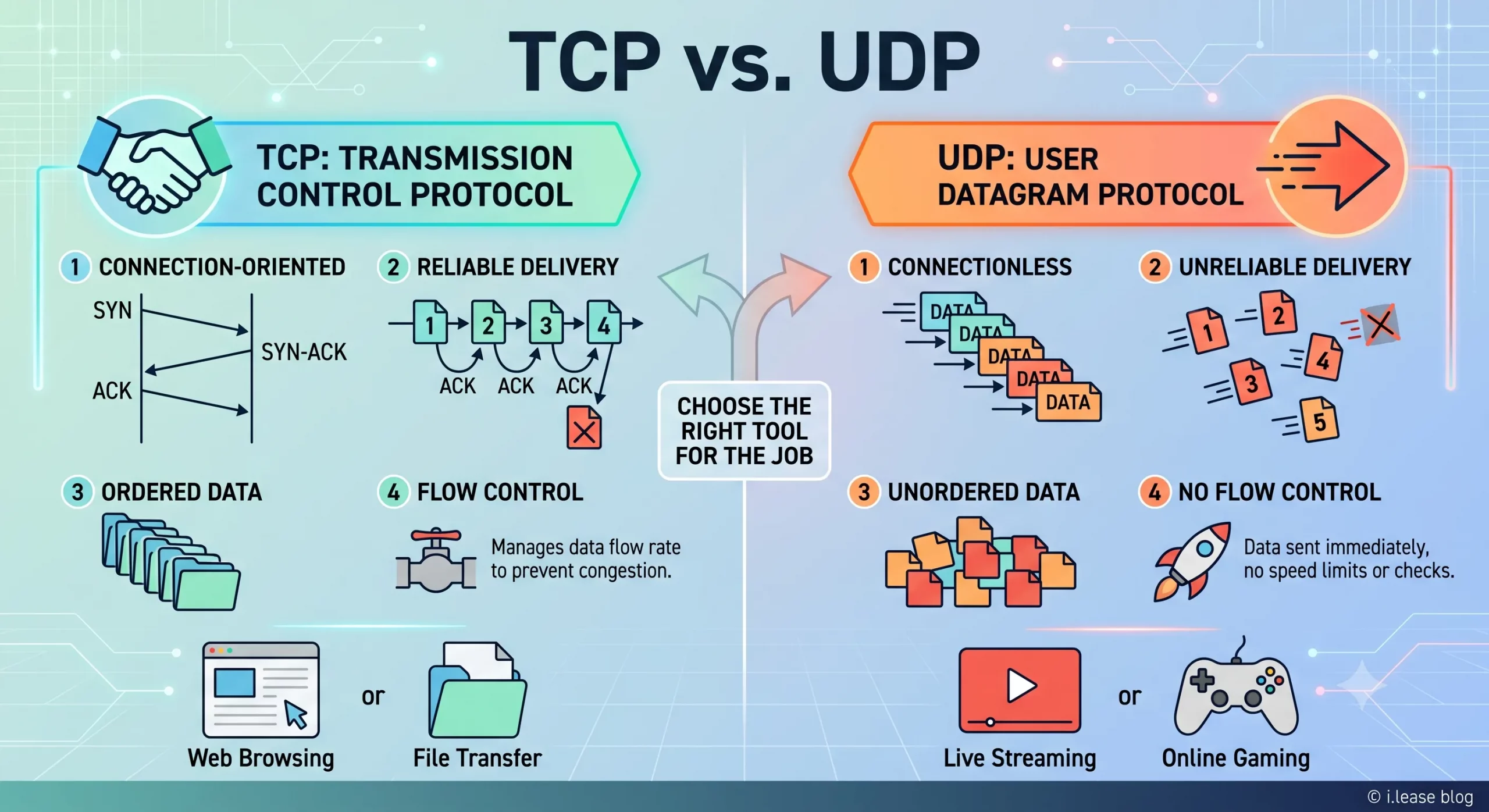
TCP vs UDP : guide de location IPv4 et de réseau d’entreprise
TCP et UDP sont deux des protocoles de transport les plus importants sur Internet. Ils déterminent la circulation des données entre les appareils, les serveurs, les plateformes cloud, les passerelles VPN, les résolveurs DNS, les systèmes de messagerie, les plateformes de streaming et les applications métier. Pour les entreprises, TCP et UDP ne sont pas de simples termes techniques. Ils ont un impact direct sur les performances de l’infrastructure. Related Posts What Is BGP Hijacking? How Route Hijacks Work, Famous Incidents, and How Networks Prevent Them BGP hijacking is the illegitimate takeover of traffic destined for IP address space, carried out by announcing routes for prefixes Which RIRs Support Inter-RIR IPv4 Transfers in 2026? IPv4 addresses may be globally routable, but transferring their registration from one organization to another is governed by Regional Internet What Is BGP? How Border Gateway Protocol Turns IP Addresses into Reachable Services BGP (Border Gateway Protocol) is the routing protocol that connects independent networks across the Internet. It allows networks to announce .related-post {} .related-post .post-list { text-align: left; } .related-post .post-list .item { margin: 5px; padding: 10px; } .related-post .headline { font-size: 18px !important; color: #999999 !important; } .related-post .post-list .item .post_thumb { max-height: 220px; margin: 10px 0px; padding: 0px; display: block; } .related-post .post-list .item .post_title { font-size: 16px; color: #3f3f3f; margin: 10px 0px; padding: 0px; display: block; text-decoration: none; } .related-post .post-list .item .post_excerpt { font-size: 13px; color: #3f3f3f; margin: 10px 0px; padding: 0px; display: block; text-decoration: none; } @media only screen and (min-width: 1024px) { .related-post .post-list .item { width: 30%; } } @media only screen and (min-width: 768px) and (max-width: 1023px) { .related-post .post-list .item { width: 90%; } } @media only screen and (min-width: 0px) and (max-width: 767px) { .related-post .post-list .item { width: 90%; } }

Pourquoi la Malaisie devient-elle un pôle de centres de données pour les infrastructures cloud et d’intelligence artificielle ?
La Malaisie devient l’un des marchés de croissance les plus importants d’Asie du Sud-Est dans le secteur des centres de données. La demande en cloud computing, intelligence artificielle, applications d’entreprise, paiements numériques, commerce électronique, cybersécurité et services régionaux à faible latence pousse les entreprises à construire davantage d’infrastructures au plus près des utilisateurs. Cette croissance ne repose pas uniquement sur un effet de mode. La Malaisie a attiré desRead more Related Posts Desbloqueando la privacidad digital con una red privada virtual (VPN) ¿Qué es una VPN? Una red privada virtual (VPN) es una tecnología que permite a los usuarios crear una conexión Comprensión de la traducción de direcciones de red (NAT) En las redes informáticas, gestionar las direcciones IP de forma eficiente es fundamental para garantizar una comunicación fluida entre los ¿Por qué Malasia se está convirtiendo en un centro neurálgico para la infraestructura de nube e IA? Malasia se está convirtiendo en uno de los mercados de crecimiento de centros de datos más importantes del Sudeste Asiático. .related-post {} .related-post .post-list { text-align: left; } .related-post .post-list .item { margin: 5px; padding: 10px; } .related-post .headline { font-size: 18px !important; color: #999999 !important; } .related-post .post-list .item .post_thumb { max-height: 220px; margin: 10px 0px; padding: 0px; display: block; } .related-post .post-list .item .post_title { font-size: 16px; color: #3f3f3f; margin: 10px 0px; padding: 0px; display: block; text-decoration: none; } .related-post .post-list .item .post_excerpt { font-size: 13px; color: #3f3f3f; margin: 10px 0px; padding: 0px; display: block; text-decoration: none; } @media only screen and (min-width: 1024px) { .related-post .post-list .item { width: 30%; } } @media only screen and (min-width: 768px) and (max-width: 1023px) { .related-post .post-list .item { width: 90%; } } @media only screen and (min-width: 0px) and (max-width: 767px) { .related-post .post-list .item { width: 90%; } }
