Qu’est-ce que SSH ? | Protocole Secure Shell (SSH)
 Chan
ChanSécuriser les communications entre appareils est essentiel, surtout lors de la gestion de systèmes distants. L’un des protocoles les plus largement utilisés et fiables pour un accès distant sécurisé est SSH (Secure Shell). Cet article explore ce qu’est SSH, comment il fonctionne et pourquoi il est crucial pour la sécurité des réseaux.
Table of Contents
Qu’est-ce que SSH ?
SSH (Secure Shell) est un protocole réseau qui permet aux utilisateurs d’accéder et de gérer des ordinateurs distants en toute sécurité via un réseau non sécurisé, comme Internet. SSH chiffre la communication entre le client (votre ordinateur) et le serveur distant, garantissant que les données sensibles, telles que les identifiants de connexion et les commandes, ne puissent pas être interceptées par des tiers.
Il est privilégié par les administrateurs système, les développeurs et les professionnels de l’informatique pour contrôler les serveurs et appareils distants, offrant une alternative plus sécurisée aux protocoles plus anciens comme Telnet, qui envoie les données en texte clair.
Comment fonctionne SSH ?
SSH fonctionne selon un modèle client-serveur, où un utilisateur se connecte depuis son appareil local (client) à une machine distante (serveur). Voici le processus typique :
Établissement de la connexion : L’utilisateur initie une connexion en utilisant un client SSH (un logiciel) pour communiquer avec le serveur SSH sur la machine distante.
Authentification : Le serveur authentifie le client en utilisant plusieurs méthodes, notamment l’authentification par mot de passe ou par clé publique. Une fois l’authentification réussie, l’utilisateur accède au serveur.
Chiffrement : Pendant la session, toutes les données échangées entre le client et le serveur sont chiffrées, garantissant qu’une interception des données serait inutile car elles ne seraient ni lisibles ni modifiables.
Principales fonctionnalités des protocoles Secure Shell
Chiffrement : SSH utilise des techniques de chiffrement robustes pour garantir que toutes les données échangées entre le client et le serveur sont sécurisées. Cela empêche l’écoute clandestine et la manipulation par des acteurs malveillants.
Authentification : SSH prend en charge plusieurs méthodes d’authentification, telles que l’authentification par mot de passe et par clé publique.
Transferts de fichiers sécurisés : SSH prend en charge les transferts de fichiers sécurisés via des protocoles comme SCP (Secure Copy) et SFTP (Secure File Transfer Protocol), permettant aux utilisateurs de télécharger ou d’envoyer des fichiers sans risque pour la sécurité.
Tunneling/Port Forwarding : SSH peut “tunnéliser” de manière sécurisée d’autres protocoles (comme HTTP ou FTP) via la connexion SSH chiffrée, permettant des communications sécurisées pour des applications autrement non sécurisées.
Utilisations courantes de SSH
SSH est principalement utilisé pour la connexion à distance, permettant aux administrateurs système et aux développeurs d’accéder et de gérer des machines distantes en toute sécurité. SSH est également largement utilisé pour les transferts de fichiers, en sécurisant le déplacement de fichiers entre une machine locale et un serveur distant à l’aide d’outils comme SCP ou SFTP.
SSH est aussi couramment utilisé pour automatiser des tâches, comme le déploiement de code, l’exécution de scripts ou la réalisation de sauvegardes sur des systèmes distants. De plus, SSH permet de sécuriser le routage du trafic réseau non sécurisé via une connexion chiffrée pour protéger les données sensibles.
Related Posts
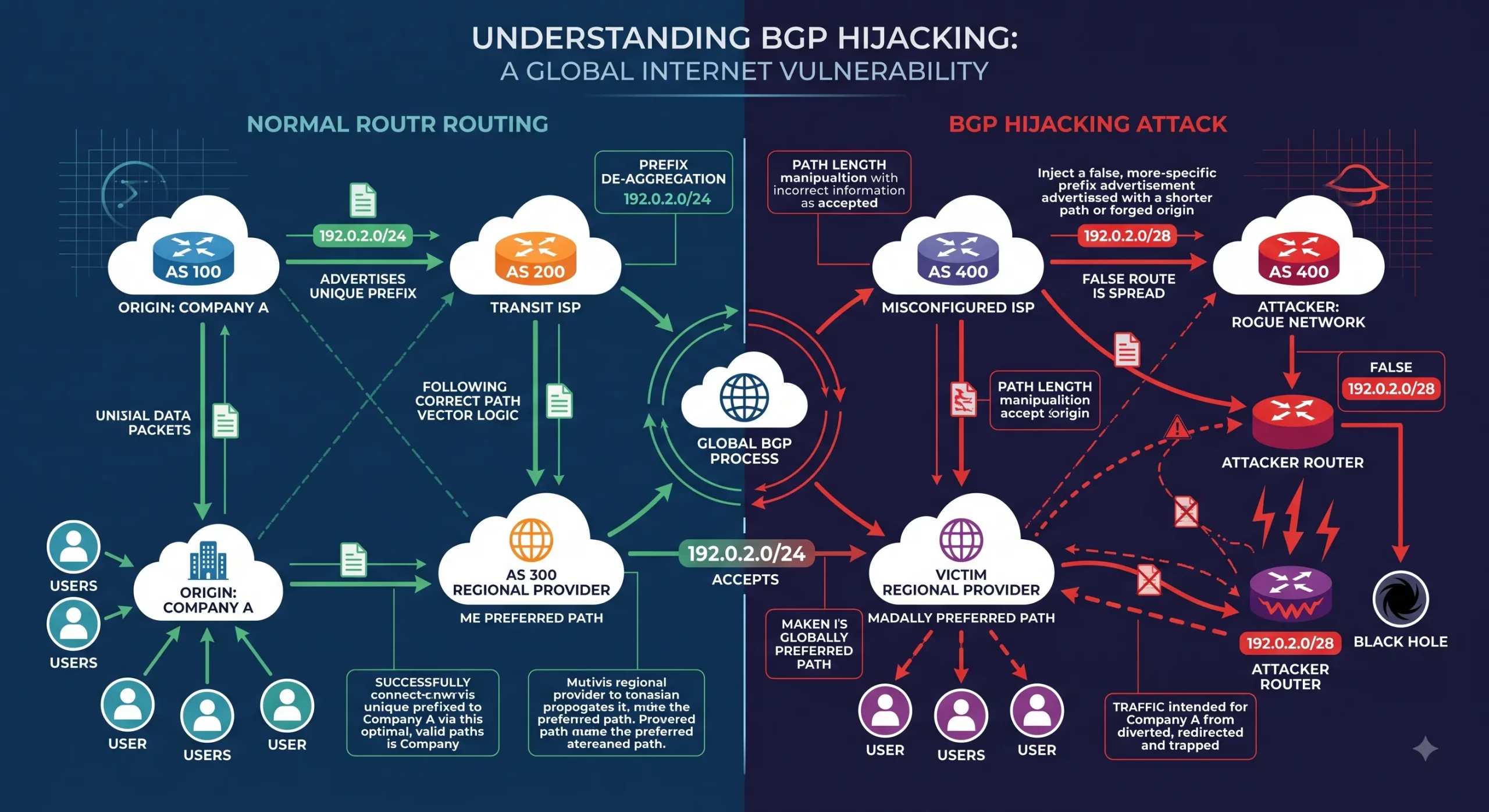
What Is BGP Hijacking? How Route Hijacks Work, Famous Incidents, and How Networks Prevent Them
BGP hijacking is the illegitimate takeover of traffic destined for IP address space, carried out by announcing routes for prefixes the announcer is not authorized to originate. Also called prefix hijacking, route hijacking, or IP hijacking, it corrupts the Internet’s routing tables themselves: networks around the world are told that the wrong party can deliver traffic for an address block, and they believe it. This makes hijacking fundamentally differentRead more Related Posts What Is BGP Hijacking? How Route Hijacks Work, Famous Incidents, and How Networks Prevent Them BGP hijacking is the illegitimate takeover of traffic destined for IP address space, carried out by announcing routes for prefixes Which RIRs Support Inter-RIR IPv4 Transfers in 2026? IPv4 addresses may be globally routable, but transferring their registration from one organization to another is governed by Regional Internet What Is BGP? How Border Gateway Protocol Turns IP Addresses into Reachable Services BGP (Border Gateway Protocol) is the routing protocol that connects independent networks across the Internet. It allows networks to announce .related-post {} .related-post .post-list { text-align: left; } .related-post .post-list .item { margin: 5px; padding: 10px; } .related-post .headline { font-size: 18px !important; color: #999999 !important; } .related-post .post-list .item .post_thumb { max-height: 220px; margin: 10px 0px; padding: 0px; display: block; } .related-post .post-list .item .post_title { font-size: 16px; color: #3f3f3f; margin: 10px 0px; padding: 0px; display: block; text-decoration: none; } .related-post .post-list .item .post_excerpt { font-size: 13px; color: #3f3f3f; margin: 10px 0px; padding: 0px; display: block; text-decoration: none; } @media only screen and (min-width: 1024px) { .related-post .post-list .item { width: 30%; } } @media only screen and (min-width: 768px) and (max-width: 1023px) { .related-post .post-list .item { width: 90%; } } @media only screen and (min-width: 0px) and (max-width: 767px) { .related-post .post-list .item { width: 90%; } }
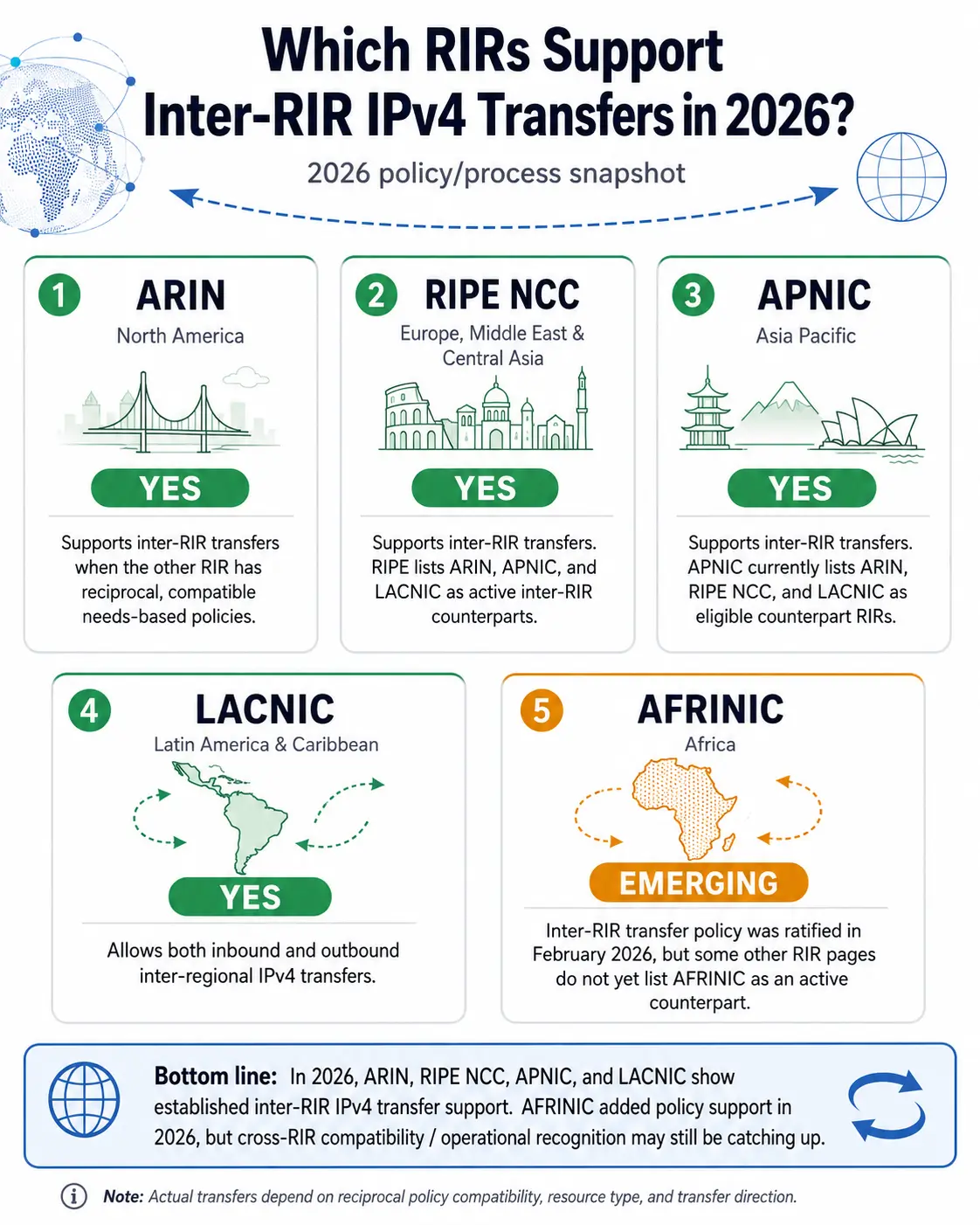
Which RIRs Support Inter-RIR IPv4 Transfers in 2026?
IPv4 addresses may be globally routable, but transferring their registration from one organization to another is governed by Regional Internet Registry (RIR) policy. For organizations buying or selling IPv4 address space internationally, this creates an important question: Which RIRs support inter-RIR IPv4 transfers in 2026? As of August 2026, ARIN, RIPE NCC, APNIC, and LACNIC have established frameworks for inter-RIR IPv4 transfers, subject to compatibility between the RIRs andRead more Related Posts What Is BGP Hijacking? How Route Hijacks Work, Famous Incidents, and How Networks Prevent Them BGP hijacking is the illegitimate takeover of traffic destined for IP address space, carried out by announcing routes for prefixes Which RIRs Support Inter-RIR IPv4 Transfers in 2026? IPv4 addresses may be globally routable, but transferring their registration from one organization to another is governed by Regional Internet What Is BGP? How Border Gateway Protocol Turns IP Addresses into Reachable Services BGP (Border Gateway Protocol) is the routing protocol that connects independent networks across the Internet. It allows networks to announce .related-post {} .related-post .post-list { text-align: left; } .related-post .post-list .item { margin: 5px; padding: 10px; } .related-post .headline { font-size: 18px !important; color: #999999 !important; } .related-post .post-list .item .post_thumb { max-height: 220px; margin: 10px 0px; padding: 0px; display: block; } .related-post .post-list .item .post_title { font-size: 16px; color: #3f3f3f; margin: 10px 0px; padding: 0px; display: block; text-decoration: none; } .related-post .post-list .item .post_excerpt { font-size: 13px; color: #3f3f3f; margin: 10px 0px; padding: 0px; display: block; text-decoration: none; } @media only screen and (min-width: 1024px) { .related-post .post-list .item { width: 30%; } } @media only screen and (min-width: 768px) and (max-width: 1023px) { .related-post .post-list .item { width: 90%; } } @media only screen and (min-width: 0px) and (max-width: 767px) { .related-post .post-list .item { width: 90%; } }
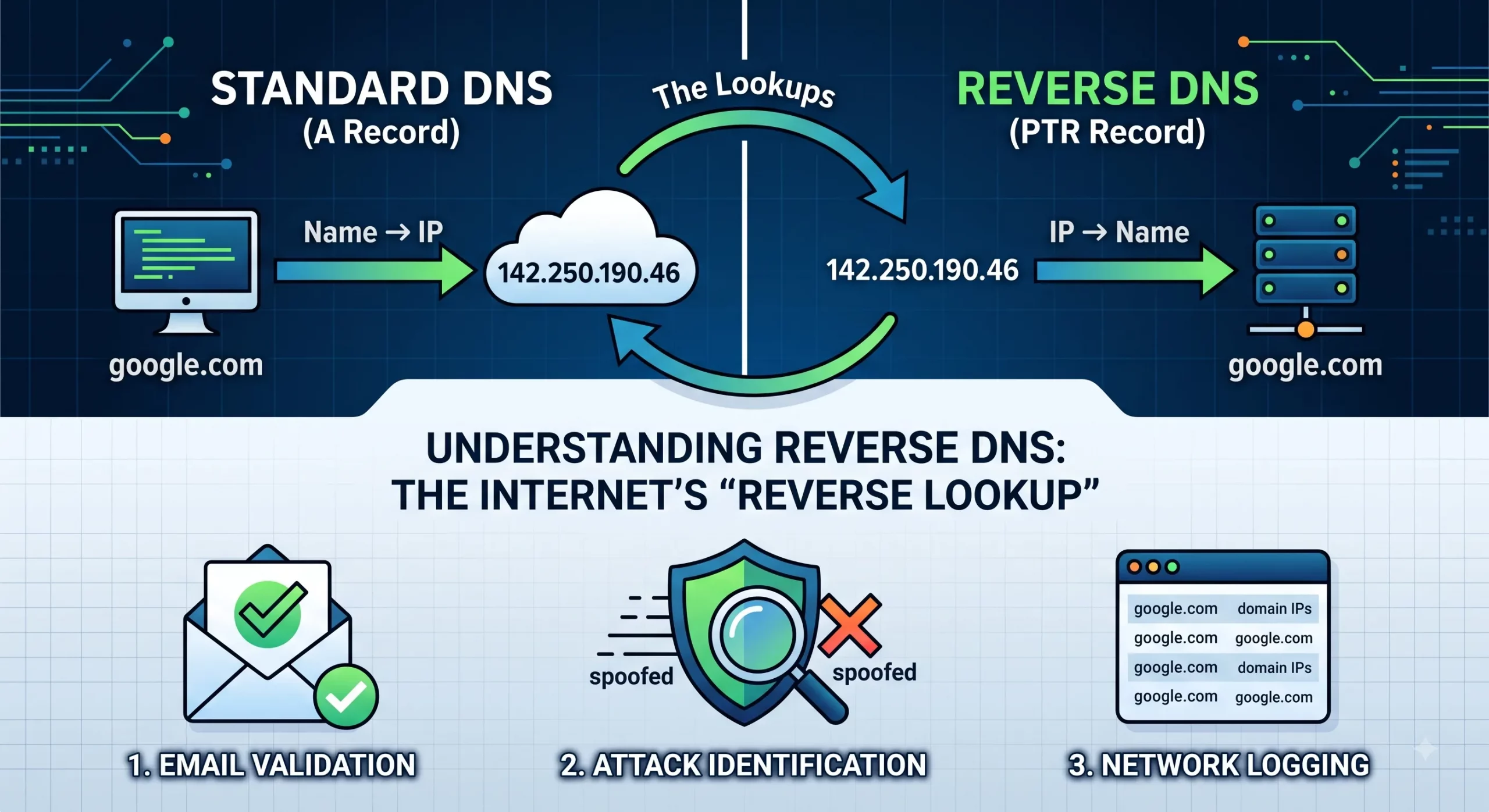
What Is Reverse DNS (rDNS)? Why PTR Records Matter for Email, Hosting, and Leased IPv4
Reverse DNS (rDNS) is the process of resolving an IP address back to a domain name. It is the mirror image of the DNS lookups most people know: forward DNS translates a name like mail.example.com into an IP address, while reverse DNS translates an IP address back into a name. The record type that stores this answer is called a PTR record. For most of the Internet’s history, reverseRead more Related Posts What Is BGP Hijacking? How Route Hijacks Work, Famous Incidents, and How Networks Prevent Them BGP hijacking is the illegitimate takeover of traffic destined for IP address space, carried out by announcing routes for prefixes Which RIRs Support Inter-RIR IPv4 Transfers in 2026? IPv4 addresses may be globally routable, but transferring their registration from one organization to another is governed by Regional Internet What Is BGP? How Border Gateway Protocol Turns IP Addresses into Reachable Services BGP (Border Gateway Protocol) is the routing protocol that connects independent networks across the Internet. It allows networks to announce .related-post {} .related-post .post-list { text-align: left; } .related-post .post-list .item { margin: 5px; padding: 10px; } .related-post .headline { font-size: 18px !important; color: #999999 !important; } .related-post .post-list .item .post_thumb { max-height: 220px; margin: 10px 0px; padding: 0px; display: block; } .related-post .post-list .item .post_title { font-size: 16px; color: #3f3f3f; margin: 10px 0px; padding: 0px; display: block; text-decoration: none; } .related-post .post-list .item .post_excerpt { font-size: 13px; color: #3f3f3f; margin: 10px 0px; padding: 0px; display: block; text-decoration: none; } @media only screen and (min-width: 1024px) { .related-post .post-list .item { width: 30%; } } @media only screen and (min-width: 768px) and (max-width: 1023px) { .related-post .post-list .item { width: 90%; } } @media only screen and (min-width: 0px) and (max-width: 767px) { .related-post .post-list .item { width: 90%; } }
